


Figure 1.
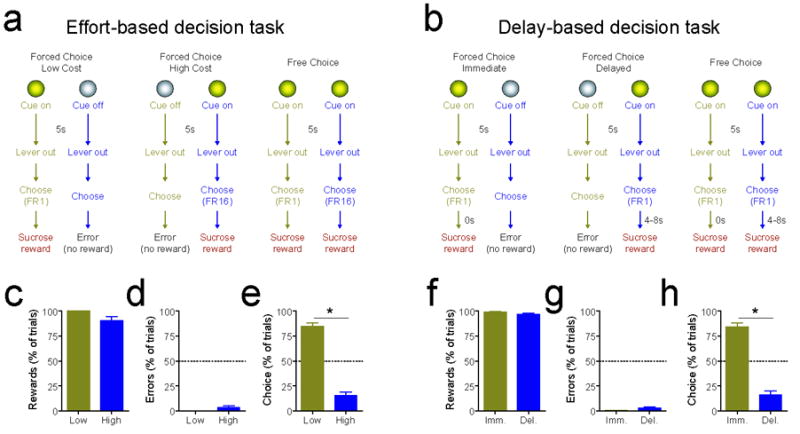
Task design and behavioral results. (a,b) Schematic representing effort-based (a) or delay-based (b) decision tasks. On forced-choice low cost/immediate reward trials (left panels), a cue light was presented for 5s and was followed by extension of two response levers into the behavioral chamber. A single lever press (FR1) on the lever corresponding to the cue light led to immediate reward (45 mg sucrose) delivery in a centrally located food receptacle. Responding on the other lever did not produce reward delivery and terminated the trial. On forced choice high cost/delayed reward trials (middle panels), the other cue light was presented for 5s before lever extension. On these trials, a reward was delivered after either sixteen responses (FR16, effort based decision task) or a delay (FR1 + 4 or 8s delay, delay based decision task). Responses on the opposite lever terminated the trial and no reward was delivered. On free choice trials (left panels), both cues were presented simultaneously, and animals could select either response option. After training, NAc electrophysiological activity was monitored in vivo during a single 90-trial behavioral session. (c-e) Behavioral performance in the effort-based task. (c) Percentage of possible rewards obtained on forced-choice trials. Animals overcame high effort requirements to maximize rewards. (d) Percentage of errors on forced-choice trials were significantly below chance levels (50%; p < 0.0001 for both comparisons), demonstrating behavioral discrimination between cues. (e) Response allocation on free-choice trials, as percentage of choices. Dashed line indicates behavioral indifference point (i.e., the lack of a preference). Animals robustly preferred the low cost option (* p < 0.0001). (f-h) Behavioral performance in the delay-based task. (f) Percentage of possible rewards obtained on forced-choice trials. For both trial types, animals obtained nearly all available rewards. (g) Percentage of errors on forced-choice trials were significantly below chance levels (50%; p < 0.0001 for both comparisons), demonstrating behavioral discrimination between cues. (h) Response allocation on free-choice trials. Animals robustly preferred the immediate reward option (* p < 0.0001).