


Figure 2.
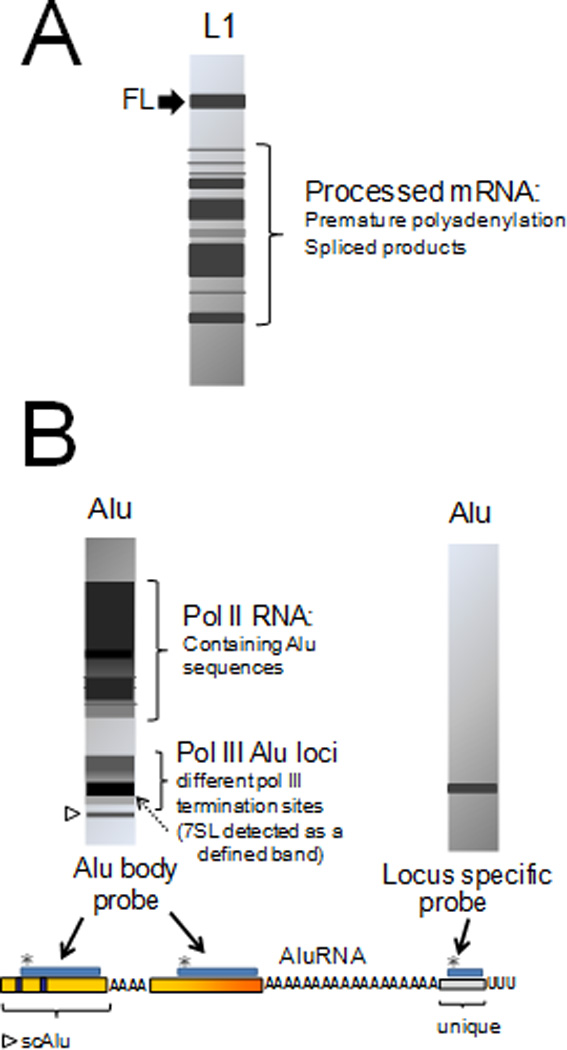
RNA profiles of L1 and Alu elements. Schematic representations of northern blot analysis of L1 (A) and Alu (B) are shown. L1 transcripts are extensively processed both by premature polyadenylation and splicing (42, 44). An L1 RNA profile may show full-length (FL) transcripts (indicated by a black arrow), in addition to a variety of processed products depending on the human tissue analyzed (45). Alu RNA profiles will vary depending on the probe utilized. The structure of a typical Alu transcript is shown at the bottom. Probes (shown as blue boxes marked with asterisks *) that hybridize with the Alu body sequence will detect both large (over 1 kb) and small (100–600 bp) RNA products (schematic shown on the left). The large products observed include RNA pol II transcripts that contain Alu sequences, while the smaller products observed include the RNA pol III transcribed Alu RNAs of various lengths, the left monomer, a degradation intermediate known as small cytoplasmic Alu (scAlu (54), indicated by an open arrowhead) and the 7SL transcript (56), indicated by a dotted arrow) due to shared sequence homology. The use of a probe that hybridizes to the unique sequence (derived from the genomic flank) will only detect those RNA pol III Alu transcripts generated from that specific locus (schematic shown on the right).