


Figure 5. 4-aminoquinoline probes activate caspase-3 and caspase-7 with subsequent PARP cleavage.
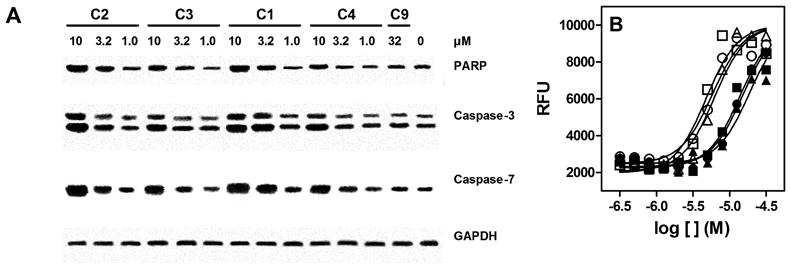
(A) H4 cells were plated onto 24 well plates the day before and treated with test compounds for overnight, followed by lysis in SDS sample buffer with subsequent immunoblotting (section 2.3). Blots represent single experiments that were replicated with similar results. (B) 4-aminoquinolines induce PARP cleavage with similar SAR to TDP-43 binding. Human H4 cells were treated with compounds 1 (□), 2 (○), 3 (●), 4 (■), 5 (△), and 6 (▲) at concentrations ranging from 0.33 to 32 μM overnight. Levels of cleaved PARP were measured using solid state immunoassay as described in section 2.6.