


Figure 1. Increased spatial and cellular complexity of the developing human cortex.
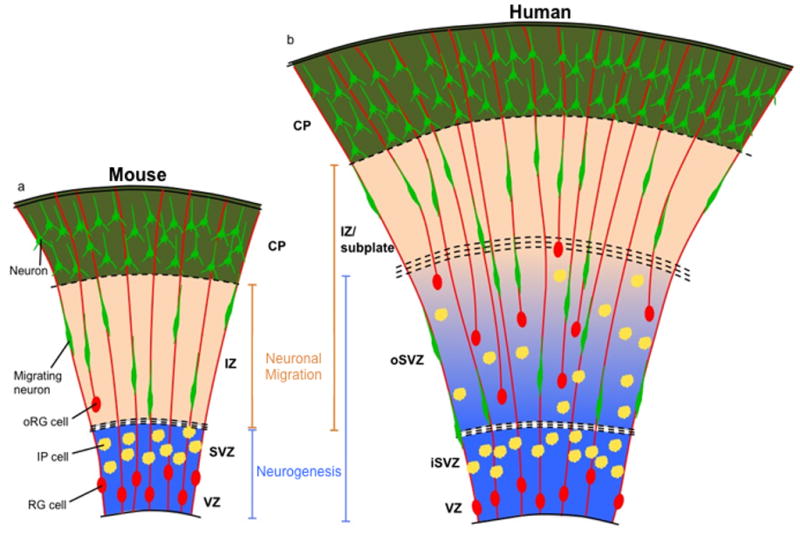
(A) Current model of mouse neocortical development. Primary zones of neurogenesis (blue) are the VZ and SVZ, where RG cells and IP cells reside, respectively. Neurons born in the VZ or SVZ migrate along the RG radial fiber scaffold found in the intermediate zone (IZ), the primary zone of neuronal migration (orange) in the mouse, to reach the CP. oRG cells are infrequent and not located in a distinct progenitor zone. (B) Expanded model of human neocortical development. RG cells, IP cells, and oRG cells are found in neurogenic zones (blue), which are the VZ, the inner SVZ (iSVZ), and the outer SVZ (oSVZ). Neurons migrate through the oSVZ and IZ/subplate (zones of neuronal migration, orange) to populate the CP. Neurons must navigate a larger distance than in the mouse, and a radial fiber scaffold of increased complexity, to reach the CP.