


Fig. 3.
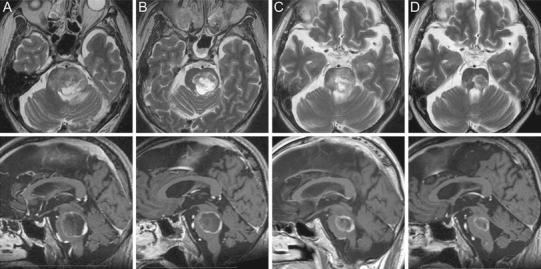
A 72-year-old man with small cell lung cancer presented with reduced conscious level. MR imaging demonstrated a large necrotic metastatic brain tumor in the pons. Due to the severity of neurological symptoms, the risk of WBRT was rated as high. As an alternative treatment option, the patient was allocated to two-session GKS. The first treatment delivered 10 Gy to the 40 % isodose (Fig. 3a). Three weeks later, at the second session, significant tumor volume reduction was observed and 10 Gy to the 40 % isodose was delivered to the tumor margin (Fig. 3b). Follow-up MR imaging after 4 months showed a considerable decrease in tumor size but brain stem perifocal edema (Fig. 3c). The perifocal edema subsided by the 8-month follow-up (Fig. 3d), and the KPS improved from 30 to 70. Although transient neurological deterioration occurred due to delayed radiation injury, the patient could lead an independent life until 2 months before he died from systemic disease progression