


Figure 2. The IGF-IR-IRS-1-JCV T-antigen signaling interplay: effects on cell proliferation cell survival and DNA repair fidelity.
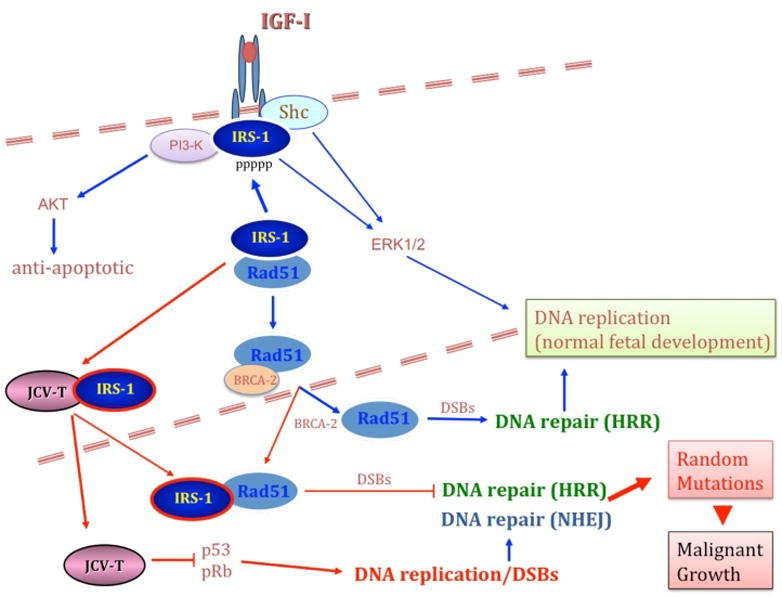
Here we propose a sequence of events in which ligand activated IGF-IR triggers multiple signaling responses leading to synchronized activation of cell proliferation (SHC or IRS-1-mediated activation of Ras-MAP kinase pathways); protection from apoptosis (IRS-1 induced activation of Akt); and DNA repair by homologous recombination. The IGF-I-mediated phosphorylation of IRS-1 seems to play a critical role in this model. In the absence of IGF-I a fraction of hypo-phosphorylated IRS-1 accumulates in the perinuclear region in complex with Rad51 (Trojanek et al., 2003). Following IGF-I stimulation, activated IGF-IR phosphorylates IRS-1 on multiple tyrosine residues, decreasing the affinity of IRS-1 to Rad51, and engages IRS-1 in multiple signaling events supporting IGF-I-induced cell proliferation and cell survival (Reiss et al., 1998; Trojanek et al., 2006b; Trojanek et al., 2003). If at the same time DNA double strands (DSBs) are formed (either naturally or by genotoxic treatment), the cell can repair them in a faithful manner, by Rad51-supported homologous recombination directed DNA repair (HRR), or less faithfully, by non-homologous end joining (NHEJ). In the presence of JCV T-antigen cells can proliferation because of p53, pRb inactivation. In parallel, JCV T-antigen translocates IRS-1 to the nucleus (Lassak et al., 2002), thus creating a condition in which IRS-1 can bind Rad51 in the subcellular compartment in which Rad51 is expected to support HRR. Therefore, if JCV T-antigen expressing cells experience extensive DNA damage, the resulting DNA double strand breaks (DSBs) can either trigger apoptosis, or if NHEJ will compensate for the impaired HRR, spontaneous mutations can accumulate in the surviving cells. These mutations when accumulate may provide the cells with growth and survival advantage, which could result in the selection of clone/s initiating tumor development and progression.