



SUMMARY
The nucleus is the largest organelle and is commonly depicted in the center of the cell. Yet during cell division, migration and differentiation, it frequently moves to an asymmetric position aligned with cell function. We consider the toolbox of proteins that move and anchor the nucleus within the cell and how forces generated by the cytoskeleton are coupled to the nucleus to move it. The significance of proper nuclear positioning is underscored by numerous diseases resulting from genetic alterations in the toolbox proteins. Finally, we discuss how nuclear position may influence cellular organization and signaling pathways.
Introduction
Diagrams in biology textbooks usually depict the nucleus as a spheroid in the center of the cell. However, the position of nuclei varies dramatically from this simple view. Nuclei are frequently positioned asymmetrically depending on cell type, stage of the cell cycle, migratory state and differentiation status. For example, during cell division in budding yeast, nuclei are moved into the bud neck so that each daughter cell receives one (Figure 1A). Nuclei are actively positioned in the middle of the fission yeast S. pombe, ensuring that the division plane produces two equal daughter cells. In fertilized mammalian and invertebrate eggs, male and female pronuclei move toward each other and fuse near the middle of the zygote, ensuring that the ensuing cell division creates two equal daughter blastomeres. Asymmetric divisions, typical of early embryos and stem cells, frequently reflect a pre-positioning of the nucleus.
Figure 1. Diversity of Nuclear Positioning.
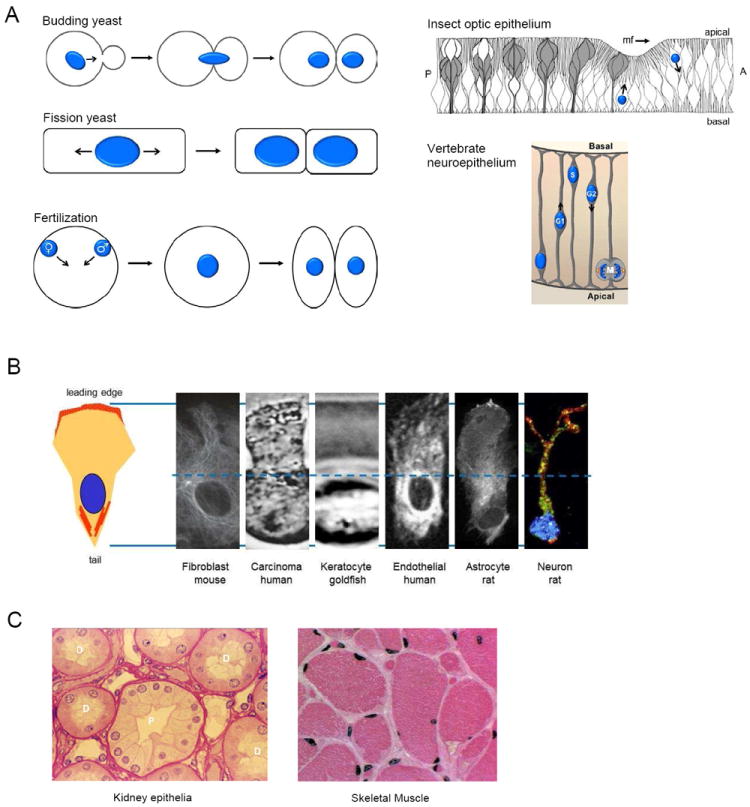
A. Schematics of nuclear positioning in dividing cells and developing epithelium. Arrows indicate movements of nuclei (blue). The nucleus is positioned relative to the plane of division in yeast and fertilized eggs. The diagram of insect optic epithelium represents a longitudinal section of a larval eye disc; two nuclei are shown. Nuclei anterior (A) to the morphogenetic furrow (mf), which moves anteriorly, move basally. Nuclei posterior (P) to the furrow move apically as cells are recruited into clusters comprising ommatidium (white cells, cones; gray cells, R-cells). Adapted from (Patterson et al., 2004; Tomlinson and Ready, 1986). The diagram of vertebrate neuroepithelium represents a longitudinal section of the developing cerebral cortex. Nuclei move basally during G1 and apically during G2. Mitosis (M) occurs near the apical surface. Adapted from (Buchman and Tsai, 2008).
B. Rearward nuclear position is typical of migrating cells. Left, schematic of a migrating cell with protruding leading edge and contracting tail. Red, actin filaments. Right, montage of migrating cells with front-back dimensions normalized. Dotted line represents the midpoint between the front and back. Nuclei are positioned along the front-back axis but always rearward of the cell center. Images reproduced from: fibroblast (Gomes et al., 2005); breast carcinoma (McNiven, 2013); keratocyte (Barnhart et al., 2010); endothelial cell (Tsai and Meyer, 2012); astrocyte (Osmani et al., 2006); neuron (Godin et al., 2012).
C. Nuclear positioning in mammalian tissues. Cross sections of kidney cortex and skeletal muscle stained with hematoxylin and eosin. Nuclei are positioned centrally in the distal (D) convoluted tubules and basally in proximal (P) convoluted tubules. Nuclei are positioned at the periphery of skeletal muscle fibers.
While nuclear positioning to affect the cell division plane makes intuitive sense, asymmetric positioning occurs in non-dividing cells where the purpose is less obvious. For example, in the developing optic epithelium in Drosophila, nuclei move basally and then apically to establish the characteristic arrangement of cells in the ommatidium (Figure 1A). An analogous movement of nuclei occurs over the cell cycle in the developing vertebrate neuroepithelium. In most migrating cells, the nucleus is positioned in the rear, well removed from the protruding front (Figure 1B). Nuclei in numerous differentiated animal tissues, such as skeletal muscle, many epithelia and neurons, are also asymmetrically positioned (Figure 1C, Table 1). These examples suggest that nuclei are positioned for specialized cellular functions and that abnormal positioning could lead to dysfunction and disease.
Table 1.
Nuclear Positions in Mammalian Cells and Tissues
| CELL/TISSUE | NUCLEAR POSITION | AXIS ALIGNMENT (position in bold) | Comments |
|---|---|---|---|
| Proliferating Cells | |||
|
| |||
| somatic | central | NA | |
|
| |||
| stem cell | usually asymmetric | Various - Niche related | |
|
| |||
| germ cells (oocytes) | asymmetric | NA | moves centrally after fertilization |
|
| |||
| Migrating Cells | |||
|
| |||
| 1D (cultured fibroblast) | asymmetric | front-rear | |
|
| |||
| 2D (cultured -many types) | asymmetric | front-rear | See Figure 1 |
|
| |||
| 3D (cultured fibroblast) | asymmetric | front-rear | |
|
| |||
| 3D (dermal sarcoma cells) | asymmetric | front-rear | |
|
| |||
| 3D (neurons in cortex) | asymmetric | front-rear | |
|
| |||
| macrophage, neutrophil | asymmetric | front-rear | |
|
| |||
| Tissues | |||
|
| |||
| muscle - skeletal | asymmetric, complex | peripheral-central | clustered at neuromuscular junction |
|
| |||
| muscle - cardiac | central | NA | |
|
| |||
| muscle - smooth | central | NA | |
|
| |||
| epithelia - squamous | central | NA | |
|
| |||
| epithelia - cuboidal | central | NA | |
|
| |||
| epithelia –columnar | asymmetric | apical-basal | |
|
| |||
| epithelia - pseudostratified | asymmetric | apical-basal | cell cycle-dependent |
|
| |||
| epithelia - secretory | asymmetric | apical-basal | aligned with secretory axis |
|
| |||
| neurons | asymmetric | proximal-distal | |
|
| |||
| astrocytes, oligodendricytes | central | NA | |
|
| |||
| connective tissue | |||
|
| |||
| osteoblasts/osteocytes | central | NA | |
| osteocytes, actively secreting | asymmetric | front-rear | Relative to secretory axis |
|
| |||
| osteoclasts | asymmetric | front-rear | |
|
| |||
| chondroblasts/chondrocytes | central | NA | |
| chondrocyte, actively secreting | asymmetric | front-rear | Relative to secretory axis |
|
| |||
| fibrocyte (resting) | central | NA | |
|
| |||
| adipocytes | asymmetric | NA | |
|
| |||
| hematopoetic | |||
|
| |||
| macrophage, | asymmetric | Front-rear | |
|
| |||
| T cells (migrating or contacting target cell) | asymmetric | Front-rear | |
|
| |||
| B cells (plasma cell) | asymmetric | Front-rear | |
Position of nuclei can be modified secondarily to changes in cytoplasmic organization. For example, when macrovesicular fat accumulates in hepatocytes in alcoholic or nonalcoholic steatosis, nuclei are forced to the cell’s periphery. Similar changes in nuclear position may occur in cells with abundant secretory granules. However, recent research has discovered regulated, cytoplasmic mechanical systems that function primarily to exert forces on the nucleus via connections to the nuclear envelope. These systems maintain the position of the nucleus or move it during processes such as cell migration and differentiation. While their role in homeostatic nuclear positioning is poorly understood, mechanistic details are being deciphered in cases where nuclei move.
We review systems where progress is being made in understanding nuclear movement and positioning and identify the molecular toolbox cells use for these processes. This toolbox includes specific nuclear envelope connections to cytoskeletal force-generating systems. We then evaluate how this toolbox is employed and identify conserved mechanisms that use microtubules (MTs) and actin filaments as force generators. Genes encoding toolbox proteins are targets of mutations that cause disease, raising the possibility that inappropriate nuclear positioning contributes to pathogenesis. As active nuclear movement suggests that its relative position may influence other cellular systems, we consider the significance of nuclear positioning for cytoskeletal organization, signaling and transcriptional control.
The Nuclear Positioning Tool Box
The molecular toolbox for nuclear positioning contains: 1) elements of the cytoskeleton and 2) protein complexes of the nuclear envelope. The cytoskeletal elements generate forces to move the nucleus. The protein complexes spanning the nuclear membranes mediate attachment of cytoskeletal elements to the nucleoskeleton (Figure 2).
Figure 2. Molecular Toolbox for Nuclear Movement/Positioning.

A. Schematic of an idealized LINC complex in nuclear envelope. The inner nuclear membrane (INM) SUNs bind within the perinuclear space to outer nuclear membrane (ONM) KASH proteins. KASH proteins bind directly or indirectly to cytoskeletal filaments including MTs, actin microfilaments and cytoplasmic intermediate filaments. In metazoans, SUNs bind to the nuclear lamina; in yeast and plants, other intranuclear proteins bind SUNs. A nuclear pore complex (NPC) is shown for reference.
B. Side view of the structure of the SUN2-nesprin2 KASH complex. Trimeric SUN2 domains are represented by different shades of blue and the KASH peptide is in orange. The structure illustrates the orientation of the KASH peptide between adjacent SUN domains. Modified from Sosa et al., 2012 with permission.
C. Schematic diagrams of KASH proteins from representative organisms and the cytoskeletal filaments to which they bind. Binding to actin filaments is mediated by CH domains and binding to cytoplasmic intermediate filaments by plectin. Binding to MTs is mediated by dynein and kinesins; direct binding to MTs has not been reported. The specific splice variants of nesprin-1 and nesprin-2 that interact with MT motors are unknown; for simplicity, a short variant of each is depicted. H.s. = Homo sapiens, M.m. = Mus musculus, D.m. = Drosophila melanogaster, C.e. = Caenorhabditis elegans, S.p. = Schizosaccharomyces pombe.
Cytoskeletal elements
Actin filaments, MTs and associated motor proteins are the principal cytoskeletal elements of the nuclear positioning toolbox. Cytoplasmic intermediate filaments may also play a role but this is currently poorly defined. In some cases, a single cytoskeletal element drives nuclear movement, as in MT-dependent movement of male and female pronuclei after fertilization and actin-dependent rearward movement of nuclei in fibroblasts polarizing for migration. In other cases, MTs and actin filaments collaborate to move nuclei, as in migrating neuronal cells. The role of these cytoplasmic elements in different systems is discussed in detail below.
Protein complexes in the nuclear envelope
An exciting advance in the past few years has been the identification of the Linker of Nucleoskeleton and Cytoskeleton (LINC) complex in the nuclear envelope that mediates connections to both MTs and actin filaments (Crisp et al., 2006). LINC complexes are composed of outer nuclear membrane KASH (Klarsicht, Anc1 and Syne homology) proteins and inner nuclear membrane SUN (Sad1 and Unc-83) proteins, both of which are type II membrane proteins with a single transmembrane segment (Starr and Fridolfsson, 2010) (Figure 2A). KASH and SUN proteins have been described in metazoan, fungi and recently plants (Razafsky and Hodzic, 2009; Zhou et al., 2012a). KASH proteins are characterized by a conserved ~60 residue KASH domain at their C-terminus, which includes a transmembrane segment and up to 30 residues that project into the perinuclear space between inner and outer nuclear membranes. KASH domains in fungi and plants are less conserved than those in metazoans. SUN proteins contain a conserved SUN domain located within the perinuclear space. Five genes encode SUN proteins in mammals, although only two of these (SUN1 and SUN2) are widely expressed; lower eukaryotes have one or two SUN proteins (Starr and Fridolfsson, 2010).
The crystal structure of SUN2 reveals an interesting mushroom-like trimer with a “cap” composed of SUN domains and a triple coiled-coil stalk, which is required for trimer formation (Figure 2B)(Sosa et al., 2012; Zhou et al., 2012b). Predictions of the length of this stalk suggest that the SUN protein could span the nearly 50 nm between inner and outer nuclear membranes (Sosa et al., 2012). Each SUN protein binds three KASH peptides in deep grooves between adjacent SUN domains in the trimer (Figure 2B). A KASH-SUN disulfide bond may further stabilize the complex.
The trimeric SUN-KASH structure raises intriguing questions about higher-ordered KASH-SUN protein assemblies, particularly if KASH proteins are indeed dimeric molecules as predicted. The binding pocket between SUN2 subunits suggests it will accommodate related KASH domains and SUN1 and SUN2 bind KASH proteins promiscuously (Starr and Fridolfsson, 2010). Yet, there is an example in cells in which a specific KASH-SUN pair assembles to move the nucleus (Luxton et al., 2011). The apparent tight packing within the SUN-KASH complex also raises questions about its assembly and regulation. KASH and SUN proteins have diffusional mobilities similar to other nuclear membrane proteins, indicating that they are likely in dynamic complexes (Östlund et al., 2009). TorsinA is a potential regulator of the LINC complex, as it localizes to the ER lumen and perinuclear space and shows affinity for KASH domains (Nery et al., 2008; Tanabe et al., 2009). TorsinA’s homology to AAA ATPases suggests that it may chaperon assembly or disassembly of LINC complexes (Tanabe et al., 2009).
Specificity of LINC complexes is determined by the N-termini of KASH proteins, which are variable in size and ability to bind cytoskeletal elements (Figure 2C). In mammals, KASH proteins (termed nesprins) are encoded by five genes, some of which generate multiple isoforms by alternative RNA splicing. The “giant” isoforms nesprin-1G and nesprin-2G (>800 kDa) respectively encoded by SYNE1 and SYNE2 bind actin through calponin homology (CH) domains near their N-termini (Luxton et al., 2011; Zhang et al., 2001). Much of their large cytoplasmic region is predicted to be composed of spectrin repeats, suggesting a structure reminiscent of dystrophin with an extended but flexible core and the potential for dimerization. Nesprin-1 and nesprin-2 isoforms also interact with the MT motors kinesin1 and dynein, although whether binding is direct is unknown (Yu et al., 2011; Zhang et al., 2009). In C. elegans the KASH protein Unc-83 interacts directly with kinesin1, dynein and dynein regulators, including BicaudalD and NudE homologs (Fridolfsson et al., 2010; Fridolfsson and Starr, 2010). Nesprin-3α an isoform encoded by SYNE3, binds the crosslinking protein plectin, which binds cytoplasmic intermediate filaments (Wilhelmsen et al., 2005). Nesprin-4 encoded by SYNE4 has a short N-terminus that associates with MTs through kinesin1 and is restricted in expression to highly secretory cells and hair cells of the cochlea (Horn et al., 2013; Roux et al., 2009). Aside from spectrin repeats, there are no other recognizable domains in nesprins 1-4. A meiosis specific “nesprin” termed KASH5 binds the dynein regulator dynactin (Morimoto et al., 2012). Lower eukaryotes express actin- and MT motor-binding KASH proteins, although there is less genetic complexity in these organisms. For example, there are two KASH proteins in Drosophila and four in C. elegans (Figure 2C) (Starr and Fridolfsson, 2010).
At the intranuclear side of the LINC complex, SUN proteins bind to nuclear lamins (Crisp et al., 2006; Haque et al., 2006). Lamins are intermediate filament proteins that polymerize to form the nuclear lamina, a meshwork underlying the inner nuclear membrane. Lamin A and lamin C (A-type lamins), alternative splice isoforms of the same gene, lamin B1 and lamin B2 are the predominent lamins in differentiated mammalian cells. N-termini of SUN1 and SUN2 bind to lamin A, mediating their interaction with the lamina. Hence, the LINC complex, via KASH protein interactions with cytoskeletal proteins and SUN protein interactions with lamins, connects the nucleoskeleton to the cytoskeleton.
In mammalian cells lacking A-type lamins, SUN proteins still localize to the nucleus (Crisp et al., 2006; Haque et al., 2006), although they and their nesprin partners have increased membrane diffusional mobility (Östlund et al., 2009). This suggests that other factors contribute to LINC complex anchoring. Indeed, yeast lack lamins but still employ KASH and SUN proteins to attach the nucleus to the cytoskeleton. In S. pombe, the heterochromatin binding protein Ima1 anchors the SUN protein Sad1, a component of the spindle pole body (King et al., 2008). SAMP1, the mammalian lma1 ortholog, localizes to LINC complex assemblies that attach actin to the nucleus (Borrego-Pinto et al., 2012). Emerin, which is an integral protein predominantly localized to the inner nuclear membrane, binds to lamins and nesprins (Mislow et al., 2002; Zhang et al., 2005). Additionally, SUN1 associates with nuclear pore complexes (Liu et al., 2007).
LINC complex components constitute the major tools for connecting the nucleus to the cytoskeleton, yet they may not be the only ones. Dynein interacts with Bicaudal2, which in turn binds to RANBP2 at the cytoplasmic face of the nuclear pore complex (Splinter et al., 2010). This association targets dynein to the nucleus during G2 and may contribute to nuclear envelope breakdown. However, it could be an alternative means to target dynein for nuclear movement. Certain muscle-specific nuclear membrane proteins accumulate along MTs, suggesting that the nuclear positioning toolbox may also contain tissue-specific tools (Wilkie et al., 2011).
Initiation of Nuclear Movement
Specific sets of tools become activated to move the nucleus in response to stimuli. In pronuclear migrations in fertilized eggs, formation of MTs by the sperm centrosome initiates movement of both male and female pronuclei. Activation of the Rho GTPase Cdc42 by the serum factor lysophosphatidic acid (LPA) initiates nuclear movement in migrating fibroblasts by activating actin retrograde flow (Gomes et al., 2005; Palazzo et al., 2001). Cdc42 is also essential for nuclear movements in neuronal migration (Solecki et al., 2004) and neuronal precursors in the neuroepithelium (Cappello et al., 2006). Nuclear movement in the neuroepithelium is under cell cycle control and interference with cell cycle progression prevents it (Taverna and Huttner, 2010). These examples indicate that initiating nuclear movements involves the de novo assembly of cytoskeletal components of the toolbox. However, this is a fledgling area of inquiry and other processes, such as activation of motors or relaxation of nuclear anchoring, may contribute to initiating nuclear movement. Almost nothing is known about factors terminating nuclear movement.
Characteristics of Nuclear Movements
Nuclear movements occur in different cellular contexts and are powered by different cytoskeletal elements. It is therefore not surprising that they have different characteristics (Table 2). Velocities vary between 0.1 and 1.0 μm/min, although peak rates can be >10 μm/min for sperm pronuclei in Xenopus eggs. Distances transversed during single episodes are generally one nuclear diameter (5-10 μm) or less, although they are longer in fertilized eggs and the neuroepithelium. Nuclear movements are usually continuous and unidirectional. However, high temporal resolution imaging of nuclei in C. elegans hypodermal cells revealed short pauses and bidirectional movements, suggesting additional complexity (Fridolfsson and Starr, 2010). During basal movement in the rat neuroepithelium, nuclei pause for hour-long intervals before continuing in the same direction, suggesting complex regulation. This diversity of nuclear movements provided an early clue that there is more than one mechanism responsible.
Table 2.
Physical Characteristics of Typical Nuclear Movements
| SYSTEM | RATE μm min-1 | DISTANCE μm | MODE | DEPENDENCE | REFERENCE |
|---|---|---|---|---|---|
| Fertilized Egg | |||||
| Male Pronucleus, Xenopus | 16 | 100-300 | ? | MT polymerization | (Reinsch and Gonczy, 1998) |
| Female Pronucleus, Xenopus | 0.2-1.5 | 100-300 | ? | dynein | (Reinsch and Gonczy, 1998) |
| Migrating neurons | |||||
| cortical brain slice | 0.33 | 1-5 | saltatory | MT & myosin II | (Tsai et al., 2007) |
| SVZ explants, matrigel | 1.2-5 | 2-5 | saltatory | (Schaar and McConnell, 2005) | |
| granular neurons on radial glia | 1.0 | 1.3 | saltatory | MT & myosin II | (Solecki et al., 2004; Solecki et al., 2009) |
| Radial glia INM, cortical brain slice | |||||
| basal directed | 0.14 | 30-50 | Intermittent w/long pauses | kinesin3 | (Tsai et al., 2010) |
| apical directed | 0.06 | 30-50 | continuous | dynein | (Tsai et al., 2007) |
| Fibroblasts polarizing for migration | 0.28-0.35 | 5-10 | continuous | actomyosin flow | (Gomes et al., 2005; Luxton et al., 2010) |
| Astrocytes polarizing for migration | 0.05 | ~10 | continuous | actomyosin flow | (Dupin et al., 2011) |
| Oocyte (D.m.) | 0.07 | 5-10 | continuous | MT polymerization | (Zhao et al., 2012) |
| Hypodermal cell (C.e.) | 0.23 | 3.3 | continuous | kinesin1 | (Fridolfsson and Starr, 2010) |
| Budding yeast | 1.18 | 1-2 | continuous | dynein (and MT depolymerization) | (Adames and Cooper, 2000) |
D.m. = Drosophila melanogaster, C.e. = Caenorhabditis elegans
MT-mediated Nuclear Movement
Pioneering studies on invertebrate and vertebrate eggs revealed that there are distinct mechanisms by which MTs connect to the nucleus to move it (reviewed in (Reinsch and Gonczy, 1998). The male pronucleus, which forms after sperm entry into the egg, nucleates MTs from its centrosome and moves toward the middle of the cell. The female pronucleus laterally engages MTs emanating from the male pronuclear-centrosome complex and moves along them to join the male nucleus near the cell center. Male pronuclear movement is generated by MT growth and pushing along cortical sites and/or sites within the cytoplasm (Reinsch and Gonczy, 1998). Force is transmitted to the nucleus through its intimate association with the centrosome and centrosomal MTs. Female pronuclear movement is generated by attached cytoplasmic dynein motors that move it toward MT minus ends at the sperm centrosome. Research on nuclear movement has progressed from fertilized eggs to more molecularly tractable systems, yet the idea that distinct MT-dependent processes move the nucleus has persisted and been strengthened by newer studies.
Nuclear Movement by MT Pushing and Pulling Forces
In the male pronuclear form of nuclear movement, a MT organizing center (MTOC) connects the nucleus to MTs and MT dynamics power movement (Figure 3A). This form of nuclear movement occurs before cell division in the budding yeast S. cerevisiae (Adames and Cooper, 2000), the fission yeast S. pombe (Tran et al., 2001), early C. elegans embryos (Gonczy et al., 1999), Drosophila oocytes (Zhao et al., 2012) and cultured mammalian cells (Levy and Holzbaur, 2008). The MTOC is either embedded in the nuclear envelope (yeast spindle pole body) or tightly associated with it (other systems). In C. elegans, the centrosome connects to the nuclear envelope through the LINC complex proteins Zyg-12, a KASH protein and SUN1 (Malone et al., 2003). Outer nuclear membrane Zyg-12 binds to dynein, moving the centrosome close to the nucleus and promoting association between Zyg-12 and a centrosomal splice variant lacking the transmembrane domain. Zyg-12 is not conserved, so whether a similar mechanism is present in other organisms is unclear. Defects in A-type lamins and emerin increase spacing between the nucleus and centrosome in mammalian cells (Lee et al., 2007; Salpingidou et al., 2007); however, it is not clear that these proteins directly link them.
Figure 3. Mechanisms of Nuclear Movement.
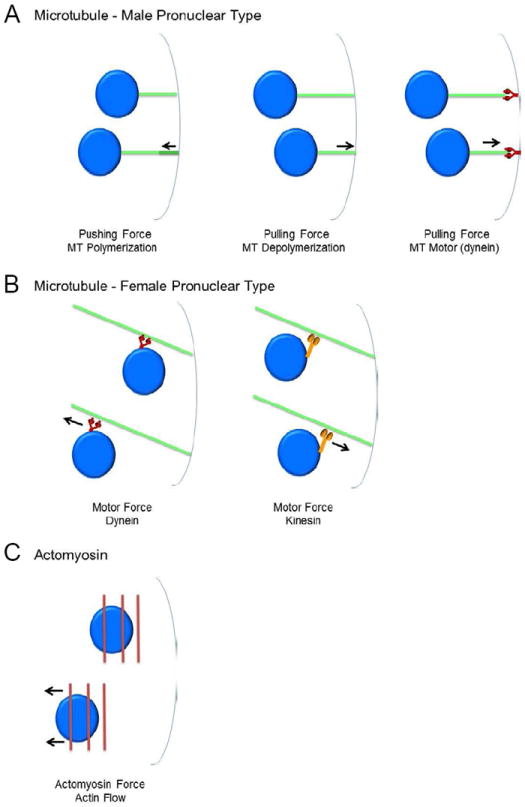
A. Schematic of male pronuclear type nuclear movement mediated by MTs (green). Forces (arrows) can be generated by MT polymerization, depolymerization or dynein motors (red) anchored in the cortex or cytoplasmic sites.
B. Schematic of female pronuclear type nuclear movement mediated by MT dynein (red) and kinesin (orange) motors. Forces (arrows) are generated by motors that laterally connect nuclei to MTs.
C. Schematic of actomyosin type nuclear movement. Force (arrows) is generated by the actomyosin-dependent flow of dorsal actin cables (red).
For male pronuclear type of nuclear movement, forces are generated by MTs interacting with cortical or cytoplasmic sites (Figure 3B). The interaction can be simply physical or mediated by anchored dynein. In S. pombe, interaction of growing MTs with the periphery generates pushing forces maintaining the nucleus in the middle of the cell (Tran et al., 2001). Pushing forces are restricted to systems in which relatively short distances (~10 μm) are involved because longer MTs cannot withstand compressive forces. Thus, in larger cells MT pulling forces contribute to centrosome movements. In most cases, pulling forces are generated by cortically anchored dynein (Grill et al., 2003; Schmoranzer et al., 2009), as originally described in budding yeast where dynein immobilized in the bud pulls on spindle pole body-associated MTs moving the nucleus toward the bud neck (Adames and Cooper, 2000).
In syncytial cells with multiple nuclei, a more complex MT pulling mechanism exists. In the filamentous fungus Aspergillus, where genetic screens revealed roles for dynein and its regulators in nuclear positioning (Morris et al., 1998), MT anchoring at cortical sites appears to evenly space nuclei in the syncytial hyphae (Gladfelter and Berman, 2009). In differentiating insect and mammalian muscle cells, which lack active centrosomes, MT minus ends associate directly with the nuclear envelope through uncharacterized factors. These cells also use dynein pulling and MT sliding by kinesin1 and MT-associated proteins to cluster nuclei near the center of syncytial myotubes (Folker et al., 2012; Metzger et al., 2012).
Nuclear Movement by Attached MT Motor Forces
In the female pronuclear form of nuclear movement, nuclei associate laterally with MTs and move along them powered by nuclear envelope-associated motors (Figure 3B). This is typical of nuclear movements that occur during developmental events. Genetic screens that identified KASH (Unc83) and SUN (Unc84) proteins in C. elegans revealed that these proteins were required for nuclear movement in various cell types (Starr and Fridolfsson, 2010). Unc83 recruits both dynein and kinesin1 motors to the nuclear envelope, where kinesin1 is responsible for moving the nucleus while dynein contributes to directionality (Fridolfsson and Starr, 2010).
Female pronuclear-type nuclear movements are pronounced in the developing nervous system. Early genetic screens in Drosophila identified Klarsicht or Klar as a founding member of the KASH protein family required for apical movements of nuclei that establish the proper arrangement of cells in the ommatidium (Mosley-Bishop et al., 1999). Klar function has been linked to kinesin and dynein (Welte, 2004), suggesting that it may recruit these MT motors to the nuclear envelope. Mutants in the dynein regulators dynactin and DLis1 have similar nuclear migration defects as Klar mutants (Fan and Ready, 1997; Swan et al., 1999). Mutants in lamin Dm(0) and the SUN protein klaroid disrupt Klar localization to the nuclear envelope and apical movement of the nucleus, generating the same Klar phenotype (Kracklauer et al., 2007; Patterson et al., 2004). This result was the first to suggest that the nuclear lamina anchored the LINC complex.
Female pronuclear-type nuclear movements occur during two stages of vertebrate central nervous system development. In neuroepithelial radial glial cells, which serve as neuronal precursors, nuclear movement occurs along the apical-basal axis in a cell cycle dependent fashion. This has been termed interkinetic nuclear migration (INM). During INM, the nucleus moves basally during G1 and returns during G2 to an apical location where mitosis occurs (Taverna and Huttner, 2010). As the centrosome remains apical, basal and apical movements occur in MT plus and minus end directions, respectively. MT motors have been implicated in these movements: the kinesin-3 family member, Kif1a, for plus end-directed and dynein for minus end-directed (Tsai et al., 2007; Tsai et al., 2010). Nesprin-1 and nesprin-2 may serve as recruitment factors for MT motors in vertebrate INM. Knockout of their genes in mice and zebrafish leads to defective INM in the neocortex and retina and mouse nesprin-2 co-immunoprecipitates with dynein and kinesin-1(Tsujikawa et al., 2007; Yu et al., 2011; Zhang et al., 2009). Interfering with the dynactin and Lis1 give similar phenotypes (Tsai et al., 2005; Tsujikawa et al., 2007). Nuclear movements in vertebrate INM may be more complex than in the Drosophila eye, as myosin II and actomyosin contractility may also play a role (Norden et al., 2009; Schenk et al., 2009).
The second stage of vertebrate central nervous system development involving female pronuclear-type movements is neuron migration. After their “birth” in the neuroepithelium, neurons migrate significant distances to their final locations. Most migrating neurons exhibit a characteristic two-stroke form of migration in which a narrow leading process extends from the soma; the centrosome then moves forward into a swelling in the leading process followed by the nucleus and the rest of the soma (Tsai and Gleeson, 2005). Nuclear movement toward MT minus ends at the centrosome is dependent on dynein and its regulators Lis1 and NudE (Shu et al., 2004; Tsai et al., 2007). The centrosome also moves in a dynein and Lis1-dependent fashion. Lis1 binds to a specific nucleotide state of dynein and enhances force generation, which may be necessary for moving the nucleus (McKenney et al., 2010). Nesprin-2 and SUN1/SUN2, which are also required for the forward movement of the nucleus, may recruit dynein to the nucleus (Zhang et al., 2009). Doublecortin, a MT-associated protein, is also required for nuclear movement during neuron migration (Koizumi et al., 2006). Importantly, nuclear movement during neuronal migration is also dependent on actomyosin contraction (see below), so this is not a pure form of female pronuclear-type movement.
The two-stroke mode of migration with a large separation (5 to 18 μm) between the centrosome and nucleus is thought to be a particular feature of neurons and is not typically observed in other migrating cells. Nonetheless, the same anterior localization of the centrosome relative to the nucleus, albeit in closer proximity, occurs in many migrating cell types and dynein has been implicated in nuclear movements in migrating nonneuronal cells (Luxton and Gundersen, 2011).
Actin-mediated Nuclear Movement
A groundbreaking study in C. elegans identified an outer nuclear membrane protein, termed Anc-1, which bound to actin and was essential for anchoring nuclei in the syncytial hypodermal and intestinal cells (Starr and Han, 2002). Anc-1 is one of the founding members of the KASH protein family and requires the SUN protein, Unc84, for its outer nuclear membrane localization. While the discovery of Anc-1 showed that nuclear connections to the actin cytoskeleton anchor nuclei, we now know that nuclei are also actively moved through actin-dependent processes, typically in cells polarizing for migration.
Nuclear Movement by Tethering to Moving Actin Cables
The rearward positioning of the nucleus in migrating cells (Figure 1B) may result, at least in part, from an extension of the leading edge. Yet, studies in a number of cultured cell types have revealed that rearward nuclear positioning is an active process independent of cell protrusion (Desai et al., 2009; Dupin et al., 2011; Gomes et al., 2005; Luxton et al., 2010).
In wounded monolayers of serum-starved fibroblasts treated with LPA, which does not stimulates polarization but not protrusion, a direct mechanism for moving the nucleus has been established (Luxton et al., 2010). In this system, rearward-moving dorsal actin cables induced by Cdc42 provide force to move the nucleus (Figure 3C). Movement of dorsal actin cables is likely powered by myosin II, as its inhibition prevents actin flow and nuclear movement (Gomes et al., 2005). These cables are directly coupled to the nucleus by nesprin-2G and SUN2, which accumulate along them to form linear assemblies termed transmembrane actin-associated nuclear (TAN) lines. Actin-binding CH domains of nesprin-2G are required for TAN line formation and nuclear movement. A-type lamins anchor TAN lines to the nucleoskeleton and in their absence TAN lines slip over an immobile nucleus (Folker et al., 2011). This anchorage is presumably mediated through SUN2 binding to A-type lamins. Additional anchorage may be mediated by SUN2 binding to SAMP1, which also localizes to TAN lines and is necessary for nuclear movement (Borrego-Pinto et al., 2012).
Nuclear Movement by Actomyosin Contraction
Nuclear movement appears to be rate limiting for cells migrating through narrow extracellular spaces in which nuclei become deformed (Friedl et al., 2011). In at least some of these cases, passage through a narrow opening specifically requires myosin II (Beadle et al., 2008), suggesting that actomyosin-mediated nuclear movement is necessary. Myosin II is also necessary for the forward movement of the nucleus in migrating neurons (Solecki et al., 2009; Tsai et al., 2007), localizing behind it where it may provide contractile forces that help move it into the leading process. This may reflect the difficulty of moving the nucleus into the narrow leading process, which requires nuclei to become elongated.
Nuclear Positioning and Disease
We have provided several examples of nuclear positioning events that are required for specific cellular processes. Given this requirement, one could imagine that defects in the molecular toolbox for nuclear positioning could lead to cellular dysfunction. Indeed, results from human subjects with inherited diseases and mouse models have shown that alterations in proteins involved in nuclear positioning are associated with pathology. Mutations in genes encoding proteins involved in MT function, LINC complex components and the nuclear lamina all cause human diseases (Table 3).
Table 3.
Genes Encoding Proteins Functioning in Nuclear Positioning Linked to Human Disease
| Human Gene | Protein(s) | Protein(s) Function(s) | Human Disease(s) | Disease Phenotype |
|---|---|---|---|---|
| DCX | Doublecortin | Stabilizes microtubules | Lissencephaly | Mislocalization of cortical neurons, “smooth brain” |
| LIS1 | Lis1 | Dynein regulation | Lissencephaly | Mislocalization of cortical neurons, “smooth brain” |
| TUBA3 | α-tubulin | MT component | Lissencephaly | Mislocalization of cortical neurons, “smooth brain” |
| LMNB1 | Lamin B1 | Lamina component | Adult onset leukodystrophy results from gene duplication | Demyelination |
| LMNB2 | Lamin B2 | Lamina component | Susceptibility to acquired partial lipodystrophy | Regional fat loss |
| SUN1 | Sun1 | LINC complex | None to date | - |
| SUN2 | Sun2 | LINC complex | None to date | - |
| SYNE1 | Nesprin-1 | LINC complex | 1) Cerebellar ataxia; 2) myopathies; 3) arthrogryposis | 1) Coordination defects; 2) cardiomyopathy and muscular dystrophy; 3) congenital joint contractures and muscle weakness |
| SYNE2 | Nesprin-2 | LINC complex | Myopathies | Cardiomyopathy and skeletal muscular dystrophy |
| SYNE4 | Nesprin-4 | LINC complex | High frequency hearing loss | Progressive high-frequency hearing loss |
| LMNA | A-type lamins | Lamina components | 1) myopathy; 2) partial lipodystrophy; 3) peripheral neuropathy; 4) progeria | 1) cardiomyopathy with variable skeletal muscular dystrophy; 2) fat loss from extremities; 3) peripheral nerve defects; 4) accelerated aging phenotypes |
Lissencephaly is characterized by mislocalization of cortical neurons, resulting in decreased cortical complexity and a smooth brain surface. Affected children have severe psychomotor retardation, seizures, muscle spasticity and failure to thrive. At the cellular level, neuronal migration required for brain development is blocked. Most cases of “classic” lissencephaly are caused by deletion or truncating mutations in LIS1 (Reiner et al., 1993). The Lis1 protein is required for INM and nuclear and centrosomal movement during two-stoke neuronal migration (Shu et al., 2004; Tsai et al., 2007). Similarly, mutations in DCX encoding doublecortin cause X-linked lissencephaly and defective nuclear movement in neurons (Gleeson et al., 1998; Koizumi et al., 2006). De novo mutations in TUBA3 encoding α-1 tubulin also cause lissencephaly and defective nuclear movement in neurons (Keays et al., 2007).
Intriguingly, depletion of lamin B1, lamin B2 or both in mice causes lissencephaly-like phenotypes (Coffinier et al., 2010; Coffinier et al., 2011). These phenotypes result from neuronal migration defects, which likely have accompanying abnormalities in nuclear movement, although this has not been assessed directly. Nuclei spin in mouse fibroblasts lacking lamin B1, suggesting that B-type lamins function in nuclear anchoring (Ji et al., 2007). B-type lamins may therefore anchor LINC complexes. Mutations in genes encoding B-type lamins have not yet been linked to human developmental brain disorders but duplications in LMNB1 cause overexpression of lamin B1 and an adult-onset demyelinating disease (Padiath et al., 2006).
Experiments in knockout mice implicate SUN1, SUN2, nesprin-1 and nesprin-2 in nuclear migration during neurogenesis and migration (Zhang et al., 2009). However, mutations in genes encoding nesprins have been linked to diseases other than lissencephaly. Mutations in SYNE1 encoding nesprin-1 cause adult-onset autosomal recessive cerebellar ataxia characterized by diffuse cerebellar atrophy and impaired walking, dysarthria and poor coordination (Gros-Louis et al., 2007). This could potentially result from neuronal migration defects in a specific region of the brain. Mutations in SYNE1 have also been reported to cause an autosomal recessive form of arthrogryposis multiplex congenita characterized by congenital joint contractures, muscle weakness and progressive motor decline (Attali et al., 2009). Mutations in SYNE1 and SYNE2 have further been reported to cause Emery-Dreifuss muscular dystrophy (EDMD)-like phenotypes (Zhang et al., 2007a). Mutations in the gene encoding the LINC complex-associated protein emerin were first reported to cause X-linked EDMD (Bione et al., 1994) and mutations in LMNA encoding A-type lamins are responsible for most autosomally inherited cases (Bonne et al., 1999). This suggests an association between LINC complex function and EDMD-like phenotypes, which generally share a dilated cardiomyopathy with variable skeletal muscle involvement. More recently, mutation in SYNE4 encoding nesprin-4 has been shown to cause autosomal recessive, progressive high frequency hearing loss (Horn et al., 2013).
Nuclear positioning defects caused by SYNE1 and SYNE2 mutations have been described. One patient with a SYNE1 mutation and cerebellar ataxia was reported to have fewer muscle nuclei under neuromuscular junctions (Gros-Louis et al., 2007). Similarly, deletion of the KASH domain from nesprin-1 in mice abolishes synaptic nuclei clustering and disrupts spacing of non-synaptic nuclei in skeletal muscle; deletion of the nesprin-2 KASH domain has no effect but exacerbates the defect in mice lacking nesprin-1 (Zhang et al., 2007b). Nesprin-2 deletion in mice disrupts nuclear movement in cells of the neocortex and retina, causing reduced thickness of the cortex and the outer nuclear layer into which newly formed photoreceptor cells migrate (Yu et al., 2011; Zhang et al., 2009). Mice lacking nesprin-4 suffer from deafness, mimicking the human mutation phenotype, and have abnormal positioning of nuclei in cochlear outer hair cells (Horn et al., 2013). While no disease-causing mutations in SUN1 or SUN2 have been described in humans, depletion of both proteins from mice cause nuclear positioning defects in muscle, retina and developing brain, similar to those in mice lacking nesprin-1 and nesprin-2 (Lei et al., 2009; Yu et al., 2011; Zhang et al., 2009). Mice without SUN1 also have hearing loss and abnormal nuclear positioning in cochlear outer hair cells (Horn et al., 2013).
The tissue-selective human diseases and pathology in mice that occur in response to alterations in different SUNs and nesprins may result because only certain isoforms are necessary in different tissues. Data from mice demonstrate tissue-selective differences in the expression of nesprins and SUNs, yet there is no comprehensive analysis of the expression patterns and tissue-type functionality of all the different nesprins and SUNs. Results from knockout mice also suggest redundancy in the function of SUN1 and SUN2 and different tissue effects of nesprin-1 and nesprin-2.
Mutations in LMNA encoding the A-type lamins cause a broad range of human diseases often referred to as “laminopathies” (Dauer and Worman, 2009). LMNA mutations that cause EDMD and related myopathies are mostly missense or small in-frame deletions, which lead to expression of variant proteins, or to splice site, truncations or promoter mutations. Depletion of A-type lamins from mice leads primarily to cardiac and skeletal muscle phenotypes, suggesting that LMNA mutations, even dominant ones leading to variant protein expression, somehow cause loss of function (Sullivan et al., 1999). Skeletal muscles from humans with autosomal dominant EDMD and Lmna null mice both have nuclei in the center of myofibers rather than at their normal peripheral localization. However, this also occurs in other myopathies not associated with defects in proteins directly implicated in nuclear positioning. For more on laminopathies please see review by Schreiber and Kennedy in this issue.
In migrating fibroblasts depleted of A-type lamins or expressing variants associated with myopathy, actin-dependent rearward nuclear movement fails to occur (Folker et al., 2011). In these cells, nesprin-2G assembles into TAN lines that slip over the nucleus rather than moving with it, indicating an anchorage defect. Amino acid substitutions within an immunoglobulin-like motif in the tail of A-type lamins cause partial lipodystrophy, which is characterized by fat loss from the extremities. In contrast to those causing myopathy, expression of lamin A variants that cause lipodystrophy in migrating fibroblasts inhibit MT-dependent centrosome positioning but not actin-dependent nuclear movement (Folker et al., 2011).
Except for cases where it associates with abnormal neuronal migration, the pathogenic relationship of nuclear positioning defects observed in model systems to various disease phenotypes remains uncertain. It is not known why alterations in the nuclear positioning proteins affect only cells in certain tissues when the proteins are widely expressed. In some instances, observed nuclear positioning defects may not directly connect to the disease, such as mispositioning of nuclei at the neuromuscular junction in cerebellar ataxia. Overall, alterations in nuclear positioning toolbox most often affect tissues, such as the nervous system and striated muscle, in which cell migration plays an important role in organ development or homeostasis. Abnormal force transmission between the nucleus and cytoplasm may also render cells more susceptible to damage by mechanical stress, leading to activation of stress-response or apoptotic pathways resulting respectively in cell dysfunction or death.
Cellular Significance of Nuclear Positioning: Hypotheses and Perspectives
Our understanding of why cells move and position their nuclei is still rudimentary. Yet, interfering with proteins involved in nuclear movement inhibits many cell functions. Defects in the nuclear positioning toolbox also cause disease. Thus, nuclear positioning itself may influence other cellular activities. Here we put into perspective evidence supporting the hypotheses that nuclear positioning influences the organization and mechanical properties of the surrounding cytoplasm, cytoplasmic signaling and accessibility of the nucleus to signaling pathways.
The Nuclear Envelope as a Cytoskeletal Integrator
Identification of the LINC complex and other proteins mediating nucleocytoskeletal connections raises the possibility that the nucleus not only attaches to the cytoskeleton but organizes it. Even before the identification of specific nucleocytoskeletal connectors, a classical experiment by Ingber and colleagues revealed that the nucleus was physically connected to integrins in the plasma membrane (Maniotis et al., 1997). These investigators showed that applying force to fibronectin beads attached to integrins moved the nucleus tens of microns away. Although the nature of the connection was not identified, this observation clearly reflects linkages that exist between the nucleus and the plasma membrane.
The nucleus influences the MT cytoskeleton through its association with MTOCs, which determine where MT minus ends are anchored. A more direct influence of the nucleus on MT distribution occurs in cells with noncentrosomal MTs. In multinucleated myotubes, which lack functional centrosomes, MTs minus ends are attached to nuclei by unidentified linkers, contributing to an overall bipolar array of MTs with mixed polarity (Tassin et al., 1985). The nucleus may also affect organization of the actin cytoskeleton. CH domain-containing nesprins tether the nucleus to actin filaments but whether they organize actin arrays around it is less certain. In fibroblasts polarizing for migration, depleting nesprin-2G or A-type lamins does not alter the overall distribution of actin filaments or the formation and movement of dorsal actin cables (Folker et al., 2011; Luxton et al., 2010). However, alterations in actin filaments and focal adhesions have been reported when LINC complex components are perturbed (Hale et al., 2008; Khatau et al., 2009). This may reflect lack of direct connection of the actin arrays to the nuclear envelope or indirect effects. These finding suggest that, at least under some circumstances, the nucleus actively participates in organizing certain actin structures.
Additional evidence that the nucleus organizes the cytoplasm comes from biophysical measurements. Cytoplasmic stiffness adjacent and distal to the nucleus is altered in cells depleted of A-type lamins (Broers et al., 2004; Lammerding et al., 2004). Whether this result solely reflects direct physical links between the nucleus and cytoskeleton or indirect effects of signaling pathways that are also modified by alterations in the nuclear envelope (see below) is presently unclear.
The Nuclear Envelope as a Regulator of Signaling Pathways
As the largest and most compression resistant membrane bound organelle in the cell, the nucleus has been likened to a “molecular shock absorber” (Dahl et al., 2004). Theoretically, movement of such a large, non-deformable organelle through the cytoplasm will result in tensile and/or compressive forces. Mediated by nuclear connections to the cytoskeleton, these forces could be transmitted to distal sites that are mechanical transducers, such as integrin-based focal adhesions or cadherin-based cell-cell adhesions (Leckband et al., 2011; Parsons et al., 2010). In a sense, the nucleus would act like the bead in Ingber’s experiment, except that force would originate inside rather than outside the cell. Given that adhesions respond to mechanical stimuli by regulating Rho GTPase and mitogen activated protein (MAP) kinase signaling, the prediction is that nuclear movement may affect the activity of these pathways.
The idea that nuclear movement may regulate cellular signaling pathways has not been directly tested. Yet, there is evidence that alterations in the nuclear movement toolbox alter signaling pathways. Lamin A variants that cause myopathies increase MAP kinase signaling as does knockdown of A-type lamins or emerin (Muchir et al., 2007; Muchir et al., 2009). Similar results have been obtained for Rho signaling (Hale et al., 2008). Given that alterations in A-type lamins interfere with actin-dependent nuclear movement (Folker et al., 2011), it is possible that changes in signaling result from altered nuclear positioning. A-type lamins may also affect signaling by interacting with proteins in the pathway, for example, by binding the MAP kinase ERK1/2 (Gonzalez et al., 2008). KASH proteins may recruit signaling molecules to the nuclear envelope and regulate their activities, as nesprin-2 binds active ERK1/2 and its knockdown results in prolonged ERK1/2 activity (Warren et al., 2010). As other actin-dependent membrane structures such a focal adhesion regulate signaling, structures assembled on the surface of the nuclear envelope, such as TAN lines, may also do so.
Nuclear Position as a Response Regulator of Signaling Pathways
The position of the nucleus may also alter its responsiveness to pathways that regulate transcription and mRNA transport and localization. It is generally assumed that latent cytoplasmic transcription factors and second messengers activated by plasma membrane receptors reach the nucleus in an unabated fashion. However, the distance that they travel may depend on encounters with co-stimulatory and inhibitory factors in the cytoplasm (Calvo et al., 2010). Thus, the nucleus’s position relative to the origin of an external signal may modulate its response. This could be particularly important for asymmetrically encountered signals, for example, on the apical or basal aspects of epithelia or in gradients of external factors during development. The spatial relationship between the nucleus and the primary cilium changes in many developing epithelia, such as the neuroepithelium, and may affect the output of signaling pathways, such as the sonic hedgehog pathway that requires the cilium (Goetz and Anderson, 2010). Signaling from intracellular sites, such as the signaling endosome, may also enhance the proximity of a signal to the nucleus, thus enhancing responsiveness.
Only one study has directly examined the relationship between nuclear position and asymmetrical signaling (Del Bene et al., 2008). A gradient of Notch signaling, highest at the apical surface, exists in the retinal neuroepithelium as in other epithelia (Murciano et al., 2002). INM moves the nucleus basally during G1 exposing it to lower Notch activity. A mutation in the zebrafish mok gene encoding the dynactin p150glued subunit causes longer and faster basal nuclear excursions, resulting in increased basal mitoses and the formation of early differentiating neurons at the expense of later ones (Del Bene et al., 2008). Notch overexpression rescues the mok phenotype, showing that it results from inadequate exposure of the nucleus to Notch due to defective nuclear movement. Alterations in Syne-2 lead to similar changes in INM and cell fate in zebrafish retina (Tsujikawa et al., 2007). D eficiencies in Cep120 and TACC, proteins that affect the centrosome-MT connection, or in nesprin-2 or SUN1/2 also affect INM in developing mouse cerebral cortex and lead to early depletion of neural progenitors (Xie et al., 2007; Zhang et al., 2009). Although altered cell fate has not yet been demonstrated in these studies, they are consistent with altered response to Notch or other apical signals.
Conclusions
Rather than being a passive or random phenomenon, active mechanisms exist to position nuclei in cells. We have reviewed the molecular tools and mechanisms that move and position nuclei, most of which are conserved among eukaryotes. Human diseases result from genetic abnormalities in nuclear movement toolbox proteins and in some cases are linked to altered nuclear movement. We have highlighted process by which nuclear position may influence physiological processes and disease pathogenesis. Additional investigation is needed to understand how the nucleus affects these processes and to separate direct from indirect effects of its positioning. Future basic research on nuclear positioning and how it affects cellular processes is likely to significantly impact public health.
Acknowledgments
We thank Susumu Antoku, Wakam Chang, Edgar Gomes, Gant Luxton and Alex Palazzo for their comments and Wakam Chang for Figures 1B and 2A. The authors are supported by NIH grants R01GM099481, R01NS059352, R01HD070713 and R01AR048997.
Footnotes
Publisher's Disclaimer: This is a PDF file of an unedited manuscript that has been accepted for publication. As a service to our customers we are providing this early version of the manuscript. The manuscript will undergo copyediting, typesetting, and review of the resulting proof before it is published in its final citable form. Please note that during the production process errors may be discovered which could affect the content, and all legal disclaimers that apply to the journal pertain.
References
- Adames NR, Cooper JA. Microtubule interactions with the cell cortex causing nuclear movements in Saccharomyces cerevisiae. J Cell Biol. 2000;149:863–874. doi: 10.1083/jcb.149.4.863. [DOI] [PMC free article] [PubMed] [Google Scholar]
- Attali R, Warwar N, Israel A, Gurt I, McNally E, Puckelwartz M, Glick B, Nevo Y, Ben-Neriah Z, Melki J. Mutation of SYNE-1, encoding an essential component of the nuclear lamina, is responsible for autosomal recessive arthrogryposis. Hum Mol Genet. 2009;18:3462–3469. doi: 10.1093/hmg/ddp290. [DOI] [PubMed] [Google Scholar]
- Barnhart EL, Allen GM, Julicher F, Theriot JA. Bipedal locomotion in crawling cells. Biophys J. 2010;98:933–942. doi: 10.1016/j.bpj.2009.10.058. [DOI] [PMC free article] [PubMed] [Google Scholar]
- Beadle C, Assanah MC, Monzo P, Vallee R, Rosenfeld SS, Canoll P. The role of myosin II in glioma invasion of the brain. Mol Biol Cell. 2008;19:3357–3368. doi: 10.1091/mbc.E08-03-0319. [DOI] [PMC free article] [PubMed] [Google Scholar]
- Bione S, Maestrini E, Rivella S, Mancini M, Regis S, Romeo G, Toniolo D. Identification of a novel X-linked gene responsible for Emery-Dreifuss muscular dystrophy. Nat Genet. 1994;8:323–327. doi: 10.1038/ng1294-323. [DOI] [PubMed] [Google Scholar]
- Bonne G, Di Barletta MR, Varnous S, Becane HM, Hammouda EH, Merlini L, Muntoni F, Greenberg CR, Gary F, Urtizberea JA, et al. Mutations in the gene encoding lamin A/C cause autosomal dominant Emery-Dreifuss muscular dystrophy. Nat Genet. 1999;21:285–288. doi: 10.1038/6799. [DOI] [PubMed] [Google Scholar]
- Borrego-Pinto J, Jegou T, Osorio DS, Aurade F, Gorjanacz M, Koch B, Mattaj IW, Gomes ER. Samp1 is a component of TAN lines and is required for nuclear movement. J Cell Sci. 2012;125:1099–1105. doi: 10.1242/jcs.087049. [DOI] [PubMed] [Google Scholar]
- Broers JL, Peeters EA, Kuijpers HJ, Endert J, Bouten CV, Oomens CW, Baaijens FP, Ramaekers FC. Decreased mechanical stiffness in LMNA-/- cells is caused by defective nucleocytoskeletal integrity: implications for the development of laminopathies. Hum Mol Genet. 2004;13:2567–2580. doi: 10.1093/hmg/ddh295. [DOI] [PubMed] [Google Scholar]
- Buchman JJ, Tsai LH. Putting a notch in our understanding of nuclear migration. Cell. 2008;134:912–914. doi: 10.1016/j.cell.2008.09.007. [DOI] [PubMed] [Google Scholar]
- Calvo F, Agudo-Ibanez L, Crespo P. The Ras-ERK pathway: understanding site-specific signaling provides hope of new anti-tumor therapies. Bioessays. 2010;32:412–421. doi: 10.1002/bies.200900155. [DOI] [PubMed] [Google Scholar]
- Cappello S, Attardo A, Wu X, Iwasato T, Itohara S, Wilsch-Brauninger M, Eilken HM, Rieger MA, Schroeder TT, Huttner WB, et al. The Rho-GTPase cdc42 regulates neural progenitor fate at the apical surface. Nat Neurosci. 2006;9:1099–1107. doi: 10.1038/nn1744. [DOI] [PubMed] [Google Scholar]
- Coffinier C, Chang SY, Nobumori C, Tu Y, Farber EA, Toth JI, Fong LG, Young SG. Abnormal development of the cerebral cortex and cerebellum in the setting of lamin B2 deficiency. Proc Natl Acad Sci U S A. 2010;107:5076–5081. doi: 10.1073/pnas.0908790107. [DOI] [PMC free article] [PubMed] [Google Scholar]
- Coffinier C, Jung HJ, Nobumori C, Chang S, Tu Y, Barnes RH, 2nd, Yoshinaga Y, de Jong PJ, Vergnes L, Reue K, et al. Deficiencies in lamin B1 and lamin B2 cause neurodevelopmental defects and distinct nuclear shape abnormalities in neurons. Mol Biol Cell. 2011;22:4683–4693. doi: 10.1091/mbc.E11-06-0504. [DOI] [PMC free article] [PubMed] [Google Scholar]
- Crisp M, Liu Q, Roux K, Rattner JB, Shanahan C, Burke B, Stahl PD, Hodzic D. Coupling of the nucleus and cytoplasm: role of the LINC complex. J Cell Biol. 2006;172:41–53. doi: 10.1083/jcb.200509124. [DOI] [PMC free article] [PubMed] [Google Scholar]
- Dahl KN, Kahn SM, Wilson KL, Discher DE. The nuclear envelope lamina network has elasticity and a compressibility limit suggestive of a molecular shock absorber. J Cell Sci. 2004;117:4779–4786. doi: 10.1242/jcs.01357. [DOI] [PubMed] [Google Scholar]
- Dauer WT, Worman HJ. The nuclear envelope as a signaling node in development and disease. Dev Cell. 2009;17:626–638. doi: 10.1016/j.devcel.2009.10.016. [DOI] [PubMed] [Google Scholar]
- Del Bene F, Wehman AM, Link BA, Baier H. Regulation of neurogenesis by interkinetic nuclear migration through an apical-basal notch gradient. Cell. 2008;134:1055–1065. doi: 10.1016/j.cell.2008.07.017. [DOI] [PMC free article] [PubMed] [Google Scholar]
- Desai RA, Gao L, Raghavan S, Liu WF, Chen CS. Cell polarity triggered by cell-cell adhesion via E-cadherin. J Cell Sci. 2009;122:905–911. doi: 10.1242/jcs.028183. [DOI] [PMC free article] [PubMed] [Google Scholar]
- Dupin I, Sakamoto Y, Etienne-Manneville S. Cytoplasmic intermediate filaments mediate actin-driven positioning of the nucleus. J Cell Sci. 2011;124:865–872. doi: 10.1242/jcs.076356. [DOI] [PubMed] [Google Scholar]
- Fan SS, Ready DF. Glued participates in distinct microtubule-based activities in Drosophila eye development. Development. 1997;124:1497–1507. doi: 10.1242/dev.124.8.1497. [DOI] [PubMed] [Google Scholar]
- Folker ES, Ostlund C, Luxton GW, Worman HJ, Gundersen GG. Lamin A variants that cause striated muscle disease are defective in anchoring transmembrane actin-associated nuclear lines for nuclear movement. Proc Natl Acad Sci U S A. 2011;108:131–136. doi: 10.1073/pnas.1000824108. [DOI] [PMC free article] [PubMed] [Google Scholar]
- Folker ES, Schulman VK, Baylies MK. Muscle length and myonuclear position are independently regulated by distinct Dynein pathways. Development. 2012;139:3827–3837. doi: 10.1242/dev.079178. [DOI] [PMC free article] [PubMed] [Google Scholar]
- Fridolfsson HN, Ly N, Meyerzon M, Starr DA. UNC-83 coordinates kinesin-1 and dynein activities at the nuclear envelope during nuclear migration. Dev Biol. 2010;338:237–250. doi: 10.1016/j.ydbio.2009.12.004. [DOI] [PMC free article] [PubMed] [Google Scholar]
- Fridolfsson HN, Starr DA. Kinesin-1 and dynein at the nuclear envelope mediate the bidirectional migrations of nuclei. J Cell Biol. 2010;191:115–128. doi: 10.1083/jcb.201004118. [DOI] [PMC free article] [PubMed] [Google Scholar]
- Friedl P, Wolf K, Lammerding J. Nuclear mechanics during cell migration. Curr Opin Cell Biol. 2011;23:55–64. doi: 10.1016/j.ceb.2010.10.015. [DOI] [PMC free article] [PubMed] [Google Scholar]
- Gladfelter A, Berman J. Dancing genomes: fungal nuclear positioning. Nat Rev Microbiol. 2009;7:875–886. doi: 10.1038/nrmicro2249. [DOI] [PMC free article] [PubMed] [Google Scholar]
- Gleeson JG, Allen KM, Fox JW, Lamperti ED, Berkovic S, Scheffer I, Cooper EC, Dobyns WB, Minnerath SR, Ross ME, et al. Doublecortin, a brain-specific gene mutated in human X-linked lissencephaly and double cortex syndrome, encodes a putative signaling protein. Cell. 1998;92:63–72. doi: 10.1016/s0092-8674(00)80899-5. [DOI] [PubMed] [Google Scholar]
- Godin JD, Thomas N, Laguesse S, Malinouskaya L, Close P, Malaise O, Purnelle A, Raineteau O, Campbell K, Fero M, et al. p27(Kip1) is a microtubule-associated protein that promotes microtubule polymerization during neuron migration. Dev Cell. 2012;23:729–744. doi: 10.1016/j.devcel.2012.08.006. [DOI] [PubMed] [Google Scholar]
- Goetz SC, Anderson KV. The primary cilium: a signalling centre during vertebrate development. Nat Rev Genet. 2010;11:331–344. doi: 10.1038/nrg2774. [DOI] [PMC free article] [PubMed] [Google Scholar]
- Gomes ER, Jani S, Gundersen GG. Nuclear movement regulated by Cdc42, MRCK, myosin, and actin flow establishes MTOC polarization in migrating cells. Cell. 2005;121:451–463. doi: 10.1016/j.cell.2005.02.022. [DOI] [PubMed] [Google Scholar]
- Gonczy P, Pichler S, Kirkham M, Hyman AA. Cytoplasmic dynein is required for distinct aspects of MTOC positioning, including centrosome separation, in the one cell stage Caenorhabditis elegans embryo. J Cell Biol. 1999;147:135–150. doi: 10.1083/jcb.147.1.135. [DOI] [PMC free article] [PubMed] [Google Scholar]
- Gonzalez JM, Navarro-Puche A, Casar B, Crespo P, Andres V. Fast regulation of AP-1 activity through interaction of lamin A/C, ERK1/2, and c-Fos at the nuclear envelope. J Cell Biol. 2008;183:653–666. doi: 10.1083/jcb.200805049. [DOI] [PMC free article] [PubMed] [Google Scholar]
- Grill SW, Howard J, Schaffer E, Stelzer EH, Hyman AA. The distribution of active force generators controls mitotic spindle position. Science. 2003;301:518–521. doi: 10.1126/science.1086560. [DOI] [PubMed] [Google Scholar]
- Gros-Louis F, Dupre N, Dion P, Fox MA, Laurent S, Verreault S, Sanes JR, Bouchard JP, Rouleau GA. Mutations in SYNE1 lead to a newly discovered form of autosomal recessive cerebellar ataxia. Nat Genet. 2007;39:80–85. doi: 10.1038/ng1927. [DOI] [PubMed] [Google Scholar]
- Hale CM, Shrestha AL, Khatau SB, Stewart-Hutchinson PJ, Hernandez L, Stewart CL, Hodzic D, Wirtz D. Dysfunctional connections between the nucleus and the actin and microtubule networks in laminopathic models. Biophys J. 2008;95:5462–5475. doi: 10.1529/biophysj.108.139428. [DOI] [PMC free article] [PubMed] [Google Scholar]
- Haque F, Lloyd DJ, Smallwood DT, Dent CL, Shanahan CM, Fry AM, Trembath RC, Shackleton S. SUN1 interacts with nuclear lamin A and cytoplasmic nesprins to provide a physical connection between the nuclear lamina and the cytoskeleton. Mol Cell Biol. 2006;26:3738–3751. doi: 10.1128/MCB.26.10.3738-3751.2006. [DOI] [PMC free article] [PubMed] [Google Scholar]
- Horn HF, Brownstein Z, Lenz DR, Shivatzki S, Dror AA, Dagan-Rosenfeld O, Friedman LM, Roux KJ, Kozlov S, Jeang K-T, et al. The LINC Complex is Essential for Hearing in Humans and Mice. J Clin Invest. 2013 doi: 10.1172/JCI66911. In Press. [DOI] [PMC free article] [PubMed] [Google Scholar]
- Ji JY, Lee RT, Vergnes L, Fong LG, Stewart CL, Reue K, Young SG, Zhang Q, Shanahan CM, Lammerding J. Cell nuclei spin in the absence of lamin b1. J Biol Chem. 2007;282:20015–20026. doi: 10.1074/jbc.M611094200. [DOI] [PubMed] [Google Scholar]
- Keays DA, Tian G, Poirier K, Huang GJ, Siebold C, Cleak J, Oliver PL, Fray M, Harvey RJ, Molnar Z, et al. Mutations in alpha-tubulin cause abnormal neuronal migration in mice and lissencephaly in humans. Cell. 2007;128:45–57. doi: 10.1016/j.cell.2006.12.017. [DOI] [PMC free article] [PubMed] [Google Scholar]
- Khatau SB, Hale CM, Stewart-Hutchinson PJ, Patel MS, Stewart CL, Searson PC, Hodzic D, Wirtz D. A perinuclear actin cap regulates nuclear shape. Proc Natl Acad Sci U S A. 2009;106:19017–19022. doi: 10.1073/pnas.0908686106. [DOI] [PMC free article] [PubMed] [Google Scholar]
- King MC, Drivas TG, Blobel G. A network of nuclear envelope membrane proteins linking centromeres to microtubules. Cell. 2008;134:427–438. doi: 10.1016/j.cell.2008.06.022. [DOI] [PMC free article] [PubMed] [Google Scholar]
- Koizumi H, Higginbotham H, Poon T, Tanaka T, Brinkman BC, Gleeson JG. Doublecortin maintains bipolar shape and nuclear translocation during migration in the adult forebrain. Nat Neurosci. 2006;9:779–786. doi: 10.1038/nn1704. [DOI] [PubMed] [Google Scholar]
- Kracklauer MP, Banks SM, Xie X, Wu Y, Fischer JA. Drosophila klaroid encodes a SUN domain protein required for Klarsicht localization to the nuclear envelope and nuclear migration in the eye. Fly (Austin) 2007;1:75–85. doi: 10.4161/fly.4254. [DOI] [PubMed] [Google Scholar]
- Lammerding J, Schulze PC, Takahashi T, Kozlov S, Sullivan T, Kamm RD, Stewart CL, Lee RT. Lamin A/C deficiency causes defective nuclear mechanics and mechanotransduction. J Clin Invest. 2004;113:370–378. doi: 10.1172/JCI19670. [DOI] [PMC free article] [PubMed] [Google Scholar]
- Leckband DE, le Duc Q, Wang N, de Rooij J. Mechanotransduction at cadherin-mediated adhesions. Curr Opin Cell Biol. 2011;23:523–530. doi: 10.1016/j.ceb.2011.08.003. [DOI] [PubMed] [Google Scholar]
- Lee JS, Hale CM, Panorchan P, Khatau SB, George JP, Tseng Y, Stewart CL, Hodzic D, Wirtz D. Nuclear lamin A/C deficiency induces defects in cell mechanics, polarization, and migration. Biophys J. 2007;93:2542–2552. doi: 10.1529/biophysj.106.102426. [DOI] [PMC free article] [PubMed] [Google Scholar]
- Lei K, Zhang X, Ding X, Guo X, Chen M, Zhu B, Xu T, Zhuang Y, Xu R, Han M. SUN1 and SUN2 play critical but partially redundant roles in anchoring nuclei in skeletal muscle cells in mice. Proc Natl Acad Sci U S A. 2009;106:10207–10212. doi: 10.1073/pnas.0812037106. [DOI] [PMC free article] [PubMed] [Google Scholar]
- Levy JR, Holzbaur EL. Dynein drives nuclear rotation during forward progression of motile fibroblasts. J Cell Sci. 2008;121:3187–3195. doi: 10.1242/jcs.033878. [DOI] [PMC free article] [PubMed] [Google Scholar]
- Liu Q, Pante N, Misteli T, Elsagga M, Crisp M, Hodzic D, Burke B, Roux KJ. Functional association of Sun1 with nuclear pore complexes. J Cell Biol. 2007;178:785–798. doi: 10.1083/jcb.200704108. [DOI] [PMC free article] [PubMed] [Google Scholar]
- Luxton GW, Gomes ER, Folker ES, Vintinner E, Gundersen GG. Linear arrays of nuclear envelope proteins harness retrograde actin flow for nuclear movement. Science. 2010;329:956–959. doi: 10.1126/science.1189072. [DOI] [PMC free article] [PubMed] [Google Scholar]
- Luxton GW, Gomes ER, Folker ES, Worman HJ, Gundersen GG. TAN lines: a novel nuclear envelope structure involved in nuclear positioning. Nucleus. 2011;2:173–181. doi: 10.4161/nucl.2.3.16243. [DOI] [PMC free article] [PubMed] [Google Scholar]
- Luxton GW, Gundersen GG. Orientation and function of the nuclear-centrosomal axis during cell migration. Curr Opin Cell Biol. 2011;23:579–588. doi: 10.1016/j.ceb.2011.08.001. [DOI] [PMC free article] [PubMed] [Google Scholar]
- Malone CJ, Misner L, Le Bot N, Tsai MC, Campbell JM, Ahringer J, White JG. The C. elegans hook protein, ZYG-12, mediates the essential attachment between the centrosome and nucleus. Cell. 2003;115:825–836. doi: 10.1016/s0092-8674(03)00985-1. [DOI] [PubMed] [Google Scholar]
- Maniotis AJ, Chen CS, Ingber DE. Demonstration of mechanical connections between integrins, cytoskeletal filaments, and nucleoplasm that stabilize nuclear structure. Proc Natl Acad Sci U S A. 1997;94:849–854. doi: 10.1073/pnas.94.3.849. [DOI] [PMC free article] [PubMed] [Google Scholar]
- McKenney RJ, Vershinin M, Kunwar A, Vallee RB, Gross SP. LIS1 and NudE induce a persistent dynein force-producing state. Cell. 2010;141:304–314. doi: 10.1016/j.cell.2010.02.035. [DOI] [PMC free article] [PubMed] [Google Scholar]
- McNiven MA. Breaking away: matrix remodeling from the leading edge. Trends Cell Biol. 2013;23:16–21. doi: 10.1016/j.tcb.2012.08.009. [DOI] [PMC free article] [PubMed] [Google Scholar]
- Metzger T, Gache V, Xu M, Cadot B, Folker ES, Richardson BE, Gomes ER, Baylies MK. MAP and kinesin-dependent nuclear positioning is required for skeletal muscle function. Nature. 2012;484:120–124. doi: 10.1038/nature10914. [DOI] [PMC free article] [PubMed] [Google Scholar]
- Mislow JM, Holaska JM, Kim MS, Lee KK, Segura-Totten M, Wilson KL, McNally EM. Nesprin-1alpha self-associates and binds directly to emerin and lamin A in vitro. FEBS Lett. 2002;525:135–140. doi: 10.1016/s0014-5793(02)03105-8. [DOI] [PubMed] [Google Scholar]
- Morimoto A, Shibuya H, Zhu X, Kim J, Ishiguro K, Han M, Watanabe Y. A conserved KASH domain protein associates with telomeres, SUN1, and dynactin during mammalian meiosis. J Cell Biol. 2012;198:165–172. doi: 10.1083/jcb.201204085. [DOI] [PMC free article] [PubMed] [Google Scholar]
- Morris NR, Efimov VP, Xiang X. Nuclear migration, nucleokinesis and lissencephaly. Trends Cell Biol. 1998;8:467–470. doi: 10.1016/s0962-8924(98)01389-0. [DOI] [PubMed] [Google Scholar]
- Mosley-Bishop KL, Li Q, Patterson L, Fischer JA. Molecular analysis of the klarsicht gene and its role in nuclear migration within differentiating cells of the Drosophila eye. Curr Biol. 1999;9:1211–1220. doi: 10.1016/s0960-9822(99)80501-6. [DOI] [PubMed] [Google Scholar]
- Muchir A, Pavlidis P, Decostre V, Herron AJ, Arimura T, Bonne G, Worman HJ. Activation of MAPK pathways links LMNA mutations to cardiomyopathy in Emery-Dreifuss muscular dystrophy. J Clin Invest. 2007;117:1282–1293. doi: 10.1172/JCI29042. [DOI] [PMC free article] [PubMed] [Google Scholar]
- Muchir A, Wu W, Worman HJ. Reduced expression of A-type lamins and emerin activates extracellular signal-regulated kinase in cultured cells. Biochim Biophys Acta. 2009;1792:75–81. doi: 10.1016/j.bbadis.2008.10.012. [DOI] [PMC free article] [PubMed] [Google Scholar]
- Murciano A, Zamora J, Lopez-Sanchez J, Frade JM. Interkinetic nuclear movement may provide spatial clues to the regulation of neurogenesis. Mol Cell Neurosci. 2002;21:285–300. doi: 10.1006/mcne.2002.1174. [DOI] [PubMed] [Google Scholar]
- Nery FC, Zeng J, Niland BP, Hewett J, Farley J, Irimia D, Li Y, Wiche G, Sonnenberg A, Breakefield XO. TorsinA binds the KASH domain of nesprins and participates in linkage between nuclear envelope and cytoskeleton. J Cell Sci. 2008;121:3476–3486. doi: 10.1242/jcs.029454. [DOI] [PMC free article] [PubMed] [Google Scholar]
- Norden C, Young S, Link BA, Harris WA. Actomyosin is the main driver of interkinetic nuclear migration in the retina. Cell. 2009;138:1195–1208. doi: 10.1016/j.cell.2009.06.032. [DOI] [PMC free article] [PubMed] [Google Scholar]
- Osmani N, Vitale N, Borg JP, Etienne-Manneville S. Scrib controls Cdc42 localization and activity to promote cell polarization during astrocyte migration. Curr Biol. 2006;16:2395–2405. doi: 10.1016/j.cub.2006.10.026. [DOI] [PubMed] [Google Scholar]
- Östlund C, Folker ES, Choi JC, Gomes ER, Gundersen GG, Worman HJ. Dynamics and molecular interactions of linker of nucleoskeleton and cytoskeleton (LINC) complex proteins. J Cell Sci. 2009;122:4099–4108. doi: 10.1242/jcs.057075. [DOI] [PMC free article] [PubMed] [Google Scholar]
- Padiath QS, Saigoh K, Schiffmann R, Asahara H, Yamada T, Koeppen A, Hogan K, Ptacek LJ, Fu YH. Lamin B1 duplications cause autosomal dominant leukodystrophy. Nat Genet. 2006;38:1114–1123. doi: 10.1038/ng1872. [DOI] [PubMed] [Google Scholar]
- Palazzo AF, Joseph HL, Chen YJ, Dujardin DL, Alberts AS, Pfister KK, Vallee RB, Gundersen GG. Cdc42, dynein, and dynactin regulate MTOC reorientation independent of Rhoregulated microtubule stabilization. Curr Biol. 2001;11:1536–1541. doi: 10.1016/s0960-9822(01)00475-4. [DOI] [PubMed] [Google Scholar]
- Parsons JT, Horwitz AR, Schwartz MA. Cell adhesion: integrating cytoskeletal dynamics and cellular tension. Nat Rev Mol Cell Biol. 2010;11:633–643. doi: 10.1038/nrm2957. [DOI] [PMC free article] [PubMed] [Google Scholar]
- Patterson K, Molofsky AB, Robinson C, Acosta S, Cater C, Fischer JA. The functions of Klarsicht and nuclear lamin in developmentally regulated nuclear migrations of photoreceptor cells in the Drosophila eye. Mol Biol Cell. 2004;15:600–610. doi: 10.1091/mbc.E03-06-0374. [DOI] [PMC free article] [PubMed] [Google Scholar]
- Razafsky D, Hodzic D. Bringing KASH under the SUN: the many faces of nucleo-cytoskeletal connections. J Cell Biol. 2009;186:461–472. doi: 10.1083/jcb.200906068. [DOI] [PMC free article] [PubMed] [Google Scholar]
- Reiner O, Carrozzo R, Shen Y, Wehnert M, Faustinella F, Dobyns WB, Caskey CT, Ledbetter DH. Isolation of a Miller-Dieker lissencephaly gene containing G protein beta-subunit-like repeats. Nature. 1993;364:717–721. doi: 10.1038/364717a0. [DOI] [PubMed] [Google Scholar]
- Reinsch S, Gonczy P. Mechanisms of nuclear positioning. J Cell Sci. 1998;111(Pt 16):2283–2295. doi: 10.1242/jcs.111.16.2283. [DOI] [PubMed] [Google Scholar]
- Roux KJ, Crisp ML, Liu Q, Kim D, Kozlov S, Stewart CL, Burke B. Nesprin 4 is an outer nuclear membrane protein that can induce kinesin-mediated cell polarization. Proc Natl Acad Sci U S A. 2009;106:2194–2199. doi: 10.1073/pnas.0808602106. [DOI] [PMC free article] [PubMed] [Google Scholar]
- Salpingidou G, Smertenko A, Hausmanowa-Petrucewicz I, Hussey PJ, Hutchison CJ. A novel role for the nuclear membrane protein emerin in association of the centrosome to the outer nuclear membrane. J Cell Biol. 2007;178:897–904. doi: 10.1083/jcb.200702026. [DOI] [PMC free article] [PubMed] [Google Scholar]
- Schaar BT, McConnell SK. Cytoskeletal coordination during neuronal migration. Proc Natl Acad Sci U S A. 2005;102:13652–13657. doi: 10.1073/pnas.0506008102. [DOI] [PMC free article] [PubMed] [Google Scholar]
- Schenk J, Wilsch-Brauninger M, Calegari F, Huttner WB. Myosin II is required for interkinetic nuclear migration of neural progenitors. Proc Natl Acad Sci U S A. 2009;106:16487–16492. doi: 10.1073/pnas.0908928106. [DOI] [PMC free article] [PubMed] [Google Scholar]
- Schmoranzer J, Fawcett JP, Segura M, Tan S, Vallee RB, Pawson T, Gundersen GG. Par3 and dynein associate to regulate local microtubule dynamics and centrosome orientation during migration. Curr Biol. 2009;19:1065–1074. doi: 10.1016/j.cub.2009.05.065. [DOI] [PMC free article] [PubMed] [Google Scholar]
- Shu T, Ayala R, Nguyen MD, Xie Z, Gleeson JG, Tsai LH. Ndel1 operates in a common pathway with LIS1 and cytoplasmic dynein to regulate cortical neuronal positioning. Neuron. 2004;44:263–277. doi: 10.1016/j.neuron.2004.09.030. [DOI] [PubMed] [Google Scholar]
- Solecki DJ, Model L, Gaetz J, Kapoor TM, Hatten ME. Par6alpha signaling controls glial-guided neuronal migration. Nat Neurosci. 2004;7:1195–1203. doi: 10.1038/nn1332. [DOI] [PubMed] [Google Scholar]
- Solecki DJ, Trivedi N, Govek EE, Kerekes RA, Gleason SS, Hatten ME. Myosin II motors and F-actin dynamics drive the coordinated movement of the centrosome and soma during CNS glial-guided neuronal migration. Neuron. 2009;63:63–80. doi: 10.1016/j.neuron.2009.05.028. [DOI] [PMC free article] [PubMed] [Google Scholar]
- Sosa BA, Rothballer A, Kutay U, Schwartz TU. LINC complexes form by binding of three KASH peptides to domain interfaces of trimeric SUN proteins. Cell. 2012;149:1035–1047. doi: 10.1016/j.cell.2012.03.046. [DOI] [PMC free article] [PubMed] [Google Scholar]
- Splinter D, Tanenbaum ME, Lindqvist A, Jaarsma D, Flotho A, Yu KL, Grigoriev I, Engelsma D, Haasdijk ED, Keijzer N, et al. Bicaudal D2, dynein, and kinesin-1 associate with nuclear pore complexes and regulate centrosome and nuclear positioning during mitotic entry. PLoS Biol. 2010;8:e1000350. doi: 10.1371/journal.pbio.1000350. [DOI] [PMC free article] [PubMed] [Google Scholar]
- Starr DA, Fridolfsson HN. Interactions between nuclei and the cytoskeleton are mediated by SUN-KASH nuclear-envelope bridges. Annu Rev Cell Dev Biol. 2010;26:421–444. doi: 10.1146/annurev-cellbio-100109-104037. [DOI] [PMC free article] [PubMed] [Google Scholar]
- Starr DA, Han M. Role of ANC-1 in tethering nuclei to the actin cytoskeleton. Science. 2002;298:406–409. doi: 10.1126/science.1075119. [DOI] [PubMed] [Google Scholar]
- Sullivan T, Escalante-Alcalde D, Bhatt H, Anver M, Bhat N, Nagashima K, Stewart CL, Burke B. Loss of A-type lamin expression compromises nuclear envelope integrity leading to muscular dystrophy. J Cell Biol. 1999;147:913–920. doi: 10.1083/jcb.147.5.913. [DOI] [PMC free article] [PubMed] [Google Scholar]
- Swan A, Nguyen T, Suter B. Drosophila Lissencephaly-1 functions with Bic-D and dynein in oocyte determination and nuclear positioning. Nat Cell Biol. 1999;1:444–449. doi: 10.1038/15680. [DOI] [PubMed] [Google Scholar]
- Tanabe LM, Kim CE, Alagem N, Dauer WT. Primary dystonia: molecules and mechanisms. Nat Rev Neurol. 2009;5:598–609. doi: 10.1038/nrneurol.2009.160. [DOI] [PMC free article] [PubMed] [Google Scholar]
- Tassin AM, Maro B, Bornens M. Fate of microtubule-organizing centers during myogenesis in vitro. J Cell Biol. 1985;100:35–46. doi: 10.1083/jcb.100.1.35. [DOI] [PMC free article] [PubMed] [Google Scholar]
- Taverna E, Huttner WB. Neural progenitor nuclei IN motion. Neuron. 2010;67:906–914. doi: 10.1016/j.neuron.2010.08.027. [DOI] [PubMed] [Google Scholar]
- Tomlinson A, Ready DF. Sevenless: a cell-specific homeotic mutation of the Drosophila eye. Science. 1986;231:400–402. doi: 10.1126/science.231.4736.400. [DOI] [PubMed] [Google Scholar]
- Tran PT, Marsh L, Doye V, Inoue S, Chang F. A mechanism for nuclear positioning in fission yeast based on microtubule pushing. J Cell Biol. 2001;153:397–411. doi: 10.1083/jcb.153.2.397. [DOI] [PMC free article] [PubMed] [Google Scholar]
- Tsai FC, Meyer T. Ca2+ pulses control local cycles of lamellipodia retraction and adhesion along the front of migrating cells. Curr Biol. 2012;22:837–842. doi: 10.1016/j.cub.2012.03.037. [DOI] [PMC free article] [PubMed] [Google Scholar]
- Tsai JW, Bremner KH, Vallee RB. Dual subcellular roles for LIS1 and dynein in radial neuronal migration in live brain tissue. Nat Neurosci. 2007;10:970–979. doi: 10.1038/nn1934. [DOI] [PubMed] [Google Scholar]
- Tsai JW, Chen Y, Kriegstein AR, Vallee RB. LIS1 RNA interference blocks neural stem cell division, morphogenesis, and motility at multiple stages. J Cell Biol. 2005;170:935–945. doi: 10.1083/jcb.200505166. [DOI] [PMC free article] [PubMed] [Google Scholar]
- Tsai JW, Lian WN, Kemal S, Kriegstein AR, Vallee RB. Kinesin 3 and cytoplasmic dynein mediate interkinetic nuclear migration in neural stem cells. Nat Neurosci. 2010;13:1463–1471. doi: 10.1038/nn.2665. [DOI] [PMC free article] [PubMed] [Google Scholar]
- Tsai LH, Gleeson JG. Nucleokinesis in neuronal migration. Neuron. 2005;46:383–388. doi: 10.1016/j.neuron.2005.04.013. [DOI] [PubMed] [Google Scholar]
- Tsujikawa M, Omori Y, Biyanwila J, Malicki J. Mechanism of positioning the cell nucleus in vertebrate photoreceptors. Proc Natl Acad Sci U S A. 2007;104:14819–14824. doi: 10.1073/pnas.0700178104. [DOI] [PMC free article] [PubMed] [Google Scholar]
- Warren DT, Tajsic T, Mellad JA, Searles R, Zhang Q, Shanahan CM. Novel nuclear nesprin-2 variants tether active extracellular signal-regulated MAPK1 and MAPK2 at promyelocytic leukemia protein nuclear bodies and act to regulate smooth muscle cell proliferation. J Biol Chem. 2010;285:1311–1320. doi: 10.1074/jbc.M109.032557. [DOI] [PMC free article] [PubMed] [Google Scholar]
- Welte MA. Bidirectional transport along microtubules. Curr Biol. 2004;14:R525–537. doi: 10.1016/j.cub.2004.06.045. [DOI] [PubMed] [Google Scholar]
- Wilhelmsen K, Litjens SH, Kuikman I, Tshimbalanga N, Janssen H, van den Bout I, Raymond K, Sonnenberg A. Nesprin-3, a novel outer nuclear membrane protein, associates with the cytoskeletal linker protein plectin. J Cell Biol. 2005;171:799–810. doi: 10.1083/jcb.200506083. [DOI] [PMC free article] [PubMed] [Google Scholar]
- Wilkie GS, Korfali N, Swanson SK, Malik P, Srsen V, Batrakou DG, de las Heras J, Zuleger N, Kerr AR, Florens L, et al. Several novel nuclear envelope transmembrane proteins identified in skeletal muscle have cytoskeletal associations. Mol Cell Proteomics. 2011;10 doi: 10.1074/mcp.M110.003129. M110 003129. [DOI] [PMC free article] [PubMed] [Google Scholar]
- Xie Z, Moy LY, Sanada K, Zhou Y, Buchman JJ, Tsai LH. Cep120 and TACCs control interkinetic nuclear migration and the neural progenitor pool. Neuron. 2007;56:79–93. doi: 10.1016/j.neuron.2007.08.026. [DOI] [PMC free article] [PubMed] [Google Scholar]
- Yu J, Lei K, Zhou M, Craft CM, Xu G, Xu T, Zhuang Y, Xu R, Han M. KASH protein Syne-2/Nesprin-2 and SUN proteins SUN1/2 mediate nuclear migration during mammalian retinal development. Hum Mol Genet. 2011;20:1061–1073. doi: 10.1093/hmg/ddq549. [DOI] [PMC free article] [PubMed] [Google Scholar]
- Zhang Q, Bethmann C, Worth NF, Davies JD, Wasner C, Feuer A, Ragnauth CD, Yi Q, Mellad JA, Warren DT, et al. Nesprin-1 and -2 are involved in the pathogenesis of Emery Dreifuss muscular dystrophy and are critical for nuclear envelope integrity. Hum Mol Genet. 2007a;16:2816–2833. doi: 10.1093/hmg/ddm238. [DOI] [PubMed] [Google Scholar]
- Zhang Q, Ragnauth CD, Skepper JN, Worth NF, Warren DT, Roberts RG, Weissberg PL, Ellis JA, Shanahan CM. Nesprin-2 is a multi-isomeric protein that binds lamin and emerin at the nuclear envelope and forms a subcellular network in skeletal muscle. J Cell Sci. 2005;118:673–687. doi: 10.1242/jcs.01642. [DOI] [PubMed] [Google Scholar]
- Zhang Q, Skepper JN, Yang F, Davies JD, Hegyi L, Roberts RG, Weissberg PL, Ellis JA, Shanahan CM. Nesprins: a novel family of spectrin-repeat-containing proteins that localize to the nuclear membrane in multiple tissues. J Cell Sci. 2001;114:4485–4498. doi: 10.1242/jcs.114.24.4485. [DOI] [PubMed] [Google Scholar]
- Zhang X, Lei K, Yuan X, Wu X, Zhuang Y, Xu T, Xu R, Han M. SUN1/2 and Syne/Nesprin-1/2 complexes connect centrosome to the nucleus during neurogenesis and neuronal migration in mice. Neuron. 2009;64:173–187. doi: 10.1016/j.neuron.2009.08.018. [DOI] [PMC free article] [PubMed] [Google Scholar]
- Zhang X, Xu R, Zhu B, Yang X, Ding X, Duan S, Xu T, Zhuang Y, Han M. Syne-1 and Syne-2 play crucial roles in myonuclear anchorage and motor neuron innervation. Development. 2007b;134:901–908. doi: 10.1242/dev.02783. [DOI] [PubMed] [Google Scholar]
- Zhao T, Graham OS, Raposo A, St Johnston D. Growing microtubules push the oocyte nucleus to polarize the Drosophila dorsal-ventral axis. Science. 2012;336:999–1003. doi: 10.1126/science.1219147. [DOI] [PMC free article] [PubMed] [Google Scholar]
- Zhou X, Graumann K, Evans DE, Meier I. Novel plant SUN-KASH bridges are involved in RanGAP anchoring and nuclear shape determination. J Cell Biol. 2012a;196:203–211. doi: 10.1083/jcb.201108098. [DOI] [PMC free article] [PubMed] [Google Scholar]
- Zhou Z, Du X, Cai Z, Song X, Zhang H, Mizuno T, Suzuki E, Yee MR, Berezov A, Murali R, et al. Structure of Sad1-UNC84 homology (SUN) domain defines features of molecular bridge in nuclear envelope. J Biol Chem. 2012b;287:5317–5326. doi: 10.1074/jbc.M111.304543. [DOI] [PMC free article] [PubMed] [Google Scholar]