


Figure 2.
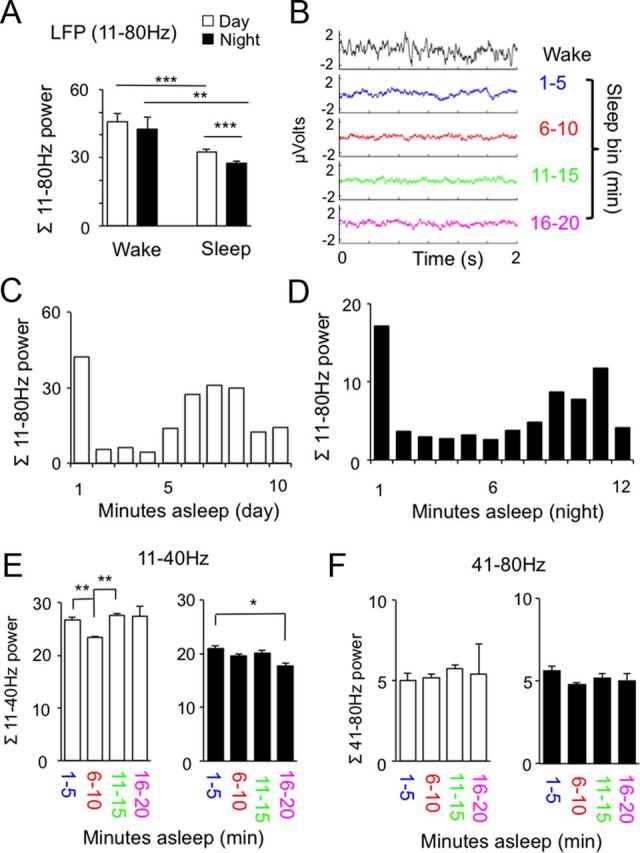
Changes in brain activity during fly sleep. A, Waking LFP activity (Σ 11–80 Hz power ± SEM) is significantly greater than sleeping LFP activity for day or night. Sleeping LFP activity is significantly greater during the day than during the night (all sleep epochs >5 min were combined, n = 13 female CS flies; ***p < 0.001, **p < 0.01 by Wilcoxon rank-sum test. B, Sample LFP activity taken at different times before and after initiation of a long sleep bout. Data are from the same fly taken from different 5 min epochs during one extended sleep bout (>20 min) at night. C, Summed 11–80 Hz LFP activity during a 10 min daytime sleep bout in a sample fly. D, Summed 11–80 Hz LFP activity during a 12 min nighttime sleep bout in a sample fly. E, Σ power (± SEM) for 11–40 Hz LFP activity for consecutive 5 min bins after sleep initiation during the day (white) and the night (black). *p < 0.05; **p < 0.01 by Wilcoxon rank-sum test. Time bins (minutes asleep) are color-coded as in B. Only long (11–20 min) sleep bouts were analyzed. F, Σ power (± SEM) for 41–80 Hz LFP activity for consecutive 5 min bins after sleep initiation during the day (white) and the night (black); same data as in E. Time bins (minutes asleep) are color coded as in B.