


Figure 8.
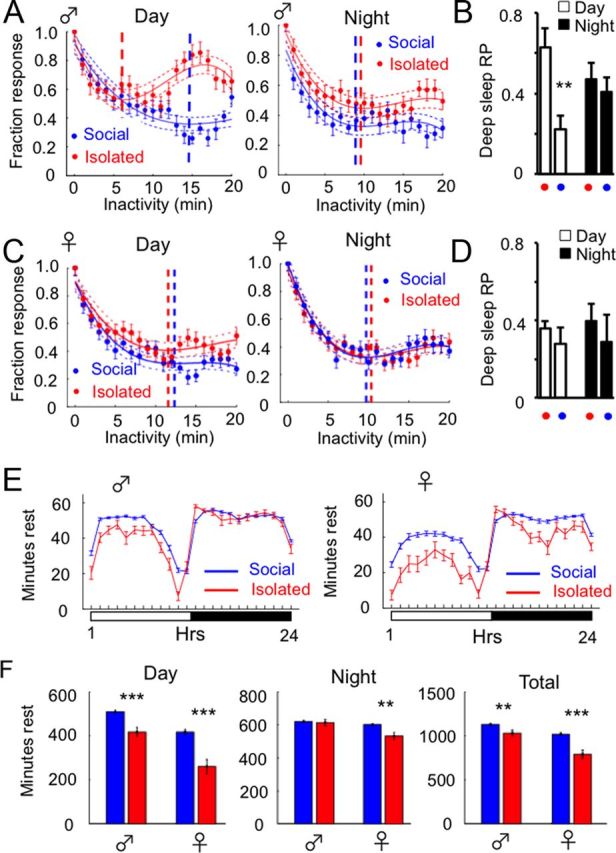
Effect of socialization on fly sleep intensity. A, B, Socialization increases deep sleep response probability (RP; ± SEM) in males during the day (blue, n = 51) compared with males kept in isolation (red, n = 51). **p < 0.05 by Wilcoxon rank-sum test. The vertical lines indicate the point of deepest sleep, from which deep sleep RP was calculated (see Materials and Methods). C, D, Socialization does not significantly change sleep intensity (deep sleep RP ± SEM) in females, day or night (blue, n = 51), compared with females kept in isolation (red, n = 51). E, Activity was measured using the DAMS (see Materials and Methods). Rest is defined as 5 min or longer without any detected activity in the DAMS, cumulative for every hour (± SEM, n = 32 flies per sex or condition). Socially reared adult flies (blue traces) are compared with 5- to 6-d-old flies that were isolated in plastic vials soon after eclosion (red traces) under the same conditions as in A–D. Flies are wild-type CS. F, Daytime and total sleep duration (± SEM) is decreased in both male and female flies that have been raised in isolation (red; socially reared flies are blue) and tracked by the DAMS system. Data are processed from flies in E. ***p < 0.001; **p < 0.01 by Wilcoxon rank-sum test.