



Abstract
Anti-CD79 antibodies have been effective at targeting B cell lymphoma cells and depleting B cells in animal models. In order to engineer recombinant antibodies with additional effector functions in mice, we cloned and sequenced the full-length cDNAs of the heavy and light chain of a hamster anti-mouse CD79B antibody. Although hamster antibodies represent a unique source of monoclonal antibodies against mouse, rat, and human antigens, sequence information of hamster immunoglobulins (IG) is sparse. Here we report a new hamster (Cricetulus migratorius) IG lambda constant (IGLC) gene region that is most homologous to mouse IGLC2 and IGLC3.
Keywords: hamster, CD79B, antibody, immunoglobulin light lambda, IMGT Collier de Perles
Antibodies have been indispensible tools for biomedical research and are currently the most rapidly growing class of human therapeutics (Carter, 2006). Generation of recombinant antibodies and engineered antibodies with additional properties has solved many limitations of the original hybridoma technology and made them even more versatile. However, the screening of hybridomas and cloning of antibody sequences from those hybridomas remains a critical and potentially time consuming step for these applications.
Hamsters are commonly used to generate monoclonal antibodies against other rodent and human antigens because hamsters are more evolutionarily distant to mouse and rat than the two are to each other and hamster spleen cells can fuse stably with mouse myeloma cells (Sanchez-Madrid et al., 1983). Unfortunately, sequence information for hamster immunoglobulin (IG) genes is sparse. Currently, there are limited hamster IgG DNA sequences available (Alegre et al., 1995; Collins and Whitters, 1995; Gilliland et al., 1996; Mallender and Voss, 1995; Verdino et al., 2011; Whitters and Collins, 1995). Of these, only two of the heavy (IGH) chain sequences are full-length sequences including the constant (C) region. Furthermore, the isotypes of hamster IgG are not well defined. For light chains, one kappa (IGK) chain and one lambda (IGL) chain have been identified. The cloning and sequencing of the hamster IG would be greatly facilitated if the constant region sequences of different heavy chain and light chains were available.
CD79A and CD79B associate with the IG, as coreceptors, and together they constitute the B cell receptor and are necessary for its expression and function (Lefranc and Lefranc, 2001; Wienands and Engels, 2001). Antibodies against human CD79, as well as those coupled to potent cytotoxic agents, are effective at killing human B cell lymphoma cells both in vitro and in mouse chimeras (Polson et al., 2007). Anti-mouse CD79 mAbs have also been shown to be effective in depleting B cells and at ameliorating autoimmune disease in MRL/lpr mice (Li et al., 2008). To engineer recombinant anti-CD79 antibodies with additional effector functions in mice, we have cloned and sequenced the full-length IG heavy and light chains of an Armenian hamster (Cricetulus migratorius) anti-mouse CD79B reagent antibody (clone HM79-16 or HM79b) (in the absence of genomic information this antibody is designated as IgG2,λ1 by the companies which distribute it) (Koyama et al., 1997). The heavy constant (IGHC) region sequence of HM79-16 is identical to that of hamster mAb H28.710 (Collins and Whitters, 1995), which showed highest homology to mouse IGHG2A. The lambda constant (IGLC) region of HM79-16 is different from the previously published hamster IGLC of HL4E10 (Verdino et al., 2011). Phylogenic analysis with known mammalian IGLC confirms that hamster genes are most related to rat/mouse in evolution. It also suggests that the HM79-16 IGLC is most likely the counterpart of mouse IGLC2 or IGLC3, whereas the HL4E10 IGLC is the counterpart of mouse IGLC1.
Most of the previously published sequences were obtained by screening cDNA libraries or designing degenerate primers from N-terminal protein sequences, both of which are labor intensive. One efficient way to clone cDNA sequences is to use the RACE (rapid amplification of cDNA ends) protocol (Frohman et al., 1988) when a partial sequence is known. In order to use this approach, we first attempted to amplify the constant regions of both the heavy and light chain of the hamster anti-mouse CD79B antibody (HM79-16). Primers were designed from conserved regions of available hamster C region sequences to amplify the cDNA of HM79-16. Successfully amplified fragments were sequenced and verified. From these partial sequences of the C region, nested primers were designed to amplify the 5′ or 3′ of the cDNA. Finally, full-length cDNA were assembled from partially overlapping sequences and verified with additional primers.
As shown in Fig. 1, the HM79-16 heavy chain comprises a 1422 base pair (bp) coding region with a 70 bp 5′UTR and a 94 bp 3′ UTR. It encodes a predicted 19 amino acid (AA) leader region (L-REGION) and a mature 454 AA protein. The variable (V) region is located from nucleotides (nt) 128–424, the junction (J) region from nt 425–476, and the constant region from nt 477–1492.
Fig. 1.

Nucleotide sequence and deduced translation of HM79-16 heavy chain. The predicted leader region cleavage site is indicated by “//”. The polyadenylation signal is underlined. Conserved amino acid cysteine 23 (1st-CYS) and cysteine 104 (2nd-CYS) are highlighted (Lefranc, 2011b; Lefranc et al., 2003; Lefranc et al., 2005). The full-length sequences have been deposited in GenBank (accession number KC294425).
IMGT/V-QUEST (Brochet et al., 2008; Giudicelli et al., 2011) was used to compare the HM79-16 variable and junction region to available human, mouse, and rat germline sequences. The HM79-16 IGHV is closest to mouse IGHV10-1*02, with an 84.3% identity at the nt level. The J region is closest to human IGHJ5*01, with an 80.4% identity at the nt level. Multiple sequence alignments of the HM79-16 IGHC with all mouse IGHG isotype regions demonstrate highest homology (79.0%) with mouse IGHG2. It should also be noted that the C region is identical to one previously published hamster C sequence (GenBank accession number U17166) (Collins and Whitters, 1995). HM79-16 IGHC is different from that of the HL4E10, which shows highest homology to mouse IGHG1*01. The V domains and C domains of HM79-16 and HL4E10 heavy chains are shown in Fig. 3 and Fig. 4, respectively.
Fig. 3.

IMGT protein displays for V domains of HM79-16 and HL4E10. VH and V-LAMDA sequences of HM79-16 (KC294425 and KC294424) and HL4E10 (HM369133 and HM369134) are aligned using IMGT/DomainGapAlign (Ehrenmann and Lefranc, 2011).
Fig. 4.

IMGT protein displays for C regions of HM79-16 and HL4E10. The heavy gamma C region comprises three domains (CH1, CH2, CH3), the hinge between CH1 and CH2, and the CHS (present at the C terminal end of a secreted chain). CH1, hinge, CH2, CH3, CHS of HM79-16 and HL4E10 are presented successively (top). The light lambda C region comprises a single C domain (C-LAMBDA). C-LAMBDA of HM79-16 (KC294424), HL4E10 (HM369134), and mouse IGLC1 (J00587), IGLC2 (J00595), IGLC3 (J00585) are shown (bottom). Sequences are aligned using IMGT/DomainGapAlign (Ehrenmann and Lefranc, 2011).
As shown in Fig. 2, the HM79-16 light chain sequence comprises a 720 bp coding region with a 59 bp 5′UTR and a 133 bp 3′UTR. It encodes a predicted 19 AA L-REGION and a mature 220 AA protein. The V region is located from nt 17–420, the J region from nt 421–461, and the C region from nt 462–779.
Fig. 2.

Nucleotide sequence and deduced translation of HM79-16 light chain. The predicted leader region cleavage site is indicated by “//”. The polyadenylation signal is underlined. Conserved amino acid cysteine 23 (1st-CYS) and cysteine 104 (2nd-CYS) are highlighted (Lefranc, 2011b; Lefranc et al., 2003; Lefranc et al., 2005). The full-length sequences have been deposited in GenBank (accession number KC294424).
The HM79-16 IGLV region is closest to human IGLV11-55*01, showing 73.5% identity at the nt level. The J region shows a similar identity of 79.4% to human IGLJ2*01, IGLJ3*01, and IGLJ3*02. The V domains of HM79-16 and HL4E10 light chains are shown in Fig. 3. The HM79-16 light chain constant region is different from previously published hamster light chain sequences (Verdino et al., 2011; Whitters and Collins, 1995). Therefore, we compared and analyzed this sequence in more detail.
Two isotypes of IG light chains, designated as kappa (IGK) and lambda (IGL), are found in most vertebrates (Lefranc and Lefranc, 2001; Lefranc and Lefranc, 2004). In mice and humans, IGK and IGL genes are located on separate chromosomes and are well characterized. Laboratory mice have three IGLV and three IGLC that are functional. Each IGLC gene has an associated upstream IGLJ gene, and the J and C genes are arranged in two clusters ((Lefranc and Lefranc, 2004), IMGT Repertoire, Locus representations, http://www.imgt.org). The IGLC regions of HM79-16 and previously published hamster and mouse sequences were compared in a pairwise manner. The result was summarized in Table 1. Regardless of species, the HM79-16 C region had much higher homology with IGLC (about 70–80%) than IGKC (about 40%) confirming that the C region of the HM79-16 light chain is encoded by an IGLC gene.
Table 1.
DNA sequence percent of identity of the IGLC regions
| Hamster | Mouse | ||||||
|---|---|---|---|---|---|---|---|
| HM79-16 | HL4E10 | H28.710 | IGLC1 | IGLC2 | IGLC3 | IGKC | |
| HM79-16 | 74.5 | 48.0 | 72.7 | 80.1 | 80.4 | 48.0 | |
| HL4E10 | 37.3 | 80.5 | 75.2 | 76.1 | 43.0 | ||
| H28.710 | 45.4 | 35.6 | 46.3 | 86.3 | |||
| IGLC1 | 73.2 | 84.4 | 46.7 | ||||
| IGLC2 | 96.4 | 46.2 | |||||
| IGLC3 | 44.7 | ||||||
DNA sequences of the IGLC regions of three hamster hybridomas (HM79-16, HL4E10, H28.710) and four mouse genes (IGLC1, IGLC2, IGLC3, IGKC) were compared in a pairwise manner. Each number in the table shows the percentage of identity between the nt sequences of the corresponding row and column.
In comparison to the recently identified hamster lambda light chain of HL4E10 (Verdino et al., 2011), the HM79-16 IGLC region shares 74.5 % identity, suggesting that it is encoded by a different IGLC gene. The IMGT Collier de Perles (Lefranc, 2011a) of the C-LAMDA for HM79-16 and HL4E10 is shown in Fig. 5. Of the three mouse IGLC genes, HM79-16 is most homologous to IGLC2 and IGLC3 (80.1% and 80.5%, respectively) (note that mouse IGLC2 and IGLC3 are 96% identical), whereas the HL4E10 IGLC shows best homology with IGLC1 (80.5%). Amino acid alignment of hamster and mouse IGLC genes also supports the same conclusion (Fig. 4). As shown in Fig. 6, phylogenetic analysis with the IGLC genes of other mammalian species including mouse, rat, rabbit and human showed that hamster sequences are most related to mouse and rat and are most distant from humans, which is consistent with the evolutionary relationship of these species.
Fig. 5.
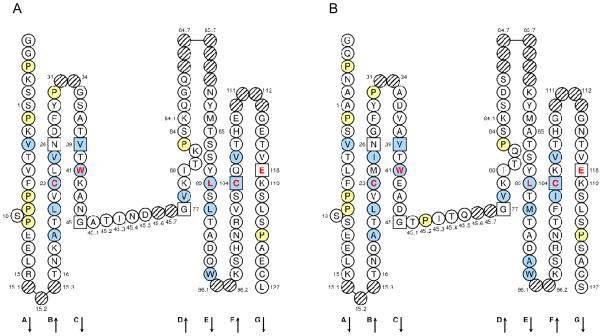
IMGT Collier de Perles of the C-LAMDA for HM79-16 (A) and HL4E10 (B). IMGT Colliers de Perles were obtained using the IMGT/Collier-de-Perles tool (Ehrenmann et al., 2011), accessed from IMGT/DomainGapAlign.
Fig. 6.

Phylogenetic tree of the IGLC regions of different species. The tree was generated by the neighbor-joining method using ClustalW2 program (Larkin et al., 2007). The bar (0.1) indicates the genetic distance. The IGLC regions of various species were obtained from IMGT®, the international ImMunoGeneTics information system® (http://www.imgt.org), IMGT/GENE-DB (Giudicelli et al., 2005; Lefranc et al., 2009). The name and accession numbers (in parentheses) are: human IGLC1 (J00252), IGLC2 (X06875), IGLC3 (J00254), IGLC6 (J03011), IGLC7 (X51755); mouse IGLC1 (J00587), IGLC2 (J00595), IGLC3 (J00585); rabbit IGLC1 (M12388), IGLC2 (M12761), IGLC3 (M12762), IGLC4 (M12763), IGLC5 (M23227), IGLC6 (M23229); Rat IGLC1 to 4 (AC111360). The standardized IMGT 6-letter abbreviations are used: Homsap (Homo sapiens, human), Musmus (Mus musculus, house mouse), Orycun (Oryctolagus cuniculus, rabbit), Ratnor (Rattus norvegicus, Norway rat), Crimig (Cricetulus migratorius, Armenian hamster).
In summary, we have cloned and determined the full-length cDNA sequences of a hamster anti-mouse CD79B antibody and have identified a new hamster IGLC gene. The cDNA sequences will be of great use for engineering recombinant anti-mouse CD79 antibodies. The identification of the new IGLC gene will help elucidate the immunogenetics of hamster IG genes and facilitate the cloning of other hamster antibodies.
Acknowledgments
We thank Dr. Robert Eisenberg for providing the HM79-16 hybridoma; and University of Chicago Comprehensive Cancer Center DNA Sequencing & Genotyping Facility for sequencing. This work was supported by NIH NIAID grant R01-AI087645 (H. Huang). Jason Perera was partially supported by NIH/NIAID Grant 2T32AI007090.
References
- Alegre ML, Tso JY, Sattar HA, Smith J, Desalle F, Cole M, Bluestone JA. An anti-murine CD3 monoclonal antibody with a low affinity for Fc gamma receptors suppresses transplantation responses while minimizing acute toxicity and immunogenicity. J Immunol. 1995;155:1544–1555. [PubMed] [Google Scholar]
- Brochet X, Lefranc MP, Giudicelli V. IMGT/V-QUEST: the highly customized and integrated system for IG and TR standardized V-J and V-D-J sequence analysis. Nucleic Acids Res. 2008;36:W503–8. doi: 10.1093/nar/gkn316. [DOI] [PMC free article] [PubMed] [Google Scholar]
- Carter PJ. Potent antibody therapeutics by design. Nat Rev Immunol. 2006;6:343–357. doi: 10.1038/nri1837. [DOI] [PubMed] [Google Scholar]
- Collins M, Whitters MJ. Hamster cDNA homologs to the mouse immunoglobulin IgG2 constant and Igh-VH10 genes. Immunogenetics. 1995;42:225–226. doi: 10.1007/BF00191230. [DOI] [PubMed] [Google Scholar]
- Ehrenmann FF, Lefranc MP. IMGT/DomainGapAlign: IMGT standardized analysis of amino acid sequences of variable, constant, and groove domains (IG, TR, MH, IgSF, MhSF) Cold Spring Harb Protoc. 2011;2011:737–749. doi: 10.1101/pdb.prot5636. [DOI] [PubMed] [Google Scholar]
- Ehrenmann F, Giudicelli V, Duroux P, Lefranc MP. IMGT/Collier de Perles: IMGT standardized representation of domains (IG, TR, and IgSF variable and constant domains, MH and MhSF groove domains) Cold Spring Harb Protoc. 2011;2011:726–736. doi: 10.1101/pdb.prot5635. [DOI] [PubMed] [Google Scholar]
- Frohman MA, Dush MK, Martin GR. Rapid production of full-length cDNAs from rare transcripts: amplification using a single gene-specific oligonucleotide primer. Proc Natl Acad Sci USA. 1988;85:8998–9002. doi: 10.1073/pnas.85.23.8998. [DOI] [PMC free article] [PubMed] [Google Scholar]
- Gilliland LK, Norris NA, Marquardt H, Tsu TT, Hayden MS, Neubauer MG, Yelton DE, Mittler RS, Ledbetter JA. Rapid and reliable cloning of antibody variable regions and generation of recombinant single chain antibody fragments. Tissue Antigens. 1996;47:1–20. doi: 10.1111/j.1399-0039.1996.tb02509.x. [DOI] [PubMed] [Google Scholar]
- Giudicelli VV, Brochet XX, Lefranc MP. IMGT/V-QUEST: IMGT standardized analysis of the immunoglobulin (IG) and T cell receptor (TR) nucleotide sequences. Cold Spring Harb Protoc. 2011;2011:695–715. doi: 10.1101/pdb.prot5633. [DOI] [PubMed] [Google Scholar]
- Giudicelli V, Chaume D, Lefranc MP. IMGT/GENE-DB: a comprehensive database for human and mouse immunoglobulin and T cell receptor genes. Nucleic Acids Res. 2005;33:D256–61. doi: 10.1093/nar/gki010. [DOI] [PMC free article] [PubMed] [Google Scholar]
- Koyama M, Ishihara K, Karasuyama H, Cordell JL, Iwamoto A, Nakamura T. CD79 alpha/CD79 beta heterodimers are expressed on pro-B cell surfaces without associated mu heavy chain. Int Immunol. 1997;9:1767–1772. doi: 10.1093/intimm/9.11.1767. [DOI] [PubMed] [Google Scholar]
- Larkin MA, Blackshields G, Brown NP, Chenna R, McGettigan PA, McWilliam H, Valentin F, Wallace IM, Wilm A, Lopez R, et al. Clustal W and Clustal X version 2.0. Bioinformatics. 2007;23:2947–2948. doi: 10.1093/bioinformatics/btm404. [DOI] [PubMed] [Google Scholar]
- Lefranc MP. IMGT Collier de Perles for the variable (V), constant (C), and groove (G) domains of IG, TR, MH, IgSF, and MhSF. Cold Spring Harb Protoc. 2011a;2011:643–651. doi: 10.1101/pdb.ip86. [DOI] [PubMed] [Google Scholar]
- Lefranc MP. IMGT unique numbering for the variable (V), constant (C), and groove (G) domains of IG, TR, MH, IgSF, and MhSF. Cold Spring Harb Protoc. 2011b;2011:633–642. doi: 10.1101/pdb.ip85. [DOI] [PubMed] [Google Scholar]
- Lefranc M-P, Lefranc G. The Immunoglobulin FactsBook. Academic Press; London, UK: 2001. pp. 1–458. [Google Scholar]
- Lefranc M-P, Lefranc G. Immunoglobulin Lambda (IGL) Genes of Human and Mouse. In: Honjo T, Alt FW, Neuberger MS, editors. Molecular Biology of B Cells. Academic Press; 2004. pp. 37–59. [Google Scholar]
- Lefranc MP, Giudicelli V, Ginestoux C, Jabado-Michaloud J, Folch G, Bellahcene F, Wu Y, Gemrot E, Brochet X, Lane J, et al. IMGT, the international ImMunoGeneTics information system. Nucleic Acids Res. 2009;37:D1006–12. doi: 10.1093/nar/gkn838. [DOI] [PMC free article] [PubMed] [Google Scholar]
- Lefranc MP, Pommié CC, Ruiz MM, Giudicelli VV, Foulquier EE, Truong LL, Thouvenin-Contet VV, Lefranc GG. IMGT unique numbering for immunoglobulin and T cell receptor variable domains and Ig superfamily V-like domains. Dev Comp Immunol. 2003;27:55–77. doi: 10.1016/s0145-305x(02)00039-3. [DOI] [PubMed] [Google Scholar]
- Lefranc MP, Pommié C, Kaas Q, Duprat E, Bosc N, Guiraudou D, Jean C, Ruiz M, Da Piédade I, Rouard M, et al. IMGT unique numbering for immunoglobulin and T cell receptor constant domains and Ig superfamily C-like domains. Dev Comp Immunol. 2005;29:19–19. doi: 10.1016/j.dci.2004.07.003. [DOI] [PubMed] [Google Scholar]
- Li Y, Chen F, Putt M, Koo YK, Madaio M, Cambier JC, Cohen PL, Eisenberg RA. B cell depletion with anti-CD79 mAbs ameliorates autoimmune disease in MRL/lpr mice. J Immunol. 2008;181:2961–2972. doi: 10.4049/jimmunol.181.5.2961. [DOI] [PMC free article] [PubMed] [Google Scholar]
- Mallender WD, Voss EW. Primary structures of three Armenian hamster monoclonal antibodies specific for idiotopes and metatopes of the monoclonal anti-fluorescein antibody 4-4-20. Mol Immunol. 1995;32:1093–1103. doi: 10.1016/0161-5890(95)00082-8. [DOI] [PubMed] [Google Scholar]
- Polson AG, Yu SF, Elkins K, Zheng B, Clark S, Ingle GS, Slaga DS, Giere L, Du C, Tan C, et al. Antibody-drug conjugates targeted to CD79 for the treatment of non-Hodgkin lymphoma. Blood. 2007;110:616–623. doi: 10.1182/blood-2007-01-066704. [DOI] [PubMed] [Google Scholar]
- Sanchez-Madrid F, Szklut P, Springer TA. Stable hamster-mouse hybridomas producing IgG and IgM hamster monoclonal antibodies of defined specificity. J Immunol. 1983;130:309–312. [PubMed] [Google Scholar]
- Verdino P, Witherden DA, Podshivalova K, Rieder SE, Havran WL, Wilson IA. cDNA Sequence and Fab Crystal Structure of HL4E10, a Hamster IgG Lambda Light Chain Antibody Stimulatory for γδ T Cells. PLoS ONE. 2011;6:e19828. doi: 10.1371/journal.pone.0019828. [DOI] [PMC free article] [PubMed] [Google Scholar]
- Whitters MJ, Collins M. Hamster cDNA homologs to the mouse immunoglobulin kappa constant and Igk-V 45.1 genes. Immunogenetics. 1995;42:227–228. doi: 10.1007/BF00191231. [DOI] [PubMed] [Google Scholar]
- Wienands J, Engels N. Multitasking of Ig-alpha and Ig-beta to regulate B cell antigen receptor function. International Reviews Of Immunology. 2001;20:679–696. doi: 10.3109/08830180109045585. [DOI] [PubMed] [Google Scholar]