


Figure 5.
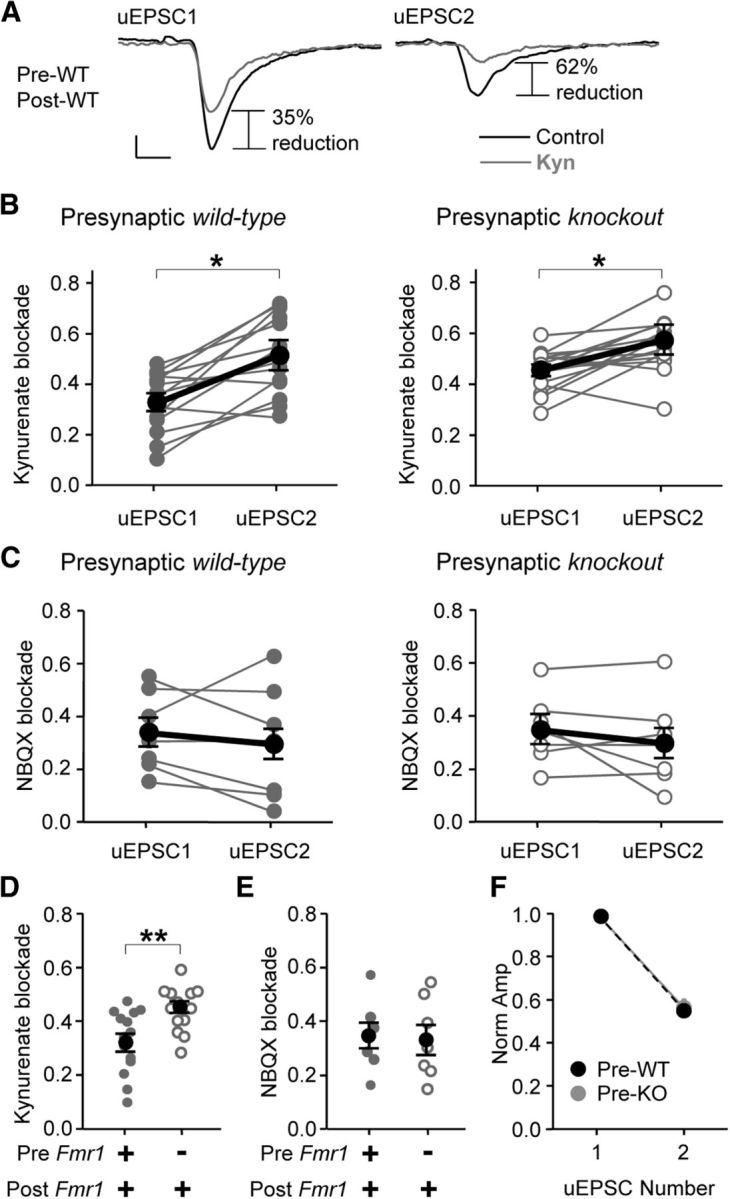
Presynaptic Fmr1 deletion causes reduced multivesicular release. A, Example average traces obtained from a WT/WT pair demonstrating the effect of the AMPAR competitive antagonist, kynurenate (Kyn, 250 μm). Note the greater blockade of uEPSC2 compared to blockade of uEPSC1, indicating multivesicular release. Calibration: 20 pA, 2 ms. B, Paired line plots showing Kyn blockade for uEPSC1 and uEPSC2 with presynaptic WT (left) and presynaptic KO expression (right). Dark lines indicate average data. C, Paired line plots showing blockade by the noncompetitive AMPAR antagonist NBQX (75 nm). NBQX had uniform affects across uEPSC number. D, Blockade by Kyn of uEPSC1 was greater with presynaptic KO, indicating less multivesicular release. E, Blockade by NBQX of uEPSC1 was not different with presynaptic KO. F, No change in short-term plasticity as observed by the average normalized uEPSC amplitude during the paired pulse train. *p < 0.05; **p < 0.01.