


Figure 4.
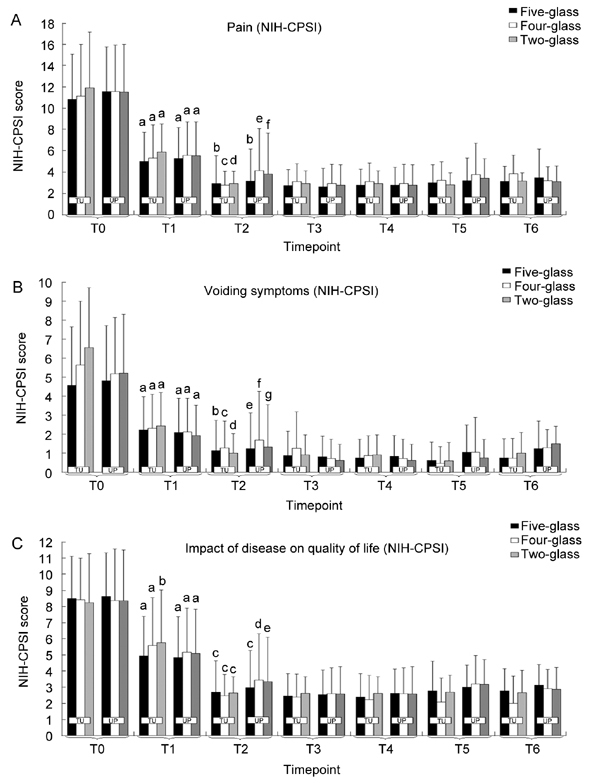
Pain, voiding, and life quality impact domains of the National Institutes of Health Chronic Prostatitis Symptom Index (NIH-CPSI) assessed in patients showing positive localizations of traditional uropathogens (TU) or unusual pathogens (UP) using the five-glass (black bars), four-glass (white bars), or two-glass (shaded bars) tests. Patients were subjected to one or two cycles of combination therapy with ciprofloxacin, azithromycin, alfuzosin, and S. repens. At T1 antibacterial agents were suspended and the remaining drugs were continued for a period of 6 months (T1–T2). The follow-up at the end of therapy was extended for 24 months (T6). (A): aP < 0.0001 vs.T0; bP < 0.001 vs. T1; cP = 0.00016 vs. T1; dP = 0.00019 vs. T1; eP = 0.091 vs. T1; fP = 0.07 vs. T1. Wilcoxon signed rank test. Intergroup differences at each time point: P > 0.1 (TU and UP together); P > 0.1 (TU only); P > 0.1 (UP only). Kruskal–Wallis test. (B): aP < 0.0001 vs. T0; bP < 0.0001 vs. T1; cP = 0.0008 vs. T1; dP = 0.004 vs. T1; eP = 0.0003 vs. T1; fP = 0.89 vs. T1; gP = 0.83 vs. T1. Wilcoxon signed rank test. Intergroup differences at each time point: P > 0.1 (TU and UP together); P > 0.1 (TU only); P > 0.1 (UP only). Kruskal–Wallis test. (C): aP < 0.0001 vs. T0; bP = 0.002 vs. T0; cP < 0.0001 vs. T1; dP = 0.004 vs. T1; eP = 0.009 vs. T1. Wilcoxon signed rank test. Intergroup differences at each time point: P > 0.1 (TU and UP together); P > 0.1 (TU only); P > 0.1 (UP only). Kruskal–Wallis test.