


Figure 3.
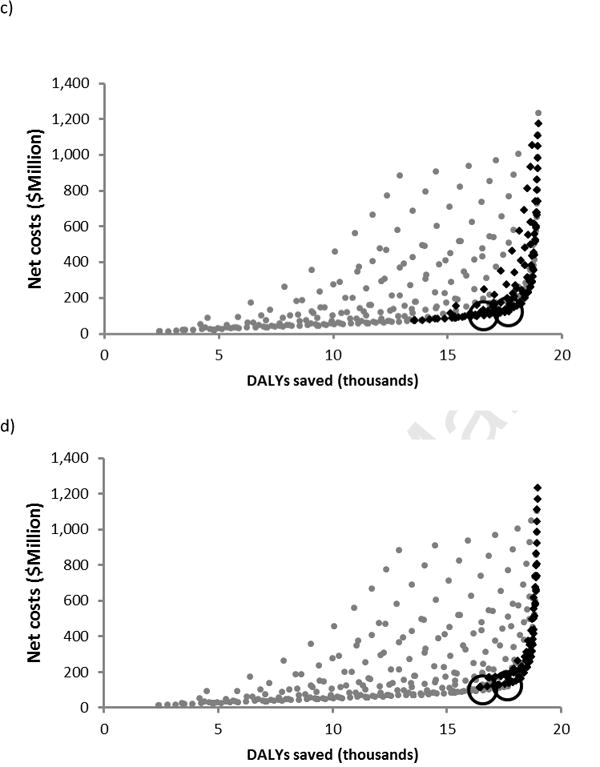
Preferred policies, having the highest probability of having the greatest net benefits, at 70% vaccine efficacy. a) Preferred policies, at a willingness-to-pay of US $36,000, as vaccination cost increases. b) Preferred policies with vaccination costs sampled uniformly from the range ($10, $300), as willingness-to-pay increases. Vertical dashed lines indicate the very cost-effective threshold (US $12,000) and the cost-effective threshold (US $36,000). Evaluated policies include progressively more extensive mass vaccination: 1) No vaccination, 2) 80% routine childhood coverage with no mass vaccination, 3) 80% routine childhood coverage with mass vaccination of 50% of 0–5 yr olds, 4) 80% routine childhood coverage with mass vaccination of 50% of 0–15 yr olds, 5) 80% routine childhood coverage with mass vaccination of 50% of 0–40 year olds, and 6) 80% routine childhood coverage with mass vaccination of 50% of the full population.