


Fig. 1.
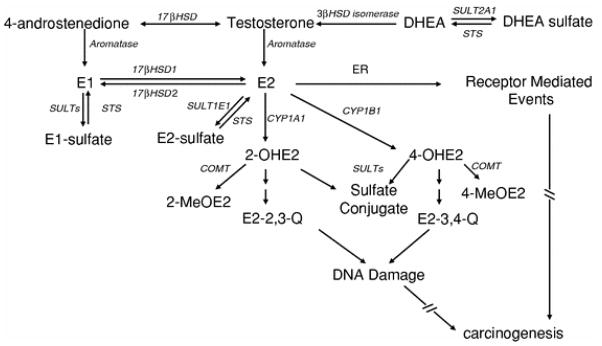
Pathways of estrogen metabolism, bioactivation, and action. CYP19 (aromatase) catalyzes the aromatization of androstenedione and testosterone to form estrone (E1) and 17β-estradiol (E2), which can bind to and activate estrogen receptor (ER). Of the cytosolic SULTs, SULT1E1 preferentially catalyzes the sulfation of E1 and E2 with high efficiency. Sulfated estrogens are ER-inactive. Steroid sulfatase (STS) catalyzes the deconjugation of sulfated steroids and favors the formation of biologically active estrogen. STS and 3-β-hydroxysteroid dehydrogenase (3βHSD isomerase) function in the formation of sex steroids from precursor hormones, such as dehydroepiandrosterone sulfate (DHEA sulfate), dehydroepiandrosterone (DHEA). 17βHSD1 reduces E1 to the more potent E2, while 17βHSD2 oxidizes E2 to E1. The 4-hydroxylation of E2 is catalyzed by CYP1B1; E2 2-hydroxylation is catalyzed by CYP1A1. Catecholestrogens auto-oxidize to form mutagenic orthoquinone electrophiles that can be detoxified via catechol-O-methyltransferase (COMT)-mediated conjugation