



Six months after his 2009 inauguration, U.S. President Obama spoke at Cairo University in Egypt and called for a new beginning in relations between the United States and Muslim-majority countries, defined by collaboration in science and technology (1). Innovation, according to the president, is the “currency of the 21st century” and the means by which the United States and its partners would create new jobs and tackle the global challenges of climate change, hunger, and disease. The Cairo speech remains a seminal moment in President Obama's broader initiative to ramp up U.S. cooperation in international science as a core component of his foreign policy agenda (2).
On the eve of the next U.S. presidential election, now is an opportune moment to evaluate whether the Obama Administration's record on promoting international science has fulfilled the promise of its early rhetoric. This question will be considered through the lenses of diplomacy, international development, and the operational requirements for scientific exchange. For this analysis, we, like the president, refer to international scientific cooperation in its broadest sense, including not only research but also capacity-building and the application of technological innovations to achieve global goals.
Diplomacy and International Development
Although U.S. science diplomacy dates back to the Cold War and détente, its use to promote international scientific collaboration has expanded under the Obama Administration (3). The U.S. Department of State enlisted eminent U.S. scientists, including Nobelist Ahmed Zewail and Bruce Alberts, editor-in-chief of Science, to serve as envoys to engage and collaborate with their counterparts in Africa, Asia, and the Middle East. The White House established high-level joint commissions on science and technology with Brazil, China, India, Japan, Russia, and South Korea. The U.S. Department of Energy launched a cofunded, $150 million United States–China Clean Energy Research Center to promote collaboration, protection of intellectual property, and advanced technology development. The Obama Administration founded networks of foreign-born U.S. researchers, engineers, and entrepreneurs to encourage collaboration and to promote the spread of scientific values, such as meritocracy and transparency, in their countries of origin (4). An expanded corps of Environment, Science and Technology, and Health officers at U.S. embassies supports these diplomatic initiatives.
The integration of science and foreign policy objectives under the Obama Administration, however, has not been seamless. The Central Intelligence Agency's use of a fake hepatitis B immunization campaign to identify Osama bin Laden's whereabouts sparked violence against World Health Organization workers and a ban on polio immunization in parts of Pakistan (5), threatening the same 24-year, nearly $10 billion polio eradication campaign on which President Obama proposed in Cairo that the United States and Muslim-majority countries should collaborate.
Obama Administration efforts to integrate science into its international development policies build on a long and distinguished history that includes expanding access to HIV/AIDS drugs, increasing global agriculture production through the Green Revolution, and reducing child mortality from cholera and diarrhea with oral rehydration therapy. Nonetheless, the current administration has distinguished itself in the degree to which it has promoted science and technology as the best means to achieve its development objectives (6). The U.S. Agency for International Development (USAID) hired its first Science and Technology Adviser since the 1980s, created the post of Chief Innovation Officer, and recruited dozens of scientists. In 2007, USAID had five Science and Technology Policy Fellows sponsored by the American Association for the Advancement of Science; today, it has 54 fellows, including 11 deployed overseas (7). USAID also instituted the Grand Challenges program, which leverages outside funding to support domestic and international research on U.S. development priorities, and the Development Innovation Ventures fund, which provides seed capital to high-risk, high-return development-friendly technologies (8, 9). The U.S. Department of Agriculture (USDA) participates in the USAID-led Feed the Future initiative and sought to orient its funding priorities toward research that would yield compound benefits for U.S. agriculture and global food security (10). Although these programs involve modest funds, they are an important foundation for future work.
Requirements for Scientific Exchange
In comparison with its progress on scientific diplomacy and international development, the Obama Administration yet had only modest success in facilitating the collaborations that account for the majority of cooperation between U.S. scientists and their foreign counterparts.
Most international science is self-organizing (11). Government-directed international research initiatives, such as ITER (formerly the International Thermonuclear Energy Reactor) and the Human Genome Project, are rare. Most U.S. government agencies, such as the National Science Foundation (NSF) and USDA, predominantly or exclusively fund U.S. researchers. Scientists pursue collaborations, international or otherwise, to share costs and access the best minds, equipment, and data. Improved information communication technologies and cheaper travel have made these collaborations easier. More than a third of the research papers produced globally now have coauthors from multiple countries, twice the share in 1990 (12). As emerging countries, such as China, dramatically increase their research and development (R&D) expenditures, international collaborations have become increasingly diverse geographically (13).
It is too soon to know whether these self-organizing international scientific collaborations have increased during the Obama Administration. The U.S. National Institutes of Health (NIH), NSF, and other U.S. government agencies that fund scientific research do not systematically track the international collaborators of their domestic grantees. Co-authored publications are a lagging indicator of international scientific cooperation, coming months or, more often, years after the collaboration formed.
It is not too early, however, to assess U.S. government policies on ensuring the operational requirements of international science: funding, quality data, and talent.
Since 2009, U.S. government R&D budgets under the Obama Administration, have remained stagnant or have declined, in the case of National Aeronautics and Space Administration (NASA), amid high unemployment and a poisonous political environment in the U.S. Congress. Reduced or stagnant R&D funding, of course, limits the opportunities for U.S. researchers to engage in international collaboration. The budgets of the few U.S. government agencies that fund international researchers directly have likewise flat-lined. For example, international research expenditures of the global-minded National Institute of Allergy and Infectious Diseases (NIAID) have remained roughly constant since 2008, after a fourfold increase over the prior decade (supplementary materials). USDA's International Science and Education program, which provided grants to U.S. researchers to engage in international collaboration, has been defunded (14). One exception is the USAID and NSF-supported Partnership for Enhanced Engagement in Research (PEER), which provides modest funding for non-U.S. researchers to work with U.S. counterparts on research on international development issues (15). Although small in scale, PEER represents an important departure from the Bush Administration, which did not, as a matter of policy, fund foreign researchers as part of its international scientific cooperation initiatives (16).
In comparison with the billions of dollars devoted through the U.S. President's Emergency Plan for AIDS Relief (PEPFAR) and the Feed the Future program to delivering treatment and sustenance to the world's poor, the Obama Administration has underinvested in the research capacity, regulatory oversight, and training that would enable developing country researchers to produce quality data, collaborate, and address their own health and development needs. Such investments would facilitate existing U.S. global health and development initiatives and encourage future research in these countries (17, 18). Modest seed funding would likewise help engage female scientists, underrepresented in international collaborations generally, in U.S. development initiatives on women and girls (19). The Medical Education Partnership Initiative, a new U.S. interagency program to support operational medical research and education in Africa, is a step in the right direction (20). The NSF Global Research Council, an initiative to promote the quality and compatibility of international research, likewise deserves support (21).
Cumbersome immigration processes and visa shortages continue to hinder the face-to-face interactions that scientists need to connect and collaborate. The Obama Administration streamlined the Mantis clearance process for U.S. visa applicants with experience working with nuclear, chemical, and biological materials, but it remains a challenge to U.S. conference attendees and organizers (22). Although F-1 student visas have increased nearly 25% since 2009, the number of H-1B work visas available for scientists, programmers, and engineers has remained stuck at 65,000 since 2004 (23). Restricting the ability of foreign-born scientists and engineers to travel to and work in the United States undermines continued U.S. scientific leadership. It also deprives the United States of its greatest ambassadors: the living testimonials to the research and economic opportunities that America provides.
A Work in Progress
Four years after being elected, the Obama Administration's initiative on international scientific collaboration remains a work in progress. According to the Pew Global Attitudes Project, approval of the United States has declined in Muslim-majority countries since 2009, from 25 to 15%, with U.S. drone attacks and the unresolved Israeli-Palestinian conflict among the cited reasons (24). Meanwhile, admiration of U.S. scientific and technological prowess in these countries has remained high (24). Building on the international respect for American science to create good will toward U.S. policies is smart. Investing in the immigration reforms, international research, and capacity-building that would help ensure that the best scientific minds come together to address the biggest global challenges is even smarter. Both are laudable goals for a future administration.
Supplementary Material
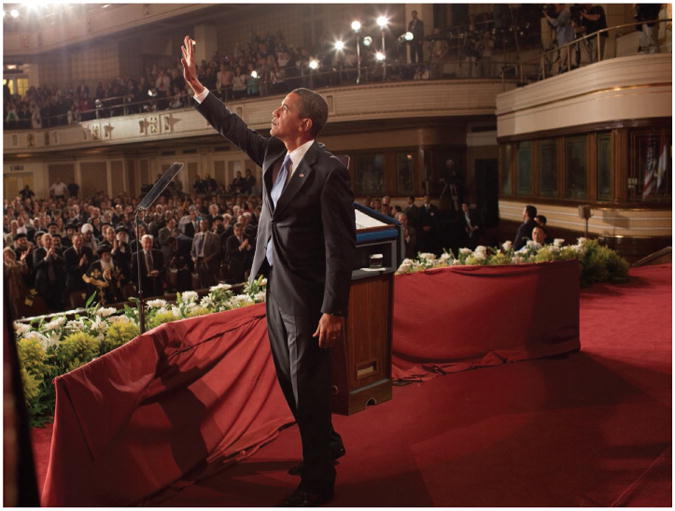
President Obama speaks at Cairo University.
In his speech, he promoted international science cooperation to create new jobs, tackle global challenges, and provide a basis for a new beginning between the United States and Muslim-majority countries.
Footnotes
References and Notes
- 1.Obama BH. Remarks by the President on a New Beginning. Cairo University; Cairo, Egypt: Jun 4, 2009. [Google Scholar]
- 2.Obama BH. Remarks by the President at the National Academy of Sciences Annual Meeting. 2009 Apr 27; [Google Scholar]
- 3.Hormats RD. Sci Diplomacy. 2012 Mar;no. 2 [Google Scholar]
- 4.Office of the Spokesman, U.S. Department of State. Department of State Announces Two New Science Outreach Platforms. 2012 Jul 26; www.state.gov/r/pa/prs/ps/2012/07/195525.htm.
- 5.Levine O, Garrett L. The fallout from the CIA's vaccination ploy in Pakistan. Washington Post; Jul 15, 2011. [Google Scholar]
- 6.Shah R. remarks for Conference on science, technology, and innovation in development, USAID; Washington, DC. 13 to 14 July 2010. [Google Scholar]
- 7.Shah R. Remarks by USAID Administrator Rajiv Shah at the University of Michigan. 2012 Sep 28; [Google Scholar]
- 8.USAID, Grand Challenges for Development. 2012 www.usaid.gov/grandchallenges/
- 9.USAID, Development Innovation Ventures. 2012 www.usaid.gov/what-we-do/science-technolog-and-innovation/development-innovation-ventures.
- 10.National Institute of Food and Agriculture, U.S. Department of Agriculture (USDA) Global Engagement: NIFA and Feed the Future. 2012 www.csrees.usda.gov/nea/international/in_focus/intl_if_feed_future.html.
- 11.Wagner C. The New Invisible College: Science for Development. Brookings Institution Press; Washington, DC: 2008. [Google Scholar]
- 12.The Royal Society. Knowledge, Networks, and Nations: Global Scientific Collaboration in the 21st Century. The Royal Society; London: 2011. [Google Scholar]
- 13.National Science Board. National Science and Engineering Indicators 2012. National Science Foundation; Arlington: 2012. [Google Scholar]
- 14.USDA. Grants: International Science and Education (ISE) Competitive Grants Program. 2011 http://nifa.usda.gov/fo/internationalscienceandeducation.cfm.
- 15.USAID. USAID and the National Science Foundation expand PEER Global Researcher Program to new countries and development challenges. 2012 Sep 11; www.usaid.gov/news-information/press-releases/usaid-and-national-science-foundation-nsf-expand-peer-global.
- 16.Stine DD. Science, Technology, and American Diplomacy: Background and Issues for Congress. Congressional Research Service; Washington, DC: 2009. [Google Scholar]
- 17.Bollyky TJ. Safer, Faster, Cheaper: Improving Clinical Trials and Regulatory Pathways to Fight Neglected Diseases: Report of Center for Global Development Working Group on Clinical Trials and Regulatory Pathways. Center for Global Development; Washington, DC: 2011. [Google Scholar]
- 18.Bollyky TJ. Intellectual Property Rights and Climate Change: Principles for Innovation and Access to Low-Carbon Technology. Center for Global Development; Washington, DC: 2009. [Google Scholar]
- 19.Frehill LM, Vlaicu S, Zippel K. paper presented at International Workshop on International Scientific Collaborations; Arlington, VA. 23 October 2010; http://nuweb.neu.edu/zippel/nsf-workshop/docs/NSF_PI_Study_ Oct23_2010.pdf. [Google Scholar]
- 20.Collins F, et al. Science. 2010;330:1324. doi: 10.1126/science.1199930. [DOI] [PMC free article] [PubMed] [Google Scholar]
- 21.Suresh S. Science. 2012;336:959. doi: 10.1126/science.1224580. [DOI] [PubMed] [Google Scholar]
- 22.Johnson VC. A Visa and Immigration Policy for the Brain-Circulation Era. National Association of Foreign Student Advisers; Washington, DC: 2009. [Google Scholar]
- 23.U.S. Citizenship and Immigration Services. H-1B Specialty Occupations, DOD Cooperative Research and Development Project Workers, and Fashion Models. 2012 www.uscis.gov.
- 24.Global Attitudes Project, Pew Research Center. Global Opinion of Obama Slips, International Policies Faulted. Pew Research Center; Washington, DC: 2012. [Google Scholar]
Associated Data
This section collects any data citations, data availability statements, or supplementary materials included in this article.