



Abstract
Solubility data were measured for omeprazole sulfide in ethanol, 95 mass-% ethanol, ethyl acetate, isopropanol, methanol, acetone, n-butanol and n-propanol in the temperature range from 280.35 to 319.65 K by employing the gravimetric method. The solubilities increase with temperature and they are in good agreement with the calculated solubility of the modified Apelblat equation and the λh equation. The experimental solubility and correlation equation in this work can be used as essential data and model in the purification process of omeprazole sulfide. The thermodynamic properties of the solution process, including the Gibbs energy, enthalpy, and entropy were calculated using the van’t Hoff equation.
Keywords: Omeprazole sulfide, Solubility, Gravimetric method, Purification, Solution thermodynamics
Introduction
Omeprazole sulfide, an amorphous colorless or white powder, is odorless and stable in air. Omeprazole sulfide (C17H19N3O2S, FW 329.42, CAS Registry No. 73590-85-9, structure shown in Fig. 1) is a degradation product of omeprazole. It has been reported to be an antagonist for AHR in HepG2 cells [1] and it acts as an agonist for AHR in human hepatocytes [2]. AHR is aryl hydrocarbon receptor, a mediated transactivation receptor-type transcription factor. Omeprazole sulfide is also an important intermediate in pharmaceuticals. It is usually used to synthesize omeprazole and esomeprazole, which are used in the treatment of gastric acid related disorders [3–5] and are effective in the control of gastric acidity of patients with Zollinger–Ellison syndrome, as well as in patients that do not respond well to histamine H2 receptor antagonists [3, 6]. In addition, gastrointestinal (GI) diseases account for substantial morbidity, mortality, and cost [7], which leads to the increased demand for the related drugs, such as omeprazole capsules, omeprazole enteric-coated tablets, esomeprazole sodium for injection, and esomeprazole magnesium enteric-coated tablets. It results in great demand for this key intermediate.
Fig. 1.
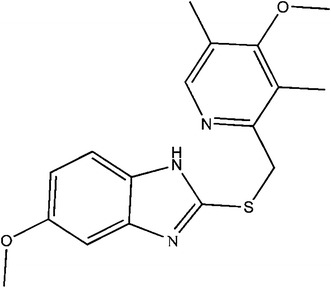
Chemical structure of omeprazole sulfide
Omeprazole sulfide is synthesized using 2-mercapto-5-methoxybenzene imidazole and 2-chloromethyl-4-methoxy-3,5-lutidine [8] or 4-methoxy-3,5-dimethyl-2-pyridine-methyl bromide [9] as substrate. It should be purified by dissolution, crystallization and separation. Crystallization processes are the critical steps that determine the quality of the product [10] of omeprazole sulfide to provide sufficient purity for the next reaction. So it is very important to know the solubility of omeprazole sulfide as a function of temperature and solvent composition in selected solvents required for the preparation and purification of the products [11]. Moreover, no literature study has reported the correlation between the solubility and temperature or the solvent composition. The most basic information for solving the solvent selection problem is the basic physical properties and solubility data [12]. Therefore we measured and correlated the solubility data of omeprazole sulfide in different solvents (ethanol, 95 mass-% ethanol, ethyl acetate, isopropanol, methanol, acetone, n-butanol and n-propanol) over the temperature range 280.35–319.65 K under atmospheric pressure by the gravimetric method [13, 14]. Thus, systematic and necessary information on the crystallization of omeprazole sulfide was obtained. For predicting the solubility of a solute in different solvents, several methods have been presented [11, 15]. This study used the modified Apelblat equation and the Buchowski–Ksiazaczak λh equation to correlate and predict the solubility of omeprazole sulfide in different solvents.
Experimental
Materials
A white crystalline powder of omeprazole sulfide was supplied by Shanghai Lingfeng Chemical Reagent Co., China. The mass fraction was higher than 0.995, measured by high performance liquid chromatography (HPLC type DIONEX P680 DIONEX Technologies). The melting temperature was 392.15 K determined by differential scanning calorimeter (Netzsch DSC 204). The ethanol, ethyl acetate, isopropanol, methanol, acetone, n-butanol and n-propanol used for experiment were all analytical purity grade with mass fraction purity higher than 0.995 except for 95 % ethanol. They were supplied by Shanghai Shenbo Chemical Co., Ltd. and used without further purification.
Methods
The solubility of omeprazole sulfide was determined by a gravimetric method. The balance used in these experiments was an analytical balance with an uncertainty of ±0.0001 g (Sartorius, BS210S). 8 mL of solvent and a rotor were put into a 10 mL glass test tube with stopper, and then excess omeprazole sulfide was added into the glass test tube [16]. The test tubes were partly immersed in a constant-temperature bath. The temperature was controlled by a jacketed vessel with water circulated through the outer jacket from a super thermostatic water-circulator bath (type DC-2006 Ningbo XinYi Biotechnology Co., Ltd.). Meanwhile, the inner chamber of the vessel needs a mercury-in-glass thermometer with an uncertainty of ±0.05 K (calibrated by using a standard thermometer) for measuring the solution equilibrium temperature. Continuous stirring was adopted for fully mixing the suspension with a magnetic stirrer at each temperature [17].
In order to make sure that the solution system established the solid–liquid equilibrium, a stirring time of 12 h was provided, and then the solution was kept still about 3 h to ensure a dynamic balance was established between the dissolution and the crystallization processes. Then, about 1 mL of supernatant was taken from the test tube and transferred to a previously weighed 5 mL sampling vial using a pre-warmed pipette [17, 18] carefully and quickly. Subsequently, the mass of the sample was determined by weighing the sampling vial again. Then the sampling vial was put into a dryer to dry at room temperature. Afterwards the sampling vial was weighed on a regular basis until it reached a constant weight. Each experiment was repeated at least twice to check the repeatability of the solubility determination, and three samples were taken for each solvent at each temperature [19] and the mean value was considered as the solubility. The saturated mole fraction solubility (x) is obtained from the following equation:
| 1 |
where m 1 represents the mass of solute and m 2 the mass of solvents. M 1 is the molecular mass of solute and M 2 that of the solvent.
Results and Discussion
Solubility Data and Correlation Models
The saturated mole fraction solubility (x) and the calculated solubility values (x c) of omeprazole sulfide in ethanol, 95 % ethanol, ethyl acetate, isopropanol, methanol, acetone, n-butanol and n-propanol in the temperature range from 280.35 to 319.65 K are presented in Table 1.
Table 1.
The saturated mole fraction solubility (x) and the calculated solubility values (x c) by Eqs. 2 and 3 of omeprazole sulfide, in different solvents at the temperature range from 280.35 to 319.65 K
| T/K | x | Equation 2 | Equation 3 | ||
|---|---|---|---|---|---|
| x c | 100RD | x c | 100RD | ||
| Ethanol | |||||
| 280.35 | 0.0144 | 0.0148 | −2.438 | 0.0142 | 1.507 |
| 284.35 | 0.0189 | 0.0193 | −2.103 | 0.0189 | 0.264 |
| 288.15 | 0.0248 | 0.0247 | 0.415 | 0.0244 | 1.615 |
| 292.25 | 0.0323 | 0.0319 | 1.145 | 0.0318 | 1.490 |
| 296.65 | 0.0412 | 0.0417 | −1.199 | 0.0418 | −1.417 |
| 300.25 | 0.0511 | 0.0514 | −0.734 | 0.0517 | −1.183 |
| 303.15 | 0.0606 | 0.0606 | −0.164 | 0.0610 | −0.670 |
| 307.65 | 0.0775 | 0.0776 | −0.145 | 0.0780 | −0.569 |
| 311.15 | 0.0946 | 0.0934 | 1.269 | 0.0937 | 1.018 |
| 315.15 | 0.1151 | 0.1145 | 0.576 | 0.1145 | 0.571 |
| 319.65 | 0.1415 | 0.1424 | −0.685 | 0.1420 | −0.398 |
| 95 mass-% Ethanol | |||||
| 280.35 | 0.0101 | 0.0103 | −1.912 | 0.0100 | 0.680 |
| 284.35 | 0.0137 | 0.0138 | −0.882 | 0.0136 | 0.570 |
| 288.15 | 0.0178 | 0.0181 | −1.881 | 0.0180 | −1.194 |
| 292.25 | 0.0240 | 0.0240 | −0.307 | 0.0240 | −0.180 |
| 296.65 | 0.0325 | 0.0323 | 0.861 | 0.0323 | 0.673 |
| 300.25 | 0.0409 | 0.0407 | 0.503 | 0.0408 | 0.224 |
| 303.15 | 0.0489 | 0.0489 | −0.043 | 0.0490 | −0.315 |
| 307.65 | 0.0641 | 0.0643 | −0.213 | 0.0644 | −0.379 |
| 311.15 | 0.0791 | 0.0789 | 0.309 | 0.0789 | 0.259 |
| 315.15 | 0.0989 | 0.0989 | −0.002 | 0.0988 | 0.053 |
| 319.65 | 0.1258 | 0.1260 | −0.101 | 0.1259 | −0.037 |
| Ethyl acetate | |||||
| 280.35 | 0.0033 | 0.0032 | 2.293 | 0.0033 | −0.852 |
| 284.35 | 0.0040 | 0.0040 | 2.238 | 0.0040 | 0.389 |
| 288.15 | 0.0049 | 0.0048 | 1.478 | 0.0048 | 0.561 |
| 292.25 | 0.0058 | 0.0059 | −1.126 | 0.0059 | −1.314 |
| 296.65 | 0.0073 | 0.0073 | 0.522 | 0.0072 | 0.839 |
| 300.25 | 0.0085 | 0.0086 | −1.649 | 0.0086 | −1.107 |
| 303.15 | 0.0098 | 0.0099 | −0.273 | 0.0098 | 0.321 |
| 307.65 | 0.0122 | 0.0121 | 0.723 | 0.0120 | 1.233 |
| 311.15 | 0.0142 | 0.0142 | 0.586 | 0.0141 | 0.915 |
| 315.15 | 0.0165 | 0.0169 | −2.217 | 0.0169 | −2.192 |
| 319.65 | 0.0208 | 0.0206 | 1.074 | 0.0207 | 0.669 |
| Isopropanol | |||||
| 280.35 | 0.0032 | 0.0033 | −2.520 | 0.0031 | 2.624 |
| 284.35 | 0.0044 | 0.0045 | −2.152 | 0.0043 | 1.309 |
| 288.15 | 0.0058 | 0.0059 | −1.943 | 0.0058 | 0.218 |
| 292.25 | 0.0079 | 0.0080 | −1.311 | 0.0079 | −0.251 |
| 296.65 | 0.0108 | 0.0110 | −1.907 | 0.0109 | −1.683 |
| 300.25 | 0.0140 | 0.0141 | −0.475 | 0.0141 | −0.698 |
| 303.15 | 0.0172 | 0.0171 | 0.870 | 0.0172 | 0.439 |
| 307.65 | 0.0234 | 0.0230 | 1.764 | 0.0231 | 1.240 |
| 311.15 | 0.0286 | 0.0287 | −0.405 | 0.0289 | −0.842 |
| 315.15 | 0.0370 | 0.0369 | 0.363 | 0.0369 | 0.204 |
| 319.65 | 0.0482 | 0.0484 | −0.361 | 0.0482 | −0.039 |
| Methanol | |||||
| 280.35 | 0.0127 | 0.0135 | −5.842 | 0.0125 | 2.056 |
| 284.35 | 0.0178 | 0.0183 | −2.814 | 0.0175 | 1.973 |
| 288.15 | 0.0239 | 0.0242 | −1.458 | 0.0236 | 1.161 |
| 292.25 | 0.0322 | 0.0325 | −0.975 | 0.0322 | −0.012 |
| 296.65 | 0.0442 | 0.0440 | 0.444 | 0.0441 | 0.293 |
| 300.25 | 0.0559 | 0.0558 | 0.078 | 0.0562 | −0.550 |
| 303.15 | 0.0668 | 0.0673 | −0.629 | 0.0678 | −1.411 |
| 307.65 | 0.0887 | 0.0888 | −0.080 | 0.0894 | −0.768 |
| 311.15 | 0.1103 | 0.1091 | 1.052 | 0.1096 | 0.627 |
| 315.15 | 0.1380 | 0.1367 | 0.974 | 0.1367 | 0.940 |
| 319.65 | 0.1721 | 0.1735 | −0.862 | 0.1728 | −0.446 |
| Acetone | |||||
| 280.35 | 0.0050 | 0.0050 | 0.325 | 0.0051 | −0.425 |
| 284.35 | 0.0065 | 0.0065 | 0.257 | 0.0066 | −0.238 |
| 288.15 | 0.0083 | 0.0083 | 0.405 | 0.0083 | 0.108 |
| 292.25 | 0.0108 | 0.0107 | 0.908 | 0.0107 | 0.779 |
| 296.65 | 0.0140 | 0.0140 | 0.339 | 0.0140 | 0.337 |
| 300.25 | 0.0172 | 0.0172 | −0.102 | 0.0172 | −0.035 |
| 303.15 | 0.0203 | 0.0204 | −1.543 | 0.0203 | −1.444 |
| 307.65 | 0.0263 | 0.0262 | 0.335 | 0.0262 | 0.445 |
| 311.15 | 0.0319 | 0.0317 | 0.746 | 0.0317 | 0.832 |
| 315.15 | 0.0390 | 0.0392 | −0.639 | 0.0392 | −0.611 |
| 319.65 | 0.0496 | 0.0495 | 0.181 | 0.0495 | 0.103 |
| n-Butanol | |||||
| 280.35 | 0.0103 | 0.0100 | 2.607 | 0.0102 | 0.882 |
| 284.35 | 0.0134 | 0.0131 | 1.640 | 0.0133 | 0.337 |
| 288.15 | 0.0171 | 0.0169 | 0.958 | 0.0171 | 0.045 |
| 292.25 | 0.0218 | 0.0220 | −0.809 | 0.0221 | −1.334 |
| 296.65 | 0.0292 | 0.0289 | 1.078 | 0.0289 | 0.928 |
| 300.25 | 0.0356 | 0.0359 | −0.641 | 0.0358 | −0.550 |
| 303.15 | 0.0425 | 0.0425 | −0.140 | 0.0424 | 0.094 |
| 307.65 | 0.0549 | 0.0549 | −0.054 | 0.0547 | 0.291 |
| 311.15 | 0.0661 | 0.0666 | −0.655 | 0.0663 | −0.334 |
| 315.15 | 0.0824 | 0.0823 | 0.061 | 0.0822 | 0.204 |
| 319.65 | 0.1039 | 0.1037 | 0.225 | 0.1039 | −0.052 |
| n-Propanol | |||||
| 280.35 | 0.0076 | 0.0077 | −1.845 | 0.0076 | −0.541 |
| 284.35 | 0.0101 | 0.0103 | −1.479 | 0.0102 | −0.767 |
| 288.15 | 0.0134 | 0.0134 | −0.416 | 0.0134 | −0.106 |
| 292.25 | 0.0178 | 0.0177 | 0.657 | 0.0177 | 0.690 |
| 296.65 | 0.0234 | 0.0236 | −0.837 | 0.0236 | −0.954 |
| 300.25 | 0.0296 | 0.0297 | −0.158 | 0.0297 | −0.310 |
| 303.15 | 0.0359 | 0.0355 | 1.109 | 0.0356 | 0.972 |
| 307.65 | 0.0470 | 0.0466 | 0.827 | 0.0466 | 0.755 |
| 311.15 | 0.0567 | 0.0571 | −0.600 | 0.0571 | −0.611 |
| 315.15 | 0.0713 | 0.0715 | −0.361 | 0.0715 | −0.323 |
| 319.65 | 0.0914 | 0.0913 | 0.154 | 0.0913 | 0.173 |
The relationship between temperature and mole fraction solubility in different solvents is described by the modified Apelblat equation, which is a semiempirical equation derived from the Clausius–Clapeyron equation [20, 21], which is as follows:
| 2 |
where T represents the absolute temperature, A, B and C are the model parameters, and x is the mole fraction solubility of omeprazole sulfide. The constants A and B represent the variation in the solution activity coefficient and provide an indication of the effect of non-ideal solution behavior on the solute solubility, while the constant C reflects the temperature influence on the enthalpy of fusion [22]. The adjustable parameters A, B and C can be obtained by fitting the experimental solubility data.
The Buchowski–Ksiazaczak λh equation is an alternate way to describe solid–liquid equilibrium behavior of omeprazole sulfide, as first proposed by Buchowski et al. [23]. The experimental data for many systems can be well represented by the Buchowski–Ksiazaczak λh equation with only two parameters λ and h [24–27]. In this paper, the solubility data were also correlated with the Buchowski–Ksiazaczak λh equation:
| 3 |
where T represents the system temperature, T m is the melting point temperature of omeprazole sulfide in Kelvin, x is the mole fraction solubility of omeprazole sulfide and λ and h are the model parameters determined by the experimental data in the system.
Using the values in Table 1, the parameters of A, B and C were estimated and presented in Table 2, and the parameters of λ and h are listed in Table 3, together with the root-mean-square deviations (RMSDs) and the relative average deviations (RADs).
Table 2.
Parameters of Eq. 2 for mole fraction solubility of omeprazole sulfide in various solvents
| Solvent | A | B | C | 102 RMSD | 102 RAD |
|---|---|---|---|---|---|
| Ethanol | 169.713 | −12176.733 | −23.160 | 1.082 | 0.973 |
| 95 % Ethanol | 100.445 | −9611.497 | −12.564 | 0.521 | 0.408 |
| Ethyl acetate | −105.237 | 932.180 | 17.069 | 1.069 | 0.945 |
| Isopropanol | 121.765 | −10949.042 | −15.700 | 1.149 | 0.868 |
| Methanol | 290.941 | −18217.582 | −40.870 | 1.125 | 0.930 |
| Acetone | −0.480 | −4587.603 | 2.051 | 0.627 | 0.487 |
| n-Butanol | 31.893 | −6080.526 | −2.624 | 0.610 | 0.459 |
| n-Propanol | 86.751 | −8848.671 | −10.657 | 0.632 | 0.564 |
Table 3.
Parameters of Eq. 3 for mole fraction solubility of omeprazole sulfide in various solvents
| Solvent | λ | h | 102 RMSD | 102 RAD |
|---|---|---|---|---|
| Ethanol | 3.582 | 1504.278 | 1.217 | 0.988 |
| 95 % Ethanol | 4.097 | 1447.915 | 0.918 | 0.639 |
| Ethyl acetate | 0.202 | 20201.853 | 1.469 | 1.289 |
| Isopropanol | 1.770 | 3496.429 | 1.496 | 1.279 |
| Methanol | 7.224 | 853.657 | 2.100 | 1.382 |
| Acetone | 1.012 | 5153.445 | 0.659 | 0.525 |
| n-Butanol | 2.614 | 2091.202 | 1.093 | 0.806 |
| n-Propanol | 2.703 | 2129.557 | 0.922 | 0.767 |
The RMSD is defined as follows:
| 4 |
The RAD is defined as follows:
| 5 |
where N is the number of experimental points obtained in each set, which equals the number of temperatures used, x c represents the calculated solubility values and x e the experimental solubilities.
The relative deviations (RDs) between the experimental values and the calculated values are also presented in Table 1. The RDs are given as:
| 6 |
where x c represents the calculated solubilities and x e the experimental values.
The x/T curves of omeprazole sulfide, measured in all the solvents studied, are presented in Fig. 2. As we can see from Fig. 2, all the solubility curves are similar, with low solubilities at low temperature, which increase at higher temperatures [28]. The solubility is a function of temperature and increases with increasing temperature. From Fig. 2, it can be seen that the solubility of omeprazole sulfide is relatively low in acetone, isopropanol and ethyl acetate at all temperatures. The solubility in ethyl acetate has the smallest percentage change, while the solubility in acetone is substantially the same as in isopropanol. As for the other five solvents, the solubilities are more sensitive to temperature, especially methanol in which the solubility varies much more obviously with temperature, ethanol and 95 % ethanol. So methanol, ethanol and 95 % ethanol can be used to recrystallize omeprazole sulfide. However, in industrial production, taking the safety and cost into account, ethanol or 95 % ethanol presents a potential advantage in the crystallization process of omeprazole sulfide.
Fig. 2.
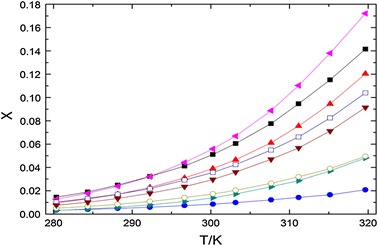
Solubilities of omeprazole sulfide in different solvents at atmospheric pressure. Left pointing filled triangle methanol, filled square ethanol, filled triangle 95 % ethanol, open square n-butanol, inverted triangle n-propanol, open circle acetone, right pointing filled triangle isopropanol, filled circle ethyl acetate. Solid lines calculated using Eq. 2
As we all know, methanol, ethanol, propanol and butanol are protic solvents that have a hydrogen atom bound to an oxygen (in a hydroxyl group). The molecules of such solvents can readily donate protons and interact with solute molecules by hydrogen bonding. The hydrogen bonds could increase the solubility of the solute. This may be the reason that the solubility is relatively high in methanol, ethanol, 95 % ethanol, n-butanol and n-propanol. The solubility in methanol and ethanol is higher than that in n-propanol and n-butanol. This phenomenon can be explained by the fact that when the alcohol chain length increases, the hydrogen bonds with alcohols are weakened [29]. However, the solubility in isopropanol is relatively low, perhaps because the hydroxy of the isopropanol molecules is located between two CH3 groups, which hinder the interaction of the H and N atoms. The solubility of omeprazole sulfide is lower in 95 % ethanol than in ethanol. The reason may be that the sulfide compounds are practically insoluble in water.
As can be seen from Tables 1, 2 and 3, the calculated data of omeprazole sulfide in a total of eight solvents show good agreement with the experimental data. For the modified Apelblat equation, as we can see from Tables 1 and 2, the RADs are 0.97, 0.41, 0.95, 0.87, 0.93, 0.49, 0.46 and 0.56 %, respectively and the absolute values of RDs do not exceed 2.6 %, which indicates that all the solubility data can be calculated in the selected solvents when the modified Apelblat equation is used. The same is true for analyzing the solubility data and the parameters that fitted the λh equation. Furthermore, from Tables 2 and 3, all the solubilities are calculated with reasonable RMSD and the average RMSDs are 0.85 and 1.2, for the modified Apelblat and Buchwski–Ksiazaczak λh equations respectively. Therefore the regression result of the modified Apelblat equation is more accurate than the Buchowski–Ksiazaczak λh equation. Compared to the Buchowski–Ksiazaczak λh equation, the modified Apelblat equation is proposed for solid–liquid equilibria, and it is widely accepted as being capable of dealing with solvent systems. Therefore, the measured solubility data and the correlation equation in this work can be applied to the design and optimization for the extraction and purification process of omeprazole sulfide [19].
Thermodynamic Properties for the Solution
The temperature dependence of the solubility allows a thermodynamic analysis that permits insight into the molecular mechanisms involved in the solution processes [30]. In this study, the thermodynamic functions in the process of solution of omeprazole sulfide are calculated on the basis of the solubility of omeprazole sulfide in different solvents. The standard molar enthalpy of solution is accessible from this equation, which is the van’t Hoff analysis and defined as [30–32]:
| 7 |
where x 1 is the mole fraction solubility, R represents the universal gas constant (8.314 J·K−1·mol−1) and T is the absolute temperature. The standard molar enthalpy change of solution, , is generally obtained from the slope of the solubility curve in a so-called van’t Hoff plot where ln x is plotted against T −1. Over a limited temperature interval, the heat capacity change of a solution may be assumed to be constant, hence the derived values of will also be valid for the mean temperature, T mean = 300 K [33]. Equation 7 can also be written as:
| 8 |
The ln x versus (1/T − 1/T mean) curves of omeprazole sulfide in the eight solvents are shown in Fig. 3.
Fig. 3.

Mole fraction solubility (ln x) of omeprazole sulfide in different solvents against 104 (1/T − 1/T mean) with a straight line to correlate the data. Left pointing filled triangle methanol, filled square ethanol, filled circle 95 % ethanol, diamond n-butanol, open square n-propanol, right pointing filled triangle acetone, inverted triangle isopropanol, filled triangle ethyl acetate
The standard molar Gibbs energy of solution can be calculated according to [34]:
| 9 |
where the intercept used is that obtained in plots of lnx versus (1/T − 1/T mean). The standard molar entropy of solution is obtained from [30]:
| 10 |
The results of the standard Gibbs energy, enthalpy, and entropy of solution are shown in Table 4, together with ξ H and ξ TS. The ξ H and ξ TS represent the comparison of the relative contributions to the standard Gibbs energy by enthalpy and entropy in the solution process, respectively [35].
| 11 |
| 12 |
Table 4.
Thermodynamic functions relative to solution process of omeprazole sulfide in solvents at mean temperature
| (kJ·mol−1) | (kJ·mol−1) | (J·K−1·mol−1) | |||
|---|---|---|---|---|---|
| Ethanol | 43.401 | 7.483 | 119.770 | 54.717 | 45.283 |
| 95 % Ethanol | 48.085 | 8.191 | 133.031 | 54.655 | 45.345 |
| Ethyl acetate | 34.744 | 11.876 | 76.255 | 60.307 | 39.693 |
| Isopropanol | 51.695 | 10.718 | 136.640 | 55.783 | 44.217 |
| Methanol | 49.457 | 7.315 | 140.528 | 53.993 | 46.007 |
| Acetone | 43.286 | 10.170 | 110.427 | 56.656 | 43.344 |
| n-Butanol | 43.956 | 8.357 | 118.708 | 55.252 | 44.748 |
| n-Propanol | 47.175 | 8.846 | 127.811 | 55.173 | 44.827 |
The conclusion can be drawn from Table 4 that the enthalpy and the standard Gibbs energy of solution of omeprazole sulfide are positive in the eight solvents, indicating the solution process of omeprazole sulfide in a total of eight solvents is endothermic. Moreover, the main contributor to the standard molar Gibbs energy of solution is the enthalpy during the dissolution, because the values of % ξ H are ≥54 %.
Conclusions
The solubility of omeprazole sulfide in a total of eight solvents has been measured from 280.35 to 319.65 K by a dependable experimental method and simple solubility apparatus. For all solvents, solubility is a function of temperature and increases with increasing temperature, but to each increment of temperature they responded with a definite change of solubility. The experimental data were fitted by using the modified Apelblat equation and λh equations and the Apelblat equation is more accurate than the λh equation for this system. The calculated solubility of omeprazole sulfide shows good agreement with the experimental values, and experimental solubility data from this work can be used for designing a purification process of omeprazole sulfide. The thermodynamic properties for the solution process including Gibbs energy, enthalpy, and entropy were obtained by the van’t Hoff analysis. The thermodynamic parameters values show that the solution process of omeprazole sulfide in a total of eight solvents is endothermic and the larger contributor to the standard molar Gibbs energy of solution is the enthalpy change during the dissolution.
Acknowledgments
This experimental work was financially supported by the Natural Science Foundation of the Agricultural Science and Technology Project of JiangSu Province (Grant No. CX (12) 3063, No. CX (12) 3060), the Jiangsu Higher Education Institutions of China (Major projects) (Grant No. 12KJA180002), the College Industrialization Project of Jiangsu Province (Grant No. JHB2011-16), and the Science and Technology support program of JiangSu Province (Agriculture) (Grant No. BE2012373, BE2012374).
References
- 1.Yoshinari K, Ueda R, Kusano K, Yoshimura T, Nagata K, Yamazoe Y. Omeprazole transactivates human CYP1A1 and CYP1A2 expression through the common regulatory region containing multiple xenobiotic-responsive elements. Biochem. Pharm. 2008;76:139–145. doi: 10.1016/j.bcp.2008.04.005. [DOI] [PubMed] [Google Scholar]
- 2.Chaloin SG, Garcia LP, Fabre JM, Cunha AS, Poellinger L, Maurel P, Chavanieu MD. Role of CYP3A4 in the regulation of the aryl hydrocarbon receptor by omeprazole sulphide. Cell Signal. 2006;18:740–750. doi: 10.1016/j.cellsig.2005.07.007. [DOI] [PubMed] [Google Scholar]
- 3.González HM, Romero EM, de Chavez TJ, Peregrina AA, Quezada V, Hoyo-Vadillo C. Phenotype of CYP2C19 and CYP3A4 by determination of omeprazole and its two main metabolites in plasma using liquid chromatography with liquid–liquid extraction. J. Chromatogr. B. 2002;780:459–465. doi: 10.1016/S1570-0232(02)00573-1. [DOI] [PubMed] [Google Scholar]
- 4.Walan A. Clinical experience with omeprazole: assessment of efficacy and safety. Gastroenterol. Hepatol. 1989;4:27–33. [PubMed] [Google Scholar]
- 5.Fellenius E, Berglind T, Sachs O, Olbe L, Elander B, Sjostrand SE, Wollmark B. Substituted benzimidazoles inhibit gastric acid secretion by blocking (H+ + K+) ATPase. Nature. 1981;290:159–161. doi: 10.1038/290159a0. [DOI] [PubMed] [Google Scholar]
- 6.Landry HD, Wilde MI. Omeprazole: a review of its use in helicobacter pylori infection, gastro-oesophageal reflux disease and peptic ulcers induced by nonsteroidal anti-inflammatory drugs. Drugs. 1998;56:447–486. doi: 10.2165/00003495-199856030-00012. [DOI] [PubMed] [Google Scholar]
- 7.Peery AF, Dellon ES, Lund J, Crockett SD, McGowan CE, Bulsiewicz WJ, Gangarosa LM, Thiny MT, Stizenberg K, Morgan DR, Ringel Y, Kim HP, DiBonaventura MD, Carroll CF, Allen JK, Cook SF, Sandler RS, Kappelman MD, Shaheen NJ. Burden of gastrointestinal disease in the United States: 2012 Update. Gastroenterology. 2012;143:1179–1187. doi: 10.1053/j.gastro.2012.08.002. [DOI] [PMC free article] [PubMed] [Google Scholar]
- 8.Brandstrom, A. E., Lamm, B. R.: Processes for the preparation of omeprazole and intermediates thereof. US Patent: 4620008 (1986)
- 9.Joseph KM, Sanchez IL. Synthesis of benzyl bromides with hexabromoacetone: an alternative path to drug intermediates. Tetrahedron Lett. 2011;52:13–16. doi: 10.1016/j.tetlet.2010.10.133. [DOI] [Google Scholar]
- 10.Yang WG, Hu YH, Chen ZG, Jiang XM, Wang JK, Wang RR. Solubility of itaconic acid in different organic solvents: experimental measurement and thermodynamic modeling. Fluid Phase Equilib. 2012;314:180–184. doi: 10.1016/j.fluid.2011.09.027. [DOI] [Google Scholar]
- 11.Jiang RY, Wang LS. Solubilities of hexaphenoxycyclotriphosphazene and tri(2-cyanoethyl)phosphine in selected solvents: measurement and correlation. J. Solution Chem. 2012;41:2107–2122. doi: 10.1007/s10953-012-9930-4. [DOI] [Google Scholar]
- 12.Zhao Y, Wang YL. Measurement and correlation of solubility of tetracycline hydro–chloride in six organic solvents. J. Chem. Thermodyn. 2013;57:9–13. doi: 10.1016/j.jct.2012.08.007. [DOI] [Google Scholar]
- 13.Yang HY, Rasmuson AC. Solubility of butyl paraben in methanol, ethanol, propanol, ethyl acetate, acetone, and acetonitrile. J. Chem. Eng. Data. 2010;55:5091–5093. doi: 10.1021/je1006289. [DOI] [Google Scholar]
- 14.Zheng YL, Liu XS, Luan LJ, Wang LH, Wu YJ. Solubility of physalin D in ethanol, methanol, propanone, trichloromethane, ethyl ethanoate, and water at temperatures from 283.2 to 313.2 K. J. Chem. Eng. Data. 2010;55:3690–3692. doi: 10.1021/je100227k. [DOI] [Google Scholar]
- 15.Wang ZZ, Dang LP. Measurement of solubility of erythromycin acetone solvate in aqueous acetone solution between 298 and 323 K. Fluid Phase Equilib. 2009;276:94–98. doi: 10.1016/j.fluid.2008.10.016. [DOI] [Google Scholar]
- 16.Brandani S, Brandani V, Flammi D. Solubility of trioxane in water. J. Chem. Eng. Data. 1994;39:201–202. doi: 10.1021/je00014a001. [DOI] [Google Scholar]
- 17.Hu YH, Jiang XM, Yang WG, Chen ZG, Meng XQ, Shen F. Solubility of erythritol in different aqueous solvent mixtures. J. Mol. Liq. 2012;169:74–79. doi: 10.1016/j.molliq.2012.02.017. [DOI] [Google Scholar]
- 18.Jiang Q, Gao GH, Yu YX, Qin Y. Solubility of sodium dimethyl isophthalate-5-sulfonate in water and in water + methanol containing sodium sulfate. J. Chem. Eng. Data. 2000;45:292–294. doi: 10.1021/je990167b. [DOI] [Google Scholar]
- 19.Fan JP, Xie YL, Tian ZY, Xu R, Qin Y, Li L, Zhu JH. Solubilities of evodiamine in twelve organic solvents from T = 283.2 to 323.2 K. J. Chem. Thermodyn. 2013;58:288–291. doi: 10.1016/j.jct.2012.11.021. [DOI] [Google Scholar]
- 20.Jia YX, Qian C, Chen XZ, He CH. Solubilities of 3-methoxy-N-phenylaniline and 3-(methylthio)-N-phenylaniline in five organic solvents (285 to 333.75 K) J. Chem. Eng. Data. 2012;57:1581–1585. doi: 10.1021/je3001816. [DOI] [Google Scholar]
- 21.Zhang J, Hu JW, Wang JL, Chen LZ. Solubility of 1,3,3-trinitroazetidine in ethanol + water systems from 293.15 to 323.15 K. J. Solution Chem. 2011;40:703–708. doi: 10.1007/s10953-011-9673-7. [DOI] [Google Scholar]
- 22.Heryanto R, Hasan M, Abdullah EC, Kumoro AC. Solubility of stearic acid in various organic solvents and its prediction using non-ideal solution models. Sci. Asia. 2007;33:469–472. doi: 10.2306/scienceasia1513-1874.2007.33.469. [DOI] [Google Scholar]
- 23.Buchowski H, Ksiazczak A, Pietrzyk K. Solvent activity along a saturation line and solubility of hydrogen-bonding solids. J. Phys. Chem. 1980;84:975–979. doi: 10.1021/j100446a008. [DOI] [Google Scholar]
- 24.Ksiazczak A, Kosinski JJ. Vapour pressure of binary, three-phase (S-L-V) systems and solubility. Fluid Phase Equilib. 1988;44:211–219. doi: 10.1016/0378-3812(88)80112-2. [DOI] [Google Scholar]
- 25.Ksiazczak A, Moorthi K, Nagata I. Solid–solid transition and solubility of even n-alkanes. Fluid Phase Equilib. 1994;95:15–29. doi: 10.1016/0378-3812(94)80058-8. [DOI] [Google Scholar]
- 26.Bao Y, Wang JK, Wang YL, Qi Z. The Measurement and correlation of solubility of spectinomycin dihydrochloride in pure water and acetone–water mixture. J. Chem. Eng. Chin. Univ. 2003;17:457–461. [Google Scholar]
- 27.Ma PS, Chen MM. Solid–liquid equilibrium of terephthalic acid in several solvents. Chin. J. Chem. Eng. 2003;11:334–337. [Google Scholar]
- 28.Chen FX, Zhao MR, Ren BZ, Zhou CR, Peng FF. Solubility of diosgenin in different solvents. J. Chem. Thermodyn. 2012;47:341–346. doi: 10.1016/j.jct.2011.11.009. [DOI] [Google Scholar]
- 29.Lim J, Jang S, Cho HK, Shin MS, Kim H. Solubility of salicylic acid in pure alcohols at different temperatures. J. Chem. Thermodyn. 2013;57:295–300. doi: 10.1016/j.jct.2012.09.006. [DOI] [Google Scholar]
- 30.Wang S, Qin LY, Zhou ZM, Wang JD. Solubility and solution thermodynamics of betaine in different pure solvents and binary mixtures. J. Chem. Eng. Data. 2012;57:2128–2135. doi: 10.1021/je2011659. [DOI] [Google Scholar]
- 31.Wei DW, Li H, Li YN, Zhu J. Effect of temperature on the solubility of 3-aminopyridine in binary ethanol + toluene solvent mixtures. Fluid Phase Equilib. 2012;316:132–134. doi: 10.1016/j.fluid.2011.11.023. [DOI] [Google Scholar]
- 32.Maher A, Croker D, Rasmuson AC, Hodnett BK. Solubility of form III piracetam in a range of solvents. J. Chem. Eng. Data. 2010;55:5314–5318. doi: 10.1021/je1003934. [DOI] [Google Scholar]
- 33.Ruidiaz MA, Delgado DR, Martínez F, Marcus Y. Solubility and preferential solvation of indomethacin in 1,4-dioxane + water solvent mixtures. Fluid Phase Equilib. 2010;299:259–265. doi: 10.1016/j.fluid.2010.09.027. [DOI] [Google Scholar]
- 34.Zhou XQ, Fan JS, Li N, Du ZX, Ying HJ, Wu JL, Xiong J, Bai JX. Solubility of l-phenylalanine in water and different binary mixtures from 288.15 to 318.15 K. Fluid Phase Equilib. 2012;316:26–33. doi: 10.1016/j.fluid.2011.08.029. [DOI] [Google Scholar]
- 35.Azar VP, Ahmadian S, Martínez F, Acree WE, Jr, Jouyban A. Thermodynamic studies of fluphenazine decanoate solubility in PEG 200 + water mixtures. Fluid Phase Equilib. 2012;330:36–43. doi: 10.1016/j.fluid.2012.06.005. [DOI] [Google Scholar]