



Introduction
Plantar fasciitis, the most common cause of heel pain, affects 10% of the general population.1 It may be due to injury at the origin of the plantar fascia, or biomechanical abnormalities of the foot.2,3 Plantar fasciitis is also called heel spur syndrome, but heel spur is also present in 27% of asymptomatic patients.1 Thus, a heel spur is not a pre-requisite for diagnosis of plantar fasciitis.
Conventional treatment options include massage, stretching,4 weight loss, night splints, motion control shoes, physical therapy, cold therapy, local ultrasound, orthotics, non-steroidal anti-inflammatory drugs (NSAIDs), local corticosteroids, and surgery in refractory cases. Surgery is unsuccessful in 2–35% of patients.5
Extracorporeal shock wave therapy (ESWT) is a non-invasive option for pain relief. Originally developed to dissolve kidney stones,6 this procedure involves shock-waves being directed from outside the body onto the affected areas. Extracorporeal shock wave therapy is thought to provide analgesia and stimulate the healing process by removal of inflammatory debris and promotion of neovascularisation. It has been recommended as a treatment for chronic plantar fasciitis in patients unresponsive to conservative treatment.7-11
Patients undergoing lithotripsy reported other unrelated aches and pains disappearing. Scientists began to consider that shock-waves may have an effect to heal other tissues. Specialised machines were developed to treat conditions involving areas where major connective tissues attach to bone. The type of shock-wave therapy used is optimised in terms of number of shots, frequency, and pressure. Main objective of this study is to determine the benefit of ESWT on patient reported measures of function, pain, patient satisfaction, level of improvement, and return to play.
Materials and method
We performed an analytical study on a group of 25 patients with heel pain from chronic plantar fasciitis. Extracorporeal shock-wave therapy was applied in five sittings on alternate days (1,000 pulses, energy 1.8 bar and 21 Hz frequency using a Storz D-Actor 200 ESWT unit). Endpoints were changes in the visual analogue scale (VAS) score and the modified Roles and Maudsley (RM) score from baseline to four weeks follow-up.
Of the 25 patients included in this study nine (36%) patients were males and remaining 16 (64%) were females ranging from 30 years to 70 years of age. The average interval between onset of symptoms and ESWT application was 214 days. Extra- corporeal shock wave therapy was given using ultrasound gel between the applicator and the skin at the point of the most intense pain. The energy flux density was 0.16 mJ/mm2 (2.5 bar). All the patients were treated with 1,000 shock waves in five sessions on every alternate day.
All patients completed a VAS in which 0 mm was no pain and 10 mm the worst imaginable pain, before each session and four weeks after the last. Modified RM scores were also completed before each session and four weeks after the last session. The 25 patients who completed five ESWT sessions were evaluated and considered for the statistical analysis of early results (Fig. 1).
Fig. 1.
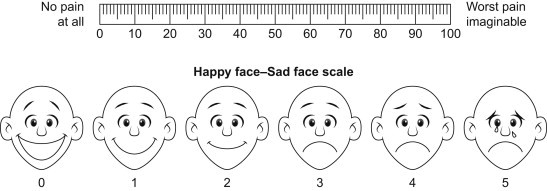
The visual analogue scale.
The inclusion criteria were: Heel pain for at least six months and those with at least three other types of treatments without relief.
Contraindications for this procedure include: Bony abnormalities of knee or ankle, neurologic abnormalities, previous surgery on the heel, age under 18 years, pregnancy, local infections, tumours, vascular diseases of the foot, rupture of the plantar fascia, pregnancy, metal implants, and anti-coagulant therapy.
Descriptive statistics were used to examine the distribution for all key variables. Additional analyses included cross tabulation and correlations of key variables to further understand the data. Statistical analysis software version 9.1 was used for all analyses.
Results
Of the 25 patients identified for inclusion in the study, all returned the survey (100%). Twenty-three patients (92%) reported moderate to high satisfaction with ESWT.
Of those patients, 22 reported high satisfaction. For those patients, the percentage of improvement in heel pain was 96.4% (SD = 6.16) with an average pain rating of 0.77 (SD = 1.10) after the procedure, which is highly significant (P < 0.0001).
The mean pre-treatment VAS for the entire group was 9.2 ± 0.7. Four weeks after treatment the VAS decreased to 3.4 ± 1.9. This difference was statistically significant (P < .05) (Fig. 2).
Fig. 2.
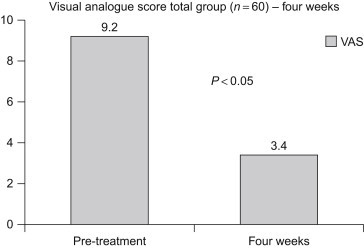
Pre- and post-treatment visual analogue scale (VAS).
Pre-treatment all patients rated the condition of the affected heel as ‘4’ (poor) in the subjective four point RM scale. Four weeks post-treatment, 18 (72%) heels were rated as ‘1’ (excellent), 4 (16%) as ‘2’ (good), and 1 (4%) as ‘3’ (fair), and 2 (8%) as ‘4’ (poor or unchanged).
Eighteen patients (72%) were able to discontinue comfort maintenance (i.e. stretching, icing, hot fomentation, etc., P < 0.0001) after ESWT. For those patients, improvement in heel pain was 95.8% with an average pain rating of 0.67 (SD = 1.19) after the procedure (P < 0.0001). For the remaining seven patients who continued maintenance, the improvement in heel pain was 79.7% with an average pain rating of 2.07 (SD = 2.77) (Table 1).
Table 1.
Roles and Maudsley score.
| Four weeks post-treatment (%) | |
|---|---|
| Excellent | 18 (72) |
| Good | 4 (16) |
| Fair | 1 (4) |
| Poor | 2 (8) |
Of the 23 patients (92%) who reported better functioning after ESWT, improvement in heel pain was 91.09%.
Discussion
Plantar fasciitis occurs as a result of repetitive microtrauma at the origin of the medial tuberosity of the calcaneus; traction forces during support lead to an inflammatory process that results in fibrosis and degeneration.12 Heel spurs and nerve entrapment (medial calcaneal, lateral plantar or fifth-finger abductor) can be associated with the inflammatory process.13
Women are affected more often than men. Plantar fasciitis is associated with obesity and the climacterium.14
In the present study, patients were more frequently females (81%), mostly overweight (87%), and their mean age was 47.3 ± 10.3 years. The occurrence of plantar fasciitis is related to activities that require support of body weight.15 Most patients in the present study (63%) had standing duties, thus indicating the importance of mechanical factors in this disease. Morning pain, an important evaluation criteria, was reported by 85% of the patients, gait pain by 72% and orthostatic pain by 78%; these findings are similar to those in other reports.
Extracorporeal shock wave therapy protocols vary from trial to trial. The different delivery modes of shock waves—single treatment vs multiple treatments, low-energy shock waves vs high-energy shock waves, electrohydraulic vs electromagnetic methods of shock wave generation—can influence the outcome of therapy. Therefore, the results reported in a study are only valid for the parameters applied in that study.
The results from this study add to the growing number of favourable reports that substantiate the efficacy of ESWT in treating chronic plantar fasciitis. Mean VAS and RM scores were statistically improved at four weeks following treatment. In the present study, all patients quantified their morning pain as greater than or equal to nine on the VAS before treatment. After treatment average VAS was < 4, thus suggesting that ESWT is an effective treatment for plantar fasciitis. There were no significant complications and none of the patients required additional shock wave treatment or any other treatment modality. Subjectively, patients were very satisfied with the procedure.
Rompe et al16 demonstrated similar findings.In their cohort of 45 running athletes with chronic plantar fasciitis treated with low-energy shock wave therapy, VAS decreased from an average of 6.9 to 2.1, 24 weeks after treatment and from 6.9 to 1.5, one year after treatment. Chen et al17 reported on 80 patients treated with high-energy shock wave therapy for chronic plantar fasciitis. At 24 weeks follow-up, 86% were either symptomatic or significantly improved.
Another study of 47 patients found 80% of patients experienced complete or nearly complete pain relief at six months post-treatment.18 Comparison of low-energy ESWT versus sham therapy showed that ESWT appears to be a supplement for the treatment of chronic Achilles tendinopathy.19
Even long-term studies have demonstrated 80% satisfactory results in their cohort of patients with 94% patients with complete or nearly complete resolution of pain.20 Using very rigid criteria to determine efficacy of shock wave therapy patients met all four outcome criteria to be considered a success. Twelve weeks later 76% of treated patients were satisfied with their outcome.21
Our results are in accordance with previous studies, which suggest that ESWT is an effective treatment modality for plantar fasciitis. Ninety-two percent of patients are pain free with five sittings of ESWT and at four weeks follow-up. However a longer follow-up would be needed to confirm its long-term efficacy.
Conclusion
The results reveal significant beneficial effects of ESWT in patients with chronic plantar fasciitis. The only significant side effect appears to be an increase in local pain levels during administration of the shots which subside within 30 minutes. The study is also significant as all the patients in the study had undergone at least three conventional treatment modalities earlier with minimal relief. This procedure can be an excellent treatment option when conventional options fail or may be used as a first line therapy in patients where timely relief is important like sportspersons and soldiers. Further prospective work is underway to better define this emerging technology.
Conflicts of interest
None identified.
References
- 1.De Maio M., Paine R., Mangine R.E., Drez D. Plantar fasciitis. Orthopedics. 1993;16:1153–1163. doi: 10.3928/0147-7447-19931001-13. [PubMed] [DOI] [PubMed] [Google Scholar]
- 2.Kuhns J.C. Changes in elastic adipose tissue. J Bone Joint Surg (Am) 1949;31:541–548. [PubMed] [Google Scholar]
- 3.Gill L.H. Plantar fasciitis: diagnosis and conservative management. J Am Acad Orthop Surg. 1997;5:109–117. doi: 10.5435/00124635-199703000-00006. [PubMed] [DOI] [PubMed] [Google Scholar]
- 4.Carlson R.E., Fleming L.L., Hutton W.C. The biomechanical relationship between the tendoachilles, plantar fascia and metatarsophalangeal joint dorsiflexion angle. Foot & Ankle International/American Orthopaedic Foot and Ankle Society [and] Swiss Foot and Ankle Society. 2000;21:18–25. doi: 10.1177/107110070002100104. PMID 10710257. [DOI] [PubMed] [Google Scholar]
- 5.Schepsis A.A., Leach R.E., Gorzyca J. Plantar fasciitis. Etiology, treatment, surgical results, and review of the literature. Clin Orthop. 1991;266:185–196. [PubMed] [PubMed] [Google Scholar]
- 6.Chaussy C., Eisenberger F., Wanner K. The use of shock waves for the destruction of renal calculi without direct contact. Urol Res. 1976;181:352–357. [Google Scholar]
- 7.Dahmen G.P., Meiss L., Nam V.C., Skruodies B. Extrakorporale Stosswellentherapie (ESWT) im knochennahen Weichteilbereich an der Schulter. Extracta Orthopaedica. 1992;11:25–27. [Google Scholar]
- 8.Rompe J.D., Küllmer K., Riehle M.H. Effectiveness of low energy extracorporeal shock waves for chronic plantar fasciitis. Foot Ankle Surg. 1996;2:215–221. [Google Scholar]
- 9.Krischek O., Rompe J.D., Herbsthofer B., Nafe B. Symptomatic low-energy shockwave therapy in heel pain and radiologically detected plantar heel spur. Z Orthop Ihre Grenzgeb. 1998;136:169–174. doi: 10.1055/s-2008-1051301. [PubMed] [DOI] [PubMed] [Google Scholar]
- 10.Ogden J.A., Alvarez R., Levitt R., Cross G.L., Marlow M. Shock wave therapy for chronic proximal plantar fasciitis. Clin Orthop. 2001;387:47–59. doi: 10.1097/00003086-200106000-00007. [PubMed] [DOI] [PubMed] [Google Scholar]
- 11.Buch M., Knorr U., Fleming L. Extracorporeal shock wave therapy in plantar fasciitis: a review. Orthopäde. 2002;31:637–644. doi: 10.1007/s00132-002-0323-z. [DOI] [PubMed] [Google Scholar]
- 12.Roxas M. Plantar fasciitis: diagnosis and therapeutic considerations. Alt Med Rev. 2005;10:83–99. [PubMed] [Google Scholar]
- 13.Zanon R.G., Kundrat A., Imamura M. Ultra-som continuo no tratamento da fasciite plantar crônica. Acta Ortop Bras. 2006;14:137–140. [Google Scholar]
- 14.Carvalho A.E., Imamura M., Moraes Filho D.C. Talalgias. In: Hebert S., Xavier R., Pardini A.G., Barros Filho, editors. TEP Ortopedia e traumatologia: principios e pratica. 3a ed. Artmed; Porto Alegre: 2003. pp. 550–566. [Google Scholar]
- 15.Riddle D.L., Pulisic M., Sparrow K. Impact of demographic and impairment-related variables on disability associated with plantar fasciitis. Foot Ankle Int. 2004;25:311–317. doi: 10.1177/107110070402500506. [DOI] [PubMed] [Google Scholar]
- 16.Rompe J.D., Nafe B., Furia J., Maffulli N. Eccentric loading, shock wave treatment or a wait-and-see policy for tendinopathy of the main body of the tendo Achilles: a randomized controlled trial. Am J Sports Med. 2007;35:374–383. doi: 10.1177/0363546506295940. [DOI] [PubMed] [Google Scholar]
- 17.Chen H.S., Chen L.M., Huang T.W. Treatment of painful heel syndrome with shock waves. Clin Orthop. 2001;387:41–46. doi: 10.1097/00003086-200106000-00006. [DOI] [PubMed] [Google Scholar]
- 18.Hammer D.S., Rupp S., Kreutz A., Pape D., Kohn D., Seil R. Extracorporeal shockwave therapy (ESWT) in patients with chronic proximal plantar fasciitis. Foot Ankle Int. 2002;23:309–313. doi: 10.1177/107110070202300403. [DOI] [PubMed] [Google Scholar]
- 19.Rasmussen S., Christensen M., Mathiesen I., Simonson O. Shockwave therapy for chronic Achilles tendinopathy: a double-blind, randomized clinical trial of efficacy. Acta Orthop. 2008;79:249–256. doi: 10.1080/17453670710015058. [DOI] [PubMed] [Google Scholar]
- 20.Wang C.J., Chen H.S., Chen W.S., Chen L.M. Treatment of painful heels using extracorporeal shock wave. J Formosa Med Assoc. 1999;200:580–583. [PubMed] [Google Scholar]
- 21.Ogden J.A., Alvarez R.G., Levitt R., Marlow M. Shock wave therapy (Orthotripsy) in musculoskeletal disorders. Clin Orthop. 2001;387:22–40. doi: 10.1097/00003086-200106000-00005. [DOI] [PubMed] [Google Scholar]