



Abstract
Background
Certificates of Confidentiality are intended to facilitate participation in critical public health research by protecting against forced disclosure of identifying data in legal proceedings, but little is known about the effect of Certificate descriptions in consent forms.
Methods
To gain preliminary insights, we conducted qualitative interviews with 50 HIV-positive individuals in Durham, North Carolina to explore their subjective understanding of Certificate descriptions and whether their reactions differed based on receiving a standard versus simplified description.
Results
Most interviewees were neither reassured nor alarmed by Certificate information, and most said it would not influence their willingness to participate or provide truthful information. However, compared with those receiving the simplified description, more who read the standard description said it raised new concerns, that their likelihood of participating would be lower, and that they might be less forthcoming. Most interviewees said they found the Certificate description clear, but standard-group participants often found particular words and phrases confusing, while simplified-group participants more often questioned the information’s substance.
Conclusions
Valid informed consent requires comprehension and voluntariness. Our findings highlight the importance of developing consent descriptions of Certificates and other confidentiality protections that are simple and accurate. These qualitative results provide rich detail to inform a larger, quantitative study that would permit further rigorous comparisons.
Keywords: Comprehension, Confidentiality, Consent forms, Informed consent, Research subjects, Risk
INTRODUCTION
The research enterprise depends on public confidence that participants’ confidentiality will be vigorously protected (Beskow et al. 2012). Authorized by federal law (Public Health Service Act §301(d), 42USC §241(d)), Certificates of Confidentiality are an important tool for meeting this ethical and legal obligation. By shielding researchers and institutions from forced disclosure of identifying data in legal proceedings, Certificates are intended to reassure prospective participants about the security of their information and thus facilitate research on sensitive topics critical to the public’s health.
When researchers obtain a Certificate, its protections must be explained during the consent process. However, standard language provided by the National Institutes of Health (NIH) (National Institutes of Health 2012), although commonly used (Check et al. in press; Wolf, Zandecki, and Lo 2004), is complex and potentially difficult to understand (Catania et al. 2007; Wolf and Zandecki 2006). Even if the language were simplified, questions remain as to whether Certificates achieve their intended purpose. Although many hope or assume they facilitate research participation (Check et al. in press), there is little empirical evidence concerning participants’ opinions about Certificates and their effects.
As a foundation for further quantitative work, we conducted qualitative interviews with HIV-positive individuals to gain preliminary insights into how people who might be asked to participate in sensitive research interpret and react to Certificate descriptions. We sought to learn about potential participants’ subjective understanding of consent language describing Certificates, whether opinions about Certificates differ between those randomized to receive standard NIH language versus simplified language, and whether hypothetical willingness to participate or to provide truthful information differs depending on receipt of standard versus simplified language.
METHODS
We developed a hypothetical study in which participants would be asked sensitive questions regarding HIV risk behaviors (Appendix A). Basing our description on similar published studies (Adimora et al. 2006; Bacon et al. 2005), we included information about standard confidentiality measures (e.g., use of coded data and physical and electronic security). We used plain language principles (Ridpath, Greene, and Wiese 2010) to create simplified consent language describing Certificates of Confidentiality (Table 1) to compare with NIH’s standard version (Table 2). Finally, we developed a semi-structured interview guide that assessed participants’ reactions to the hypothetical study and Certificate description.
Table 1.
Simplified Consent Language Describing Certificates
| Introduction | To help protect your privacy, we have gotten a Certificate of Confidentiality from the National Institutes of Health, a federal research funding agency. |
| How Does the Certificate Protect My Privacy? | |
| The Certificate says that we do not have to give out your personal information, even if ordered to by a judge or court. The Certificate means that courts cannot get research records that identify you from us, unless you ask us in writing to hand over those records. | |
| Government audits | When Does the Certificate Not Protect My Research Records? |
| Even with a Certificate, we may need to give your personal information to government agencies if they need your records to review this research. This rarely happens, but could happen if the government needed to know how we spent the research money they gave us, or to see if we did the study the way we were supposed to. | |
| State reporting | In addition, we will disclose information about you if the information is something that the law says we must report to state officials. For example, we have to report:
|
| Self-disclosure | Can I Give Out My Research Information? |
| Yes. The Certificate does not stop you from giving out information about yourself or your part in this study. If you give us written okay to give your research information to someone else, then the Certificate does not stop us from doing so. (For example, if you want to give your information to an insurer, employer or another person.) |
Readability characteristics: Flesch-Kincaid grade level 9.6; Flesch-Kincaid reading ease 57 (100-point scale; the higher the score, the easier it is to understand); passive sentences 7%.
Italicized headings on the left correspond to data presented under Results; these headings were not included in the version shown to participants.
Table 2.
Standard (NIH) Consent Language Describing Certificates
| Introduction | To help us protect your privacy, we have obtained a Certificate of Confidentiality from the National Institutes of Health. With this Certificate, the researchers cannot be forced to disclose information that may identify you, even by a court subpoena, in any federal, state, or local civil, criminal, administrative, legislative, or other proceedings. The researchers will use the Certificate to resist any demands for information that would identify you, except as explained below. |
| Government audits | The Certificate cannot be used to resist a demand for information from personnel of the United States Government that is used for auditing or evaluation of Federally funded projects or for information that must be disclosed in order to meet the requirements of the federal Food and Drug Administration (FDA). |
| Self-disclosure | You should understand that a Certificate of Confidentiality does not prevent you or a member of your family from voluntarily releasing information about yourself or your involvement in this research. If an insurer, employer, or other person obtains your written consent to receive research information, then the researchers may not use the Certificate to withhold that information. |
| State reporting | The Certificate of Confidentiality does not prevent the researchers from disclosing voluntarily, without your consent, information that would identify you as a participant in the research project under the following circumstances: |
| If the researchers become aware of possible child abuse or elder abuse, or that you may cause serious harm to yourself or others, the researchers may report this to the appropriate authorities without your consent. | |
| If the research shows that you have a reportable communicable disease (for example, tuberculosis (TB) or HIV/AIDS), the researchers may report this to state and/or federal public health authorities without your consent. |
Readability characteristics: Flesch-Kincaid grade level 18.1; Flesch-Kincaid reading ease 20 (100-point scale, the higher the score, the easier it is to understand); passive sentences 25%.
Italicized headings on the left correspond to data presented under Results; these headings were not included in the version shown to participants.
The Duke University Health System institutional review board (IRB) determined this study to be exempt from federal regulations for the protection of human subjects under 45 CFR 46.101(b)(2). This determination was based on:
The research involved only the use of standard interview procedures; and
Having robust confidentiality protections in place, including keeping identifying information solely for the purposes of scheduling the interview; (b) assigning a code number, which was not linked to identifying information, to the interview materials at the time of the study visit; and (c) deleting the person’s name from the scheduling list as soon as the study visit was completed.
Procedures
We conducted our study in an HIV-positive population to learn from people able to realistically consider the risks and confidentiality protections involved in research typically considered eligible for a Certificate (National Institutes of Health 2012). We recruited participants by posting flyers at organizations providing services for people with HIV in the Durham, North Carolina area. Volunteers contacted the study team by phone, at which time we collected demographic information and screened for eligibility. Eligible participants were aged ≥18 years, able to speak and read English, and reported themselves HIV-positive. We assigned participants to receive either the standard or simplified Certificate description, using stratified block randomization based on sex (male vs. female), race (white vs. other than white), education (high school or less vs. more than high school), and age (<50 vs. ≥50 years). To avoid bias, participants were not told about this randomization, but were informed that the study’s purpose was to learn how people make decisions about participating in sensitive research.
In-person interviews, lasting approximately 30 minutes, were conducted by one of two team members (DKC and NA) during February-March 2012. Verbal consent was obtained and interviews were audio-recorded and professionally transcribed. Participants were compensated $40.
During interviews, we presented participants with the hypothetical research scenario and asked about their impressions of the study, theoretical willingness to participate, and reactions to the confidentiality protections. We then asked participants to read either the standard or simplified consent language about Certificates (as randomly assigned) and posed questions regarding their subjective understanding of and opinions about this additional information.
Data Analysis
Interview transcripts were uploaded into NVivo 9 (QSR International) for analysis using structural and thematic codes (Guest, MacQueen, and Namey 2012). A structural (question-based) codebook was devised by one team member (LMB) and verified by the two interviewers. After confirming consistency in five commonly coded transcripts, the two interviewers independently applied structural codes to the remaining transcripts. All three team members then jointly developed a codebook reflecting dominant themes across interview questions. The interviewers applied these themes to the same five transcripts before independently applying them to remaining transcripts. Inter-coder consistency was assessed and maintained by coding every sixth transcript in common. Coders’ datasets were also periodically merged and reviewed to identify discrepancies. Codes were modified iteratively as themes emerged, and previously coded data recoded as necessary.
We present the numeric proportions of interviewees who gave different responses to each question, capitalizing on the structured nature of our interview guide to facilitate ease of comparison between groups. It is important to be clear, however, that ours was a qualitative study, with a sample size intended to achieve thematic saturation—not statistical power to test for quantitatively significant differences. Narrative segments presented here illustrate frequently mentioned ideas; additional examples are available in Appendix B.
RESULTS
Participant Characteristics (Table 3)
Table 3.
Participant Characteristics (n=50)
| Standard Language | Simplified Language | Total | ||||
|---|---|---|---|---|---|---|
| n | (%) | n | (%) | n | (%) | |
| Age | ||||||
| <50 years | 13 | (57) | 12 | (44) | 25 | (50) |
| ≥50 years | 10 | (43) | 15 | (56) | 25 | (50) |
| Education | ||||||
| More than high school | 15 | (65) | 15 | (56) | 30 | (60) |
| High school or less | 8 | (35) | 12 | (44) | 20 | (40) |
| Race | ||||||
| White | 1 | (4) | 1 | (4) | 2 | (4) |
| Other than white | 22 | (96) | 26 | (96) | 48 | (96) |
| Sex | ||||||
| Male | 15 | (65) | 15 | (56) | 30 | (60) |
| Female | 8 | (35) | 12 | (44) | 20 | (40) |
| Interviewer | ||||||
| Interviewer 1 | 12 | (52) | 14 | (52) | 26 | (52) |
| Interviewer 2 | 11 | (48) | 13 | (48) | 24 | (48) |
Our interviewees (n=50) were diverse: most were male; educational attainment for many was a high school diploma or less; and the majority reported race as other than white. The participants were divided equally between the younger and older age groups.
Reactions to Research Scenario
When asked what aspects of the hypothetical study they liked, most (39/50) interviewees noted the study topics as important and relevant. Among these, the opportunity for researchers and participants to learn more about HIV was a common theme. Over half (29/50) identified the confidentiality protections as something they liked: “I like that they use passwords. And that your identity will not be revealed. That’s basically strict confidentiality right there.”
Regarding concerns about the hypothetical study, slightly fewer than half (22/50) of interviewees said they had none. This response was often accompanied by reference to comfort with the topics based on an attitude of openness about their HIV status and risk behaviors. However, over one-third (18/50) raised concerns about confidentiality:
“Some of this information … you could turn that over to the police. I would have to be assured … that there is no way in the world … that that could be used against me in a court of law.”
Nearly one-fourth (11/50) had concerns about study topics, including the possibility that some questions “may be uncomfortable for a lot of people.”
Even so, almost all (48/50) said they would or probably would consider participating based on the information provided. When asked about their most important considerations, nearly three-fourths (36/50) talked about benefits to self or others. Over one-third (18/50) mentioned compensation; a similar proportion (17/50) described confidentiality considerations.
When asked, “If you took part in this study, would you have any concerns about sharing a full and honest account of your HIV risk behaviors with researchers?” a large majority (41/50) said they would not or probably would not have any concerns. Among these, frequent themes included the importance of honesty, helping others, and an attitude of openness: “If you sugar-coat or lie then that’s not really giving accurate accounts that are going to be helpful down the line. You’re tainting and misleading.” The remainder expressed some reservations, commonly noting confidentiality concerns (“I wouldn’t mind sharing information, but I don’t want my identity [known] because HIV is a stigma”) or distrust of researchers (“Let’s hope [the researchers] don’t go out there and talk and say the wrong thing to the wrong people”).
As reported above, many interviewees spontaneously discussed confidentiality in response to general questions about the hypothetical study. Our next questions specifically solicited feedback on the confidentiality protections described. When asked, “Is there anything unclear or that you don’t understand?” most (35/50) said the description of the study was clear. Those who felt something was unclear focused on exceptions to protections; for example, the phrases “authorized access to research data” and “except as required by law.” As one summarized, “Everything is really unclear in these last three paragraphs … I don’t know how to say it other than that’s just a mouthful of words.”
Regarding concerns about the confidentiality protections, over three-fourths (39/50) of interviewees said they had none. The remainder often noted that the protections are not absolute (“just no such thing as confidentiality”), although a few were concerned about trusting researchers: “I don’t know the lead researcher and I don’t know what kind of locked drawer you’re talking about here.”
But when asked their overall impression of the confidentiality protections, a large majority (40/50) expressed favorable views, citing the use of codes rather than direct identifiers and an overall sense of comfort with the study and researchers: “I don’t believe they have it set up to have something just leak out on purpose. I believe … they’ve got pretty good safeguards and [they’ll] do their best.”
Reactions to Certificate Description
We next asked participants to read either the “simplified” (Table 1) or “standard” (Table 2) consent language describing Certificates, emphasizing that this new information “would apply in addition to the privacy protections in the study description.”
Willingness to participate
We asked interviewees whether the Certificate information made any aspects of the hypothetical study seem more or less concerning. Most indicated they found the information neither alarming nor reassuring. However, lack of alarm was more pronounced in the simplified group, where over three-fourths (21/27) said the Certificate information did not heighten concerns versus about two-thirds (15/23) in the standard group. Lack of reassurance was more pronounced in the standard group, where over three-fourths (18/23) said the information did not lessen any concerns versus over half (15/27) in the simplified group.
A majority (14/23 standard group; 18/27 simplified group) said the Certificate information did not change their opinion regarding risks of participation. However, opinions changed for the worse among a higher proportion of the standard group (6/23) compared with the simplified group (4/27). Among those whose opinions changed for the worse, most felt the Certificate raised concerns they had not previously considered (Table 4).
Table 4.
Do participants find consent form descriptions of Certificates reassuring or alarming? *
| Response | Examples |
|---|---|
| Alarming (Certificates raise new concerns) |
Standard Language:
|
Simplified Language:
| |
|
| |
| Reassuring (Certificates provide extra protection) |
Standard Language:
|
Simplified Language:
| |
Illustrative responses to the interview question: “Having read this additional [Certificate] information, does it change your opinion about the possible risks to you, if you were to participate?”
Conversely, the Certificate information changed opinions for the better among a higher proportion of the simplified group (6/27) compared with the standard group (3/23). Many whose opinions improved talked about Certificates as providing extra protection (Table 4).
Referring to earlier responses regarding participation in the hypothetical study, we asked if the Certificate information changed that likelihood. More than half (14/23 standard group; 14/27 simplified group) said the Certificate made no difference. However, a higher proportion of the simplified group (12/27) said they were more likely to participate given the Certificate information versus the standard group (5/23). Among interviewees more likely to participate, the Certificate’s “extra protection” was again a common theme. (In a confirmatory follow-up question, we asked interviewees to rate their likelihood of participation on a 5-point scale; see Figure 1.)
Figure 1.
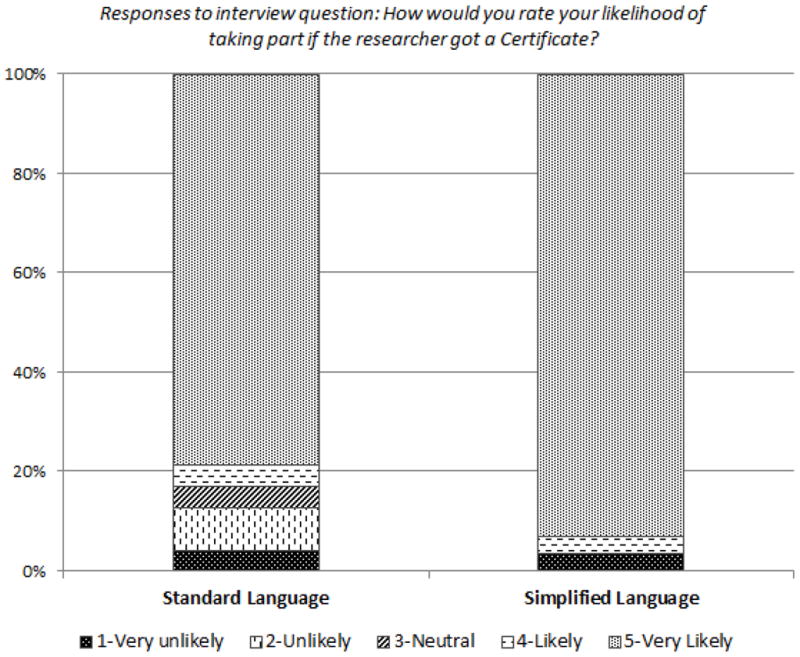
Do consent from descriptions of Certificates influence hypothetical willingness to participate in research? ^
Willingness to provide truthful information
We also asked interviewees whether the Certificate information would affect their willingness to honestly share their HIV risk behaviors with researchers. A majority (14/23 standard group; 21/27 simplified group) said it would have no effect. As when asked about providing truthful information in the absence of a Certificate, this opinion was frequently accompanied by general comments about the importance of honesty.
Similar proportions in each group (4/23 standard group; 4/27 simplified group) said the Certificate information would make them more forthcoming. However, a higher proportion of the standard group (5/23) said they would be less forthcoming, compared with the simplified group (2/27)—responses that apparently reflected interviewees’ perception of the risk of information disclosure (Table 5).
Table 5.
Do consent form descriptions of Certificates influence hypothetical willingness to provide truthful information? #
| Response | Examples |
|---|---|
| Would be more forthcoming with Certificate |
Standard Language:
|
Simplified Language:
| |
|
| |
| Would be less forthcoming with Certificate |
Standard Language:
|
Illustrative responses to interview question: “Do you think the information about Certificates would affect your willingness to share a full and honest account of your HIV risk behaviors with researchers?”
Understanding of Certificate Description
Referring to each component of the Certificate description separately, we asked interviewees “Is there anything unclear or that you don’t understand?”
Introduction
Most interviewees (17/23 standard group; 22/27 simplified group) found the introductory material clear. However, a higher proportion of the standard group (5/23) found it unclear, compared with the simplified group (2/27). In the standard group, interviewees commented on the need to make the language more comprehensible or precise (e.g., what would it mean to “resist” a demand for research data?). In the simplified group, lack of clarity seemed to stem from disbelief that a researcher could or would refuse a court order: “The part where it says you don’t have to give out the information … to a judge. I thought maybe they could get everything.”
Government audits
Perceptions of information about disclosures for government audits differed depending on the version received. The standard group was evenly split between those who thought the information clear (12/23) and those who thought it unclear (11/23). Among the latter, interviewees again often commented on the need for more clarity and specificity in the language itself, for example, questioning the word “resist” (which appeared again) and uncertainty about whether personal information would be released. In contrast, nearly three-fourths (20/27) of the simplified group thought this information was clear. Those who found something unclear questioned which government agencies would request data and why personal identifiers were needed: “Why can’t they just use a false name or letters or numbers or something?”
Self-disclosure
Perceptions of information about self-disclosure also differed by group. In the standard group, most (14/23) said it was clear, but a substantial minority (9/23) found it unclear. Among the latter, interviewees questioned the reference to voluntary disclosure by family members: “Why could a member of your family be able to ask for your information to be released?” as well as other phrases (e.g., “researchers may not withhold information…”). In contrast, nearly three-fourths (20/27) of the simplified group said it was clear. Those who found something unclear talked about the importance of controlling access to their information (“I wouldn’t give permission for [researchers] to give my information to somebody else … I would deal with that person directly”), with some instances of confusion about the phrase “the Certificate does not stop us…”.
State reporting
Opinions about the description of state-mandated reporting were broadly similar between groups, with most (17/23 and 19/27 in the standard and simplified groups, respectively) saying it was clear. Those who found the standard version unclear suggested it should be stated whether participants would also be notified about communicable diseases, and whether both past and current abuse would be reported. Those who found the simplified version unclear wanted more information, for example, about the relevance of certain kinds of reporting to the hypothetical study: “Why do you need this information on my sexually-transmitted diseases, domestic violence, child abuse, why do you need all of this information?”
Comparison of Confidentiality Protections
We asked “Having gone over this description of Certificates more closely, what is your overall impression of the privacy protections?” Each interviewee could express both favorable and unfavorable impressions. Overall, approximately three-fourths (17/23 and 21/27 in the standard and simplified groups, respectively) had positive comments about Certificates. A common theme was that of feeling comfortable, safe, or more confident given the protections described.
However, nearly one-third (7/23) of the standard group had negative comments, most often about too many entities having access to their information: “It’s too many people releasing too much stuff.” In contrast, only a few (2/27) in the simplified group voiced negative comments, reflecting general discomfort about whether the protection was absolute: “It’s not private enough to satisfy me.”
We then asked “Compared to the protections in the original study description, do you think a Certificate increases or decreases the confidentiality of your information?” Although large majorities in both groups (17/23, standard group; 19/27, simplified groups) said a Certificate increases confidentiality, approximately one-fourth (6/23) of the standard group said it decreases confidentiality. In contrast, only about one-tenth (3/27) of the simplified group said a Certificate decreases confidentiality.
Finally, we asked, “Out of all the information we’ve looked at today, what gives you the most confidence that your data will be protected?” Each interviewee could identify more than one aspect. Roughly half (12/23 standard group; 12/27 simplified group) identified something in the original description of the study’s confidentiality protections as reassuring. In particular, interviewees commonly singled out use of codes as inspiring the most confidence.
Just under half (11/23) of the standard group identified some aspect of the Certificate’s protections as giving them confidence compared with a substantial majority (19/27) of the simplified group. Again, Certificates as extra protection was a common theme. Those in the simplified group also expressed general comfort and a sense of control over access to their information.
DISCUSSION
Our qualitative results provide insights into how one population potentially eligible for sensitive research reacts to and interprets consent language describing Certificates of Confidentiality. Most interviewees were neither reassured nor alarmed by information about Certificates, and most also said it would not influence their willingness to participate or provide truthful information. However, a higher proportion of those who read NIH’s standard consent description said that it raised new concerns, that their likelihood of participating would be lower, and that they might be less forthcoming with researchers.
The extent to which Certificates should reassure prospective participants is an important consideration. In crafting our simplified language, we attempted to remain faithful to the substance of NIH’s version, which states: “With this Certificate, the researchers cannot be forced to disclose information that may identify you, even by a court subpoena.” Despite this strong assertion, it is unclear whether Certificates can provide such absolute protection in all circumstances (Beskow et al. 2012; Beskow, Dame, and Costello 2008, 2009; Wolf et al. 2012). Thus, developing consent descriptions of Certificates that are both simple and accurate is critically important.
Regarding subjective understanding of Certificate descriptions, most in our study population said they found each of the sections clear. However, except for information about state reporting, every section was deemed unclear by a higher proportion of those who read NIH’s standard version versus those reading our simplified version. In particular, a substantial minority of the standard group often found particular words and phrases about government audits and self-disclosure confusing. Notably, simplified-group participants seemed to more often question the substance of the information rather than the meaning of the language per se and suggested improvements (e.g., clarifying whether participants would also be notified about communicable disease). This could indicate that simplifying consent language may not reduce the number of questions but may help participants ask questions that better inform decision-making.
Our findings give rise to several other practical observations. First, standard confidentiality protections, especially maintaining data in coded form, appear to be reassuring to many of our participants. Together with the perception of Certificates as providing “extra” protection—a view shared by IRB chairs (Beskow et al. 2012) and institutional legal counsel (Wolf et al. 2012) and supported by legal analysis (Wolf et al. 2013)—this suggests that developing simple, non-technical descriptions of basic protections may be beneficial (Albala, Doyle, and Appelbaum 2010; Breese et al. 2004; Kass et al. 2011; Paasche-Orlow, Taylor and Brancati 2003).
Second, the goal of Certificates—promoting participation in sensitive research—may be advanced by clearly explaining the study’s premise, why gathering sensitive data is necessary, and how it will contribute to important public health knowledge. Our interviewees said the chance to help researchers learn more about HIV, benefitting themselves and others in the process, was a major consideration when deciding whether to participate. These findings are comparable to those from studies of disclosure risk and confidentiality assurances more broadly (Couper et al. 2008, 2010; Singer and Couper 2010). For example, in an online, vignette-based study, researchers found that the precise wording of confidentiality assurances had some effect on respondents’ perceptions of the risks and benefits associated with the survey described, but little impact on their stated willingness to participate (Singer and Couper 2010). In contrast, the topic of the survey had a consistent and statistically significant effect on willingness to participate. As these authors concluded,
People do not participate because disclosure risk has been reduced or because we have given them a credible confidentiality assurance; they participate because they see some benefit, either for themselves or for society in general. (Singer and Couper 2010, 7)
Thus, the utility of including elaborate, boilerplate descriptions of Certificates in consent forms may be in question. At a minimum, tailoring the description to the actual study may help avoid unwarranted concerns. Our interviewees, for instance, questioned how certain details in the Certificate description (e.g., reporting domestic violence) were relevant to the hypothetical HIV study. Further, our simplified language is amenable to further improvement. As one example, some interviewees were confused by our attempt to simplify yet closely mirror NIH’s standard language, “If an insurer, employer, or other person obtains your written consent to receive research information, then the researchers may not use the Certificate to withhold that information.”
Our study population comprised HIV-positive individuals, most of whom were non-white males, and it is essential to consider our results in this context. Individuals with HIV are likely to be familiar with the concept of state-mandated reporting of communicable disease, and many interviewees mentioned participation in substance abuse treatment programs, where honesty and accountability are emphasized. In addition, our hypothetical research scenario plainly described collecting information about illegal activity. For populations that do not share these characteristics, or study designs that do not directly invoke prospects of legal jeopardy, Certificate descriptions could have a different effect. For instance, a Certificate could alarm prospective participants by introducing concerns about subpoenas for research data, or reassure them that researchers have been scrupulous in protecting them from even unexpected risks. Thus, reactions to Certificates in other contexts is an essential topic for future research, particularly given the promotion of Certificates for biobanking (National Cancer Institute 2011) and large-scale data sharing (National Institutes of Health 2011).
Interpretation of our findings is subject to other limitations. First, we presented interviewees with a hypothetical (but also realistic and familiar) situation; a real study setting might have elicited different responses. We note, however, that conducting a study where Certificate information is manipulated during the actual consent process would confront significant challenges due to federal regulations and concerns about participant burden. Second, our interviewees volunteered in response to recruitment flyers and thus were likely more favorably inclined toward research in general than a random selection of HIV-positive individuals.
Our study provides empirical data on an important, little-studied topic, exploring understanding and opinions among one particular population with regard to both basic confidentiality measures and Certificates. Our design integrated randomization with in-depth qualitative techniques, allowing comparison and detailed investigation of reactions to standard versus simplified Certificate descriptions. Our sample size was large for a qualitative study, given that thematic saturation has been shown to occur at 6–12 interviews/group when using structured instruments (such as our interview guide) (Guest, Bunce, and Johnson 2006; Guest, Namey, and Mitchell 2013). Our qualitative results provide the rich detail needed to inform a larger, quantitative study that would permit further rigorous comparisons with statistical testing and analysis.
Informed consent is intended to allow competent individuals to decide whether to participate in research. Comprehension and voluntariness—both crucial to valid informed consent—are threatened when information provided to prospective participants is too complex. Certificates are issued when disclosure of identifying information could have significant adverse consequences for participants; thus, it is vital that Certificate descriptions be understood. Our simplified description provides a foundation for further research and practice improvements that advance this important goal.
Supplementary Material
Acknowledgments
The authors thank Professor Lauren Dame and Ms. Emily Namey for their assistance with the development of the simplified Certificate description, and Ms. Namey for her assistance with the interview guide. The authors also thank the other members of their research team for their input: Dr. Alexandra Cooper, Dr. Kevin Weinfurt, and Professor Leslie Wolf. Finally, the authors thank their expert advisory group for their contributions throughout this project: Professor Mark Barnes, Dr. John Falletta, Mr. William E. Freeman, Dr. Bernard Lo, Dr. Jon Merz, Dr. Lawrence Muhlbaier, Dr. Pearl O’Rourke, Professor, Mark Rothstein, Dr. Marjorie Speers, and Dr. Jeremy Sugarman.
Funding: This work was supported by the National Human Genome Research Institute (NHGRI) (Grant R01HG005087).
Footnotes
Author Contributions: The content is solely the responsibility of the authors and does not necessarily represent the official views of the National Human Genome Research Institute (NHGRI) or the National Institutes of Health (NIH).
Competing Interests: None declared.
Ethical approval: The Duke University Health System IRB determined this study to be exempt from federal regulations for the protection of human subjects under 45 CFR 46.101(b)(2).
Contributor Information
Laura M. Beskow, Email: laura.beskow@duke.edu, Duke Institute for Genome Sciences & Policy, 240 North Building, Duke University, Campus Box 90141, Durham, NC 27708 USA, Tel: 919-668-2293, FAX: 919-668-0799
Devon K. Check, Duke Clinical Research Institute, Duke University School of Medicine, Durham, NC, USA
Natalie Ammarell, Duke University Medical Center, Durham, NC, USA.
References
- Adimora AA, V, Schoenbach J, Martinson FE, Coyne-Beasley T, Doherty I, Stancil TR, Fullilove RE. Heterosexually transmitted HIV infection among African Americans in North Carolina. Journal of Acquired Immune Deficiency Syndromes. 2006;41(5):616–23. doi: 10.1097/01.qai.0000191382.62070.a5. [DOI] [PubMed] [Google Scholar]
- Albala I, Doyle M, Appelbaum PS. The evolution of consent forms for research: a quarter century of changes. IRB. 2010;32(3):7–11. [PubMed] [Google Scholar]
- Bacon MC, von Wyl V, Alden C, Sharp G, Robison E, Hessol N, Gange S, Barranday Y, Holman S, Weber K, Young MA. The Women’s Interagency HIV Study: an observational cohort brings clinical sciences to the bench. Clinical and Diagnostic Laboratory Immunology. 2005;12(9):1013–9. doi: 10.1128/CDLI.12.9.1013-1019.2005. [DOI] [PMC free article] [PubMed] [Google Scholar]
- Beskow LM, Dame L, Costello EJ. Author reply. Science. 2009;323(5919):1289–90. [Google Scholar]
- Beskow LM, Dame L, Costello EJ. Research ethics. Certificates of confidentiality and compelled disclosure of data. Science. 2008;322(5904):1054–5. doi: 10.1126/science.1164100. [DOI] [PMC free article] [PubMed] [Google Scholar]
- Beskow Laura M, Check Devon K, Namey Emily E, Dame Lauren A, Lin Li, Cooper Alexandra, Weinfurt Kevin P, Wolf Leslie E. Institutional Review Boards’ use and understanding of Certificates of Confidentiality. PLoS One. 2012;7(9):e44050. doi: 10.1371/journal.pone.0044050. [DOI] [PMC free article] [PubMed] [Google Scholar]
- Breese P, Burman W, Rietmeijer C, Lezotte D. The Health Insurance Portability and Accountability Act and the informed consent process. Annals of Internal Medicine. 2004;141(11):897–8. doi: 10.7326/0003-4819-141-11-200412070-00034. [DOI] [PubMed] [Google Scholar]
- Catania JA, Wolf LE, Wertleib S, Lo B, Henne J. Research participants’ perceptions of the certificate of confidentiality’s assurances and limitations. Journal of Empirical Research on Human Research Ethics. 2007;2(4):53–59. doi: 10.1525/jer.2007.2.4.53. [DOI] [PubMed] [Google Scholar]
- Check DK, Wolf LE, Dame LA, Beskow LM. Certificates of Confidentiality and informed consent: Institutional and professional perspectives. IRB: Ethics & Human Research. 2013 in press. [PMC free article] [PubMed] [Google Scholar]
- Couper MP, Singer E, Conrad FG, Groves RM. Risk of Disclosure, Perceptions of Risk, and Concerns about Privacy and Confidentiality as Factors in Survey Participation. Journal of Official Statistics. 2008;24(2):255–275. [PMC free article] [PubMed] [Google Scholar]
- Couper MP, Singer E, Conrad FG, Groves RM. Experimental Studies of Disclosure Risk, Disclosure Harm, Topic Sensitivity, and Survey Participation. Journal of Official Statistics. 2010;26(2):287–300. [PMC free article] [PubMed] [Google Scholar]
- Guest G, Bunce A, Johnson L. How many interviews are enough? An experiment with data saturation and variability. Field Methods. 2006;18(1):59–82. [Google Scholar]
- Guest G, MacQueen KM, Namey EE. Applied Thematic Analysis. Los Angeles, CA: Sage Publications; 2012. [Google Scholar]
- Guest Greg, Namey Emily E, Mitchell Marilyn L. Collecting qualitative data : a field manual for applied research. Thousand Oaks: SAGE Publications; 2013. [Google Scholar]
- Wolf LE, Patel MJ, Williams BA, Austin JL, Dame LA. Certificates of Confidentiality: Protecting human subject research data in law and practice. Minnesota Journal of Law, Science & Technology. 2013;14(1):11–87. [PMC free article] [PubMed] [Google Scholar]
- Kass NE, Chaisson L, Taylor HA, Lohse J. Length and complexity of US and international HIV consent forms from federal HIV network trials. Journal of General Internal Medicine. 2011;26(11):1324–8. doi: 10.1007/s11606-011-1778-6. [DOI] [PMC free article] [PubMed] [Google Scholar]
- National Cancer Institute. Best Practices for Biospecimen Resources. 2011 Available from http://biospecimens.cancer.gov/practices/2011bp.asp.
- National Institutes of Health. Certificates of Confidentiality Kiosk. 2012 Available from http://grants.nih.gov/grants/policy/coc/
- National Institutes of Health. Genome-Wide Association Studies (GWAS). NIH Points to Consider for IRBs and Institutions. 2011 Available from http://gwas.nih.gov/08institutions.html.
- Paasche-Orlow MK, Taylor HA, Brancati FL. Readability standards for informed-consent forms as compared with actual readability. New England Journal of Medicine. 2003;348(8):721–6. doi: 10.1056/NEJMsa021212. [DOI] [PubMed] [Google Scholar]
- Ridpath JR, Greene SM, Wiese CJ. PRISM Readability Toolkit. 3. Group Health Research Institute; 2010. Available from http://www.grouphealthresearch.org/capabilities/readability/readability_home.html. [DOI] [PubMed] [Google Scholar]
- Singer E, Couper MP. Communicating disclosure risk in informed consent statements. Journal of Empiral Research on Human Research Ethics. 2010;5(3):1–8. doi: 10.1525/jer.2010.5.3.1. [DOI] [PMC free article] [PubMed] [Google Scholar]
- Wolf LE, Zandecki J. Sleeping better at night: investigators’ experiences with certificates of confidentiality. IRB. 2006;28(6):1–7. [PubMed] [Google Scholar]
- Wolf LE, Zandecki J, Lo B. The certificate of confidentiality application: a view from the NIH Institutes. IRB. 2004;26(1):14–8. [PubMed] [Google Scholar]
- Wolf LE, Dame LA, Patel MJ, Williams BA, Austin JA, Beskow LM. Certificates of confidentiality: legal counsels’ experiences with and perspectives on legal demands for research data. Journal of Empirical Research on Human Research Ethics. 2012;7(4):1–9. doi: 10.1525/jer.2012.7.4.1. [DOI] [PMC free article] [PubMed] [Google Scholar]
Associated Data
This section collects any data citations, data availability statements, or supplementary materials included in this article.