


Figure 1. Suppression of plasma viremia with cART in SIVmac239-infected Indian rhesus macaques.
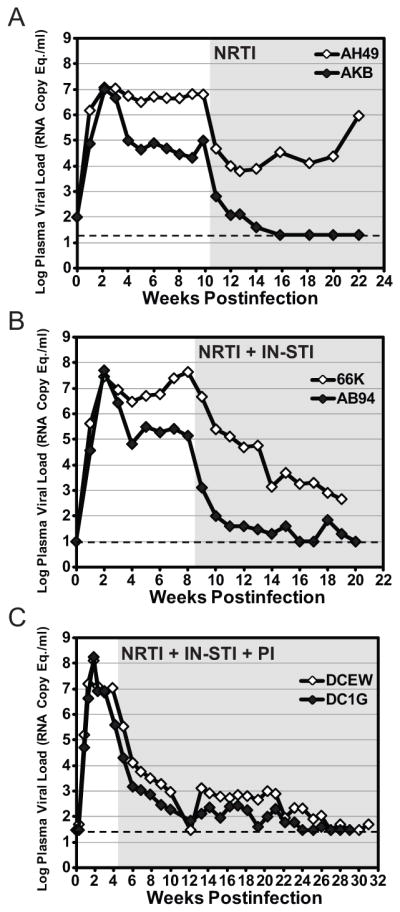
Each panel shows SIV RNA plasma viral load profiles for representative animals from a different experiment in a series of studies, with samples obtained prior to and during treatment with cART. Each cohort received a different cART regimen: A) two NRTIs (PMPA, FTC) starting at 10 weeks postinfection, B) two NRTIs (PMPA, FTC) plus two IN-STIs (L-‘564, L-‘812) starting at 8 weeks postinfection, C) two NRTIs (PMPA, FTC) plus two IN-STIs (L-‘564, L-‘812) plus a boosted PI (DRV boosted with RTV) starting at 4 weeks postinfection. As shown, it is possible to suppress viral replication in some animals with lower pretreatment viral loads (≤105 RNA copy Equivalents/ml) to clinically relevant levels (<50 RNA copy Eq./ml) with as few as two drugs from one inhibitor class, while a greater number of drugs spanning multiple classes, such as the five drug, three class regimen shown in (C), are typically required to achieve clinically relevant virologic suppression in animals with higher pretreatment viral loads (~106–108 RNA copy Eq./ml). PMPA was administered at 20 mg/kg/day SubQ, FTC at 40 mg/kg/day SubQ, L-‘564 at 10 mg/kg BID oral, L-‘812 at 20 mg/kg BID oral, DRV at 600 mg BID, and RTV at 100 mg BID. The gray shaded area of each plot represents the on-treatment phase of the study. The limit of quantification for the plasma viral load assay used for each cohort is indicated by a dashed line (A, 20 copy Eq./ml; B, 10 copy Eq./ml; C, 30 copy Eq./ml).