


Fig. 4.
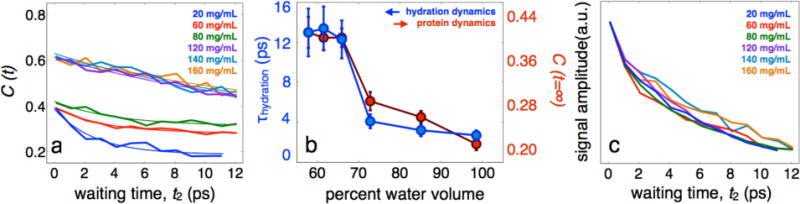
Interfacial water and protein dynamics of HEWL-RC in the presence of excess lysozyme. a, FFCFs for HEWL-RC in self-crowding conditions, ranging from 20 mg/mL to 160 mg/mL. b, Hydration timescale, obtained by the initial decay of the correlation function, and the protein dynamics, estimated by the static offset of the correlation function, plotted as a function of solvent composition. A strong coupling is clear from the data, with both the hydration and protein dynamics slowing down as excess lysozyme is added to the system. Similar to the PEG400 crowding, a dynamical transition is observed at sufficient crowding, though this transition occurs at lower concentrations of HEWL because of the more significant constraining effect that HEWL has on surrounding waters. c, Vibrational lifetimes estimated through the signal amplitude of the rephasing spectrum again show a consistently short lifetime, consistent with a lack of protein-protein interactions that would result in surface dehydration and increased lifetimes.