


Figure 2. FA-OOH increases the rate of mitochondrial ROS production during forward electron transfer.
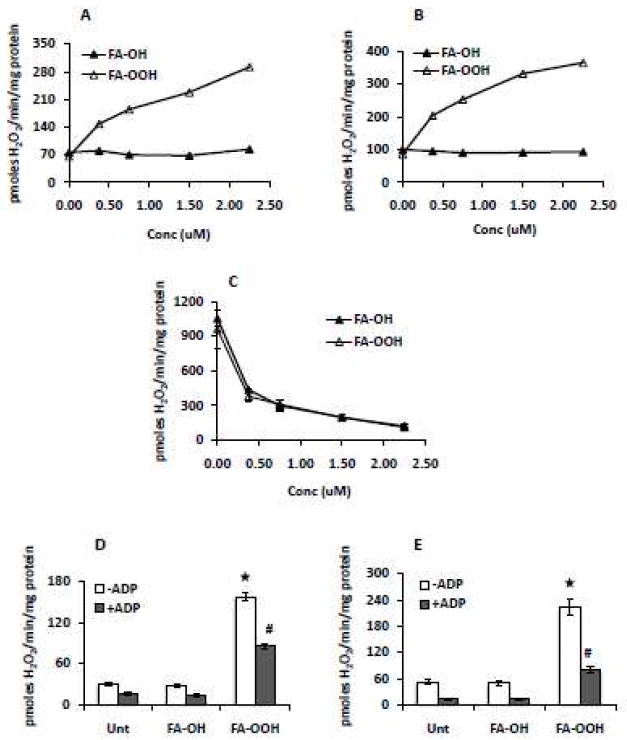
Amplex red was used to measure H2O2 production in the presence of respiratory substrates specific for complex I and complex II and complex I inhibitor, rotenone - (A) glutamate/malate (G/M), 5 mM; (B) succinate (5 mM) + rotenone (0.5 μM) (S/R) and (C) succinate, 5 mM. FA-OH or FA-OOH was added at the concentrations indicated. The amplex red assay was performed in the absence/presence of 2 mM ADP to determine the effect of FA-OH or FA-OOH (0.75 μM) on ROS production in resting vs phosphorylating mitochondria in the presence of (D) G/M (5 mM) and (E) succinate (5 mM) + rotenone (0.5 μM). The results represent means ± S.E.M. for 6-7 individual mitochondrial preparations. Statistical significance was assessed by one-way ANOVA with Newman Keul’s multiple comparison test (*p < 0.0001 vs. untreated mitochondria (State 4), #p < 0.001 vs. untreated mitochondria (State 3).