


Figure 1.
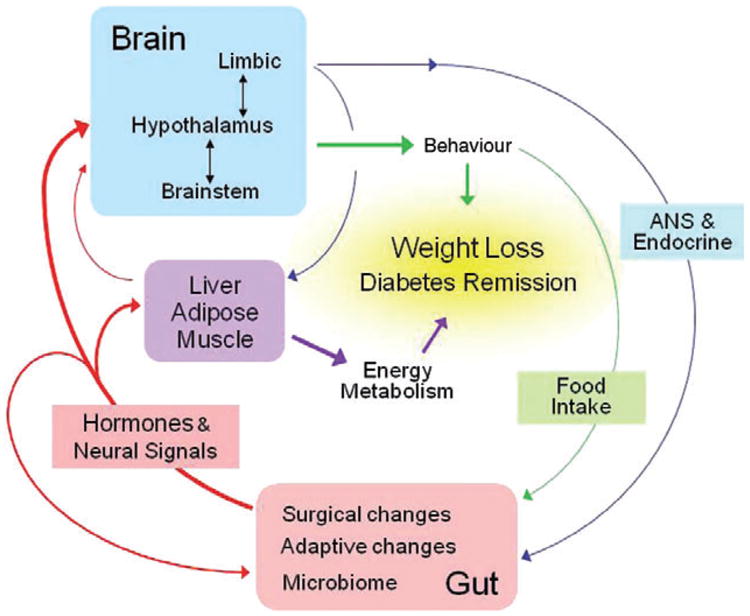
Schematic diagram showing flow of information potentially involved in the physiological and behavioural consequences of gastric bypass surgery. Changes in hormonal and neural signals generated by the surgery and its adaptive consequences affecting other peripheral organs and the brain are shown in red (Berthoud, Holst, Kaplan, Poires, Strader, Seeley, Hajnal) Behavioural changes such as food intake and food preference resulting from altered signalling to the brain are shown by green lines (Berthoud, Bueter, Chakravarthy, Geleibter, Seeley). Changes in autonomic and endocrine functions that feed back to the gut and other peripheral organs are shown by blue lines (Raybould). The contribution of changed energy metabolism and energy expenditure is shown in purple (Kaplan, Ravussin). Note that the arrangement allows learning to take place, as ingestion of different foods produces different consequences in the altered gut that are in turn sensed by the brain.