


Fig. 4. Generation of subtypes of interneurons.
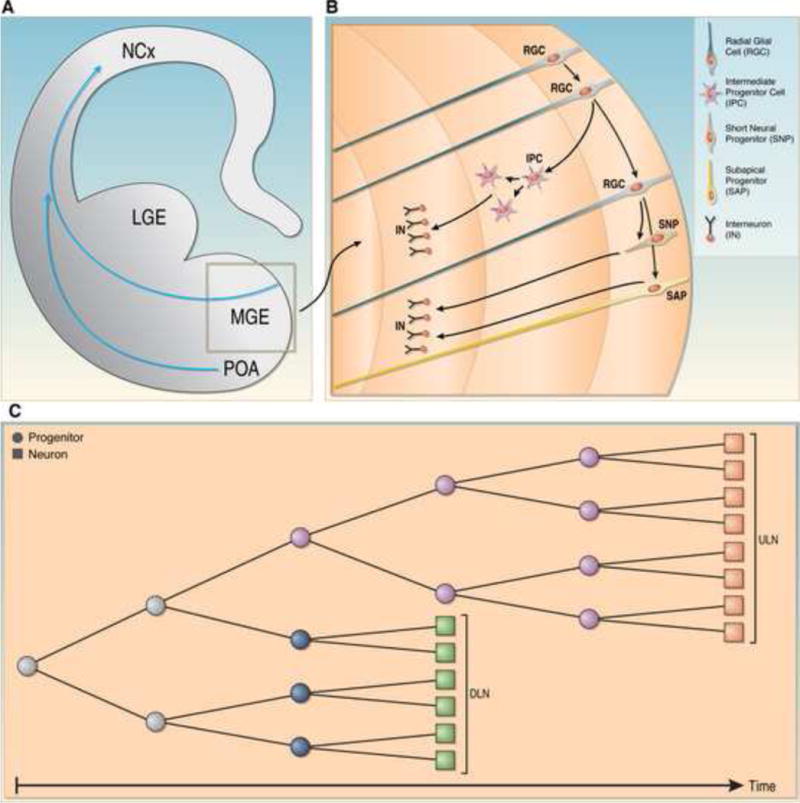
(A) Coronal hemisection of the developing brain. The blue arrow indicates the migration route of interneurons from the medial ganglionic eminence (MGE) to the neocortex (NCx). The lateral ganglionic eminence (LGE) is also depicted. (B) Enlargement of the region boxed in (A) indicating different progenitor types. Radial glial cells (RGCs) that were derived from neuroepithelial cells self renew and generate intermediate progenitors (IPCs), short neural progenitors (SNPs) and subapical progenitors (SAPs), all of which further proliferate to generate interneurons (INs). (C) Model for the generation of interneurons that populate deep layers (DLN) and upper layers (ULN) of the neocortex. In this model, distinct progenitors exist for DLN and ULN but their relative abundance changes over developmental time. Note that most of the data regarding the diversity of the progenitor pool for interneurons were obtained with studies on the LGE, which is not depicted here.