


Figure 1.
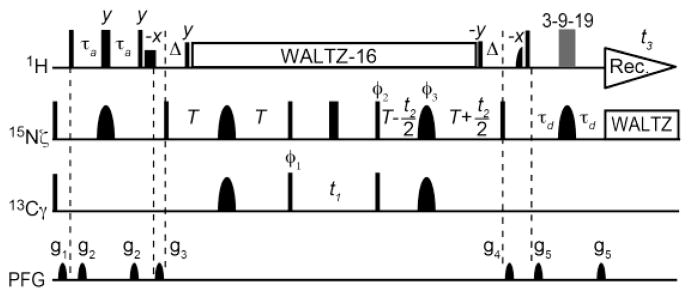
Pulse sequences for the 3D H3NCG experiment for Lys side-chain NH3+ resonance assignment. Thin and bold bars in black represent hard rectangular 90° and 180° pulses, respectively. Unless indicated otherwise, pulse phases are along x. Carrier positions: 1H, the position of the water resonance; 15N, 33 ppm; and 13C, 20 ppm. Short-bold bars represent water-selective soft-rectangular 1H 90° pulses (1.2 ms). The 3-9-19 pulse train-based WATERGATE scheme (Piotto et al. 1992) was used to suppress the water signal. The 13Cγ-selective pulses should not affect 13Cε nuclei (~42ppm). RF strengths for 1H and 15N WALTZ-16 composite pulses (Shaka et al. 1983) were 3.3 kHz and 1.0 kHz, respectively. Shaped pulses: 1H half-Gaussian 90° pulse (2.1 ms); 13C I-BURP2 180° pulse (1.2 ms); and 15N r-SNOB 180° pulse (1.03 ms). Delays: τa = 2.7 ms; δ = 2.6 ms; and T = 50 ms. Phase cycles: ϕ1 = [2x, 2(−x)], ϕ2 = [x, −x], ϕ3 = [4x, 4y], and receiver = [x, −x,−x, x, −x, x, x, −x]. Quadrature detections for indirect 13C and 15N dimensions were achieved using States-TPPI (Marion et al. 1989) for ϕ1 and ϕ2, respectively.