



Abstract
Urzymes are catalysts derived from invariant cores of protein superfamilies. Urzymes from both aminoacyl-tRNA synthetase classes possess sophisticated catalytic mechanisms: pre-steady state bursts, significant transition-state stabilization of both amino acid activation, and tRNA acylation. However, they have insufficient specificity to ensure a fully developed genetic code, suggesting that they participated in synthesizing statistical proteins. They represent a robust experimental platform from which to articulate and test hypotheses both about their own ancestors and about how they, in turn, evolved into modern enzymes. They help reshape numerous paradigms from the RNA World hypothesis to protein structure databases and allostery.
Keywords: Aminoacyl tRNA Synthetase, Bioinformatics, Protein Engineering, Protein Evolution, Protein Synthesis, Genetic Code, Precellular Evolution
Novel Methods and Targets
Urzyme derives from the German/Dutch prefix “Ur,” which means primitive or authentic. Woese (1) used the related term “ur-enzyme,” which he attributed to K. C. Atwood. As the name suggests, my colleagues and I believe that Urzymes represent legitimate experimental models for very early ancestral enzymes. This belief is based on phylogenetic evidence, their conservation in modern enzymes, and biochemical evidence, their surprisingly high catalytic rate enhancements.
On an evolutionary scale (Fig. 1), Urzymes occupy a gap that is inaccessible to other approaches to evolution. Urzymology has different objectives and methods from ancestral gene reconstruction and directed evolution. During most of biological evolution, fully articulated enzymes assumed new functions via point mutations and short insertions and/or deletions: a process called neofunctionalization (2). Many such events can be recovered from multiple sequence alignments by ancestral gene reconstruction (3–9). Directed evolution uses selection to evoke changes in contemporary enzymes.
FIGURE 1.
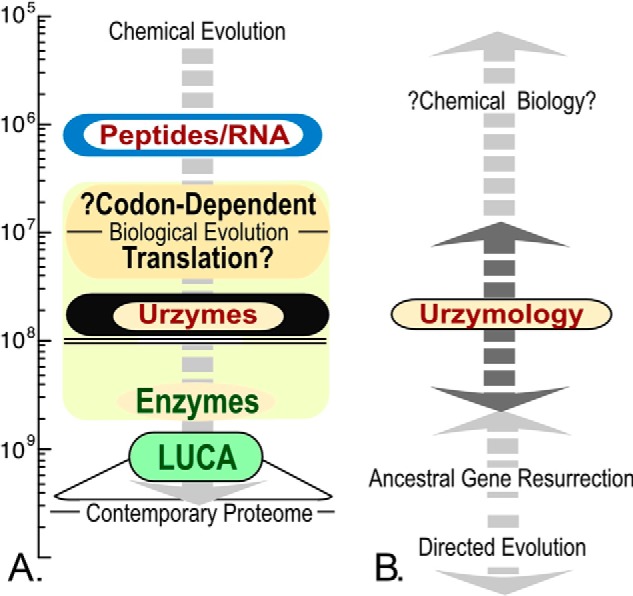
Urzymology and molecular evolution. A, proposed role of aaRS Urzymes in the development of codon-dependent translation (yellow background). The scale indicates time in years since the earth formed. Urzymes are rehabilitated forms of invariant structural cores of modern enzyme superfamilies. Many modern enzymes likely preceded the last universal common ancestor and first “organism” (LUCA). B, methods appropriate for studying objects and processes along the timeline in A. Because urzymology connects the earliest genetic coding to the emergence of modern enzymes, it affords a powerful enabling technology for studying key transitions in the evolution of the genetic code.
My colleagues and I seek to characterize catalysts that are 50–85% smaller and more remote than their contemporary descendants, and are missing entire domains of genetic information. Loss of these substantial modules creates a crucial barrier to accessing early developmental evolution; phylogenetic trees based on multiple sequence alignments representing essentially modern enzymes lose coherence at that stage and do not root in the invariant structural cores (10).
Urzymology uses three-dimensional structural superposition to identify invariant cores. Novel combinations of modular protein engineering, design, biochemistry, and high sensitivity assays allow my colleagues and I then to reconstruct and analyze representations of simpler primordial enzymes that have long been extinct in any form, and whose accessible descendants are much more sophisticated.
Defining evolutionary intermediates is analogous to proving chemical reaction intermediates (11). Intermediate states must be identified and characterized. Then, they must be shown to result from a plausible evolutionary precursor. Finally, they must be shown to give rise to more modern molecular species by similarly plausible evolutionary processes. Biological evolution intermediates are also constrained by using phylogenetic methods to trace ancestries.
This logic extends that articulated by Thornton et al. (12). Urzymes inferred from multiple structure alignments are not true ancestors, but are our best approximations. Given their homology to contemporary enzymes and their robust catalysis, it is very likely that the catalytic cores of these enzymes conserved across all branches of the tree of life point to a quite similar common molecular ancestor. Moreover, irrespective of how closely they resemble true ancestral forms, their activities represent a powerful new tool for studies of contemporary enzyme mechanisms.
The gap between the earliest peptide catalysts and modern enzymes represents an intellectually challenging era that coincides with the emergence of the genetic code, and hence of both genetics and biology. Codon-dependent translation is the nexus between chemical and biological evolution. Amino acid activation and tRNA acylation are necessary and sufficient to translate the genetic code (supplemental Fig. S1). Thus, my colleagues and I have studied Urzymes derived from aminoacyl-tRNA synthetases (aaRS)2 (13–18). aaRS form two distinct superfamilies with unrelated primary, secondary, and tertiary structures, as well as with significant mechanistic differences (19) (supplemental Figs. S2 and S3).
Fig. 2 illustrates both the notion of and the precedent involved in creating Urzymes. Schwob and Söll (20) nearly produced the first Urzyme by selecting random internal deletions of a suppressor glutaminyl-tRNA synthetase (GlnRS; Class I) for their ability to rescue an amber lacZ mutation. Much of the connective peptide 1 (CP1) insertion and the anticodon-binding domain (ABD) could be removed without eliminating suppression, and a “minimal GlnRS” fusion of the largest CP1 and ABD deletions also restored prototrophy on minimal plates. The length of this minimal GlnRS (260 residues) is still roughly twice the size of the putative GlnRS Urzyme, which is shown as a ribbon within the context of the full-length GlnRS.
FIGURE 2.
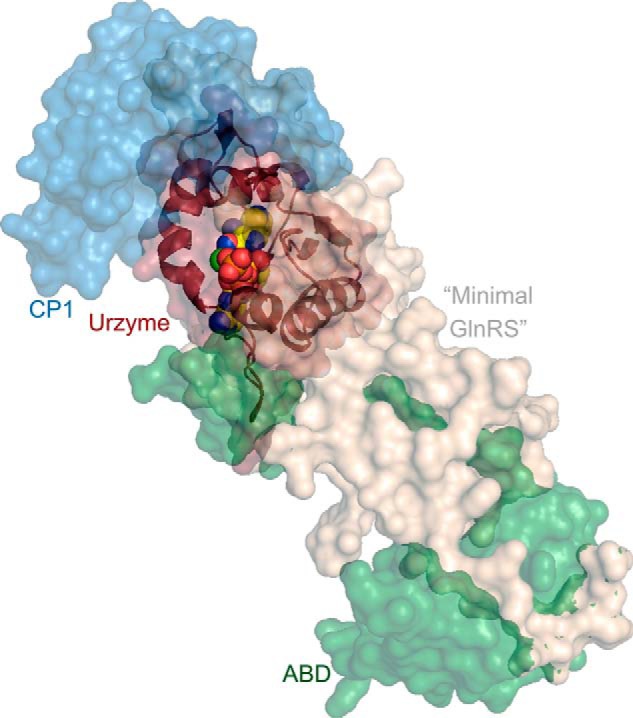
Minimal Glutaminyl-tRNA synthetase (20) and its putative Urzyme (firebrick ribbon). Selection of functional deletions from CP1 (100 amino acids; blue) and the ABD (134 amino acids; green) yielded a minimal enzyme (wheat) that is still twice the size of the invariant core used to construct TrpRS and LeuRS Urzymes. Active-site ligands are shown as spheres.
Similar work established the functionality of tRNA acceptor stems (21, 22) and microhelices (23), which could be acylated by intact cognate aaRS. Thus, contemporary aaRS and tRNAs both contain functional subsets that are 50–85% smaller than their full-length relatives. The distinction between these forms and their full-length relatives is both quantitative and qualitative. They have fewer domains and exhibit significant reductions in catalyzed rates.
The radical, directed protein surgery necessary to create Urzymes was motivated by the Rodin-Ohno (RO) hypothesis (24) (supplemental Figs. S2 and S3) that ancestral Class I and Class II aaRS coding sequences were originally complementary strands of the same gene. The only segments of the superfamilies that could be aligned antiparallel as suggested by Rodin and Ohno also turned out to be the invariant cores that position active site residues. The RO hypothesis thus predicted that these cores were intermediates in aaRS evolution, and hence should be catalytically active (18).
Excising Urzymes from full-length enzymes exposes many hydrophobic side chains. These residues must be identified and mutated to restore solubility. Computational methods identified side chains with the greatest newly generated solvent-accessible surface area. Suitable mutations were suggested by the Rosetta protein design program (25). Native TrpRS Urzyme sequences at interfaces with deleted sequences are active when the wild type Urzyme is fused to the anticodon-binding domain (15).
Physical principles motivating the choices that Rosetta makes for these extinct sequences may overlap those induced by selective pressures for stability (26), evoking surrogates for sequence information missing in multiple sequence alignments from living organisms. Thus, protein design extends the study of protein evolution substantially closer to the origin of life.
My colleagues and I are fortunate to have begun by investigating aaRS Urzymes. Urzymes derived from the invariant structural cores of Class I TrpRS (17), LeuRS,3 and Class II HisRS (16) all have only ∼15–25% of the total contemporary mass, yet they accelerate both amino acid activation and tRNA aminoacylation proportionately by ∼108-fold over the uncatalyzed rates (27).
Their strong phylogenetic support (structural invariance) and high catalytic proficiencies afford a robust platform. They point both backward in time to yet more ancient antecedents and forward to the fully developed genetic code (Fig. 1). Thus, their catalytic activities establish a base camp for articulating and testing new and previously inaccessible experimental studies to identify and test intermediates in molecular evolution and allostery (13, 27).
Urzyme Catalytic Activities Satisfy Complementary Tests of Authenticity
Three lines of evidence, pre-steady state burst size, sensitivity to mutation, and substrate binding affinity, reinforce the conclusion that the Urzymes themselves are the authentic sources of the observed catalytic activities. Most unexpected was that the TrpRS, LeuRS, and HisRS Urzymes all exhibit pre-steady state bursts comparable in magnitude with the catalyst concentrations, ruling out contamination by tiny amounts of full-length aaRS (16–18). Bursts established that rate-limiting product release (28) was a third fundamental link to contemporary enzymes, in addition to accelerating amino acid activation and tRNA aminoacylation (see supplemental Fig. S1).
Mutational and protein engineering experiments also support the authenticity of aaRS Urzyme catalytic activities. TrpRS and HisRS Urzymes, expressed as maltose-binding protein (MBP) fusions, are activated ∼50-fold by tobacco etch virus protease cleavage. Further, four different HisRS Urzymes differing in the presence or absence of class-defining signature Motif 3 and a 6-residue N-terminal extension exhibit catalytic differences consistent with catalytic contributions of each module plus a significant (i.e. −1.6 kcal/mole) synergistic interaction between them (16). Finally, point mutation of active-site residues alter catalytic activity by an order of magnitude or more (16, 17). None of these effects are consistent with activity from a contaminating catalyst.
Steady-state kinetic parameters afford a third line of evidence for authenticity. Both TrpRS and HisRS Urzymes bind ATP tightly, but amino acid affinities are 10–100-fold lower than those of the full-length enzymes. The TrpRS Urzyme tryptophan Km is 1–2 mm, 500 times that of intact TrpRS (17). Weak cognate amino acid binding suggests that discrimination against similar, non-cognate amino acids is also weakened, as observed (13, 15, 17).
aaRS Urzymes: Low Specificity, High Proficiency Catalysts
aaRS Urzyme catalytic activities are dramatically higher than estimates for the uncatalyzed rates (Fig. 3A). Notably, Urzymes from both classes accelerate both activation and acylation 105–106-fold more than necessary to launch ribosome-independent protein synthesis (Fig. 3B). Further, the two classes achieve similar activities with similar masses, consistent with their joint requirement for protein synthesis. Thus, both classes appear to have achieved comparable proficiency increments as their entirely different domain architectures grew comparably in size.
FIGURE 3.

Quantitative framework for assessing the catalytic significance of Urzymes and other putative stages of aaRS evolution. A, rate accelerations estimated from experimental data for single (red) and bisubstrate (black and bold) reactions adapted from Ref. 63 to include uncatalyzed and catalyzed rates of bisubstrate reactions of the ribosome (71), amino acid activation (18), and kinases (72). Abbreviations: CAN, carbonic anhydrase; CMU, chorismate mutase; KSI, ketosteroid isomerase; RIBO, ribosome; CDA, cytidine deaminase; PEP, carboxypeptidase B; MAN, mandelate racemase; KINA, hexokinase; FUM, fumarase; GLU, β-glucosidase; ODC, orotidylate carboxylase; ADC, amino acid decarboxylase; IPT, inositol phosphatase. Second order rate constants (black bars) were converted into comparable units by multiplying by 0.002 m, which is the ATP concentration used to assay the catalysts shown in B. B, experimental rate accelerations estimated from steady state kinetics as kcat/Km for a series of catalysts derived from Class I and Class II aaRS. A and B have the same vertical scales, and the origin in B has been set equal to the uncatalyzed rate of amino acid activation (AAact) in A. Red bars, Class I TrpRS and LeuRS (see Footnote 3) constructs; blue bars, Class II HisRS constructs; green bar, a ribozymal catalyst (38), for comparison. Research presented in A and B was originally published in Ref. 27. © The American Society for Biochemistry and Molecular Biology. C, Class I LeuRS and Class II HisRS Urzyme amino acid specificities. More negative ΔGkcat/Km values indicate higher activities. By ∼1 kcal/mole (light bands) or ∼5-fold, each Urzyme prefers substrates from its own class (dark bands).
Urzyme specificities are low. Spectra for Class I LeuRS and Class II HisRS Urzyme specificities (Fig. 3C) are similar and complementary. Both Urzymes activate a range of non-cognate amino acids. Nonetheless, each Urzyme exhibits an ∼5-fold preference for amino acids from its own class. Unknown differences between aaRS Urzymes and the true ancestral forms may account for some of their promiscuity.
The TrpRS Urzyme provided a unique “molecular knock-out” lacking the entire CP1 and ABD, affording a baseline against which to determine contributions of the two deleted modules. Neither CP1 nor the ABD restored any specificity (15), which results entirely from their energetic coupling.
Using allosteric interactions between genetic modules entirely absent from the Urzymes to enhance specificity resolves challenges (29–33) associated with failure of rational amino acid-binding pocket point mutants to accomplish anything but reducing catalytic activity. Moreover, generating orthogonal synthetase-tRNA pairs appears to require pruning all amino acid-binding residues to alanine and using random mutation to select rebuilt pockets to match the altered substrates consistent with induced-fit mechanisms (34).
These partial results suggest that aaRS Urzymes could not support a canonical 20-amino acid alphabet. Low Urzyme specificity and the fact that Urzymes cannot utilize the tRNA anticodon for recognition form the first experimental basis for the conjecture of Woese (1, 35) that the first coded proteins were statistical ensembles, without unique sequences.
Reduction and Recapitulation
“You have to deeply understand the essence of a product to be able to get rid of the parts that are not essential.” (Jony Ive, quoted in Ref. 36)
Urzymes afford a robust platform for reductionist experiments aimed at characterizing even simpler ancestral protein catalysts that look backward in time (37, 39)4 and for recapitulating plausible intermediates to test possible evolutionary paths that look forward in time (15) (Fig. 1).
The ability to measure the subtle effects of modules as small as 6–20 amino acids (16) greatly enhances the resolution of modular deconstruction as a tool in protein science. Radical surgery of Class II aaRS afforded evidence that Motif 3, considered essential to catalytic activity because of its interactions with ATP, is dispensable and synergistic even with modular additions elsewhere, including a 6-amino acid N-terminal extension to Motif 1 (15). The catalytic role of Motif 3 may be realized fully only when the Class II insertion domain is present between the Urzyme and Motif 3 (40), or in full-length HisRS. Further experiments are necessary to map the intermodular synergy.
The unprecedented radical protein surgery that gave rise to the Class I TrpRS and LeuRS Urzymes entailed removing one or more long internal peptides as well as conventional truncation of the C-terminal anticodon-binding domain. Deleting CP1, an internal subdomain, was non-trivial because the two remaining fragments had to be joined together without corrupting the active site. The LeuRS Urzyme5 entailed removing CP2, in addition to CP1. Removing internal segments was facilitated by the fact that α carbon atoms of their N- and C-terminal residues in full-length aaRS are separated by the length of a peptide bond (13).
Straightforward removal of CP1 from TrpRS and LeuRS and CP2 from LeuRS affords existence proofs that the reverse process, assimilation of a CP1 or CP2 ancestor, is a legitimate evolutionary operation accounting for these insertions into the Class I aaRS as they evolved. Further support for this conclusion arises because insertions into the Toprim domain (41), the closest contemporary homolog of Class I aaRS Urzymes, occur at the locations of Class I CP1 and CP2 insertions (Fig. 4) (42).
FIGURE 4.

Structural homology between Class I Urzymes and the TOPRIM domain found in topoisomerases and primases (41). Core domain structures are superimposed in the center. Insertion points corresponding to Class I CP1 and CP2 (42) are shared by various TOPRIM domains, as indicated. The N and C termini of the insertions are indicated by red spheres and correspond closely throughout the domain superfamily. P. horikoshii, Pyrococcus horikoshii; D. radiodurans, Deinococcus radiodurans; E. coli, Escherichia coli.
CP1 wraps nearly 360° around the TrpRS specificity α-helix, constraining it against the N-terminal crossover connection that binds ATP. Molecular dynamics simulations (17) suggested it might stabilize that helix, which reorients markedly in long trajectories in the presence of ATP, but without tryptophan.
Full TrpRS specificity and tRNATrp aminoacylation activity (15) both require essentially complete interdomain synergy (also called epistasis (43–45)). The observed epistasis (15) implies that both modules interact in the decision to activate the amino acid present in the active site. Combinatorial mutagenesis (13) implicated the D1 Switch, a dynamic (46) packing motif (47), in mediating allosteric communication between domain movement and catalysis. The four-way energetic coupling between mutated D1 residues (13) makes a quantitatively equivalent contribution to both catalysis and specificity as is observed for the intermodular CP1XABD energetic coupling (15).
Unexpectedly, the TrpRS Urzyme appears to have higher fitness at the two tasks, amino acid recognition and tRNA aminoacylation, required of aaRS than either of the two larger intermediate, potentially more advanced constructs. Urzymes thus appear to lie closer to the actual path of aaRS evolution. The negative epistasis suggests that evolutionary growth of contemporary aaRS must be subtler than simply accumulating either CP1 or ABD domains.
RO Hypothesis Redux
The RO hypothesis may have been ignored because it was not obvious how to test it. The relevant objects, ancestral Class I and II aaRS, are so remote that it was hardly evident that the hypothesis could be falsified (48). My colleagues and I articulated and verified bioinformatic (14) and biochemical (16–18, 27) predictions. The balanced, proportionate rate accelerations of both amino acid activation and tRNA aminoacylation by TrpRS and HisRS Urzymes confirmed the prediction that Class I and II segments consistent with antiparallel alignment should be active (27).
Bioinformatic predictions of sense/antisense coding ancestry were tested by excerpting a 94-residue Urgene from ∼200 contemporary coding sequences of Class I TrpRS and Class II HisRS. Tyrosyl-tRNA synthetase (TyrRS) and prolyl-tRNA synthetase (ProRS) served as outgroups in rooting the respective trees. Codon middle bases formed base pairs in ∼0.34 of all-by-all antiparallel alignments in all four cases, with a standard error of <0.0003, as compared with a well established value of 0.25 for the null hypothesis (supplemental Fig. S4). Middle-base pairing increased in independently reconstructed ancestral sequences for the two trees (supplemental Fig. S5 (14). Middle-base pairing of sense/antisense-related sequences thus appears to be a phylogenetic metric that persists far deeper into the past than do metrics for multiple sequence alignments for a single phylogenetic tree.
Their sophistication and tuned catalytic activities argue that aaRS Urzymes had far simpler ancestors. The sense/antisense ancestry of the Urzymes suggests in turn that these simpler ancestors also were encoded on opposite strands of the same gene(s). Phylogenetic evidence and the similar comparisons between two Class IC and two Class IIA aaRS sequence alignments (14) and analysis of amino acid activation by 46-residue ATP-binding sites coded by a designed sense/antisense gene (37) suggest, in turn, that certain properties of these ancestors may be accessible via methods analogous to those of ancestral gene reconstruction (8, 12). See Ref. 39 for additional details.
Urzymology-driven Paradigm Shifts
My colleagues and I expected that experimental studies of ancestral aaRS would identify novel perspectives on the origins of translation itself and hence in contemporary molecular biology and biochemistry. However, unexpected new perspectives on phylogenetics/genomics and the origins of protein folding, catalytic activity, specificity, and allostery will also likely shift and enhance comprehensive paradigms in genetics and biophysics.
Codon-dependent Translation
The evolutionary history of the universal genetic code is, in a real sense, that of the two synthetase superfamilies and their cognate tRNAs. Support for the RO hypothesis argues against paradigms holding that the aaRS classes appeared independently, one after the other (49, 50). Urzyme tRNA acylation activity opens to more detailed testing the proposal that early translation used an “operational RNA code” (51) vested only in the tRNA acceptor stem bases, the only parts of tRNA that can be recognized by aaRS Urzymes.
Sense/antisense coding projects further into the past than other metrics (14), implying that catalytic peptides responsible for activating amino acids co-evolved with tRNA from a very primitive state. Thus, contrary to the prevailing RNA World hypothesis, my colleagues and I restated (27) the proposal (52, 53) that genetic coding emerged from mutually catalytic RNA and peptides, using rudimentary stereochemical coding between the two biopolymers.
Phylogenetics/Genomics
Systematic protein structure classifications, SCOP (54) and CATH (55), fail to identify Urzymes of either aaRS class as ancestral forms (10). However, aaRS Urzymes represent plausible ancestors for a wide spectrum of contemporary proteins. The Rossmannoid superfamily (56), the biggest in the proteome (57), includes consensus homologs of Class I aaRS. My colleagues and I argued (58) that the 26 families in the HSP70/actin ATPase superfamily are ancient paralogs of Class II aaRS (pfam: CL0108).
Class II aaRS Urzymes illustrate a distinct, but related problem. One might expect their descendants to include a proportion of the contemporary proteome comparable with that (0.25–0.3) occupied by the Rossmannoid protein superfamily that includes Class I aaRS. The only proposed relative is the dual function biotin synthase/repressor BirA (59). Although evidence for that homology is strong, it relies heavily on the C-terminal halves of the molecules that follow Motif 2. This essentially modern homology may also be misleading because the smallest Class II Urzymes lack both Motif 3 and C-terminal insertion domains, which may obscure more distant homologies based on the Class II Urzyme, for example, the HSP70/actin superfamily (58).
Validating the RO sense/antisense coding hypothesis (24) thus introduces new, potentially deep relationships between protein superfamilies. This conundrum highlights possible limitations in current structural database annotations, and accommodating Urzymes into evolutionary frameworks should therefore enhance inferences drawn from structural databases.
Protein Folding
Information carried by a gene is generally perceived to be unambiguous. However, for sense/antisense genes, this unique information has two valid but quite different interpretations resulting in two different folds, depending on which strand is read. The inverse duality in the genetic code (60) ensures that secondary structures coded by opposite strands of the same gene can both be amphipathic, consistent with formatting globular ensembles that are, in a sense, “inside out” (Fig. 6 of Ref. 14).
Catalysis
A widespread consensus (61–63) holds that enzymic rate enhancements require strong bonds to the transition state and hence favorable enthalpies of activation. To minimize unfavorable entropy changes in forming such strong transition state interactions, one naively expects aaRS Urzymes to be properly folded proteins. We do not yet know whether Urzymes are fully folded. Recently, however, Hu (64) confirmed that alternative properly folded and molten globular forms of the same enzyme (65) achieve the same rate enhancements by different enthalpy/entropy compensations. Molten globular proteins can actually achieve higher transition state complementarity than more rigid, folded proteins. Dissociating catalysis from the requirement for folding suggests that a much broader range of early translation products may have been catalytically active, accelerating early stages of natural selection.
aaRS Modularity
The modularity of contemporary protein structures is a perplexing problem that intensifies challenges posed by protein evolution. aaRS enzymes exhibit unusually high percentages (5-fold more than other families (66)) of accreted sequences with new functionality, i.e. physiocrines, along the organismal phylogenetic trees. Physiocrines appear in aaRS from both classes. Their functions are unrelated to translation, ranging from endocrine regulation of cardiovascular development to immune system activities, as well as regulation of mammalian target of rapamycin (mTOR), IFN-γ, and p53 signaling (67). Urzymology introduces techniques needed to recapitulate the gain of such functions.
Specificity and Allostery
The most significant puzzle arising thus far from studies of urzymology is that enhanced specificity of contemporary TrpRS, relative to its Urzyme, involves negative epistasis, requiring allosteric energetic coupling between the ABD and the CP1 insertion via a switching element intrinsic to the Urzyme (13, 15). Intramolecular epistasis may have developed while different modules present in contemporary aaRS functioned in trans. Some authors suggest that off-loading functions such as specificity to allosteric effects may be beneficial by making specificity a more robust property (68). The dynamic switching element responsible for this coupling is a widely conserved packing motif (47). How this “protoallosteric” motif (69) functions without the ABD and CP1 modules and how coupling might have emerged before modules became covalently joined remain outstanding questions.
Like knock-out mice, Urzymes are extensive molecular knock-outs that provide unique experimental baselines for helping to answer such questions. Their measurable catalytic rates facilitate multidimensional thermodynamic analysis of modular epistasis in mechanistic enzymology (13, 15).
Protein Design
Recovering Urzymes by deleting non-essential protein masses has adverse effects on stability and solubility. Mutations, identified by Rosetta (60, 61), compensate for these effects. Interfaces between Urzymes and more recently acquired modules can, in principle, also be redesigned. As proficient, relatively nonspecific catalysts, Urzymes can likely be engineered to acylate tRNAs with non-canonical amino acids (34, 70) for industrial purposes.
Urzymes Have Measurable Activities
Most enzyme-catalyzed rates are within the same order of magnitude, irrespective of the uncatalyzed reaction rates (63). Roughly comparable enzyme-catalyzed rates appear to be a requirement for biology. An important implication is that catalytic activities of different enzymes have always been subject to such a constraint. The 108-fold rate accelerations observed for Class I and II aaRS Urzymes (3, 6) suggests that other Urzymes are likely also to have measurable catalytic rates.
Conclusions
In launching urzymology, my colleagues and I took three steps for which there was little, if any, precedent: (i) validating the Rodin-Ohno hypothesis; (ii) testing the evolutionary implication that the most highly conserved portions of enzymes (i.e. their invariant cores) probably have significant catalytic activities; and (iii) using protein design (Rosetta (25)) to compensate for protein mass lost on creating Urzymes, facilitating radical protein surgery. Previously, there was no way to formulate or test hypotheses about how simple, extinct ancestors came to resemble contemporary proteins. Urzymology now offers coherent paradigms that open unprecedented experimental access to mechanisms of very early protein evolution, as well as to novel and effective studies of contemporary mechanistic enzymology.
The first examples of urzymology introduced the ability to use high resolution modular engineering pro-actively, to address previously inaccessible questions. My colleagues and I developed Class I and II aaRS Urzymes to test the Rodin-Ohno hypothesis that ancestral forms of each class descended from opposite strands of the same gene. Unexpected results from that effort will likely change prevailing paradigms in several areas. In validating the hypothesis, my colleagues and I discovered that urzymology, because it connects the earliest genetic coding to the emergence of modern enzymes, affords a powerful enabling technology for studying a key transitional period in the evolution of the genetic code. aaRS Urzymes afford a base camp for probing even more primitive peptide catalysts and for recapitulating subsequent evolutionary steps leading to the emergence of full-length aaRS.
Supplementary Material
Acknowledgments
I am grateful to numerous laboratory members for their contributions over the past decade and to Richard Wolfenden for helpful discussions.
This work was supported, in whole or in part, by National Institutes of Health Grants GM 78227 and GM 90406 through the NIGMS (to C. W. C.). This is the third article in the Thematic Minireview series “Enzyme Evolution.”

This article contains supplemental Figs. S1–S5.
O. Erdogan and M. Collier, unpublished results.
C. W. Carter, Jr., and R. Wolfenden, manuscript in preparation.
M. Collier, O. Erdogan, and C. W. Carter, Jr., manuscript in preparation.
- aaRS
- aminoacyl-tRNA synthetase(s)
- CP1
- connecting peptide 1
- ABD
- anticodon-binding domain
- TrpRS
- tryptophanyl-tRNA synthetase
- TyrRS
- tyrosyl-tRNA synthetase
- LeuRS
- leucyl-tRNA synthetase
- HisRS
- histidyl-tRNA synthetase
- GlnRS
- glutaminyl-tRNA synthetase
- RO
- Rodin-Ohno.
REFERENCES
- 1. Woese C. R. (1965) On the origin of the genetic code. Proc. Natl. Acad. Sci. U.S.A. 54, 1546–1552 [DOI] [PMC free article] [PubMed] [Google Scholar]
- 2. Rastogi S., Liberles D. A. (2005) Subfunctionalization of duplicated genes as a transition state to neofunctionalization. BMC Evol. Biol. 5, 28. [DOI] [PMC free article] [PubMed] [Google Scholar]
- 3. Hanson-Smith V., Kolaczkowski B., Thornton J. W. (2010) Robustness of ancestral sequence reconstruction to phylogenetic uncertainty. Mol. Biol. Evol. 27, 1988–1999 [DOI] [PMC free article] [PubMed] [Google Scholar]
- 4. Bridgham J. T., Ortlund E. A., Thornton J. W. (2009) An epistatic ratchet constrains the direction of glucocorticoid receptor evolution. Nature 461, 515–519 [DOI] [PMC free article] [PubMed] [Google Scholar]
- 5. Dean A. M., Thornton J. W. (2007) Mechanistic approaches to the study of evolution: the functional synthesis. Nat. Rev. Genet. 8, 675–688 [DOI] [PMC free article] [PubMed] [Google Scholar]
- 6. Thornton J. W. (2004) Resurrecting ancient genes: experimental analysis of extinct molecules. Nat. Rev. Genet. 5, 366–375 [DOI] [PubMed] [Google Scholar]
- 7. Stackhouse J., Presnell S. R., McGeehan G. M., Nambiar K. P., Benner S. A. (1990) The ribonuclease from an extinct bovid ruminant. FEBS Letters 262, 104–106 [DOI] [PubMed] [Google Scholar]
- 8. Gaucher E. A., Govindarajan S., Ganesh O. K. (2008) Palaeotemperature trend for Precambrian life inferred from resurrected proteins. Nature 451, 704–707 [DOI] [PubMed] [Google Scholar]
- 9. Benner S. A., Sassi S. O., Gaucher E. A. (2007) Molecular paleoscience: systems biology from the past. Adv. Enzymol. Relat. Areas Mol. Biol. 75, 1–132 [DOI] [PubMed] [Google Scholar]
- 10. Caetano-Anollés G., Wang M., Caetano-Anollés D. (2013) Structural phylogenomics retrodicts the origin of the genetic code and uncovers the evolutionary impact of protein flexibility. PLoS One 8, e72225. [DOI] [PMC free article] [PubMed] [Google Scholar]
- 11. Fersht A. R. (1999) Structure and Mechanism in Protein Science, pp. 217–218, W. H. Freeman and Company, New York [Google Scholar]
- 12. Thornton J. W., Need E., Crews D. (2003) Resurrecting the ancestral steroid receptor: ancient origin of estrogen signaling. Science 301, 1714–1717 [DOI] [PubMed] [Google Scholar]
- 13. Weinreb V., Li L., Chandrasekaran S. N., Koehl P., Delarue M., Carter C. W., Jr. (2014) Enhanced amino acid selection in fully evolved tryptophanyl-tRNA synthetase, relative to its Urzyme, requires domain movement sensed by the D1 Switch, a remote, dynamic packing motif. J. Biol. Chem. 289, 4367–4376 [DOI] [PMC free article] [PubMed] [Google Scholar]
- 14. Chandrasekaran S. N., Yardimci G. G., Erdogan O., Roach J., Carter C. W., Jr. (2013) Statistical evaluation of the Rodin-Ohno hypothesis: sense/antisense coding of ancestral Class I and II aminoacyl-tRNA synthetases. Mol. Biol. Evol. 30, 1588–1604 [DOI] [PMC free article] [PubMed] [Google Scholar]
- 15. Li L., Carter C. W., Jr. (2013) Full Implementation of the genetic code by tryptophanyl-tRNA synthetase requires intermodular coupling. J. Biol. Chem. 288, 34736–34745 [DOI] [PMC free article] [PubMed] [Google Scholar]
- 16. Li L., Weinreb V., Francklyn C., Carter C. W., Jr. (2011) Histidyl-tRNA synthetase Urzymes: Class I and II aminoacyl-tRNA synthetase Urzymes have comparable catalytic activities for cognate amino acid activation. J. Biol. Chem. 286, 10387–10395 [DOI] [PMC free article] [PubMed] [Google Scholar]
- 17. Pham Y., Kuhlman B., Butterfoss G. L., Hu H., Weinreb V., Carter C. W., Jr. (2010) Tryptophanyl-tRNA synthetase Urzyme: a model to recapitulate molecular evolution and investigate intramolecular complementation. J. Biol. Chem. 285, 38590–38601 [DOI] [PMC free article] [PubMed] [Google Scholar]
- 18. Pham Y., Li L., Kim A., Erdogan O., Weinreb V., Butterfoss G. L., Kuhlman B., Carter C. W., Jr. (2007) A minimal TrpRS catalytic domain supports sense/antisense ancestry of Class I and II aminoacyl-tRNA synthetases. Mol. Cell 25, 851–862 [DOI] [PubMed] [Google Scholar]
- 19. Carter C. W., Jr. (1993) Cognition, mechanism, and evolutionary relationships in aminoacyl-tRNA synthetases. Annu. Rev. Biochem. 62, 715–748 [DOI] [PubMed] [Google Scholar]
- 20. Schwob E., Söll D. (1993) Selection of a 'minimal' glutaminyl synthetase and the evolution of Class I synthetases. EMBO J. 12, 5201–5208 [DOI] [PMC free article] [PubMed] [Google Scholar]
- 21. Francklyn C., Musier-Forsyth K., Schimmel P. (1992) Small RNA helices as substrates for aminoacylation and their relationship to charging of transfer RNAs. Eur. J. Biochem. 206, 315–321 [DOI] [PubMed] [Google Scholar]
- 22. Francklyn C., Schimmel P. (1989) Aminoacylation of RNA minihelices with alanine. Nature 337, 478–481 [DOI] [PubMed] [Google Scholar]
- 23. Francklyn C., Schimmel P. (1990) Enzymatic aminoacylation of an eight-base-pair microhelix with histidine. Proc. Natl. Acad. Sci. U.S.A. 87, 8655–8659 [DOI] [PMC free article] [PubMed] [Google Scholar]
- 24. Rodin S. N., Ohno S. (1995) Two types of aminoacyl-tRNA synthetases could be originally encoded by complementary strands of the same nucleic acid. Orig. Life Evol. Biosph. 25, 565–589 [DOI] [PubMed] [Google Scholar]
- 25. Kuhlman B., Dantas G., Ireton G. C., Varani G., Stoddard B. L., Baker D. (2003) Design of a novel globular protein fold with atomic-level accuracy. Science 302, 1364–1368 [DOI] [PubMed] [Google Scholar]
- 26. Dokholyan N. V., Shakhnovich E. I. (2001) Understanding hierarchical protein evolution from first principles. J. Mol. Biol. 312, 289–307 [DOI] [PubMed] [Google Scholar]
- 27. Li L., Francklyn C., Carter C. W., Jr. (2013) Aminoacylating Urzymes challenge the RNA World hypothesis. J. Biol. Chem. 288, 26856–26863 [DOI] [PMC free article] [PubMed] [Google Scholar]
- 28. Fersht A. R. (1987) Dissection of the structure and activity of the tyrosyl-tRNA synthetase by site-directed mutagenesis. Biochemistry 26, 8031–8037 [DOI] [PubMed] [Google Scholar]
- 29. Perona J. J., Gruic-Sovulj I. (2014) Synthetic and editing mechanisms of aminoacyl-tRNA synthetases. Top. Curr. Chem. 344, 1–41 [DOI] [PubMed] [Google Scholar]
- 30. Corigliano E. M., Perona J. J. (2009) Architectural underpinnings of the genetic code for glutamine. Biochemistry 48, 676–687 [DOI] [PMC free article] [PubMed] [Google Scholar]
- 31. Bullock T. L., Rodríguez-Hernández A., Corigliano E. M., Perona J. J. (2008) A rationally engineered misacylating aminoacyl-tRNA synthetase. Proc. Natl. Acad. Sci. U.S.A. 105, 7428–7433 [DOI] [PMC free article] [PubMed] [Google Scholar]
- 32. Ibba M., Söll D. (2004) Aminoacyl-tRNAs: setting the limits of the genetic code. Genes Dev. 18, 731–738 [DOI] [PubMed] [Google Scholar]
- 33. Praetorius-Ibba M., Stange-Thomann N., Kitabatake M., Ali K., Söll I., Carter C. W., Jr., Ibba M., Söll D. (2000) Ancient adaptation of the active site of tryptophanyl-tRNA synthetase for tryptophan binding. Biochemistry 39, 13136–13143 [DOI] [PubMed] [Google Scholar]
- 34. Wang L., Brock A., Herberich B., Schultz P. G. (2001) Expanding the genetic code of Escherichia coli. Science 292, 498–500 [DOI] [PubMed] [Google Scholar]
- 35. Woese C. (1998) The universal ancestor. Proc. Natl. Acad. Sci. U.S.A. 95, 6854–6859 [DOI] [PMC free article] [PubMed] [Google Scholar]
- 36. Isaacson W. (2011) Steve Jobs, p. 364, Simon & Schuster, New York [Google Scholar]
- 37. Jimenez M., Williams T., González-Rivera A. K., Li L., Erdogan O., Carter C. W. J. (2014) Did Class 1 and Class 2 aminoacyl-tRNA synthetases descend from genetically complementary, catalytically active ATP-binding motifs? Biophys. J. 106, 675a [Google Scholar]
- 38. Kumar R. K., Yarus M. (2001) RNA-catalyzed amino acid activation. Biochemistry 40, 6998–7004 [DOI] [PubMed] [Google Scholar]
- 39. Carter C. W., Jr., Li L., Weinreb V., Collier M., Gonzalez-Rivera K., Jimenez-Rodriguez M., Erdogan O., Kuhlman B., Ambroggio X., Williams T., Chandrasekharan S. N. (2014) The Rodin-Ohno hypothesis that two enzyme superfamilies descended from one ancestral gene: an unlikely scenario for the origins of translation that will not be dismissed. Biol. Direct 9, 11. [DOI] [PMC free article] [PubMed] [Google Scholar]
- 40. Augustine J., Francklyn C. (1997) Design of an active fragment of a Class II aminoacyl-tRNA synthetase and its significance for synthetase evolution. Biochemistry 36, 3473–3482 [DOI] [PubMed] [Google Scholar]
- 41. Aravind L., Leipe D. D., Koonin E. V. (1998) Toprim: a conserved catalytic domain in type IA and II topoisomerases, DnaG-type primases, OLD family nucleases and RecR proteins. Nucleic Acids Res. 26, 4205–4213 [DOI] [PMC free article] [PubMed] [Google Scholar]
- 42. Burbaum J. J., Starzyk R. M., Schimmel P. (1990) Understanding structural relationships in proteins of unsolved three-dimensional structure. Proteins 7, 99–111 [DOI] [PubMed] [Google Scholar]
- 43. Gong L. I., Suchard M. A., Bloom J. D. (2013) Stability-mediated epistasis constrains the evolution of an influenza protein. eLife 2, e00631. [DOI] [PMC free article] [PubMed] [Google Scholar]
- 44. Nasrallah C. A., Huelsenbeck J. P. (2013) A phylogenetic model for the detection of epistatic interactions. Mol. Biol. Evol. 30, 2197–2208 [DOI] [PMC free article] [PubMed] [Google Scholar]
- 45. Covert A. W., 3rd, Lenski R. E., Wilke C. O., Ofria C. (2013) Experiments on the role of deleterious mutations as stepping stones in adaptive evolution. Proc. Natl. Acad. Sci. U.S.A. 110, E3171–EE3178 [DOI] [PMC free article] [PubMed] [Google Scholar]
- 46. Kapustina M., Weinreb V., Li L., Kuhlman B., Carter C. W., Jr. (2007) A conformational transition state accompanies amino acid activation by B. stearothermophilus tryptophanyl-tRNA synthetase. Structure 15, 1272–1284 [DOI] [PMC free article] [PubMed] [Google Scholar]
- 47. Cammer S., Carter C. W., Jr. (2010) Six Rossmannoid folds, including the Class I aminoacyl-tRNA synthetases, share a partial core with the anticodon-binding domain of a Class II aminoacyl-tRNA Synthetase. Bioinformatics 26, 709–714 [DOI] [PMC free article] [PubMed] [Google Scholar]
- 48. Popper K. R. (1959) The Logic of Scientific Discovery, pp. 124–130, Routledge, Oxford, United Kingdom [Google Scholar]
- 49. Weiner A. M. (1999) Molecular evolution: aminoacyl-tRNA synthetases on the loose. Curr. Biol. 9, R842–R844 [DOI] [PubMed] [Google Scholar]
- 50. Klipcan L., Safro M. (2004) Amino acid biogenesis, evolution of the genetic code and aminoacyl-tRNA synthetases. J. Theor. Biol. 228, 389–396 [DOI] [PubMed] [Google Scholar]
- 51. Schimmel P., Giegé R., Moras D., Yokoyama S. (1993) An operational RNA code for amino acids and possible relationship to genetic code. Proc. Natl. Acad. Sci. U.S.A. 90, 8763–8768 [DOI] [PMC free article] [PubMed] [Google Scholar]
- 52. Carter C. W. J. (1975) Cradles for molecular evolution. New Sci. 65, 784–787 [Google Scholar]
- 53. Carter C. W., Jr., Kraut J. (1974) A proposed model for interaction of polypeptides with RNA. Proc. Nat. Acad. Sci., U.S.A. 71, 283–287 [DOI] [PMC free article] [PubMed] [Google Scholar]
- 54. Andreeva A., Howorth D., Chandonia J. M., Brenner S. E., Hubbard T. J., Chothia C., Murzin A. G. (2008) Data growth and its impact on the SCOP database: new developments. Nucleic Acids Res. 36, D419–D425 [DOI] [PMC free article] [PubMed] [Google Scholar]
- 55. Pearl F. M., Bennett C. F., Bray J. E., Harrison A. P., Martin N., Shepherd A., Sillitoe I., Thornton J., Orengo C. A. (2003) The CATH database: an extended protein family resource for structural and functional genomics. Nucleic Acids Res. 31, 452–455 [DOI] [PMC free article] [PubMed] [Google Scholar]
- 56. Goldstein R. (2008) The structure of protein evolution and the evolution of protein structure. Curr. Opin. Struct. Biol. 18, 170–177 [DOI] [PubMed] [Google Scholar]
- 57. Shakhnovich B. E., Dokholyan N. V., DeLisi C., Shakhnovich E. I. (2003) Functional fingerprints of folds: evidence for correlated structure-function evolution. J. Mol. Biol. 326, 1–9 [DOI] [PubMed] [Google Scholar]
- 58. Carter C. W., Jr., Duax W. L. (2002) Did tRNA synthetase classes arise on opposite strands of the same gene? Mol. Cell 10, 705–708 [DOI] [PubMed] [Google Scholar]
- 59. Artymiuk P. J., Rice D. W., Poirrette A. R., Willet P. (1994) A tale of two synthetases. Nat. Struct. Biol. 1, 758–760 [DOI] [PubMed] [Google Scholar]
- 60. Zull J. E., Smith S. K. (1990) Is genetic code redundancy related to retention of structural information in both DNA strands? Trends Biochem. Sci. 15, 257–261 [DOI] [PubMed] [Google Scholar]
- 61. Wolfenden R. (2011) Benchmark reaction rates, the stability of biological molecules in water, and the evolution of catalytic power in enzymes. Ann. Rev. Biochem. 80, 645–667 [DOI] [PubMed] [Google Scholar]
- 62. Stockbridge R. B., Lewis C. A., Jr., Yuan Y., Wolfenden R. (2010) Impact of temperature on the time required for the establishment of primordial biochemistry, and for the evolution of enzymes. Proc. Natl. Acad. Sci. U.S.A. 107, 22102–22105 [DOI] [PMC free article] [PubMed] [Google Scholar]
- 63. Wolfenden R., Snider M. J. (2001) The depth of chemical time and the power of enzymes as catalysts. Acc. Chem. Res. 34, 938–945 [DOI] [PubMed] [Google Scholar]
- 64. Hu H. (2014) Wild-type and molten globular chorismate mutase achieve comparable catalytic rates using very different enthalpy/entropy compensations. Science China 57, 156–164 [Google Scholar]
- 65. Pervushin K., Vamvaca K., Vögeli B., Hilvert D. (2007) Structure and dynamics of a molten globular enzyme. Nat. Struct. Mol. Biol. 14, 1202–1206 [DOI] [PubMed] [Google Scholar]
- 66. Guo M., Yang X.-L., Schimmel P. (2010) New functions of aminoacyl-tRNA synthetases beyond translation. Nat. Rev. Mol. Cell Biol. 11, 668–674 [DOI] [PMC free article] [PubMed] [Google Scholar]
- 67. Guo M., Schimmel P. (2013) Essential nontranslational functions of tRNA synthetases. Nat. Chem. Biol. 9, 145–153 [DOI] [PMC free article] [PubMed] [Google Scholar]
- 68. del Sol A., Fujihashi H., Amoros D., Nussinov R. (2006) Residues crucial for maintaining short paths in network communication mediate signaling in proteins. Mol. Syst. Biol. 2, 2006.0019. [DOI] [PMC free article] [PubMed] [Google Scholar]
- 69. Weinreb V., Li L., Campbell C. L., Kaguni L. S., Carter C. W., Jr. (2009) Mg2+-assisted catalysis by B. stearothermophilus TrpRS is promoted by allosteric effects. Structure 17, 952–964 [DOI] [PMC free article] [PubMed] [Google Scholar]
- 70. Liu C. C., Schultz P. G. (2010) Adding new chemistries to the genetic code. Ann. Rev. Biochem. 79, 413–444 [DOI] [PubMed] [Google Scholar]
- 71. Schroeder G. K., Wolfenden R. (2007) The rate enhancement produced by the ribosome: an improved model. Biochemistry 46, 4037–4044 [DOI] [PubMed] [Google Scholar]
- 72. Stockbridge R. B., Wolfenden R. (2009) The intrinsic reactivity of ATP and the catalytic proficiencies of kinases acting on glucose, N-acetylglucosamine, and homoserine. J. Biol. Chem. 284, 22747–22757 [DOI] [PMC free article] [PubMed] [Google Scholar]
Associated Data
This section collects any data citations, data availability statements, or supplementary materials included in this article.