



Abstract
Heuristics involve the ability to utilize memory to make quick judgments by exploiting fundamental cognitive abilities. In the current study we investigated the memory processes that contribute to the recognition heuristic and the fluency heuristic, which are both presumed to capitalize on the by-products of memory to make quick decisions. In Experiment 1, we used a city-size comparison task while recording event-related potentials (ERPs) to investigate the potential contributions of familiarity and recollection to the two heuristics. ERPs were markedly different for recognition heuristic-based decisions and fluency heuristic-based decisions, suggesting a role for familiarity in the recognition heuristic and recollection in the fluency heuristic. In Experiment 2, we coupled the same city-size comparison task with measures of subjective pre-experimental memory for each stimulus in the task. Although previous literature suggests the fluency heuristic relies on recognition speed alone, our results suggest differential contributions of recognition speed and recollected knowledge to these decisions, whereas the recognition heuristic relies on familiarity. Based on these results, we created a new theoretical frame work that explains decisions attributed to both heuristics based on the underlying memory associated with the choice options.
Keywords: recognition heuristic, fluency heuristic, familiarity, recollection, ERPs
The study of how people make judgments has often acknowledged a role of memory in shaping these decisions. For example, the fast-and-frugal heuristics research program (e.g. Gigerenzer, 2004) promotes an adaptive toolbox approach, suggesting that the mind has any number of specific heuristic judgment rules it can apply in conditional situations. Some of these heuristics, notably the recognition heuristic and the fluency heuristic, are presumed to rely upon memory processes to make a judgment. The recognition heuristic is said to rely simply on recognition of objects to make quick choices, whereas the fluency heuristic is said to rely on recognition speed, or the speed of retrieval from memory to make choices. However, there has been an under-appreciation in the heuristics research program for the specific underlying memory processes that presumably enable these heuristics to function. Likewise, there has been little work done from a memory perspective to extend current theories of memory to heuristic decision making. The current study aims to map the dual-process account of recognition memory (Diana & Reder, 2006; Rugg & Curran, 2007; Wixted, 2007; Yonelinas, 2002) onto the recognition and fluency heuristics.
The recognition heuristic (RH), as coined by Goldstein and Gigerenzer (2002), was proposed for two-alternative choice tasks where one has to decide which of two items scores higher on a given criterion. A common example is the city-size comparison task (e.g., Dougherty, Franco-Watkins, & Thomas, 2008; Gigerenzer & Goldstein, 1996; Marewski & Schooler, 2011) where the goal is to judge which of two cities is likely to have more inhabitants. The RH posits that if exactly one of these two cities is recognized, then this city should be inferred to have the higher population. Inherent in the RH’s definition is its conditional use - it can only be applied when one item is recognized and one item is not recognized. Consequently, when both items are recognized the decision maker must resort to an alternate strategy (if we adopt the adaptive toolbox approach). The fluency heuristic (FH), as formalized by Schooler and Hertwig (2005), posits that if both items within a pair are recognized, one should compare the recognition speeds, or retrieval times, of both items and infer that the item retrieved more quickly from memory has the higher criterion value. For instance, if one recognizes both Boston and Tulsa, but retrieves Boston more quickly from memory, then the FH posits that Boston should be chosen as being more populous.
Results from behavioral/cognitive, neuropsychological, and neuroimaging studies of human memory increasingly indicate that recognition memory performance reflects two distinct memory processes or types of memory, often referred to as familiarity and recollection (Rugg & Curran, 2007; Rugg & Yonelinas, 2003; Woodruff, Hayama, & Rugg, 2006; Yonelinas, 2002). Familiarity-based recognition is considered fast-acting, relatively automatic, and does not involve the retrieval of qualitative information about an encoding episode. By contrast, recollection is conceived as a slower, more effortful process that gives rise to conscious retrieval of contextual information from a previously encoded experience. We will review the potential contributions of familiarity and recollection to each heuristic.
The Recognition Heuristic
There have been few direct attempts in the literature to parse out the contributions of familiarity and/or recollection to RH-based decisions. However, several theoretical claims surrounding the RH point to familiarity as being the primary mechanism serving the heuristic. Gigerenzer et al. (1991) claimed that when criterion knowledge is lacking subjects will rely on one of several cues including subjective recognition of an item, which they referred to as the “familiarity cue”, implying that simple familiarity could be used to guide judgments.
Gigerenzer and Goldstein (1996) later asserted that recognition served as an initial “screening step” prior to searching for knowledge. Based on this assertion, one might suggest from a dual-process perspective that RH decisions are based on an initial sense of familiarity that precedes recollection of other cues or knowledge. If two items can be dissociated based solely upon their respective familiarities (as should be expected if one item is recognized and the other is completely novel), it would be unnecessary to probe memory for further cues to make a quick choice.
Goldstein and Gigerenzer (2002) reconstituted the assertion of RH-based decisions as being guided by a noncompensatory cue - if one item is recognized but not the other, an inference is based exclusively on this binary recognition cue, and all other cue knowledge pertaining to the recognized item is ignored. In contrast, others have inferred that different compensatory or knowledge-based strategies account for people’s behavior better than the RH, based on evidence that additional knowledge impacts the rate at which people employ the RH (e.g., Hilbig & Pohl, 2009; Hilbig, Pohl, & Bröder, 2009; Newell & Fernandez, 2006; Pohl, 2006). However, these experiments were unable to determine if participants were actively using this additional knowledge when making choices. Insofar as additional knowledge can be assumed to be retrieved via recollection, this debate is pertinent to the question of what memory processes are underlying the RH. Proponents of the RH continue to back its noncompensatory nature (e.g. Pachur, Todd, Gigerenzer, Schooler, & Goldstein, 2011; Gigerenzer & Gaissmaier, 2011; Gigerenzer & Goldstein, 2011), citing among other things that recognition seems to have retrieval primacy compared to other cue knowledge (Pachur & Hertwig, 2006), and that use of recognition in isolation can lead to more accurate inferences than strategies that integrate recognition with further cues (Gigerenzer & Goldstein, 1996). Marewski, Gaissmaier, Schooler, Goldstein, & Gigerenzer (2010) were the first group to formally test knowledge-based strategies against the RH, and they found that the RH predicted participants’ decisions better than knowledge-based strategies. Further, it is likely that any item associated with more additional knowledge is also associated with a greater sense of familiarity. This heightened sense of familiarity could help explain the finding of greater adherence to the RH in cases where additional knowledge was available.
Taken altogether, previous research surrounding the RH has predominantly promoted familiarity as the primary contributor to recognition-based decisions, though few studies have formally placed familiarity within a dual-process account of memory when considering its role. One exception is Rosburg, Mecklinger, and Frings’ (2011) study that used event-related potentials (ERPs) to investigate the underlying memory processes engaged during RH-based decisions. There is an extensive amount of research demonstrating that ERPs are able to dissociate the dual-process contribution of familiarity and recollection to recognition memory (Curran, 2000; Friedman & Johnson, 2000; Opitz & Cornell, 2006; Rugg & Curran, 2007). Two ERPs that are both temporally and topographically distinct have been specifically associated with familiarity and recollection. Familiar stimuli elicit more positive-going ERP waveforms than unfamiliar stimuli at fronto-central recording sites between 300–500 ms, an effect commonly referred to as the ‘FN400’ (e.g., Curran, 2000). Recollection is associated with a parietal maximally-positive ERP that onsets around 500 ms post-stimulus until around 800 ms, and has been termed simply the “parietal old/new effect”(e.g., Jäger, Mecklinger, & Kipp, 2006).
Rosburg et al. (2011) endorsed a dual-process familiarity-based approach to the RH that implemented a city-size comparison task while recording ERPs. Cities with previously established recognition rates were paired so that well-known cities were always paired with little-known cities. Their results showed pronounced differences for ERPs in response to well-known and little-known city names during a 300–450 ms window (roughly corresponding to the FN400) as well as a 450–600 ms window (roughly corresponding to the parietal old/new effect). These findings suggested that well-known city names elicited both greater familiarity and recollection than less-known city names at pertinent sites. Rosburg et al.’s interpretation emphasizes the significance of FN400 familiarity effects in dissociating recognized from unrecognized cities and their potential usefulness in RH-based decisions. They trained pattern classification models that included the FN400 time window by itself, as well as in addition to the parietal old/new effects window, and showed that the classifiers accurately predicted participants’ decisions. However, a model consisting solely of the parietal old/new effects time window was not tested, and thus the role of recollection in RH-based decisions is more difficult to ascertain from this experiment.
In summary, multiple theoretical accounts in the literature as well as empirical ERP findings reported by Rosburg et al. (2011) point to a role for familiarity in RH-based decisions. In environments where recognition is correlated with a given criterion (e.g. city population), a sense of familiarity should help guide recognition-based decisions. The existence and active use of recollection during RH-based decisions would challenge the noncompensatory claim of the RH, which asserts that any recollected cue knowledge beyond recognition should not be considered, and could imply that alternate knowledge-based strategies are being used.
The Fluency Heuristic
Research surrounding the FH has also been limited with respect to directly addressing potential dual-process contributions of familiarity and recollection. However, similar to the RH, several theoretical claims seem to endorse familiarity as the main contributor to FH-based decisions. Faster recognized items are considered more fluent, and people attribute fluent processing of stimuli to having experienced the stimuli before. More frequent and meaningful exposure to a stimulus in the environment is said to lead to more fluent processing. For example, researchers have tampered with the previous exposure of certain stimuli to increase the perceived fame of nonfamous names (the false fame effect; Jacoby et al., 1989) and the perceived truth of repeated assertions (the reiteration effect; Begg, Anas, & Farinacci, 1992; Hertwig, Gigerenzer, & Hoffrage, 1997). These researchers predominantly suggested that increasing exposure to a given stimulus increases its familiarity, and thereby its fluency. More recently, however, Kurilla and Westerman (2008) conducted a study that demonstrated that experimentally enhancing perceptual and conceptual fluency reliably increased claims of both familiarity and recollection. So, fluency has been shown to influence perceived memory judgments across a multitude of domains.
A problem with this general line of research remains the slippery nature of the word ‘fluency’, and researchers’ tendencies to interpret it slightly differently across studies. Fluency has been referred to as “the subjective experience of ease” (Oppenheimer, 2008), “the subjective feeling of familiarity” (Kelley & Jacoby, 1998), and “easy or efficient processing” (Whittlesea & Leboe, 2003), among others. The particular understanding we are concerned with is Schooler and Hertwig’s (2005) formalization of the FH, where fluency is defined as the time it takes to retrieve a trace from long-term memory, or the speed at which objects are judged to be recognized. Schooler & Hertwig implemented the FH and the RH within the ACT-R cognitive architecture (Anderson, Bothell, Byrne, Douglass, Lebiere, & Qin, 2004), and were therefore able to precisely define “retrieval fluency” in terms of the time it takes to retrieve a memory “record” (or chunk, to use ACT-R terminology). The FH was assumed to tap indirectly, via retrieval fluency, into the environmental frequency information locked in the chunks’ activation values. Retrieval of a record implies recognition of the associated word, or city name, so retrieval is taken to mean recollection of simply the city’s name, not necessarily recollection of any associated knowledge pertaining to that city. The ACT-R architecture also allows for positive underlying memory activation of an item that fails to meet a certain “retrieval threshold”. This positive activation is necessarily attributable to familiarity, due to a lack of retrieval even for the city’s name. It is unclear in this interpretation whether, behaviorally, a presented stimulus could be recognized even if it elicited activation below the retrieval threshold set in the ACT-R model, and would thus be considered a positive recognition response attributable solely to familiarity.
Marewski and Mehlhorn (2011) later advanced the work integrating the RH and FH within the ACT-R architecture. Importantly, their instantiation of the models assumed that people would first assess recognition of city names, explicitly stated as being synonymous with familiarity, before potentially attempting to retrieve any further cues. Thus, the authors assume familiarity is first assessed before any recollection. Marewski and Mehlhorn tested several additional models that allowed for recollection of further cues, allowing some models to utilize recollection (compensatory models) and instructing others to ignore recollected information (noncompensatory models). There was no large difference in the performance of these models, with both types fitting the human data well.
Hertwig, Herzog, Schooler, and Reimer (2008) showed that people’s decisions adhered to the FH more frequently when there was a large difference in retrieval fluency between two items. In their review of previous literature, Hertwig et al. abstract across different meanings of the FH and conclude that a resulting conscious experience of familiarity is a core property of the FH. Importantly, Hertwig et al.’s main goal was to advance the idea that decisions could be made, and were indeed made, based on retrieval fluency differences for a pair of objects in a single-cue fashion. So, to the extent that fluency might reference different levels of familiarity, it could be argued that the FH relies indirectly on a familiarity distinction between two objects.
Recent work, however, has called into question the use of the FH versus other knowledge-based strategies that could be used to make the same inferences. Because the FH entails only a conscious assessment of retrieval speeds, any active use of recollected knowledge would allude to use of an alternate strategy. Marewski and Schooler (2011) divide these strategies into two types: decisions based on knowledge about the world, which depend upon the actual content of retrieval, and decisions based on accessibility of memories. Both the RH and FH are considered accessibility-based strategies, because they rely on a byproduct of memory retrieval (i.e. recognition and fluency) to make decisions, ignoring any content of that retrieval. Marewski and Schooler created a new quantitative integrated model within the ACT-R framework incorporating a memory model and time perception model that allowed them to test different types of strategies against each other. The integrated model suggested that not only were knowledge-based strategies more accurate than the FH in situations where both strategies could be applied, but that they accounted for peoples’ inferences better than the FH. All else being equal, participants would do well to rely on knowledge-based strategies over the FH. Around the same time, Hilbig, Erdfelder, & Pohl (2011) created a multinomial processing tree model, which we discuss below, that suggested people were actually using the FH far less frequently than previously believed.
In summary, literature surrounding the FH implicates familiarity as operating in FH decisions via its influence on fluency. The FH does not allow for use of recollected knowledge, or any information beyond a conscious assessment of retrieval speeds. However, the frequency of utilization of the FH has recently been challenged, and there is evidence that recollected knowledge might be driving decisions previously attributed to the FH.
Modeling the Recognition and Fluency Heuristics
Though Schooler & Hertwig (2005, see also Hertwig et al., 2008) certainly demonstrated that fluency affects judgments, their early experiments were unable to show that participants relied on a fluency cue in isolation when making inferences. However, these same arguments can be made against the noncompensatory claim of the RH. The vast majority of research on both heuristics has relied on adherence rates, or accordance rates, to quantify usage. Adherence rates are calculated as the proportion of a participant’s responses that are in line with a certain heuristic (i.e., for the RH, actually choosing the recognized city as being more populous). This calculation results in a biased (though not inconsequential) approximation of a given heuristic’s use. Adherence rates are biased because observed choices in line with a heuristic’s prediction cannot imply that this heuristic was actually used (e.g., Fielder, 2010; Hilbig & Pohl, 2008). In both the case of the RH and the FH, further knowledge or information that ultimately argued for the chosen item may have been considered. For RH cases where only one item is recognized, any further knowledge available about the recognized object is confounded with its mere recognition during decisions. For FH cases where both items are recognized, further knowledge is confounded with retrieval fluency, and it is probable that more fluently recognized items are also associated with more accessible knowledge. So in both cases adherence rates cannot capture which source of information is contributing to decisions.
Hilbig, Erdfelder, & Pohl (2010) created a multinomial processing tree (MPT) model that was able to provide a less biased measure of RH use. Furthermore, Hilbig, Erdfelder, & Pohl (2011) extended the model to incorporate an unbiased measure of FH use in addition to RHuse; they coined this model the r-s-model (see Figure 1). Previous models have been proposed to circumvent the confound between true heuristic use and the use of further cues or knowledge (e.g., Hilbig & Pohl, 2008; Pleskac, 2007), though most have considered the RH or FH in isolation. The r-s-model’s ability to handle both RH and FH decisions makes it an ideal vehicle to discuss both heuristics simultaneously.
Figure 1.

Processing tree representation of the r-s-model, reproduced from pg. 830 of Hilbig et al. (2011). Parameters include: Recognition validity (a), fluency validity (c), knowledge validities (b1, b2, b3), probability of valid guesses (g), probabilities of using the recognition heuristic (RH; r), and probabilities of using the fluency heuristic (FH; s). Boxes with rounded corners signify latent states.
Figure 1 shows the r-s-model in its entirety, which consists of four separate trees representing four possible cases: a) both objects are recognized, and their difference in retrieval fluencies is less than 100 ms (“fluency-homogeneous knowledge cases”), b) both objects are recognized, and their difference in retrieval fluencies is greater than a threshold (e.g., >100 ms,“fluency-heterogeneous knowledge cases”, corresponding to FH trials), c) only one object is recognized (“recognition cases”, corresponding to RH trials), or d) neither object is recognized (“guessing cases”). Knowledge cases are divided into fluency-homogeneous and fluency-heterogeneous conditions in accordance with Hertwig et al.’s (2008) finding that retrieval fluency differences below a 100 ms threshold were in distinguishable by participants, and therefore the fluency cue was unavailable in these conditions. Empirically observed judgments for each of these four cases are further categorized as correct or false with respect to the true criterion (e.g., city population), as well as whether a given choice adhered to the applicable heuristic. Taken together, these categories represent 12 observable outcomes (labeled in the right column of Figure 1). Using empirical data collected from a heuristic decision making task, it is possible to first test the fit of the model statistically, and then obtain more useful model parameter estimates. The two parameters of greatest interest are the r-parameter(for recognition-based judgments), and s-parameter (for speed-based judgments), which indicate use of the RH and FH, respectively.
Because the r-parameter and s-parameter incorporate extra categorical information that adherence rates do not, it is possible for these estimates to unconfound the actual heuristic cue in question (i.e., recognition or fluency) from further knowledge that might have been used in the decision. It was found that “true” RH use (r-parameter) was approximately 15–20% lower than indicated by traditional adherence rates, whereas “true” FH use (s-parameter) was approximately 40–50% lower than typical adherence rates (Hilbig, 2010; Hilbig et al., 2010; Hilbig et al., 2011). Importantly, most data sets tested showed that participants still used the RH a majority of the time, but the FH was being used more sparsely, on about one-fifth of applicable trials. The question remains what memory processes could be playing a role in these decisions formerly attributed to fluency. Any use of additional knowledge to make decisions would not only challenge the implied noncompensatory component of the FH, but would perhaps suggest that reliance on further knowledge is a more useful cue than retrieval fluency, thus challenging the viability of the FH as a model of comparative judgments.
A new memory-based theoretical framework
The fast-and-frugal heuristics research program promotes the use of an “adaptive toolbox”, referring to the existence of separate and unique judgment strategies that can only be utilized under conditional circumstances (Gigerenzer, 2004). The RH requires that only one of two items be recognized in order to be applied to a decision, and the FH requires that both items be recognized in order to be applied. Inherent in these conditions is the understanding of recognition memory as binary - items are either recognized or they are not. Based on our review of the literature, and our subsequent findings reported here, we consider a different approach towards heuristic memory-based decision making.
Following recent work that graphically displays the processes underlying heuristic decision making in a schematic flow chart (Marewski, Pohl, & Vitouch, 2011; Pohl, 2011), we propose a new theoretical framework (see Figure 2) that incorporates the familiarity and recollection processes that comprise dual process theories of recognition memory. This chart has core parallels to both Pohl’s (2011) and Marewski et al.’s (2011) flow charts, but reworks and expands the decision flow with an emphasis on memory processes guiding decisions. Although this decision flow is partially based on results from the present experiments, it is introduced beforehand to help guide interpretation. First, we assume that if a decision maker has direct knowledge of the decision criterion then they will utilize this information, because availability of this information renders the heuristic unnecessary. Additionally, we assume that the memory-based decision flow is only applied in domains where recognition and knowledge validities are high. That is, memory regarding the given items should be reliably correlated with the decision criterion of interest (e.g., city population). So, prior to advancing through the decision flow a decision maker first assesses if she has direct knowledge of the answer, and if not assesses if memory (via recognition and further knowledge) is a good indicator of the decision criterion, proceeding through the decision flow if it is deemed so. Though the chosen sequence of steps may appear serial, with the decision maker assessing memory in a step-wise fashion, the flow chart is not intended to rule out modes of parallel processing.
Figure 2.

The memory-based decision flow chart. Setting: A pair of items is presented in a forced choice task. In the absence of criterion knowledge, individual decision makers first assess the relative familiarity difference between two items, and then follow the sketched decision flow. The red (rightmost, gray) path represents the most common path for recognition heuristic decisions, and the blue (leftmost, gray) path represents the most common path for fluency heuristic decisions.
In the first step, decision makers assess the relative familiarity difference between two given items in a forced choice task. If there is a large difference in the familiarity of two items (e.g. one item is well-known and the other has never been seen before), individuals can utilize this familiarity difference to make a choice, simply choosing the more familiar item. This is the path taken by most traditional RH decisions (highlighted in red in Figure 2), due to a necessary difference in familiarities for an unknown item and a recognized item. If there is a relatively small difference in the familiarity of two items, this signal may not be robust enough to make a reliable choice, and individuals must attempt to recollect knowledge-based cues. If recollected cue knowledge is available for at least one item, and this recollected knowledge discriminates between the two items (through content or amount), decision makers can choose the item that their cue knowledge favors. However, if no knowledge is available for either item, or if available knowledge fails to discriminate between items, decision makers can assess their retrieval fluencies. If one item was recognized reliably faster than the other item, decision makers can follow the FH path (highlighted in blue in Figure 2) and choose the more fluently retrieved item. We contend, similar to Marewski & Schooler (2011), that most FH decisions occur when no knowledge about either item is available, because decision makers are likely to base a decision off of knowledge if it is available. If no discernible fluency difference exists, decision makers resort to guessing.
This decision flow chart prioritizes memory strength differences when determining which decision strategy to apply. By incorporating a dual-process perspective of recognition memory within the decision flow, we can more clearly examine the different memory components at play during heuristic decision making.
The current study
In Experiment 1 we collected ERPs while participants performed an adapted version of the city-size comparison task (e.g., Goldstein & Gigerenzer, 2002) in order to investigate the unique roles of familiarity and recollection to the RH and FH. Instead of pairing cities based on a priori recognition rates, as was done by Rosburg et al. (2011), we coupled the inference task with a recognition test in order to obtain recognition responses unique to each participant for each city included in the experiment. This approach allowed us to measure memory processes directly and on-line during decision making, and to examine specific situations where either the RH or FH was supposedly applicable, based on individuals’ own recognition responses. In Experiment 2, participants again performed a city-size comparison task, and we collected subjective memory judgments from each participant for each stimulus in the experiment. This information allowed us to classify trials beyond simply RH or FH trials, lending further insight to the potential role of familiarity and recollection in making heuristic decisions.
Experiment 1
Method
Participants
Fifty-nine right-handed participants ranging in age from 18–29 took part in the study. Data from 11 participants were excluded due to technical artifacts, incomplete data, or low trial counts (less than 15 trials per condition). The remaining 48 subjects used for analyses represented a full counterbalance; 21 were female and 27 male. Sample size was chosen based on previous recognition memory ERP studies run in our lab, but increased to accommodate the between-subject manipulation of task order which was a counterbalanced nuisance variable that we were concerned may influence the results. The final sample of 48 subjects included four fully counterbalanced sets of 12 participants, with 24 subjects assigned to each task order. Recruited participants were either paid volunteers ($15/hour) or undergraduate students receiving course credit from the University of Colorado. All participants were informed about the procedure and gave their written consent before participating.
Materials and Procedure
Each participant performed two computerized tasks while EEG data were recorded: a city/country recognition test and a population inference task. Task order was counterbalanced across subjects, as was order of presentation of cities and countries. Prior to beginning the experiment, each participant completed a 1min practice session for the population inference task. Stimuli were the same for both tasks: U.S. city and country names displayed in the center of a computer monitor, one at a time. The stimuli that appeared in the practice session did not appear in the actual task.
For the recognition test, participants viewed the 100 most populous cities in the United States and the 100 most populous countries in the world, in addition to 10 fictional cities and 10 fictional countries intended to increase the honesty of responses. For the sake of brevity, in the remainder of this manuscript we will refer to both city and country materials under the umbrella of “cities”. City names were displayed on the screen one at a time in random order, with separate counterbalanced city and country blocks. Participants were instructed to indicate with a button press, as quickly and accurately as possible, whether or not they were familiar with each city from prior to the experiment. Stimuli remained on the screen for a minimum of 2 s or until a response was made. If a response was not made within 4 s, a question mark prompt (“?”) appeared, encouraging participants to respond. A 1000ms inter stimulus fixation-cross followed each response before the next city was presented. Left and right response (“yes”/“no”) key assignments were counterbalanced. Participants were instructed to use their left and right index fingers to respond. Reaction times were recorded and interpreted as recognition speeds. This practice is common in the literature, but it should be noted that these retrieval speeds are noisy because they also incorporate the time it takes to execute additional processes, such as encoding an item’s name and motor response times (e.g. Marewski & Schooler, 2011). Responses were recorded with response boxes accurate to within 1 ms.
The population inference task closely mirrored the design of Rosburg et al. (2011), and each participant performed the same task for two conditions: U.S. cities and countries (see Figure 3 for a sample trial sequence). Countries were included in addition to cities in order to increase EEG trial counts while simultaneously decreasing repetition of stimuli. Order of task condition was counterbalanced across participants. Stimuli presented in the inference task were identical to those in the recognition test, with the exception of the fictional city names, which were excluded from the inference task. Each trial consisted of four screens, each separated by a centered fixation-cross. Finger placement on the keys (left index on top vs. right index on top) was counterbalanced.
Figure 3.

Sample sequence of a single inference trial with trial timing. The next trial started immediately after the response to the previous trial.
In each condition (cities and countries) of the inference task, there were eight blocks of 25 trials for a total of 200 inferences or decisions per condition. Subject-timed breaks occurred after every 8 trials. Stimuli were drawn randomly without replacement for the first two blocks (50 inferences), so that every city was shown once. This process repeated for a total of eight blocks for each condition, so that participants viewed each city exactly four times. In rare cases (1.42% of trials/subject on average, SD = 0.56%) the same two cities were paired twice for the same participant, though not frequently enough to impact the results. Participants were allowed to rest halfway through the inference task. Responses were collected while continuous EEG was recorded throughout the task.
EEG/ERP Methods
EEG (electroencephalogram) was collected with a 128-channel HydroCel Geodesic Sensor Net connected to AC-coupled, 128-channel, high-input impedance amplifiers (Electrical Geodesics Inc., Eugene, OR). Amplified voltages were digitized at 250 Hz. Individual sensors were adjusted at ~20-min intervals until impedances were less than 50 kΩ.
The EEG was digitally low-pass filtered at 40 Hz and high-pass filtered at 0.1 Hz prior to ERP analysis. Trials were discarded from analyses if they contained eye movements (vertical EOG channel differences greater than 70 μV) or had more than 20 bad channels (changing more than 100 μV between samples, or reaching amplitudes over 200 μV). Individual bad channels in trials with less than 20 total bad channels were replaced on a trial-by-trial basis with a spherical spline algorithm (Srinivasan, Nunez, Silberstein, Tucker, & Cadusch, 1996). EEG was collected with respect to a vertex reference, and ERPs were re-referenced to an average reference. ERPs were baseline corrected to a 200 ms pre-stimulus recording interval.
Results
Behavioral
Participants recognized on average 76 out of the 100 most populous U.S. cities, and 82 out of the 100 most populous countries. This resulted in an average of 296 inferences/participant where both cities within a pair were recognized (FH trials), 93 inferences/participant where only one city within a pair was recognized (RH trials), and 11 inferences/participant where neither city was recognized. Additionally, participants on average only claimed to recognize 1.3 out of the 20 fictional cities and countries included in the recognition test, so responses were honest. Because our stimulus set was slightly different than what has traditionally been used in city-size comparison tasks, we first assessed the operational statistics to ensure comparability with previous studies. Effect sizes are reported as Hedge’s g for pairwise comparisons, a test statistic similar to but less biased than Cohen’s d. The most important factor for determining the usefulness of these two heuristics within a given domain is the strength of the relationship between memory and the criterion of interest (Goldstein & Gigerenzer, 2002; Schooler & Hertwig, 2005), which for our purposes was population of U.S. cities and countries. To assess this relationship between memory and population we calculated what has been termed the recognition validity for RH cases and the fluency validity for FH cases. Recognition validity is defined as the proportion of RH trials where the recognized city is actually more populous than the unrecognized city, regardless of the participant’s decision. Similarly, fluency validity is defined as the proportion of FH trials where the more speedily recognized city is actually more populous than the less speedily recognized city, regardless of the participant’s decision. This number also reflects what the participants’ highest attainable accuracy would be in the task if they adhered to the heuristic on all trials, and hence assesses the “ecological rationality” of a given heuristic within a certain domain (Goldstein & Gigerenzer, 2002).
For our stimulus set, the recognition validity (M = .76, SD = .07) and fluency validity (M = .57, SD = .04) were within range of previously reported findings (e.g., Goldstein & Gigerenzer, 2002; Hertwig et al., 2008; Hilbig et al., 2011), and both were significantly greater than chance (t(47) = 28.1, p < .0001, g = 3.99; t(47) = 13.0, p < .0001, g = 1.85; respectively) indicating that recognition was an ecologically rational cue during RH trials, and fluency was an ecologically rational cue during FH trials. Adherence rates were calculated to assess how frequently participants’ actual choices were in line with each heuristic’s predictions. The RH adherence rate was calculated as the proportion of trials where a recognized city was chosen as being more populous out of a pair consisting of one recognized and one unrecognized city. RH adherence was 89.4%, indicating participants’ inferences adhered to the RH at an above-chance level (t(47)=37.21, p<.0001, g = 5.29). Likewise, the FH adherence rate was calculated as the proportion of trials where the more quickly recognized city was chosen as more populous out of a pair of two recognized cities. The overall FH adherence rate was 58.8%, significantly above chance (t(47)=12.14, p<.0001, g = 1.72). FH adherence rates were also calculated separately for trials with large recognition speed differences (>400 ms) between two cities within a pair, and trials with small recognition speed differences (<400 ms) within a pair (following Hertwig et al., 2008; Volt et al., 2010). For trials with large differences, FH adherence was 66.9%, significantly above chance (t(47)=12.86, p<.0001, g = 1.83). For trials with small differences, FH adherence was 55.8%, also significantly above chance (t(47)=8.13, p<.0001, g = 1.16). Importantly, FH adherence rates were significantly greater for trials with large recognition speed differences compared to trials with small differences (t(47)=7.89, p< .0001, g = 1.12). It should also be noted that overall decision times were not analyzed for different conditions. This is because the inference trial sequence necessary to obtain reliable ERPs required sequential presentation of stimuli prior to a decision frame (see Figure 3), and recorded decision times would not be reflective of actual decision times.
Multinomial Processing Tree analysis
As noted previously, it should be emphasized that although participants’ choices may be in line with a given heuristic’s prediction, adherence rates alone cannot imply that this heuristic was actually used (e.g., Fielder, 2010; Hilbig & Pohl, 2008). Hilbig et al.’s (2011) r-s-model, as discussed above, allows for a more complete picture of noncompensatory RH- and FH-use. We applied the r-s-model to our data, first by computing the frequency of the 12 observable outcomes across all participants (see Appendix A), and then using standard software for MPT modeling (Mohegan, 2010) to obtain parameter estimates and the overall fit of the r-s-model. Forty-eight participants resulted in an aggregate of 19,200 inference trials. Considering the large number of trials and high statistical power for a goodness of fit test, the model fit the data well (G2(1)= 3.57, p = .06) and was comparable to Hilbig et. al’s (2011) original model fit (G2(1)= 1.5, p = .22) that contained fewer trials. With over 19,000 observations, the G2 test has substantially greater power than is typical in categorical frequency data, and even miniscule deviations from the perfect model fit are very likely to be detected. In turn, p> .05 should be considered a superior fit (it should be noted that for the log-likelihood ratio statistic G2 larger p-values indicate a better model fit). Parameter estimates are displayed in Table 1.
Table 1.
Experiment 1 Parameters of the r-s-model, psychological meaning of the parameters, and parameter estimates with standard errors of each estimate, based on data from all participants.
| Parameter | Psychological Meaning | Estimate (SE) |
|---|---|---|
| a | recognition validity | .76 (.01) |
| b1 | knowledge validity, fluency-homogenous FH cases | .66 (.01) |
| b2 | knowledge validity, fluency-heterogeneous FH cases | .68 (.01) |
| b3 | knowledge validity, RH cases | .671 |
| c | fluency validity | .59 (.00) |
| g | correct guessing (neither object is recognized) | .56 (.02) |
| p | proportion of fluency-homogenous FH cases | .30 (.00) |
| r | RH-use (considering the recognition cue in isolation) | .76 (.01) |
| s | FH-use (considering retrieval speed in isolation) | .16 (.01) |
This number is derived analytically from b3 = p × b1 + (1 − p) × b2 and is thus reported without a standard error.
Previous literature on heuristic decision making has emphasized the need to assess data on the individual level in addition to the aggregate level, in part because individuals may differ in their use of conditional heuristics (Goldstein & Gigerenzer, 2002; Hertwig et al., 2008, Hilbig et al., 2008, among others). To test if the reported findings above held on an individual level, we applied the r-s-model to each participant’s data to obtain individual parameter estimates. Results indicated that the r-s-model fit 45 out of the 48 participants’ data well (G2< 4, p> .05), with three participants obtaining a reasonable fit (G2<6, p> .01).
The aggregate model-estimated recognition validity (M = .76) was identical to that reported in the observational statistics above (M = .76), and the model-estimated fluency validity (M = .59) was nearly identical to that reported in the observational statistics above (M = .57). The similarity of these validities corroborates the estimates obtained from the r-s-model. The two parameter estimates of greatest importance are the probability of RH-use based on recognition alone (r-parameter) and the probability of FH-use based on retrieval fluency, or recognition speed alone (s-parameter). According to the r-s-model, during RH trials when one city was recognized and the other was not, participants relied on the recognition cue in isolation on 76% (r = .76) of the trials. This estimate is lower than the mean adherence rate reported above (M = .89), though still used on a majority of trials (ΔG2= 357, p< .0001, when fixing r = .50).
For FH trials when both cities were recognized, the s-parameter estimated that participants relied on recognition speed in isolation on only 16% (s = .16) of the trials, much lower than the mean FH adherence rate (M = .59). This estimate also closely replicates Hilbig et al.’s (2011) finding (s = .23), suggesting dramatically reduced reliance on the FH. This result perhaps implies that recollected knowledge is playing a role in decisions that was not previously captured by adherence rates. By setting the s-parameter to a fixed value of .59 in the r-s-model and comparing it to the fitted baseline model where s = .16, we can statistically show that reliance on retrieval fluency in isolation for 59% of FH trials is greater than could be reasonably expected (ΔG2= 2675, p< .0001, when fixing s = .59) in the r-s-model.
The design of Experiment 1 followed what has been termed a “repeated-set procedure” (Schweickart & Brown, 2014), such that multiple repetitions of the same stimuli are viewed during the experiment. While the majority of previous studies of the RH have used this design, there are obvious drawbacks. Schweickart and Brown point out that with repetition, participants could create ad hoc cognitive structures that represent the linear ordering of items used in the experiment, in turn relying on these structures to make decisions instead of retrieving information from semantic memory. There is also the concern of pre-experimentally unrecognized items becoming more familiar throughout the duration of the experiment. Although our design only consisted of four repetitions per stimulus, as opposed to the common practice of 20+ repetitions that results from exhaustively pairing items, we ran two separate r-s-models based on the first and last presentation of stimuli across participants in order to examine if repetition of stimuli affected reliance on the recognition and fluency cues. The first-encounter trials fit the r-s-model well (G2(1)= 1.77, p = .18; see Appendix C for model category frequencies and parameter estimates), as did the fourth-encounter trials (G2(1)=.46, p = .50; see Appendix D for model category frequencies and parameter estimates). The resulting r-parameters of .762 for first repetition trials and .761 for fourth repetition trials did not differ (ΔG2= .002, p =. 96, when fixing r(rep1) = .761), indicating that RH use remained consistent on first repetition and final repetition trials. The resulting s-parameters of .153 for first repetition trials and .140 for fourth repetition trials also did not differ (ΔG2= .45, p =. 50, when fixing s(rep1) = .140), indicating that FH use remained consistent on first and final repetition trials. It should be noted that due to the counterbalancing of the recognition and inference task across participants, participants who completed the recognition test first were actually viewing stimuli for the 2nd and 5th time due to initial exposure in the recognition test. Looking at just the subset of participants who completed the inference task first, and comparing their 1st repetition to 4th repetition, we get the following parameters: r1 = .758, r4 = .769, s1 = .163, s4 = .130. None of these 1st repetition parameters differ from their 4th repetition counterparts, although the 1st repetition model did not fit the data very well (G2(1)= 9.25, p = .002), which renders a statistical comparison invalid. Overall, these r-s-model results indicate that repetition of stimuli did not result in altered heuristic use across the duration of Experiment 1.
ERP Results
ERPs were only examined during the inference task where participants made population judgments, though responses from the recognition test were used to bin inference trials into different conditions. Based on previous studies that examined the ERP correlates of familiarity and recollection, we selected a priori post stimulus onset time windows of 300–500 ms (capturing FN00 effects) and 500–800 ms (capturing parietal old/new effects) (Hayama, Johnson, & Rugg, 2008; Rugg & Curran, 2007; Woodruff et al., 2006; among others). For RH trials, recognized cities were considered ‘more recognizable’ and unrecognized cities were considered ‘less recognizable’. For FH trials, cities with shorter recognition speeds within a pair were considered ‘more recognizable’, and those with longer recognition speeds were considered ‘less recognizable’. In each time window, mean amplitudes were extracted and a 3 (condition: RH, FH < 400, FH > 400) × 2 (recognizability: more recognizable, less recognizable) × 2 (posteriority: anterior clusters, posterior clusters) × 2 (laterality: left-hemisphere clusters, right-hemisphere clusters) repeated measures ANOVA was conducted. Greenhouse-Geisser correction for nonsphericity was applied when necessary. Task order was included as a between subjects variable, but did not reach significance in any analyses. Condition in the inference task was broken down to RH trials, FH trials with small reaction time differences (<400 ms), and FH trials with large reaction time differences (>400 ms).
Four regions of interest (ROIs) were selected for analysis based on those used in other studies (e.g., Curran, 2004; Curran, DeBuse, & Leynes, 2007; Curran & Friedman, 2004; Mollison & Curran, 2012), each composed of an average of 7 electrodes (see Figure 4). The ROIs were labeled as follows: LAS: Left anterior-superior, RAS: Right anterior-superior, LPS: Left posterior-superior, RPS: Right posterior-superior. Figure 5 shows plots of grand average ERPs of the four ROIs for the three conditions (RH, FH < 400, FH > 400). Figure 6 shows corresponding topographic plots of the entire scalp for all three conditions (RH, FH < 400, FH > 400) at the early (300–500 ms) and late (500–800 ms) time windows.
Figure 4.

The 128-channel HydroCel Geodesic Sensor Net™ used to measure the EEG and regions of interest (ROIs) on which the analysis were based. Each ROI label describes its position on the skull: R, right; L, left; A, anterior; P, posterior. ERPs displayed are averaged across anterior sites (AS) and posterior sites (PS).
Figure 5.

Event-related potentials (ERPs) averaged across responses for recognition heuristic (RH) trials, Fluency Heuristic (FH) trials with small reaction time (RT) differences, and FH trials with large RT differences. ERP waveforms are shown from −200 ms pre-stimulus to 1000 ms post-stimulus. Positive is plotted upward. The two time windows of interest (300–500ms, 500–800ms) are indicated by dotted vertical lines. Asterisks denote significant differences in ERP mean amplitudes for the corresponding time window (p < .05).
Figure 6.
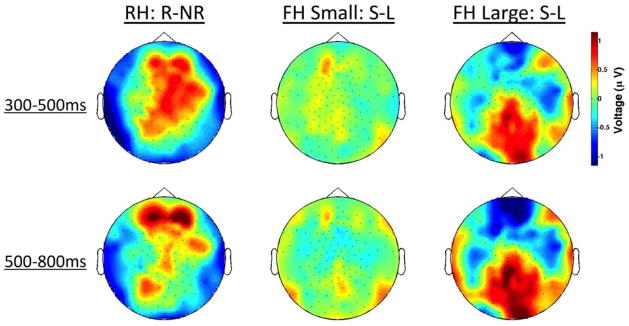
Topographic maps of voltage amplitude differences across the entire scalp. The left column shows recognition heuristic trials (RH): activation for unrecognized cities is subtracted from recognized cities (R-NR) for the early time window associated with familiarity (300–500 ms) and the late time window associated with recollection (500–800 ms). The middle column shows activation differences for fluency heuristic trials with a small recognition speed difference (FH Small): the city with a longer reaction time within a pair subtracted from the city with a shorter reaction time within a pair. The right column shows activation differences for fluency heuristic trials with a large recognition speed difference (FH Large): the city with a longer reaction time within a pair subtracted from the city with a shorter reaction time within a pair. Red (light gray) regions indicate greater amplitudes for well-known cities within a pair, and blue regions (dark gray) indicate greater amplitudes for the lesser-known cities within a pair.
Only relevant and/or significant main effects and interactions resulting from the ANOVAs are reported. The reported analyses were limited to adherent trials, where participants’ decisions were in line with the given heuristic’s prediction. Separate analysis of non-adherent trials was run on a subset of participants with satisfactory EEG trial counts, but a statistical analysis of these trials resulted in no ERP FN400 or parietal old/new effects.
300 – 500 ms
The ANOVA for the time window corresponding to the FN400 (300 – 500 ms) revealed a significant three-way interaction between condition, recognizability, and posteriority (F(2, 94) = 4.04, p = .021, ηp2= .08), such that there was only a two-way condition by recognizability interaction present for the anterior ROIs (F(2, 94) = 6.37, p = .003, ηp2= .12), consistent with the typical anterior distribution of the FN400. Within the anterior ROIs, only the RH condition yielded a significant effect of recognizability, such that ERPs in response to unrecognized cities with in a pair were significantly more negative than those in response to recognized cities (t(95) =−3.92, p< .001, g = −0.45). This result is consistent with greater familiarity for recognized compared to unrecognized stimuli during RH-based decisions.
500 – 800 ms
The ANOVA for the time window corresponding to parietal old/new effects (500 – 800 ms)revealed a significant three-way interaction between condition, recognizability, and posteriority (F(2, 94) = 7.56, p = .001, ηp2 = .14), such that there was only a two-way recognizability by posteriority interaction present for the FH large difference (>400 ms) condition (F(1, 47) = 23.6, p< .0001, ηp2= .33). Within the FH large difference (>400 ms) condition, only the posterior ROIs yielded a significant effect of recognizability (consistent with the typical posterior distribution of the parietal old/new effects), such that posterior ERPs in response to faster (more fluently) recognized cities within a pair were significantly more positive than ERPs in response to slower recognized cities (t(95) = −4.41, p< .0001, g = −0.50). This result is consistent with greater recollection for faster recognized cities compared to slower recognized cities during FH trials with large recognition speed differences.
300 – 800 ms
To examine possible differences between the early and late time windows, an ANOVA was conducted including the early and late time windows as an additional two-level independent variable. Because the FH small difference (< 400 ms) condition yielded no significant results in the above analyses, this condition was eliminated for this analysis.
There was a marginally significant four-way interaction between condition, time window, recognizability, and posteriority (F(1, 47) = 4.04, p = .05, ηp2 = .08). This four-way interaction would potentially doubly dissociate familiarity at the early time window during RH trials at anterior electrode sites, and recollection at the late time window during FH trials (>400 ms) at posterior electrode sites. Potentially holding back this dissociation is the finding that at posterior sites, faster recognized cities in the FH (>400 ms) condition are significantly more positive than slower recognized cities during the early time window (t(95) = −3.30, p = .002, g = −0.38; see Figure 6, upper-right) as well as the late time window (Figure 6, lower-right). In other words, the fluency-related parietal recollection effects may have started earlier in this experiment than is typical for recollection effects to start in recognition memory experiments.
Discussion
Experiment 1 implemented a city-size comparison task to investigate the impact of recognition memory on heuristic decision-making. We sought to replicate Rosburg et al.’s (2011) finding of greater familiarity for recognized compared to unrecognized cities, as indexed by more positive FN400 effects for recognized cities. Because a recognized and an unrecognized city should be strongly dissociable based on familiarity alone, we predicted it would be unnecessary to retrieve further knowledge about the recognized city, and thus parietal old/new effects (thought to index recollection) may be indistinguishable between these cities. This prediction is compatible with the noncompensatory claim of the RH, such that decisions would be based solely on an early familiarity signal without consideration of further recollected knowledge. The ERP results supported these predictions, as FN400 effects at anterior sites were significantly more positive for recognized compared to unrecognized cities while parietal old/new effects at posterior sites did not differ between recognized and unrecognized cities.
These findings are consistent with the framing of the RH as a fast, less-is-more, noncompensatory decision mechanism. As suggested by Goldstein and Gigerenzer (2002), recognition, or more specifically familiarity, appears to serve as an initial screening step that can be used to differentiate two items. Because RH trials necessitate a certain level of disparity in subjective memory between two items (one must be recognized to some degree and one must not), the majority of RH trials would flow down the right arm of our decision flow chart (see Figure 2, highlighted in red) corresponding to large familiarity differences. If two items are deemed reliably dissociable based solely on familiarity, it seems logical that search for further cue knowledge (via recollection) may be abandoned and a decision made efficiently based on familiarity. Goldstein and Gigerenzer claimed that further cue knowledge would only be searched for if both objects in a decision frame were recognized (to a certain degree); a condition that would permit use of the FH but not the RH by their traditional definitions.
For FH-applicable trials in Experiment 1 (i.e. both cities were recognized) when there was a small recognition speed difference between cities, we predicted and found indistinguishable FN400 and parietal old/new effects. Based on their similar retrieval fluencies, these cities should be comparable in terms of how familiar they are as well a show much recollected cue knowledge they elicit. The FH is not typically an advantageous decision-making strategy in this situation due to the similar fluency values, and previous studies have found that people adhere less frequently to the FH in these cases (Hertwig et al., 2008; Schooler & Hertwig, 2005). These trials are likely predominantly guided by guessing or other strategies.
For FH-applicable trials in Experiment 1 with a large recognition speed difference between two recognized cities, there was no significant FN400 difference between faster recognized and slower recognized cities at anterior sites, implying similar levels of familiarity for the two cities. However, we did find significantly greater parietal old/new effects at posterior sites for faster recognized cities than slower recognized cities within a pair, suggesting greater recollection for more quickly retrieved cities. These results are consistent with the perspective that when both cities are associated with some intermediate level of recognition (FH trials), the corresponding familiarities encompass a smaller range of memory activation than in cases where only one city is associated with some level of recognition (RH trials) (e.g., Hertwig et al., 2008; Hilbig et al., 2011). In instances where two cities are recognized, familiarity alone might often not be robust enough to dissociate faster recognized cities from slower recognized cities, and participants may then turn to recollected knowledge to make decisions.
These ERP results are inconsistent with the notion that FH decisions are based on a familiarity comparison, instead alluding to a role for recollection in determining population inferences. Because both cities within these large (>400ms) recognition speed difference trials are necessarily associated with an intermediate level of recognition, they should have similar familiarities relative to RH trials, and should predominantly follow the left branch of our decision flow chart (see Figure 2) associated with a small familiarity difference between cities. If cue knowledge exists for either of the cities presented, participants could use this recollection as a decision cue if available knowledge discriminates between the two cities. According to our ERP results, more quickly recognized cities are associated with greater recollection, which could provide knowledge-based cues relevant to acity’s population. If no such knowledge exists for either city, or if available knowledge for one city is not distinguishably greater in terms of content or amount than the other city, participants can turn to retrieval fluency to guide decisions. At this point, it is clear that no direct memory cues exist upon which to base a decision. In turning to the FH (see Figure 2, blue highlighted path), participants can rely on a byproduct of memory (retrieval fluency) only if the difference in retrieval fluencies between the cities is distinguishable (see Hertwig et al., 2008). However, because inferences at this step of the decision flow will necessarily be associated with a small familiarity difference, it is likely that the retrieval fluencies for the two cities will be similar as well, limiting the usefulness of the FH. In situations where participants cannot reliably discriminate between retrieval fluencies, they can resort to guessing.
Taken together, our results corroborate existing perspectives of the RH and provide unique evidence for its assertion as a noncompensatory mechanism. Additionally, the existence of parietal old/new effects during FH trials provides novel evidence in support of potential knowledge-based strategies at work during supposed FH-based decisions (Marewski & Schooler, 2011), and the lack of FN400 effects undermines a potential role for familiarity during these decisions.
Experiment 2
Though our results from Experiment 1 suggest RH-based decisions are based solely on the familiarity component of recognition memory, our observation of FN400 and parietal old/new ERP effects was not coupled with behavioral measures of familiarity and recollection. This interpretation therefore hinges on a reverse inference problem. Although we had reason to expect familiarity to be operative during heuristic decision making, as Paller, Lucas, and Voss (2012) point out in their critique of Rosburg et al. (2011), it would be presumptuous to conclude that familiarity (and recollection) are contributing to decisions based on ERP evidence alone. FN400 signals, they note, may indicate only one possible familiarity source - not familiarity itself.
In Experiment 2, we attempt to alleviate some of these concerns by collecting behavioral measures of familiarity and recollection for all of the same stimuli used in Experiment 1. By directly gauging participants’ assessments of their explicit memory for presented stimuli, we can utilize converging methods to better estimate the use of familiarity and recollection during heuristic decision making.
An initial question to consider is how recollection might be related to the speed at which an item is recognized or retrieved from memory - its retrieval fluency. Research implementing the RH and FH into the ACT-R cognitive architecture has typically assumed that the more quickly an item is retrieved, the greater the sense of recognition and ease of retrieval (Anderson et al., 1998; Marewski & Schooler, 2011; Schooler & Hertwig, 2005). In support of this assumption, Hertwig et al. (2008) conducted an experiment that showed that reaction times in a recognition test were shorter for more populous cities, perhaps indicating that more well-known cities are associated with faster retrieval fluencies. Our ERP results suggest that two recognized cities associated with largely different recognition speeds differ on the basis of recollection. Thus, it seems likely that cities associated with greater recollection are also more fluently retrieved. In this way, retrieval fluency may be negatively correlated and confounded with recollection, making it difficult to determine which cue participants are utilizing when making population decisions - recognition speed or recollected cue knowledge.
Experiment 2 aims to answer some of the questions surrounding retrieval fluency, familiarity, and recollection by collecting additional information about each city presented in the task. Experiment 2 differed from Experiment 1 only in the recognition test phase. In addition to providing timed “yes” or “no” recognition responses to each city in the task, a modified remember-know procedure was included. In the literature, the remember-know procedure has been commonly used to differentiate items that are familiar (“known”) from those that are consciously recollected (“remembered”). The procedure typically involves a study phase and test phase where participants are asked to make remember/know judgments pertaining to items in the previous study phase. Our implementation of this design instead focuses on pre-experimental memory, where participants make analogous remember/familiar judgments about cities or countries they had heard of outside the context of the experiment. Other researchers have used similarly modified versions of the remember-know procedure (Bird, Davies, Ward, & Burgess, 2011; Trinkler, King, Doeller, & Rugg, 2009) and typically found universally enhanced familiarity and recollection for pre-experimentally known items compared to novel items. Additionally, some previous studies considering the RH and FH have implemented similar versions of a recognition test that inquire about recognition and further knowledge from prior to the experiment (e.g., Castela, Kellen, Erdfelder, & Hilbig, 2014; Pohl, 2006). For our version of the task, after giving an initial speeded yes/no response to obtain unadulterated RTs, participants identified cities as “remembered”, “familiar”, or “unknown”. Additionally, for cities identified as “remembered”, participants provided information about how many specific contextual details they could recollect about that given city.
Regarding the relationship between retrieval fluency and familiarity/recollection, we predict that reaction times for cities identified solely as “familiar” will be longer than cities identified as “remembered”. Presumably, cities identified as “familiar” are less well-known, associated with less experience in the environment, and not associated with any recollectable cue knowledge, so an effortful search through memory should persist longer in these cases in an attempt to recollect ultimately unavailable knowledge that would verify a city is legitimately extant. Cities identified as “remembered” should be associated with faster reaction times as a result of readily accessible and recollectable cue knowledge that immediately verifies their status as a U.S. city or country. Though we cannot precisely measure gradients of familiarity with the present methodology, it is also likely that “remembered” cities are in actuality more familiar than simply “familiar” cities, because they should be associated with more frequent exposure in the environment. Following this same logic, we predict that cities where participants are able to identify higher quantities of distinct remembered details will have faster reaction times than cities where participants identify lower quantities of distinct remembered details. Ideally, we would expect a continuum of reaction times, with the fastest recognized cities associated with the largest amounts of recollectable cue knowledge, and the slowest recognized cities associated with solely “familiar” judgments. This pattern of results would bolster our ERP findings from Experiment 1 as well as verify previous assumptions in the literature, such that faster recognized cities would be validated as more well-known, and provide direct evidence of the availability of a recollection-based cue that participants could be using as the basis for their population decisions, in addition to the already-established fluency cue.
Collection of additional information in the recognition test will allow for finer-grain comparison of trials in the population decision-making task. Additionally, participants’ assessments of their own explicit memory for cities will provide behavioral evidence to help inform our interpretation of ERP findings from Experiment 1, and give greater insight as to which memory processes are contributing to decisions.
Method
Participants
Thirty-four new participants (11 female) ranging in age from 18 to 23 were recruited to partake in the study. Sample size was decreased relative to Experiment 1 because all subjects received the same task order (recognition before inference) and EEG recording was not included. All participants were undergraduate students receiving course credit from the University of Colorado. All participants were informed about the procedure and gave their written consent before participating.
Materials and Procedure
Each participant performed two computerized tasks similar to those in Experiment 1: a city/country recognition test first and a population inference task second. Task order was not counterbalanced because results from Experiment 1 yielded no significant effects of task order, and we wished to obtain the purest measures of pre-experimental memory as possible during the recognition test. Prior to beginning, each participant completed an approximately 3-min practice session for both tasks, using non-experimental stimuli.
For the recognition test, participants viewed the same 100 U.S. cities, 100 countries, 10 fictional cities, and 10 fictional countries. Order of city and country blocks was counterbalanced. Each trial began with a 2 s fixation cross (+), followed by a single randomly selected city name on the center of the screen. On the first screen, participants were instructed to indicate with a “yes”/“no” button press whether or not they recognized each city from prior to the experiment, just as was done in Experiment 1. Reaction times were recorded for this first response and interpreted as the recognition speed for that given city. Key assignments remained at the bottom of the screen for the duration of the experiment, with order of key assignments counterbalanced across participants. After the first “yes”/”no” recognition response was made, the stimuli remained on the screen, but the key assignments at the bottom of the screen updated to a three-choice set: “Remember”, “Familiar”, or “Unknown”. Participants were instructed to identify whether they could “remember” that city, described as recall of any type(s) of specific details about that city from prior to the experiment; if the city was simply “familiar”, described as knowing they have heard of that city prior to the experiment, but being unable to recall any specific details; or “unknown”, described as never having heard of that city before. Stimuli remained on the screen until this second response was made, and accuracy was emphasized over speed. If participants identified a city as “remembered”, they were immediately prompted with the question “How many details can you recall about [city X]?” on the center of the screen. Response options appeared on the bottom of the screen, with four choices ranging from 1 to 4+ (4 or more), and their counterbalanced key assignments beneath them. Responses were untimed, and upon making a choice the trial ended and the next trial began. If participants instead identified a city as “familiar” or “unknown”, they were immediately prompted with the question “How confident are you that [city X] is [familiar/unknown] to you?” on the center of the screen. Response options appeared below, as a set of four confidence choices (“Guess”, “Minimally”, “Somewhat”, “Very”), with their designated counterbalanced key assignments below. Confidence judgments for “familiar”/”unknown” responses were primarily included in an attempt to equalize participant effort across all trial types.
The population inference task for Experiment 2 was nearly identical to that described in Experiment 1 (See Figure 3). The only deviation from Experiment 1 was that participants viewed each city for 1500 ms instead of the previous 2000 ms, because EEG was not recorded and longer stimulus durations were not necessary.
Results and Discussion
Participants recognized on average 79 out of the 100 most populous U.S. cities, and 86 out of the 100 most populous countries. This resulted in an average of 272 FH-applicable trials, 104 RH-applicable trials, and 17 guessing trials (neither city recognized) per participant. Additionally, participants on average only claimed to recognize 1.7 of the 20 fictional cities and countries included in the recognition test, so responses were honest. The recognition validity (M = .76, SD = .05) and fluency validity (M = .60, SD = .05) were again within range of previously reported findings (Hertwig et al., 2008; Hilbig et al., 2011) including our own Experiment 1 findings (M = .76, M = .59, respectively), and both were significantly greater than chance (t(33) = 28.7, p < .0001, g = 4.82; t(33) = 10.3, p < .0001, g = 1.73; respectively) indicating that recognition and fluency were ecologically rational cue during RH and FH trials, respectively. The overall adherence rate for the RH (M = .85, SD = .10) was significantly above chance (t(33) = 19.6, p< .0001, g = 3.29), as was the overall adherence rate for the FH (M = .62, SD = .05; t(33) = 14.1, p < .0001, g = 2.36), indicating that participants’ choices were in line with each heuristic’s prediction on a majority of trials.
Multinomial Processing Tree analysis
Thirty-four participants resulted in an aggregate of 13,383 inference trials (see Appendix B). Similar to Experiment 1, considering the large number of trials and high statistical power for a goodness of fit test, the model fit the data well (G2(1)= 3.14, p = .08). Parameter estimates are displayed in Table 2. The model-estimated recognition validity was identical to that reported in the observational statistics above (M = .76), as well as a nearly identical fluency validity (M = .61), thus corroborating the estimates obtained from the r-s-model. According to the r-s-model, participants relied on the recognition cue in isolation (r-parameter) when one city was recognized and the other was not recognized on 63% of the trials. This estimate is lower than the mean adherence rate reported above (M = .85), though still indicates participants were using the RH on a majority of trials (ΔG2= 67, p< .0001, when fixing r = .50).
Table 2.
Experiment 2 parameters of the r-s-model, psychological meaning of the parameters, and parameter estimates with standard errors of each estimate, based on data from all participants.
| Parameter | Psychological Meaning | Estimate (SE) |
|---|---|---|
| a | recognition validity | .76 (.01) |
| b1 | knowledge validity, fluency-homogenous FH cases | .63 (.01) |
| b2 | knowledge validity, fluency-heterogeneous FH cases | .67 (.01) |
| b3 | knowledge validity, RH cases | .661 |
| c | fluency validity | .61 (.01) |
| g | correct guessing (neither object is recognized) | .51 (.02) |
| p | proportion of fluency-homogenous FH cases | .13 (.00) |
| r | RH-use (considering the recognition cue in isolation) | .63 (.01) |
| s | FH-use (considering retrieval fluency in isolation) | .21 (.01) |
This number is derived analytically from b3 = p × b1 + (1 − p) × b2and is thus reported without a standard error.
Most importantly, the r-s-model estimated that participants relied on retrieval fluency (recognition speed) in isolation when both cities were recognized on 21% of trials (s = .21). This estimate replicates Hilbig et al.’s (2011) findings, indicating that participants only used the FH on approximately one fifth of the trials in which it could have been applied. This s-parameter estimate, which again unconfounds the contributions of retrieval fluency and further knowledge to a decision, is significantly lower than the mean FH adherence rate reported above (ΔG2= 1713, p< .0001, when fixing s = .62). So, across all participants, use of the FH as it is traditionally defined seemed quite sparse.
To test if the reported findings above hold on an individual level, we applied the r-s-model to each participant’s data to obtain individual parameter estimates. Results indicated that the r-s-model fit 32 out of the 34 participants’ data well (G2< 4, p> .05), with the remaining two participants obtaining a reasonable fit (G2< 10, p> .002). No participant had an r-parameter larger than their adherence rate, and thus the finding of reduced RH-use reported from the aggregate results appears to represent a pattern across all participants. Similarly for the FH, no participant had an s-parameter larger than their adherence rate, and furthermore no participant relied on retrieval fluency alone on greater than 38% of the trials, suggesting that all participants relied on more than just recognition speed to make choices on a majority of trials.
As was done in Experiment 1, we also fit separate r-s-models to the 1st and 4th repetition of each stimulus to examine heuristic use across the duration of the experiment. The first-encounter trials fit the r-s-model well (G2(1)= 1.68, p = .19; see Appendix E for model category frequencies and parameter estimates), as did the fourth-encounter trials (G2(1)= .04, p = .85; see Appendix F for model category frequencies and parameter estimates). The resulting r-parameter of .688 for first repetition trials was lower than .592 for fourth repetition trials (ΔG2= 10.6, p =. 001, when fixing r(rep1) = .592), suggesting that RH use may have decreased across the duration of the experiment. This is not unreasonable, as repetition may have increased the familiarity of previously unknown stimuli within the experiment (see Schweickart & Brown, 2014), forcing participants to rely on more knowledge-based strategies later in the experiment. The resulting s-parameters of .198 for first repetition trials and .202 for fourth repetition trials did not differ (ΔG2= .03, p =. 87, when fixing s(rep1) = .202), suggesting that FH use remained consistent across the duration of Experiment 2.
Remember-Know analysis
Information pertaining to a participant’s perceived memory for each city and country was collected. Each city was identified as remembered, familiar, or unknown (for the first analysis we will focus only on cities identified as remembered or familiar). Furthermore, each city identified as remembered was associated with a specific number of recalled details about that particular city, ranging from one to four or more. This resulted in a total of five perceived memory judgments for each city: familiar (F), remembered with 1 detail (R1), remembered with 2 details (R2), remembered with 3 details (R3), and remembered with 4 or more details (R4).
To assess the relationship between retrieval fluency and recollection, mean recognition speeds for five memory judgments were calculated (see Figure 7). A linear mixed model was fit to the data, using perceived memory as the categorical independent variable and recognition speed as the continuous dependent variable. Reaction times were log-transformed prior to analysis. The model resulted in a significant linear effect of memory strength on recognition speed (r = −.701), indicating that as perceived memory strength for a city incrementally increased, recognition speed decreased (F(1, 32.86) = 80.47, p< .0001). F-statistics and p-values were obtained using the Kenward-Rogers approximation (Kenward & Roger, 1997). This result demonstrates that retrieval fluency (i.e., recognition speed) is indeed confounded and negatively correlated with the amount of further knowledge accessible for a given city (i.e., perceived memory). It also demonstrates that cities identified more quickly are directly associated with greater knowledge or recollection, and corroborates the existence of a ‘recollection cue’ that participants could capitalize on when making population decisions.
Figure 7.
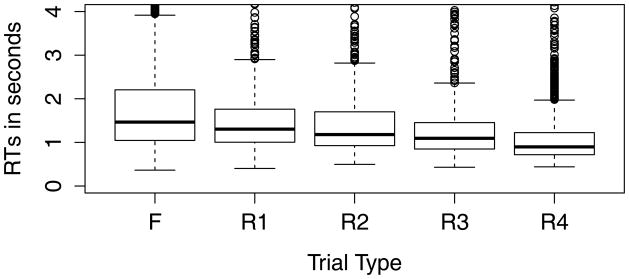
Boxplot of aggregate recognition speeds (RTs) prior to log transformation for all cities and countries on the y-axis, grouped by the five memory categories of interest (F = Familiar, R1/R2/R3/R4 = Remembered with 1, 2, 3, or 4 or more details) on the x-axis. Upper bounds of boxes represent the upper quartile of responses and lower bounds of boxes represent the lower quartile. Solid horizontal lines within boxes indicate the median recognition speed for each memory category. Responses outside the tails of each box represent outliers.
To consider the usefulness of perceived memory and further knowledge as a potential decision cue during the inference task, we can examine trials where both cities were recognized. Figure 8 shows inference task choices for these trials for each participant. Participants with less than 5 trials in either condition were excluded from that condition. In trials where one city was identified as remembered and the other was identified as familiar (Fig. 8A), participants chose the remembered city as being more populous 77% of the time, significantly above chance level (t(33) = 14.18, p<.0001, g = 2.38). It should be noted that this number is substantially larger than the overall FH adherence rate (M = .62), suggesting that perceived memory for a city is potentially a more useful decision cue than retrieval fluency (however, these two results cannot be statistically compared because they consist of the same overlapping observations). In trials where both cities were identified as “remembered” (Fig. 8B), we can restrict analysis to pairs where one city was identified as strongly remembered (3–4 or more details remembered) and the other city was relatively weakly remembered (1–2 details remembered). In these trials, participants chose the more strongly remembered city as being more populous 70% of the time, significantly above chance level (t(30) = 9.71, p<.0001, g = 1.70). This result suggests that even when specific details can be recalled for both cities within a pair, the city associated with greater recollection is typically chosen as being more populous. Furthermore, the city associated with greater recollection is also chosen as being larger more frequently than the city that was simply recognized more speedily.
Figure 8.

(A) Inference choices for remembered vs. familiar fluency heuristic (FH) trials. Participants are sorted on the x-axis, with the percentage of trials they chose the remembered city as being more populous than the familiar city on the y-axis, with the red line indicating 50%. (B) Inference choices for remembered vs. remembered fluency heuristic trials. Participants are sorted on the x-axis, with the percentage of trials they chose the more strongly remembered city (Rem. (3,4); 3–4 memory details) as more populous than the less strongly remembered city (Rem. (1,2); 1–2 memory details), with the red line indicating 50%.
In order to parse out the relative contributions of recognition speed and perceived memory strength to population decisions, we adopted a mixed model approach based on the aggregate data. A memory difference variable was created for each pair of cities in the inference task by subtracting the perceived memory value of city 2 from city 1 (familiar = 0, R1 = 1, R2 = 2, R3 = 3, R4 = 4), forming a 5-level categorical variable. Recognition speed difference between both cities within a pair was also computed by subtracting the recognition speed of city 2 from city 1. An initial model incorporated all trials where either city was identified as familiar or remembered (4,790 trials), and used both log-transformed recognition speed difference and categorical perceived memory difference to predict participants’ decisions. This model yielded a strong simple effect of perceived memory difference (b = −.40, SE = .03, p < .00011), as well as a strong simple effect of recognition speed difference (b = 2.28, SE = .31, p<.0001). However, this model incorporates comparisons where both cities received the same perceived memory response (e.g. familiar vs. familiar), and therefore perceived memory difference is an uninformative predictor of choice. Focusing solely on trials where one city was identified as familiar and one city was identified as remembered, we fit the same mixed model. Again, there was a strong simple effect of perceived memory difference (b = −.42, SE = .04, p<.0001), and a slightly attenuated, though still significant simple effect of recognition speed difference (b = 1.92, SE = .62, p = .002). These results demonstrate that both retrieval fluency and recollected knowledge (via perceived memory) play differential roles when participants are making population decisions, but that perhaps perceived memory is a superior decision making cue compared to recognition speed when it is available.
Returning to the multinomial processing model (r-s-model), we can now look at different trial types based on perceived memory and observe their effects on supposed RH and FH use. For RH cases, we can examine “remembered” vs. “unknown” (RvU) trials and “familiar” vs. “unknown” (FvU) trials. To do this, we can extract the RH tree within the r-s-model, and compare only RvU and FvU observations as separate trees within a new model. This procedure is valid because trees within multinomial processing models are independent (Batchelder & Riefer, 1999), and we have established that the model holds for our data. When comparing these two trees, it is not possible to perform a goodness of fit test (the new model is saturated), but this is not a problem because we have shown that the full model holds with our data. However, we cannot definitively show that the full model holds for the separation of RvU and FvU trials, thus we cannot rule out the possibility that the full model operates differently in these cases, and therefore our comparison of output from these different trial types in the new model must be taken as suggestive rather than indisputable.
The comparison of RvU and FvU trees within the new multinomial model estimated recognition validities of .80 and .70, respectively. This finding suggests, because the probability of the recognized city actually being more populous is higher in RvU cases (regardless of participants’ choices), that relying on recognition in isolation to make a decision is simply more reliable in RvU cases. Furthermore, the new model output r-parameter estimates were .71 for RvU trials and .59 for FvU trials, indicating participants relied on mere recognition alone to make their decisions in 71% of RvU trials and 59% of FvU trials. By setting this model as a baseline model, and fixing the r-parameter to be a constant 71% for FvU trials (or alternatively setting the r-parameter to be a constant 59% for RvU trials) in a new model, we can statistically compare these two r-parameters. This comparison indicates that the r-parameter for RvU trials is significantly greater than the r-parameter for FvU trials (ΔG2= 26.2, p< .0001; when fixing rFvU= .71), implying that participants were using the RH on a greater portion of RvU trials than FvU trials.
In addition to examining different RH trial types, there are three different FH trial types that can be examined: “remembered” vs. “familiar” (RvF), “remembered” vs. “remembered” (RvR), and “familiar” vs. “familiar” (FvF). Just as was done with the RH, we can extract the FH tree from the r-s-model and create a new model composed of three separate FH trees to accommodate the three separate trial types within one model. A unique latent parameter that is provided by the r-s-model, and therefore carried over to our new model, is the knowledge validity. This estimates the probability of recollecting valid knowledge as opposed to invalid knowledge. The knowledge validities of the three trial types were estimated to be: RvF, .72; RvR, .67; FvF, .60. These numbers indicate that knowledge, or recollection, was most valid for RvF trials, significantly greater than RvR trials (ΔG2= 14.3p< .01; when fixing bRvF = .67)and FvF trials (ΔG2= 83.8 p< .0001; when fixing bRvF = .60). This finding is consistent with recollection being a more useful decision cue for RvF trials, where recollection only occurs for one city within the pair, compared to other trial types. The s-parameter estimates indicate that recognition speed was used in isolation to make population decisions on approximately 28% of RvF trials, 17% of RvR trials, and 16% of FvF trials. We can statistically compare these numbers by comparing independent trees within the new model. This comparison indicates that the retrieval fluency cue was used in isolation on a significantly larger portion of decisions for RvF trials than RvR trials (ΔG2= 29.1 p< .0001; when fixing sRvF = .174) and FvF trials (ΔG2= 39.8 p< .0001; when fixing sRvF = .156). True FH use for RvR trials and FvF trials did not significantly differ (ΔG2= 0.43 p = .51; when fixing sRvR = .156). These numbers indicate that people are actually using the FH more often on RvF trials, where we also found further knowledge to be most useful based on knowledge validities, compared to RvR and FvF trials.
Another estimate we can utilize to assess use of retrieval fluency in FH decisions is the fluency validity, which outputs the proportion of trials in which the more quickly recognized city is actually more populous. The fluency validity for the three trial types was as follows: RvF, .643; RvR, .593; FvF, .562. A comparison of these numbers shows that fluency validity is greater for RvF trials than both RvR (ΔG2= 42.86, p< .0001; when fixing cRvR = .643) and FvF (ΔG2= 38.55, p< .0001; when fixing cFvF = .643) trials. This suggests that retrieval fluency, or recognition speed, is most useful as a decision cue in RvF trials compared to RvR and FvF trials.
General Discussion
The main idea behind the recognition and fluency heuristics is that decision makers are able to capitalize on recognition (in the case of the RH), or speed of retrieval (in the case of the FH), and use this memory-based information as an isolated cue when making a decision. However, extant research has made limited progress towards connecting these decision-making heuristics to specific hypothesized memory processes. Recent years have seen these heuristics challenged from multiple angles (Bröder & Eichler, 2006; Hilbig 2010; Hilbig et al., 2011; Newell & Fernandez, 2006; Pohl, 2006, among others), and as such a better understanding of the fundamental underlying processes could make progress toward resolving the controversy surrounding the RH and FH as realistic and practical models of comparative judgment.
In two experiments we adopted a dual-process perspective of recognition memory aimed to uncover the different memory components at play in the RH and FH. Findings from both experiments supported a role for familiarity in RH-based decisions. Conversely, both experiments supported a role for recollection in FH-based decisions, suggesting that perhaps in situations where there was not a reliable familiarity difference between cities, further memory search via recollection could provide knowledge-based cues that participants could utilize to make population decisions. Based on these results, we proposed a new theoretical framework as a decision flow chart that incorporates the RH and FH to make decisions based on a non-binary construal of recognition memory (Figure 2). We will briefly review findings concerning each heuristic, and then discuss the theoretical implications these findings have on the understanding of the recognition and fluency heuristics.
The Recognition Heuristic
Results of both experiments suggest that RH-based decisions could be made based solely on familiarity, ignoring any further knowledge. Experiment 2 results showed that in the absence of any knowledge for either city within a pair, the RH was still used on a majority of trials (RH use during FvU trials = 59%), which supported the interpretation of significant FN400 familiarity effects observed in Experiment 1.
Closer examination of the two possible RH trial types (RvU and FvU) showed greater true RH use for RvU trials compared to FvU trials. Our theoretical stance thus far has been that familiarity processes are utilized in RH decisions in a noncompensatory fashion, and that recollection plays no readily identifiable role. The r-parameter estimates reliance on recognition in isolation, without contribution from further knowledge, and thereby the finding of a greater r-parameter for RvU trials does not necessarily suggest recollection was utilized in these decisions (which would challenge the noncompensatory claim). Rather, this finding is likely attributable to familiarity. More disparate familiarities between cities in RvU trials presents a larger, more usable familiarity cue for decision makers to capitalize on. In other words, ‘remembered’ cities should have greater familiarity than ‘familiar’ cities, because they should be associated with more frequent exposure in one’s environment. More exposure in the environment should lead to corresponding increases in familiarity, because familiarity is thought to operate on a continuum (Woodruff et al., 2006; Yonelinas, Otten, Shaw, & Rugg, 2005). Moreover, a greater r-parameter in cases where recollection was available suggests that this corresponding knowledge was ignored, and that the RH is utilized in a noncompensatory rather than a compensatory fashion.
Marewski & Schooler (2011) utilized the ACT-R architecture to examine some of the same questions regarding the RH and FH. Their approach differed from ours in that the authors ranked the cities used in their experiment using environmental frequency information, and used this to assess the probability of a person being in one of six “memory states”. Whereas Marewski and Schooler used pre-experimental environmental frequencies to predict the probability of a person being in a given memory state (and therefore which decision strategies they might select), our methodology measured which cities were unknown, familiar (merely recognized), or remembered (further knowledge available) for each participant, allowing us to examine actual decision behavior in six analogous memory conditions. For example, the RH is only applicable in two of the six memory conditions or trial types: when one city is ‘familiar’ and the other is ‘unknown’(FvU trials), and when one city is ‘remembered’ and the other is ‘unknown’ (RvU trials). Marewski and Schooler referred to their analogous RH conditions as tartle-unrecognized pairs (tartle is a Scottish verb for merely recognizing something but having no knowledge about it), which map onto our FvU trials, and knowledge-recognized pairs, which map onto our RvU trials. Generally, they showed that recognition validities covaried with available knowledge, and thus asserted that participants could do well using the RH in both conditions, though slightly better in memory states analogous to our RvU trials. They also point to Marewski, Gaissmaier, and Schooler’s (2010) comparative model tests, which provided some evidence to suggest that participants do indeed rely on the RH over knowledge-based strategies in these types of memory states, which implicates a stronger role for familiarity over recollection in these trial types.
The interpretation of divergent familiarity for two items driving RH decisions is consistent with what could be expected within our proposed decision flow. More so than FH trials, RH trials typically represent cases where one city is considerably better recognized than the other. This is especially true for RvU trials, which represent the most extreme disparity in memory between two cities. Following the decision flow for these trials with a large familiarity difference between the two cities (the right path), one should be able to make a decision based on which city is more familiar a majority of the time, thus utilizing the recognition cue in isolation and abiding by the RH as it is traditionally defined. Alternatively, familiarity differences for FvU trials are relatively more homogenous. These trials, more often than RvU trials, would follow the left path with similar familiarities between two cities, and because no recollection of any kind is extant in these trials, participants would either fall back on retrieval fluency or guess. The trials most likely to follow this path would be those where the participant is unsure if a city is truly familiar, or its familiarity is very weak. Lack of a large familiarity difference between cities in these trial types coupled with the absence of any recollected knowledge would leave no direct memory-based cue participants could grasp to make decisions. Erdfelder, Küpper, & Mattern (2011) elaborated on a similar idea, asserting that recognition judgments could arise from two types of cognitive states: certainty states where memory strength is strongly correlated with judgments, and uncertainty states where judgments reflect guessing rather than differences in memory strength. Based on their results, they argued that these memory states influenced peoples’ reliance on the RH, such that in situations where there was certainty for high memory strength or low memory strength (certainty for non-recognition) for an item, people were more likely to utilize the RH. That is, when a large (presumably familiarity) difference in memory for two items exists, people could more often rely on the RH.
The recognition heuristic has traditionally embraced recognition as a binary entity, and has worked to describe decisions based on this single binary cue. Though simplistic, this approach has been sufficient to explain behavior in a majority of cases. We emphasize that recognition is a more graded entity in reality (via familiarity), and the RH has succeeded in describing choice behavior because it happens to exploit the most extreme endpoints of this familiarity gradient. This is not so much a critique of the RH as it is an alternative understanding. Our understanding lifts the limitation of binary recognition, and allows for a more diverse set of inferences to be made.
The Fluency Heuristic
The FH by definition assumes that decision makers are relying on consciously assessable recognition speeds to make choices. However, our findings suggest that recollection of alternate knowledge cues could be utilized to make population decisions and implicate a potential preference for knowledge-based strategies over the FH. Results from the r-s-model indicated that participants relied on recognition speed, or retrieval fluency, in isolation to make their decisions on only approximately one-fifth of trials where it was applicable. This stark contrast to the more generous and biased FH adherence rate (M = .59) lends further credence to the idea that participants were predominantly capitalizing on recollected knowledge to make their decisions, not the FH.
Experiment 1 highlighted an apparent confound between retrieval fluency and recollection: more fluently retrieved cities were also associated with greater parietal old/new effects thought to index greater recollection. In Experiment 2, we found that cities identified as simply “familiar” were associated with the slowest recognition speeds, and that recognition speeds linearly decreased as participants identified greater amounts of recollectable cue knowledge for “remembered” cities. This result provided direct behavioral evidence in support of our ERP FH findings from Experiment 1, demonstrating the availability of a recollection-based distinction between more quickly and slowly retrieved cities that participants could utilize when making population decisions. Additionally, the finding that our memory-difference variable in the mixed model accurately predicted participants’ decisions provides evidence for a memory-based distinction driving decisions.
Data from Experiment 2 allowed us to further examine subtypes of FH trials using the s-parameters provided by the r-s-model. The s-parameter not only provides estimates of the proportion of supposed FH decisions made based solely on recognition speed, it also assumes that decisions not made based on retrieval fluency incorporate further knowledge. In this way, the s-parameter is a direct measure of the contribution of recognition speed to decisions, and an indirect measure of the contribution of further knowledge to decisions. We examined three different FH trial types to parse out potentially differential contributions of recognition speed to decisions at different levels of subjective explicit memory. We found that the FH is utilized more often when there are large differences in subjective memory and recognition speeds between two items (see also Hertwig et al., 2008), and that more speedily recognized items are associated with greater recollection. A similar result was demonstrated by Marewski & Schooler (2011), as their model predicted that the magnitude of reaction time differences within a pair of items correlated with the availability of knowledge, and as such, with the applicability of knowledge-based strategies. As Marewski and Schooler put it, the cognitive niches of the FH and other knowledge-based strategies overlap in situations where knowledge is available. In other words, both recollection and fluency should have the highest reliability during the same memory condition - most prominently RvF trials. Furthermore, we found that both the fluency validity and knowledge validity was highest for these trials, again mirroring the findings of Marewski and Schooler, demonstrating that trials where recognition speed best predicted population were the same trials where recollected knowledge about the given city was most valid. Marewski and Schooler argued that the accuracy of knowledge-based strategies depends more on the content retrieved than the type of noisy retrieval and time perception processes the FH relies on, and therefore people would do better to rely on knowledge-based strategies when these strategies’ cognitive niches overlap with the FH. In support of this argument, the s-parameter estimated that reliance on fluency in isolation occurred on only 28% of RvF trials (where the FH is best-suited to provide accurate choices), alluding to the possibility of reliance on recollection and knowledge-based strategies for the remaining 72% of trials.
To investigate this possibility, we examined RvF trials from a choice perspective, and found that participants chose the “remembered” city as being more populous than the “familiar” city on 77% of trials. Additionally, in cases where one city was associated with strong recollection and the other with weak recollection, participants chose the more strongly recollected city as being more populous on 70% of the trials. Although a statistical comparison is not possible due to overlapping observations, these numbers are considerably larger than the overall FH adherence rate (62%), a biased measure to begin with, suggesting that participants followed the recollection/knowledge cues more frequently than the fluency cue.
Despite findings of a preference for knowledge-based strategies over the FH when both were applicable, Marewski & Schooler (2011) inferred from their modeling data that on tartle pairs with no available knowledge (equivalent to FvF trials in our experiment), the FH could still allow people to make inferences that were more accurate than guessing. They found that FH accordance rose up to 73% on tartle pairs when the probability of detecting a difference in recognition times between two cities was maximal, leading them to assert that people employ the FH when knowledge is not available yet both cities are recognized. However, we found no evidence to support this assertion in our data. The accordance rate for all FvF trials in Experiment 2 was 55%, much lower Marewski and Schooler’s 73%, although their results show accordance rates similar to our findings when the probability of detecting a difference in recognition speeds is low. Additionally, when FvF trials were applied to Hilbig et al.’s (2011) rs-model, the s-parameter was 16%, indicating retrieval fluency was only utilized on 16% of these trials. We agree with Marewski & Schooler that theoretically the FH could help people make more accurate inferences than guessing in these situations, but are more pessimistic regarding how often it is actually utilized. Our results indicate that even when knowledge is not available, people rely sparsely on the FH.
Implementing FH trials into our schematic flow chart grants us more freedom with respect to assessing the possible decision strategies chosen. The main advantage of our decision flow is it is more naturalistic, allowing varying levels of underlying memory to determine which decision strategy is chosen, as opposed to the rigidity of traditional RH and FH decisions. While any of the three FH trial types (RvF, RvR, FvF) could theoretically go down either familiarity path (large or small difference) of the decision flow in certain situations, FH trials are likely to have more similar memory strengths within a pair than RH trials because both items are necessarily recognized. Depending on how sensitive a participant is to familiarity differences between cities, a majority of trials where both cities are recognized would likely follow the small familiarity difference path. According to our decision flow, participants would then attempt to recollect any available knowledge. Recollection could favor an item in one of two ways: the amount of readily available knowledge, and the content of available knowledge. The sheer existence of more knowledge about a city, regardless of its content, suggests that city is associated with greater exposure in one’s environment. This alone could push decision makers to choose that city, because population is ecologically correlated with exposure in the environment (e.g., Goldstein & Gigerenzer, 2002). Alternatively, information embedded in the content of recollected knowledge could point to one city being larger, for example if one knows that a city has a major airport or a professional basketball team. Some form of recollected knowledge would likely resolve most RvF and RvR trials, as Marewski and Schooler (2011) showed that a person will most likely be able to apply a knowledge-based strategy when comparing two items that occur very frequently in the environment. However, if knowledge did not discriminate between cities, or if it did not exist (as is the case for FvF trials), participants could apply the FH. If participants cannot discriminate a retrieval fluency difference between cities, they would then resort to guessing. More often than not, FH trials should travel down the small familiarity difference path, which relies primarily on recollection as a decision strategy.
In summary, output from the r-s-model as well as choice data from trials with reliable recollection differences points to recollection being a superior decision cue to fluency. In an attempt to assess which cue was really contributing to decisions, we created a mixed model and found that both a recollection cue and fluency cue accounted for unique and substantial portions of the variance. However, after restricting analyses to trials where the two cities within a pair differed on both predictors, the simple effect of the retrieval fluency cue was attenuated and the simple effect of the recollection cue was strengthened. This result portends to a more preferable reliance on recollection when making decisions in situations where both predictors (fluency and recollection) are useful. Taken together, the present analyses suggest separate roles for recollection and retrieval fluency in decisions where the FH is applicable, although most evidence suggests that recollection is a more widely utilized cue.
Theoretical Implications for the RH and FH
When our data from both Experiment 1 and Experiment 2 were fit to Hilbig et al.’s (2011) r-s-model, it returned results that closely replicated their main finding: retrieval fluency in isolation was only used in approximately one-fifth of the trials where it could be applied. In contrast, the RH accounted for a substantial portion of decisions. Such low estimates of FH use obtained by Hilbig et al. caused them to question the plausibility of the FH as a valid model of comparative judgment. If the RH and FH rely on similar underlying processes, why is the RH robustly outperforming the FH? The authors pointed to a disconnect between the recognition memory literature and fast and frugal heuristics literature in their respective interpretations of “fluency” and “recognition” in an attempt to explain the starkly different performances of each heuristic in the r-s-model.
The recognition memory literature has generally assumed fluency to be experienced as a heightened sense of familiarity, which, in turn, can be used for a recognition judgment in the absence of actual recall (Jacoby & Dallas, 1981). So, in terms of dual-process theories of memory, as Hilbig et al. (2011) point out, this path from fluency via subjective familiarity is typically considered the alternative route to recognition as opposed to conscious recollection (Jacoby, 1991). According to the recognition memory literature, Hilbig et al. argue, recognition and fluency are inherently intertwined via familiarity, and would therefore exert their potential influence on decisions in unison. Alternatively, a different view is held within the fast and frugal heuristics program (e.g., Gigerenzer, 2004). From this viewpoint, recognition and fluency are treated separately, with each forming the basic cue for the RH and FH, respectively. Furthermore, the FH is actually conditional upon recognition, such that fluency only exerts its influence on a decision if both items within a pair are recognized.
The root of the disconnect between these two bodies of research is the interpretation of recognition as binary (yes or no) in the fast and frugal heuristics perspective, and more of a continuous process (via underlying familiarity) in the recognition memory perspective. If recognition is considered as more of a continuous, no binary cue (Erdfelder et al., 2011), comparative judgments could be performed based on this familiarity-driven cue without the need for two separate heuristics (Shah & Oppenheimer, 2008). Hilbig et al. (2011) advocated collapsing the RH and FH into a single heuristic, because by allowing both RH and FH decisions to be made based on a continuous familiarity cue, you eliminate the need for two distinct heuristics that rely on two separate cues. Although we believe that Hilbig et al. make several valid points, our data presents certain challenges to this perspective. Though the authors initially adopt a dual-process perspective of memory, noting the relationship between familiarity and fluency, no hypotheses are put forth regarding a potential role for recollection, presumably because the presence of recollection would oppose the implied noncompensatory nature of the heuristics. By neglecting a potential impact of recollection on decisions, the authors could have been overvaluing the role of familiarity. Indeed, claiming that all decisions, regardless of whether they are categorized as RH or FH decisions, are made on the basis of an underlying familiarity-driven signal is placing a heavy burden on familiarity and assuming a high sensitivity to this signal. Is our perception of familiarity acute enough to accurately discriminate minor differences, or might other memory processes be stepping in to more reliably inform decisions?
Based on our data from the above experiments, and inherent in the decision flow we proposed in the introduction, we do not think familiarity can tell the whole story. However, much of Hilbig et al.’s (2011) account is in line with what we believe is occurring during RH-based decisions. In Experiment 1 we found that familiarity signals could accurately discriminate recognized cities from unrecognized cities. These cases are cherry-picked, by the definition of the RH, to create sizeable familiarity differences. Because a quick, relatively automatic familiarity process should be able to dissociate between these items, it is unnecessary to pursue further recollection. We did not find significant parietal old/new effect differences for RH-based decisions, so we are in agreement with Hilbig et al. (2011) that familiarity is driving population decisions in these trials.
However, our current results as well as the model-based findings reported by Marewski & Schooler (2011) lead us to posit a greater role for recollection than familiarity in traditional FH cases. Hilbig et al. (2011) suggest that the same underlying familiarity processes guiding RH decisions are guiding FH decisions, the only difference being that FH cases hinge on a smaller memory range because they are contingent upon positive amounts of recognition, and thus necessitate at least some intermediate degree of familiarity for both cities within a pair. Although the authors seemingly contend there is still exploitable information in the comparison of these intermediary familiarity signals, our ERP results provide no evidence in support of this assertion. It is possible that our ERP measurements were not sensitive enough to detect a familiarity difference during FH trials, or simply that the FN400 effects were not robust enough across all trials to dissociate the two cities. These trials were, however, associated with large parietal old/new effects, indicating greater recollection occurring for more quickly retrieved cities. Recollection allows an influx of potentially relevant knowledge that could contain valid population cues. This information is not only more telling than a coarse familiarity signal, but also more valid than retrieval fluency, and it would be unwise for a decision maker to ignore this information in situations where accuracy is emphasized.
Hilbig et al. (2011) conclude that once recognition becomes weighted by familiarity, it can incorporate all RH and FH trial types through the use of a single familiarity cue, and there is no need for an additional FH mechanism that emphasizes use of retrieval fluency (a secondary product of familiarity). However, it still appears that at least two different memory-based cues are being relied upon in different situations: familiarity and recollection. We argue that familiarity can act as an early, relatively effortless screening signal used to dissociate two items when the difference between the two familiarity signals is large enough to be exploited (similar to Atkinson and Juola, 1973; 1974). When the familiarity of two items is more homogenous, this difference cannot be reliably exploited to make a decision, and one must resort to recollection of cue knowledge that could aid in the decision. However, it is still possible that two recognized cities - one with a very weak familiarity and one with a strong familiarity - could indeed be dissociated based on familiarity. This scenario would violate the current definition of the RH, but is consistent with Hilbig et al.’s (2011) perspective, and could be accommodated by our decision flow as well. Once the difference between the familiarities of two items becomes indistinguishable or unreliable, decision makers can rely on the slightly more effortful recollection process to provide cues about decisions, assuming some type of recollectable knowledge is available for at least one of the items. These cases often correspond to traditional FH cases, again due to the conditional nature of the FH, which states that both items must be associated with some level of positive recognition. Once the direct memory cues (familiarity and recollection) have been exhausted, decision makers can turn to retrieval fluency, a secondary product of memory retrieval, to inform decisions more accurately than guessing. Although retrieval fluency does seem to be playing role in a minority of decisions, our findings provide evidence against a prominent role for retrieval fluency in isolation as a decision making cue, and thus cast doubt regarding the reliability of the FH as a model of comparative judgment.
Conclusions
We began this work with an impression of the RH and FH as discrete decision making mechanisms. A more careful assessment of the underlying memory processes seems to suggest a distinction based less upon the dichotomy and speed of recognition, but rather the relative contributions of underlying memory processes. RH decisions have typically been considered to be made based on mere recognition of one item within a pair, and we have demonstrated that insofar as recognition parallels a positive underlying level of familiarity, this remains true. Because a recognized and unrecognized item will necessarily be associated with disparate levels of familiarity, the RH can capitalize on this information to make a quick, accurate decision with little effort. FH decisions, on the other hand, have typically been presumed to rely on retrieval fluency or speed of recognition to make judgments. Prior research has asserted that an underlying familiarity process also governs this retrieval fluency, upon which decisions are based. However, our research suggests that in situations in which the FH has been presumed to operate, underlying levels of familiarity for two items are often too similar to produce a reliable cue upon which to base decisions. When a reliable familiarity difference between two items is not present, we propose that decision makers turn to recollection processes to inform their choices on a majority of trials. If knowledge also does not discriminate between the two items, we assert that decision makers could then fall back retrieval fluency to inform their decisions on a minority of trials, or resort to guessing if retrieval fluency does not discriminate between the items.
Our results support the hypothesis that the RH and FH, due to their conditional natures, have seemed to capture instances where decision makers are indeed relying on different memory-based cues: familiarity during RH cases and recollection during FH cases. Recognition speed (fluency) during FH cases, however, likely plays an auxiliary role to recollection, and thus causes us to question the practicality of the FH as it is traditionally defined. We believe these types of memory-based heuristic decisions are best explained by a decision flow similar to the one proposed in Figure 2, where the relative memory strength of two items dictates the most efficient and effective decision strategy, and that the perspective of the RH and FH as discrete decision making mechanisms should be revised.
Acknowledgments
The authors acknowledge support from National Institutes of Health Grant MH64812. We are grateful to Christopher Bird, Krystin Corby, Megan Freeman, Cameron Barton, Lucas Ellison, Sean Fox, Ryan Guild, Jared Konner, Shaina Martis, Samantha Rubeck, Leah Tinsley, and Rosalyn Wong for assistance with data collection, and to Alice Healy and Randy O’Reilly for helpful comments.
Appendix A
| Experiment 1: r-s-Model Categories and Observed Choice Frequencies | ||
|---|---|---|
| r-s-model category | r-s-model category meaning | N |
| 1 | Fluency-homogenous FH case, correct judgment | 2821 |
| 2 | Fluency-homogenous FH case, false judgment | 1410 |
| 3 | Neither recognized (guess), correct judgment | 260 |
| 4 | Neither recognized (guess), false judgment | 205 |
| 5 | One recognized, adherence to RH, correct judgment | 3065 |
| 6 | One recognized, adherence to RH, false judgment | 895 |
| 7 | One recognized, non-adherence to RH, false judgment | 281 |
| 8 | One recognized, non-adherence to RH, correct judgment | 157 |
| 9 | Fluency-heterogeneous FH case, adherence to FH, correct judgment | 4406 |
| 10 | Fluency-heterogeneous FH case, adherence to FH, false judgment | 1741 |
| 11 | Fluency-heterogeneous FH case, non-adherence to FH, false judgment | 1586 |
| 12 | Fluency-heterogeneous FH case, non-adherence to FH, correct judgment | 2373 |
Note: RH = recognition heuristic; FH = fluency heuristic
Appendix B
| Experiment 2: r-s-Model Categories and Observed Choice Frequencies | ||
|---|---|---|
| r-s-model category | r-s-model category meaning | N |
| 1 | Fluency-homogenous FH case, correct judgment | 756 |
| 2 | Fluency-homogenous FH case, false judgment | 448 |
| 3 | Neither recognized (guess), correct judgment | 293 |
| 4 | Neither recognized (guess), false judgment | 284 |
| 5 | One recognized, adherence to RH, correct judgment | 2337 |
| 6 | One recognized, adherence to RH, false judgment | 658 |
| 7 | One recognized, non-adherence to RH, false judgment | 354 |
| 8 | One recognized, non-adherence to RH, correct judgment | 194 |
| 9 | Fluency-heterogeneous FH case, adherence to FH, correct judgment | 3620 |
| 10 | Fluency-heterogeneous FH case, adherence to FH, false judgment | 1490 |
| 11 | Fluency-heterogeneous FH case, non-adherence to FH, false judgment | 1257 |
| 12 | Fluency-heterogeneous FH case, non-adherence to FH, correct judgment | 1692 |
Note: RH = recognition heuristic; FH = fluency heuristic
Appendix C: Experiment 1, first repetition
| Experiment 1: r-s-Model Categories and Observed Choice Frequencies (first-repetition trials) | ||
|---|---|---|
| r-s-model category | r-s-model category meaning | N |
| 1 | Fluency-homogenous FH case, correct judgment | 699 |
| 2 | Fluency-homogenous FH case, false judgment | 355 |
| 3 | Neither recognized (guess), correct judgment | 64 |
| 4 | Neither recognized (guess), false judgment | 55 |
| 5 | One recognized, adherence to RH, correct judgment | 756 |
| 6 | One recognized, adherence to RH, false judgment | 231 |
| 7 | One recognized, non-adherence to RH, false judgment | 69 |
| 8 | One recognized, non-adherence to RH, correct judgment | 38 |
| 9 | Fluency-heterogeneous FH case, adherence to FH, correct judgment | 1113 |
| 10 | Fluency-heterogeneous FH case, adherence to FH, false judgment | 425 |
| 11 | Fluency-heterogeneous FH case, non-adherence to FH, false judgment | 388 |
| 12 | Fluency-heterogeneous FH case, non-adherence to FH, correct judgment | 607 |
| Parameter | Psychological Meaning | Estimate (SE) |
|---|---|---|
| a | recognition validity | .75 (.01) |
| b1 | knowledge validity, fluency-homogenous FH cases | .66 (.01) |
| b2 | knowledge validity, fluency-heterogeneous FH cases | .69 (.01) |
| b3 | knowledge validity, RH cases | .681 |
| c | fluency validity | .59 (.01) |
| g | correct guessing (neither object is recognized) | .54 (.05) |
| p | proportion of fluency-homogenous FH cases | .29 (.01) |
| r | RH-use (considering the recognition cue in isolation) | .76 (.02) |
| s | FH-use (considering retrieval speed in isolation) | .15 (.02) |
Note: RH = recognition heuristic; FH = fluency heuristic
This number is derived analytically from b3 = p × b1 + (1 − p) × b2 and is thus reported without a standard error.
Appendix D: Experiment 1, fourth repetition
| Experiment 1: r-s-Model Categories and Observed Choice Frequencies (final-repetition trials) | ||
|---|---|---|
| r-s-model category | r-s-model category meaning | N |
| 1 | Fluency-homogenous FH case, correct judgment | 693 |
| 2 | Fluency-homogenous FH case, false judgment | 376 |
| 3 | Neither recognized (guess), correct judgment | 67 |
| 4 | Neither recognized (guess), false judgment | 56 |
| 5 | One recognized, adherence to RH, correct judgment | 750 |
| 6 | One recognized, adherence to RH, false judgment | 229 |
| 7 | One recognized, non-adherence to RH, false judgment | 67 |
| 8 | One recognized, non-adherence to RH, correct judgment | 40 |
| 9 | Fluency-heterogeneous FH case, adherence to FH, correct judgment | 1089 |
| 10 | Fluency-heterogeneous FH case, adherence to FH, false judgment | 423 |
| 11 | Fluency-heterogeneous FH case, non-adherence to FH, false judgment | 406 |
| 12 | Fluency-heterogeneous FH case, non-adherence to FH, correct judgment | 604 |
| Parameter | Psychological Meaning | Estimate (SE) |
|---|---|---|
| a | recognition validity | .75 (.01) |
| b1 | knowledge validity, fluency-homogenous FH cases | .65 (.01) |
| b2 | knowledge validity, fluency-heterogeneous FH cases | .68 (.01) |
| b3 | knowledge validity, RH cases | .671 |
| c | fluency validity | .59 (.01) |
| g | correct guessing (neither object is recognized) | .54 (.04) |
| p | proportion of fluency-homogenous FH cases | .30 (.01) |
| r | RH-use (considering the recognition cue in isolation) | .76 (.02) |
| s | FH-use (considering retrieval speed in isolation) | .14 (.02) |
Note: RH = recognition heuristic; FH = fluency heuristic
This number is derived analytically from b3 = p × b1 + (1 − p) × b2 and is thus reported without a standard error.
Appendix E: Experiment 2, first repetition
| Experiment 2: r-s-Model Categories and Observed Choice Frequencies (first-repetition trials) | ||
|---|---|---|
| r-s-model category | r-s-model category meaning | N |
| 1 | Fluency-homogenous FH case, correct judgment | 195 |
| 2 | Fluency-homogenous FH case, false judgment | 102 |
| 3 | Neither recognized (guess), correct judgment | 69 |
| 4 | Neither recognized (guess), false judgment | 84 |
| 5 | One recognized, adherence to RH, correct judgment | 605 |
| 6 | One recognized, adherence to RH, false judgment | 166 |
| 7 | One recognized, non-adherence to RH, false judgment | 79 |
| 8 | One recognized, non-adherence to RH, correct judgment | 36 |
| 9 | Fluency-heterogeneous FH case, adherence to FH, correct judgment | 923 |
| 10 | Fluency-heterogeneous FH case, adherence to FH, false judgment | 377 |
| 11 | Fluency-heterogeneous FH case, non-adherence to FH, false judgment | 338 |
| 12 | Fluency-heterogeneous FH case, non-adherence to FH, correct judgment | 426 |
| Parameter | Psychological Meaning | Estimate (SE) |
|---|---|---|
| a | recognition validity | .77 (.01) |
| b1 | knowledge validity, fluency-homogenous FH cases | .65 (.03) |
| b2 | knowledge validity, fluency-heterogeneous FH cases | .66 (.01) |
| b3 | knowledge validity, RH cases | .661 |
| c | fluency validity | .61 (.00) |
| g | correct guessing (neither object is recognized) | .45 (.04) |
| p | proportion of fluency-homogenous FH cases | .13 (.01) |
| r | RH-use (considering the recognition cue in isolation) | .69 (.03) |
| s | FH-use (considering retrieval speed in isolation) | .20 (.02) |
Note: RH = recognition heuristic; FH = fluency heuristic
This number is derived analytically from b3 = p × b1 + (1 − p) × b2 and is thus reported without a standard error.
Appendix F: Experiment 2, fourth repetition
| Experiment 2: r-s-Model Categories and Observed Choice Frequencies (final-repetition trials) | ||
|---|---|---|
| r-s-model category | r-s-model category meaning | N |
| 1 | Fluency-homogenous FH case, correct judgment | 200 |
| 2 | Fluency-homogenous FH case, false judgment | 118 |
| 3 | Neither recognized (guess), correct judgment | 76 |
| 4 | Neither recognized (guess), false judgment | 68 |
| 5 | One recognized, adherence to RH, correct judgment | 584 |
| 6 | One recognized, adherence to RH, false judgment | 172 |
| 7 | One recognized, non-adherence to RH, false judgment | 88 |
| 8 | One recognized, non-adherence to RH, correct judgment | 65 |
| 9 | Fluency-heterogeneous FH case, adherence to FH, correct judgment | 902 |
| 10 | Fluency-heterogeneous FH case, adherence to FH, false judgment | 370 |
| 11 | Fluency-heterogeneous FH case, non-adherence to FH, false judgment | 296 |
| 12 | Fluency-heterogeneous FH case, non-adherence to FH, correct judgment | 461 |
| Parameter | Psychological Meaning | Estimate (SE) |
|---|---|---|
| a | recognition validity | .74 (.01) |
| b1 | knowledge validity, fluency-homogenous FH cases | .63 (.03) |
| b2 | knowledge validity, fluency-heterogeneous FH cases | .69 (.01) |
| b3 | knowledge validity, RH cases | .681 |
| c | fluency validity | .59 (.00) |
| g | correct guessing (neither object is recognized) | .53 (.04) |
| p | proportion of fluency-homogenous FH cases | .14 (.01) |
| r | RH-use (considering the recognition cue in isolation) | .59 (.03) |
| s | FH-use (considering retrieval speed in isolation) | .20 (.02) |
Note: RH = recognition heuristic; FH = fluency heuristic
This number is derived analytically from b3 = p × b1 + (1 − p) × b2 and is thus reported without a standard error.
Footnotes
Recent research surrounding linear mixed models has warned against reporting degrees of freedom and F-statistics, due to the fact that the pivotal quantities for theses tests do not have t or F-distributions (e.g., Baayen, Davidson, & Bates, 2008). As an alternative, it is encouraged to report parameter estimates, standard errors, and p-values when sample size is large enough to justify, as it is in our sample (n = 4,790).
References
- Anderson JR, Bothell D, Byrne MD, Douglass S, Lebiere C, Qin Y. An integrated theory of the mind. Psychological Review. 2004;111:1036–1060. doi: 10.1037/0033-295X.111.4.1036. http://dx.doi.org/10.1037/0033-295X.111.4.1036. [DOI] [PubMed] [Google Scholar]
- Anderson JR, Bothell D, Lebiere C, Matessa M. An integrated theory of list memory. Journal of Memory and Language. 1998;38:341–380. http://dx.doi.org/10.1006/jmla.1997.2553. [Google Scholar]
- Atkinson RC, Juola JF. Factors influencing speed and accuracy of word recognition. Attention and performance IV. 1973:583–612. [Google Scholar]
- Atkinson RC, Juola JF. Search and decision processes in recognition memory. Oxford, England: WH Freeman; 1974. [Google Scholar]
- Baayen RH, Davidson DJ, Bates DM. Mixed-effects modeling with crossed random effects for subjects and items. Journal of memory and language. 2008;59:390–412. http://dx.doi.org/10.1016/j.jml.2007.12.005. [Google Scholar]
- Batchelder WH, Riefer DM. Theoretical and empirical review of multinomial process tree modeling. Psychonomic Bulletin & Review. 1999;6:57–86. doi: 10.3758/bf03210812. http://dx.doi.org/10.3758/BF03210812. [DOI] [PubMed] [Google Scholar]
- Begg IM, Anas A, Farinacci S. Dissociation of processes in belief: Source recollection, statement familiarity, and the illusion of truth. Journal of Experimental Psychology: General. 1992;121:446–458. http://dx.doi.org/10.1037/0096-3445.121.4.446. [Google Scholar]
- Bird CM, Davies RA, Ward J, Burgess N. Effects of pre-experimental knowledge on recognition memory. Learning and Memory. 2011;18:11–14. doi: 10.1101/lm.1952111. http://dx.doi.org/10.1101/lm.1952111. [DOI] [PubMed] [Google Scholar]
- Bröder A, Eichler A. The use of recognition information and additional cues in inferences from memory. Acta Psychologica. 2006;121:275–284. doi: 10.1016/j.actpsy.2005.07.001. http://dx.doi.org/10.1016/j.actpsy.2005.07.001. [DOI] [PubMed] [Google Scholar]
- Castela M, Kellen D, Erdfelder E, Hilbig BE. The impact of subjective recognition experiences on recognition heuristic use: A multinomial processing tree approach. Psychonomic Bulletin & Review. 2014:1–8. doi: 10.3758/s13423-014-0587-4. http://dx.doi.org/10.3758/s13423-014-0587-4. [DOI] [PMC free article] [PubMed]
- Curran T. Brain potentials of recollection and familiarity. Memory & Cognition. 2000;28:923–938. doi: 10.3758/bf03209340. http://dx.doi.org/10.3758/BF03209340. [DOI] [PubMed] [Google Scholar]
- Curran T. Effects of attention and confidence on the hypothesized ERP correlates of recollection and familiarity. Neuropsychologia. 2004;42:1088–1106. doi: 10.1016/j.neuropsychologia.2003.12.011. http://dx.doi.org/10.1016/j.neuropsychologia.2003.12.011. [DOI] [PubMed] [Google Scholar]
- Curran T, DeBuse C, Leynes PA. Conflict and criterion setting in recognition memory. Journal of Experimental Psychology: Learning, Memory, and Cognition. 2007;33:2–17. doi: 10.1037/0278-7393.33.1.2. http://dx.doi.org/10.1037/0278-7393.33.1.2. [DOI] [PubMed] [Google Scholar]
- Curran T, Friedman WJ. ERP old/new effects at different retention intervals in recency discrimination tasks. Cognitive Brain Research. 2004;18:107–120. doi: 10.1016/j.cogbrainres.2003.09.006. http://dx.doi.org/10.1016/j.cogbrainres.2003.09.006. [DOI] [PubMed] [Google Scholar]
- Diana RA, Reder LM. Models of recognition: a review of arguments in favor of a dual-process account. Psychonomic Bulletin & Review. 2006;13:1–21. doi: 10.3758/bf03193807. [DOI] [PMC free article] [PubMed] [Google Scholar]
- Dougherty MRP, Franco-Watkins AN, Thomas R. Psychological plausibility of the theory of probabilistic mental models and the fast and frugal heuristics. Psychological Review. 2008;115:199–211. doi: 10.1037/0033-295X.115.1.199. http://dx.doi.org/10.1037/0033-295X.115.1.199. [DOI] [PubMed] [Google Scholar]
- Erdfelder E, Küpper-Tetzel CE, Mattern SD. Threshold models of recognition and the recognition heuristic. Judgment and Decision Making. 2011;6:7–22. [Google Scholar]
- Fiedler K. How to study cognitive decision algorithms: The case of the priority heuristic. Judgment and Decision Making. 2010;5:21–32. http://dx.doi.org/10/91006/jdm91006.pdf. [Google Scholar]
- Friedman D, Johnson R. Event-related potential (erp) studies of memory encoding and retrieval: A selective review. Microscopy Research and Technique. 2000;51:6–28. doi: 10.1002/1097-0029(20001001)51:1<6::AID-JEMT2>3.0.CO;2-R. [DOI] [PubMed] [Google Scholar]
- Gigerenzer G. Fast and frugal heuristics: The tools of bounded rationality. In: Koehler DJ, Harvey N, editors. Blackwell handbook of judgment and decision making. Malden, MA: Blackwell Publishing; 2004. pp. 62–88. http://dx.doi.org/10.1002/9780470752937.ch4. [Google Scholar]
- Gigerenzer G, Goldstein D. Reasoning the fast and frugal way: Models of bounded rationality. Psychological Review. 1996;103:650–669. doi: 10.1037/0033-295x.103.4.650. http://dx.doi.org/10.1037/0033-295X.103.4.650. [DOI] [PubMed] [Google Scholar]
- Gigerenzer G, Gaissmaier D. Heuristic decision making. Annual Review of Psychology. 2011;62:451–482. doi: 10.1146/annurev-psych-120709-145346. http://dx.doi.org/10.1146/annurev-psych-120709-145346. [DOI] [PubMed] [Google Scholar]
- Gigerenzer G, Goldstein D. The recognition heuristic: A decade of research. Judgment and Decision Making. 2011;6:100–121. [Google Scholar]
- Gigerenzer G, Hoffrage U, Kleinbölting H. Probabilistic mental models: A Brunswikian theory of confidence. Psychological Review. 1991;98:506–528. doi: 10.1037/0033-295x.98.4.506. http://dx.doi.org/10.1037/0033-295X.98.4.506. [DOI] [PubMed] [Google Scholar]
- Goldstein DG, Gigerenzer G. Models of ecological rationality: The recognition heuristic. Psychological Review. 2002;109:75–90. doi: 10.1037/0033-295x.109.1.75. http://dx.doi.org/10.1037/0033-295X.109.1.75. [DOI] [PubMed] [Google Scholar]
- Hayama HR, Johnson JD, Rugg MD. The relationship between the right frontal old/new ERP effect and post-retrieval monitoring: specific or non-specific? Neuropsychologia. 2008;46:1211–1223. doi: 10.1016/j.neuropsychologia.2007.11.021. http://dx.doi.org/10.1016/j.neuropsychologia.2007.11.021. [DOI] [PMC free article] [PubMed] [Google Scholar]
- Hertwig R, Gigerenzer G, Hoffrage U. The reiteration effect in hindsight bias. Psychological Review. 1997;104:194–202. http://dx.doi.org/10.1037/0033-295X.104.1.194. [Google Scholar]
- Hertwig R, Herzog SM, Schooler LJ, Reimer T. Fluency Heuristic: A model of how the mind exploits a by-product of information retrieval. Journal of Experimental Psychology: Learning, Memory, and Cognition. 2008;34:1191–1206. doi: 10.1037/a0013025. http://dx.doi.org/10.1037/a0013025. [DOI] [PubMed] [Google Scholar]
- Hilbig BE. Reconsidering “evidence” for fast-and-frugal heuristics. Psychonomic Bulletin & Review. 2010;17:923–930. doi: 10.3758/PBR.17.6.923. http://dx.doi.org/10.3758/PBR.17.6.923. [DOI] [PubMed] [Google Scholar]
- Hilbig BE, Erdfelder E, Pohl RF. One-reason decision-making unveiled: A measurement model of the recognition heuristic. Journal of Experimental Psychology: Learning, Memory, & Cognition. 2010;36:123–134. doi: 10.1037/a0017518. http://dx.doi.org/10.1037/a0017518. [DOI] [PubMed] [Google Scholar]
- Hilbig BE, Erdfelder E, Pohl RF. Fluent, Fast, and Frugal? A formal model evaluation of the interplay between memory, fluency, and comparative judgments. Journal of Experimental Psychology: Learning, Memory, & Cognition. 2011;37:827–839. doi: 10.1037/a0022638. http://dx.doi.org/10.1037/a0022638. [DOI] [PubMed] [Google Scholar]
- Hilbig BE, Pohl RF. Recognizing users of the recognition heuristic. Experimental Psychology. 2008;55:394–401. doi: 10.1027/1618-3169.55.6.394. http://dx.doi.org/10.1027/1618-3169.55.6.394. [DOI] [PubMed] [Google Scholar]
- Hilbig BE, Pohl RF. Ignorance-versus evidence-based decision making: a decision time analysis of the recognition heuristic. Journal of Experimental Psychology: Learning, Memory, and Cognition. 2009;35:1296. doi: 10.1037/a0016565. http://dx.doi.org/10.1037/a0016565. [DOI] [PubMed] [Google Scholar]
- Hilbig BE, Pohl RF, Bröder A. Criterion knowledge: A moderator of using the recognition heuristic? Journal of Behavioral Decision Making. 2009;22:510–522. http://dx.doi.org/10.1002/bdm.644. [Google Scholar]
- Jacoby LL. A process dissociation framework: Separating automatic from intentional uses of memory. Journal of Memory and Language. 1991;30:513–541. http://dx.doi.org/10.1016/0749-596X(91)90025-F. [Google Scholar]
- Jacoby LL, Dallas M. On the relationship between autobiographical memory and perceptual learning. Journal of Experimental Psychology: General. 1981;110:306–340. doi: 10.1037//0096-3445.110.3.306. http://dx.doi.org/10.1037/0096-3445.110.3.306. [DOI] [PubMed] [Google Scholar]
- Jacoby LL, Kelley C, Brown J, Jasechko J. Becoming famous overnight: Limits on the ability to avoid unconscious influences of the past. Journal of Personality and Social Psychology. 1989;56:326–338. http://dx.doi.org/10.1037/0022-3514.56.3.326. [Google Scholar]
- Jäger T, Mecklinger A, Kipp K. Intra- and inter-item associations doubly dissociate the electrophysiological correlates of familiarity and recollection. Neuron. 2006;52:535–45. doi: 10.1016/j.neuron.2006.09.013. http://dx.doi.org/10.1016/j.neuron.2006.09.013. [DOI] [PubMed] [Google Scholar]
- Kelley CM, Jacoby LL. Subjective reports and process dissociation: fluency, knowing, and feeling. Acta Psychologica. 1998;98:127–140. http://dx.doi.org/10.1016/S0001-6918(97)00039-5. [Google Scholar]
- Kenward MG, Roger JH. Small sample inference for fixed effects from restricted maximum likelihood. Biometrics. 1997;53:983–997. http://dx.doi.org/10.2307/2533558. [PubMed] [Google Scholar]
- Kurilla BP, Westerman DL. Processing fluency affects subjective claims of recollection. Memory and Cognition. 2008;36:82–92. doi: 10.3758/mc.36.1.82. http://dx.doi.org/10.3758/MC.36.1.82. [DOI] [PubMed] [Google Scholar]
- Marewski JN, Gaissmaier W, Schooler LJ, Goldstein DG, Gigerenzer G. From recognition to decisions: Extending and testing recognition-based models multi alternative inference. Psychonomic Bulletin & Review. 2010;17:287–309. doi: 10.3758/PBR.17.3.287. doi: http://dx.doi.org/10.3758/PBR.17.3.287. [DOI] [PubMed] [Google Scholar]
- Marewski JN, Mehlhorn K. Using the ACT-R architecture to specify 39 quantitative process models of decision making. Judgment and Decision Making. 2011;6:439–519. [Google Scholar]
- Marewski JN, Pohl RF, Vitouch O. Recognition-based judgments and decisions: What we have learned (so far) Judgment and Decision Making. 2011;6:359–380. [Google Scholar]
- Marewski JN, Schooler LJ. Cognitive niches: an ecological model of strategy selection. Psychological Review. 2011;118:393–437. doi: 10.1037/a0024143. http://dx.doi.org/10.1037/a0024143. [DOI] [PubMed] [Google Scholar]
- Mollison MV, Curran T. Familiarity in source memory. Neuropsychologia. 2012;50:2546–2565. doi: 10.1016/j.neuropsychologia.2012.06.027. http://dx.doi.org/10.1016/j.neuropsychologia.2012.06.027. [DOI] [PMC free article] [PubMed] [Google Scholar]
- Moshagen M. multiTree: A computer program for the analysis of multinomial processing tree models. Behavior Research Methods. 2010;42:42–54. doi: 10.3758/BRM.42.1.42. http://dx.doi.org/10.3758/BRM.42.1.42. [DOI] [PubMed] [Google Scholar]
- Newell BR, Fernandez D. On the binary quality of recognition and the inconsequentially of further knowledge: Two critical tests of the recognition heuristic. Journal of Behavioral Decision Making. 2006;19:333–346. http://dx.doi.org/10.1002/bdm.531. [Google Scholar]
- Opitz B, Cornell S. Contribution of familiarity and recollection to associative recognition memory: insights from event-related potentials. Journal of Cognitive Neuroscience. 2006;18:1595–1605. doi: 10.1162/jocn.2006.18.9.1595. http://dx.doi.org/10.1162/jocn.2006.18.9.1595. [DOI] [PubMed] [Google Scholar]
- Oppenheimer DM. The secret life of fluency. Trends in Cognitive Sciences. 2008;12:237–241. doi: 10.1016/j.tics.2008.02.014. http://dx.doi.org/10.1016/j.tics.2008.02.014. [DOI] [PubMed] [Google Scholar]
- Pachur T, Hertwig R. On the psychology of the recognition heuristic: retrieval primacy as a key determinant of its use. Journal of Experimental Psychology: Learning, Memory, and Cognition. 2006;32:983–1002. doi: 10.1037/0278-7393.32.5.983. http://dx.doi.org/10.1037/0278-7393.32.5.983. [DOI] [PubMed] [Google Scholar]
- Pachur T, Todd PM, Gigerenzer G, Schooler LJ, Goldstein DG. The recognition heuristic: A review of theory and tests. Frontiers in Psychology. 2011:2–147. doi: 10.3389/fpsyg.2011.00147. http://dx.doi.org/10.3389/fpsyg.2011.00147. [DOI] [PMC free article] [PubMed]
- Paller KA, Lucas HD, Voss JL. Assuming too much from ‘familiar’ brain potentials. Trends in cognitive sciences. 2012;16:313–315. doi: 10.1016/j.tics.2012.04.010. http://dx.doi.org/10.1016/j.tics.2012.04.010. [DOI] [PubMed] [Google Scholar]
- Pleskac TJ. A signal detection analysis of the recognition heuristic. Psychonomic Bulletin & Review. 2007;14:379–391. doi: 10.3758/bf03194081. http://dx.doi.org/10.3758/BF03194081. [DOI] [PubMed] [Google Scholar]
- Pohl RF. Empirical tests of the recognition heuristic. Journal of Behavioral Decision Making. 2006;19:251–271. http://dx.doi.org/10.1002/bdm.522. [Google Scholar]
- Pohl RF. On the use of recognition in inferential decision making: An overview of the debate. Judgment and Decision Making. 2011;6:423–438. http://journal.sjdm.org/11/rh19/rh19.html. [Google Scholar]
- Rosburg T, Mecklinger A, Frings C. When the brain decides: A familiarity-based approach to the recognition heuristic as evidenced by event-related brain potentials. Psychological Science. 2011;22:1527–1534. doi: 10.1177/0956797611417454. http://dx.doi.org/10.1177/0956797611417454. [DOI] [PubMed] [Google Scholar]
- Rugg MD, Curran T. Event-related potentials and recognition memory. Trends in Cognitive Sciences. 2007;11:251–257. doi: 10.1016/j.tics.2007.04.004. http://dx.doi.org/10.1016/j.tics.2007.04.004. [DOI] [PubMed] [Google Scholar]
- Rugg MD, Yonelinas AP. Human recognition memory: a cognitive neuroscience perspective. Trends in Cognitive Sciences. 2003;7:313–319. doi: 10.1016/s1364-6613(03)00131-1. http://dx.doi.org/10.1016/S1364-6613(03)00131-1. [DOI] [PubMed] [Google Scholar]
- Schooler LJ, Hertwig R. How forgetting aids heuristic inference. Psychological Review. 2005;112:610–628. doi: 10.1037/0033-295X.112.3.610. http://dx.doi.org/10.1037/0033-295X.112.3.610. [DOI] [PubMed] [Google Scholar]
- Schweickart O, Brown NR. Magnitude comparison extended: how lack of knowledge informs comparative judgments under uncertainty. Journal of Experimental Psychology: General. 2014;143:273–294. doi: 10.1037/a0031451. http://dx.doi.org/10.1037/a0031451. [DOI] [PubMed] [Google Scholar]
- Shah AK, Oppenheimer DM. Heuristics made easy: An effort-reduction framework. Psychological Bulletin. 2008;134:207–222. doi: 10.1037/0033-2909.134.2.207. http://dx.doi.org/10.1037/0033-2909.134.2.207. [DOI] [PubMed] [Google Scholar]
- Srinivasan R, Nunez PL, Silberstein RB, Tucker DM, Cadusch PJ. Spatial sampling and filtering of EEG with spline laplacians to estimate cortical potentials. Brain topography. 1996;8:355–366. doi: 10.1007/BF01186911. http://dx.doi.org/10.1007/BF01186911. [DOI] [PubMed] [Google Scholar]
- Trinkler I, King JA, Doeller CF, Rugg MD. Neural bases of autobiographical support for episodic recollection of faces. Hippocampus. 2009;19:718–730. doi: 10.1002/hipo.20556. http://dx.doi.org/10.1002/hipo.20556. [DOI] [PubMed] [Google Scholar]
- Volz KG, Schooler LJ, von Cramon DY. It just felt right: The neural correlates of the fluency heuristic. Consciousness and Cognition. 2010;19:829–837. doi: 10.1016/j.concog.2010.05.014. http://dx.doi.org/10.1016/j.concog.2010.05.014. [DOI] [PubMed] [Google Scholar]
- Whittlesea BW, Leboe JP. Two fluency heuristics (and how to tell them apart) Journal of Memory and Language. 2003;49:62–79. http://dx.doi.org/10.1016/S0749-596X(03)00009-3. [Google Scholar]
- Wixted J. Dual-process theory and signal-detection theory of recognition memory. Psychological Review. 2007;114:152–176. doi: 10.1037/0033-295X.114.1.152. http://dx.doi.org/10.1037/0033-295X.114.1.152. [DOI] [PubMed] [Google Scholar]
- Woodruff CC, Hayama HR, Rugg MD. Electrophysiological dissociation of the neural correlates of recollection and familiarity. Brain Research. 2006;1100:125–35. doi: 10.1016/j.brainres.2006.05.019. http://dx.doi.org/10.1016/j.brainres.2006.05.019. [DOI] [PubMed] [Google Scholar]
- Yonelinas AP. The nature of recollection and familiarity: A review of 30 years of research. Journal of Memory and Language. 2002;46:441–517. http://dx.doi.org/10.1006/jmla.2002.2864. [Google Scholar]
- Yonelinas AP, Otten LJ, Shaw KN, Rugg MD. Separating the brain regions involved in recollection and familiarity in recognition memory. The Journal of Neuroscience. 2005;25:3002–3008. doi: 10.1523/JNEUROSCI.5295-04.2005. http://dx.doi.org/10.1523/JNEUROSCI.5295-04.2005. [DOI] [PMC free article] [PubMed] [Google Scholar]