


Fig. 6.
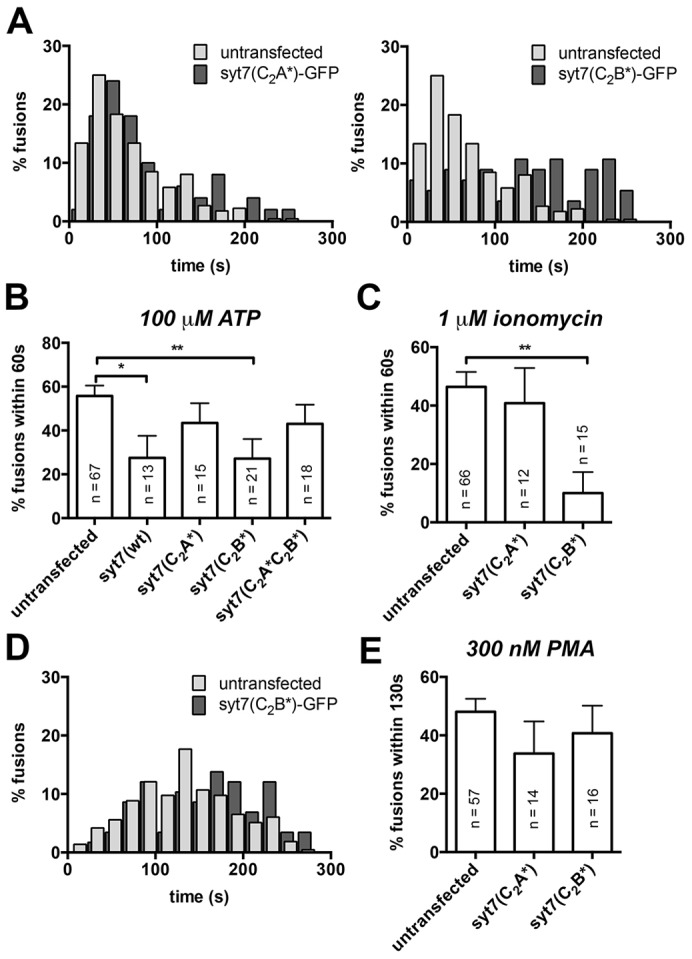
The C2A domain of Syt7 impairs Ca2+-dependent lamellar body exocytosis in ATII cells. (A) Expression of Syt7(C2B*)–GFP (right), but not Syt7(C2A*)–GFP (left) resulted in a significant left shift in the fusion delay histograms compared to untransfected cells following stimulation with 100 µM ATP. (B) The percentage of fusions occurring within 60 s of stimulation with 100 µM ATP (during the transient rise in intracellular Ca2+, see Fig. 4A) was significantly reduced in cells expressing Syt7(wt)–GFP or Syt7(C2B*)–GFP compared to untransfected cells. Transfection of ATII cells with Syt7 mutants with impaired Ca2+ binding to the C2A domain [Syt7(C2A*)–GFP or Syt7(C2A*C2B*)–GFP] did not impact on Ca2+-dependent fusion activity. (C) Following stimulation with 1 µM ionomycin, a Ca2+ ionophore that results in a strong long-lasting elevation of the cytoplasmic Ca2+, the effect of Syt7(C2B*)–GFP on inhibiting lamellar body exocytosis was even more significant than following stimulation with ATP. Expression of Syt7(C2A*)–GFP had no significant impact on fusion activity within 60 s of stimulation. (D) When lamellar body exocytosis was stimulated with 300 nM PMA, which does not result in any significant increase in the cytoplasmic Ca2+ concentration (supplementary material Fig. S2) expressing Syt7(C2B*)–GFP did not alter fusion kinetics. (E) No significant difference in the percentage of fusions occurring within 130 s of stimulation with PMA (when ∼50% of fusion occurred in untransfected control cells) were observed between untransfected cells and cells expressing either Syt7(C2A*)–GFP or Syt7(C2B*)–GFP. Results are mean±s.e.m. *P<0.05; **P<0.01.