


Figure 8. ILK and AKT protect EA.hy926 cells from uraemic toxin-mediated ROS production.
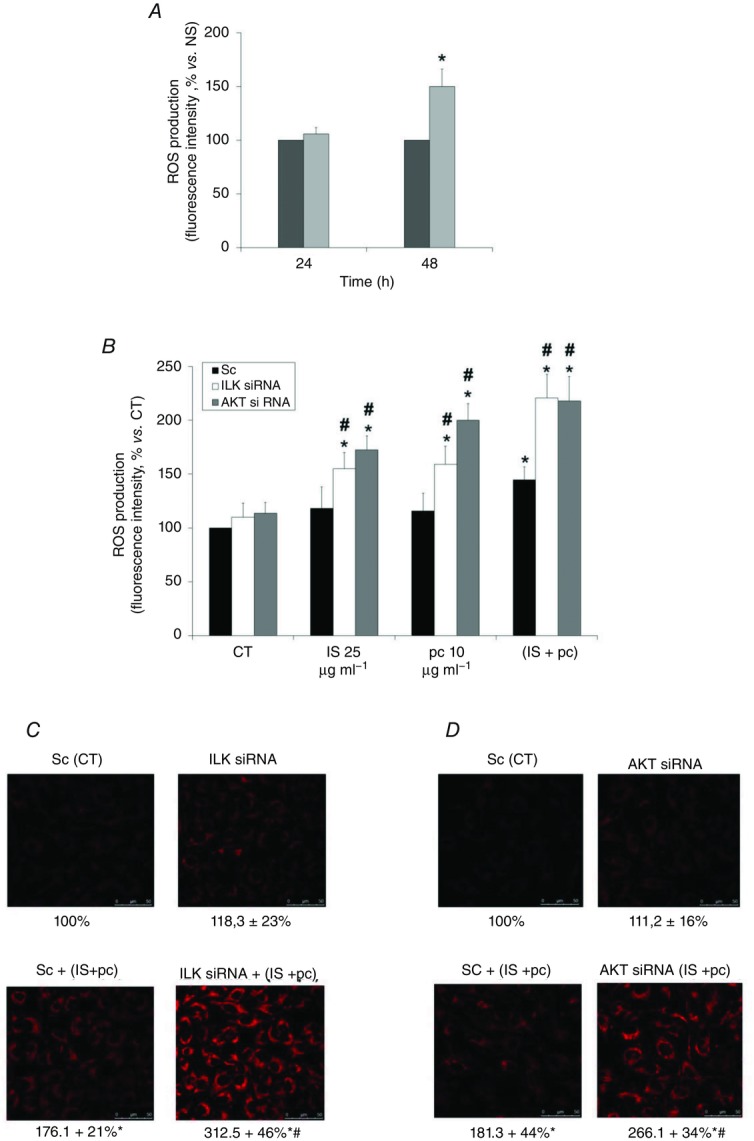
A, cells were incubated in medium supplemented with normal serum (NS, dark grey bars) (10%) or uraemic serum (light grey bars) (10%) for 24 and 48 h. After incubation, intracellular ROS production was determined by flow cytometry using 5 mm H2DCFDA probe, calculated as the percentage of fluorescence intensity versus normal serum. *P < 0.05 vs. NS. B, cells were depleted of ILK (open bars) or AKT (light grey bars) with specific siRNA (100 nm) and afterwards were incubated in medium supplemented with 2.5% NS plus indoxyl sulfate (IS; 25 or 100 μg ml−1), p-cresol (pc; 10 or 100 μg ml−1) or a combination of low concentrations of IS (25 μg ml−1) and pc (10 μg ml−1) (IS + pc) for 24 h. Scrambled RNA (Sc) (filled bars) was used as control. After incubation, intracellular ROS production was determined by flow cytometry using 5 mm H2DCFDA probe, calculated as the percentage of fluorescence intensity versus control (CT; 2.5% NS, 24 h). Data are expressed as mean ± SEM of five independent experiments. *P < 0.05 vs. control; #P < 0.05 vs. Sc. C and D, cells were depleted of ILK (C) or AKT (D) with specific siRNA (100 nm) and afterwards they were incubated in medium supplemented with 2.5% NS and a combination of low concentrations of IS (25 μg ml−1) and pc (10 μg ml−1) (IS + pc) for 24 h. Scrambled RNA (Sc) was used as control. After incubation, intracellular ROS production was determined by confocal microscopy, using 5 μm CellROX Deep Red Reagent fluorogenic probe. A representative experiment is shown. Data represent the densitometric analysis of the fluorescence of 20 cells of six independent experiments. The results are expressed as a percentage of scrambled untreated control and are the mean ± SEM of the mean from six different experiments. *P < 0.05 vs. Sc (CT); #P < 0.05 vs. Sc + (IS +pc).