



Abstract
The short chain, gaseous alkanes ethane, propane, n- and iso-butane are released in significant amounts into the atmosphere, where they contribute to tropospheric chemistry and ozone formation. Biodegradation of gaseous alkanes by aerobic microorganisms, mostly bacteria and fungi isolated from terrestrial environments, has been known for several decades. The first indications for short chain alkane anaerobic degradation were provided by geochemical studies of deep-sea environments around hydrocarbon seeps, and included the uncoupling of the sulfate-reduction and anaerobic oxidation of methane rates, the consumption of gaseous alkanes in anoxic sediments, or the enrichment in 13C of gases in interstitial water vs. the source gas. Microorganisms able to degrade gaseous alkanes were recently obtained from deep-sea and terrestrial sediments around hydrocarbon seeps. Up to date, only sulfate-reducing pure or enriched cultures with ethane, propane and n-butane have been reported. The only pure culture presently available, strain BuS5, is affiliated to the Desulfosarcina–Desulfococcus cluster of the Deltaproteobacteria. Other phylotypes involved in gaseous alkane degradation have been identified based on stable-isotope labeling and whole-cell hybridization. Under anoxic conditions, propane and n-butane are activated similar to the higher alkanes, by homolytic cleavage of the C—H bond of a subterminal carbon atom, and addition of the ensuing radical to fumarate, yielding methylalkylsuccinates. An additional mechanism of activation at the terminal carbon atoms was demonstrated for propane, which could in principle be employed also for the activation of ethane.
Keywords: Gaseous alkanes, Microbial degradation, Anaerobic, Marine, Sediments, Sulfate
1. Introduction
The short chain, nonmethane gaseous alkanes ethane, propane, n-butane and iso-butane are major constituents of natural gas. The gaseous alkanes are also abundant in crude oil reservoir gas caps, and are found in smaller amounts dissolved in crude oil [1]. They are generally formed through the abiotic, thermal decomposition of fossil organic matter, but are also produced biologically, as shown recently for ethane and propane (e.g. [2,3]). Ethane and propane are also produced in significant amounts by biomass burning, leading to their direct release into the atmosphere [4]. The gaseous alkanes reach the biosphere through vertical migration of gas and oil from deep seated reservoirs, along fractures in the crust caused by plate tectonics, or as a result of anthropogenic activities. Migration through the sediment takes place as free gas or as dissolved constituents of geothermal fluids. The short-chain alkanes are released into marine and terrestrial environments via microseepage, which accounts for the bulk emissions, onshore and marine seeps, and mud volcanoes [5]. Seepage in environments characterized by low temperatures and elevated pressures, such as the deep seafloor and permafrost regions, leads to formation of type II gas hydrates [6]. Although methane is still the most abundant hydrocarbon, gas hydrates in the Gulf of Mexico and Caspian Sea contain over 30% C2–C4 alkanes [7]. The short-chain alkanes are eventually released into the atmosphere, contributing to the tropospheric chemistry as important precursors for the formation of ozone and organic aerosols [8]. Global atmospheric emissions are estimated at 9.2–9.6 Tg yr− 1 for ethane, 9.6–10.5 Tg yr− 1 propane, 10 Tg yr− 1 n-butane and 4.2 Tg yr− 1 iso-butane [4,5]. The amounts reaching the atmosphere may be severely limited by their biodegradation by aerobic and anaerobic microorganisms in marine sediments or in the water column, and in terrestrial environments.
2. Aerobic degradation of short chain alkanes
Microorganisms able to grow with gaseous alkanes as substrates under aerobic conditions are known since several decades. Among the first bacterial pure cultures reported were strains assigned to Mycobacterium spp., isolated or otherwise able to grow with ethane, propane or n-butane (e.g. [9,10]). Most of the strains isolated so far with gaseous alkanes are affiliated with the high G + C Gram-positive bacteria, e.g. Arthrobacter, Corynebacterium, Mycobacterium, Nocardia and Rhodococcus [11]. Comparatively, a smaller number of strains affiliated with the Proteobacteria (Gamma and Betaproteobacteria) have been reported [11]. In addition to bacteria, cultures of fungi able to degrade gaseous alkanes have been isolated. The diversity of aerobic, gaseous alkane degrading bacteria and fungi has been reviewed recently [11], and it will not make the subject of the present review. However, it is worth noting that the vast majority of microbial strains reported so far have been isolated from soil, or otherwise terrestrial environments (see [11] and the references therein). Marine bacteria able to degrade C2–C4 alkanes have been seldom reported, despite the fact that the oceans receive large inputs of hydrocarbons from natural seepage or anthropogenic activities. Instead, filamentous fungi isolated with crude oil from coastal marine sediments have been found to degrade also gaseous alkanes [12]. Marine bacteria involved in the aerobic degradation of ethane and propane have been recently identified by incubation of surface sediment from a hydrocarbon seep with 13C-labeled substrates, followed by DNA stable isotope probing [13]. Ethane was apparently degraded by members of Methylococcaceae (Gammaproteobacteria), and propane by members of an unclassified group of Gammaproteobacteria [13]. Among the strains most closely related to the propane-degrading phylotypes were obligate hydrocarbon degraders of the genera Marinobacter and Alcanivorax, isolated from marine environments [13,14]. The degradation of gaseous alkanes in marine environments received more attention in the recent years. Analyses of stable isotope fractionation factors showed that gaseous alkanes were biologically degraded under oxic conditions in incubations with marine sediments from hydrocarbon seeps [15], and in the water column above mud volcanoes in the Nile deep-sea fan [16]. A preferential oxidation of propane and n-butane over ethane was observed [15]. Following the Deepwater Horizon event large amounts of natural gas were emitted in deep waters of the Gulf of Mexico [17]. The gas formed plume structures, with the highest concentrations at depths greater than 800 m. Ethane and propane were degraded in fresh plumes, accounting for up to 70% of the observed oxygen depletion [17].
Under aerobic conditions, the gaseous alkanes are typically activated at the terminal carbon atom by reactive oxygen species derived from molecular oxygen, yielding primary alcohols [11]. For propane, a second route of activation at the secondary carbon atom, yielding 2-propanol, has been described [11]. The activation reaction is catalyzed by monooxygenases (see [18], for an overview of the activation mechanism). Most of the bacterial gaseous alkane monooxygenases are soluble di-iron monooxygenases (e.g. [11,19,20]). A copper-containing monooxygenase, similar with the particulate methane monooxygenase and ammonia monooxygenase, was proposed for a strain of Nocardioides [21]. Activation of gaseous alkanes in fungi was proposed to be carried out by cytochrome P-450 monooxygenases [22]. The primary alcohols are further oxidized to aldehydes and fatty acids, which are channeled into central metabolic pathways, and typically oxidized completely to CO2 [11]. In case of propane activation at the secondary carbon atom, the formed 2-propanol is oxidized to propanone (acetone), and further to hydroxypropanone for which several routes of degradation have been proposed, including oxidation to acetate or to pyruvate [11]. Degradation of iso-butane has been less frequently treated in the literature devoted to gaseous alkane degradation. Iso-butane can be activated at a primary carbon atom, yielding isobutanol, which can be further degraded via iso-butylaldehyde and iso-butyrate [23]. Alternatively, iso-butane could be activated at the tertiary carbon atom, to tert-butanol. Subsequent oxidation may lead to 2-hydroxyisobutyrate. Degradation of the 2-hydroxyisobutyrate, a compound containing a tertiary carbon atom, has been shown to proceed via a carbon skeleton rearrangement catalyzed by a mutase [24].
3. Anaerobic degradation of short chain alkanes — evidence from in situ studies
The anaerobic degradation of short-chain alkanes was for the first time suggested by geochemical studies of deep-sea marine sediments around hydrocarbon seeps. These studies preceded the isolation and cultivation of the first anaerobic microorganisms able to degrade gaseous alkanes. For consistency, all studies addressing the in situ degradation will be summarized here. In environments affected by hydrocarbon seepage, the sulfate reduction rates (SRRs), which were usually attributed to the anaerobic oxidation of methane (AOM), were much higher than the rates of AOM. In Gulf of Mexico sediments around gas hydrates, the SRRs were two to three orders of magnitude higher than the AOM rates [25,26]. This difference was even more pronounced in Gulf of Mexico sediments associated with type II gas hydrates, which contain high concentrations of C2–C5 alkanes [27]. Other sites with high ratios of SR rates versus AOM rates and with confirmed presence of short chain alkanes include mud volcanoes in the Gulf of Cadiz [28,29], mud volcanoes in the Eastern Mediterranean Sea [30,31], crude oil and gas cold-seeps in the Gulf of Mexico [32], the Chapopote asphalt volcano [32], Mississippi Canyon sediments [33], and hydrothermal sediments from the Guaymas Basin [34]. These rate measurements have been recently summarized with calculation of a global median ratio of about 10:1 for SR vs. AOM rates [35]. The discrepancy between SR and AOM rates was generally attributed to the oxidation of hydrocarbons other than methane, including short-chain alkanes, by sulfate-reducing microorganisms (e.g. [32,35]).
The anaerobic oxidation of gaseous alkanes has been proposed to contribute to the formation of dry gas caps (enriched in methane due to the degradation of C2–C5 alkanes) associated with biodegraded oil [36], and to the formation of carbonate precipitates around gas hydrates in the Gulf of Mexico [37]. A decrease in the concentrations of gaseous alkanes within the sulfate–methane transition zone at mud volcanoes in the Gulf of Cadiz could also be due to degradation of these compounds under anoxic conditions [28]. Measurements of isotopic composition of gaseous alkanes in marine sediments associated with gas hydrates in the Gulf of Mexico showed that propane and n-butane were enriched in 13C in sediment interstitial water relative to vent gas and to gas in hydrates [38]. This was proposed to be due to anaerobic microbial oxidation. Ethane and iso-butane, enriched to a lesser extent in 13C relative to the source gas, appeared relatively stable to microbial degradation [38]. Stable isotope fractionation analyses also showed that propane and n-butane were preferentially degraded versus ethane and iso-butane in anoxic sediments of deep-sea mud volcanoes in the Mediterranean Sea [16].
The anaerobic degradation of gaseous alkanes in the environment was also indicated by the finding of metabolites typical for the biochemical activation under anoxic conditions. Ethyl- and propylsuccinates, indicative of anaerobic ethane and propane degradation, were detected in samples from crude oil contaminated aquifers [39], in oilfields [40], and coal beds [41]. Alkylsuccinates suggestive of anaerobic degradation of ethane, propane and n-butane were also detected in samples from oil processing facilities [42]. This indicated that the gas repeatedly injected into reservoir in order to increase oil recovery may have led to the enrichment of microorganisms able to degrade gaseous alkanes.
In addition to direct in situ observations, anaerobic degradation of gaseous alkanes has been also determined in laboratory incubations with sediment samples. The anaerobic degradation of propane was demonstrated in incubations of fresh sediment samples from marine hydrocarbon seeps with 13C-propane under sulfidogenic conditions [43]. Preferential oxidation of propane and n-butane in Gulf of Mexico sediments was recently demonstrated by stable isotope analyses in incubations of hydrocarbon-rich sediment samples with individual alkanes [44]. Also, batch sediment incubations with sediments from hydrothermal vent systems at Middle Valley, Juan de Fuca Ridge showed that ethane, propane and n-butane were degraded under sulfate-reducing conditions over a broad range of temperatures (25°, 55° and 75 °C) [45]. Overall, the in situ studies and ex situ incubations point out that anaerobic microorganisms able to degrade SCA are relatively widespread and physiologically diverse, at least with respect to the range of temperatures at which SCA degradation has been observed.
4. Microorganisms degrading SCA under anoxic conditions
The first anaerobic microorganisms able to degrade short-chain alkanes were enriched and isolated from marine hydrocarbon seep sediments [46]. Very slow ethane-dependent sulfate reduction was shown at 12 °C with an enrichment culture from Gulf of Mexico sediments. Cold-adapted (12 °C), sediment-free enrichment cultures were obtained with propane and n-butane as substrates from Gulf of Mexico sediments, and with n-butane from Hydrate Ridge sediments [46,47]. Mesophilic (28 °C) and thermophilic (60 °C) enrichment cultures with propane and n-butane were obtained from Guaymas Basin sediments; from the mesophilic enrichment culture with n-butane a pure culture, strain BuS5, was isolated [46]. Substrate tests showed that strain BuS5 was able to use only propane and n-butane, but not shorter (ethane, methane), or longer chain alkanes (e.g. pentane) [46]. This narrow hydrocarbon substrate range, i.e. the ability to degrade only propane and n-butane, suggesting a restricted environmental distribution of these microorganisms, was later shown also for cold-adapted enrichment cultures from the Gulf of Mexico and Hydrate Ridge [47]. Mesophilic, propane-degrading sulfate-reducing microorganisms were also enriched from a low-temperature, sulfidic hydrocarbon seep [48]. To date, no pure or enriched culture able to oxidize iso-butane under anoxic conditions has been reported.
All anaerobic SCA degraders identified so far are sulfate-reducing bacteria. Strain BuS5, which to date is the only pure culture available able to degrade SCA under strictly anoxic conditions, is phylogenetically affiliated with the Desulfosarcina–Desulfococcus cluster of the Deltaproteobacteria [46] (Fig. 1). Strain BuS5 is closely related to other hydrocarbon-degrading bacteria, including degraders of n-alkanes > C6 and of aromatic hydrocarbons [49]. Using incubations with 13C-labeled substrates followed by probing with fluorescently-labeled oligonucleotide probes and chemical imaging via nanoSIMS analysis, propane and butane-degrading sulfate-reducing bacteria were identified in cold-adapted enrichment cultures from the Gulf of Mexico and Hydrate Ridge [47]. These microorganisms were closely related to strain BuS5, forming an apparent phylogenetic cluster of SCA degraders (Fig. 1). The phylogenetic diversity of potential SCA degrading microorganisms was also investigated in batch incubations of Gulf of Mexico sediments with gaseous alkanes [44]. The sequences retrieved were closely related to the BuS5 group, although a relatively high diversity of Deltaproteobacterial sequences was retrieved from the incubations with ethane [44]. In a recent study, incubations with 13C-labeled substrates followed by stable isotope probing showed that microorganisms affiliated with the strain BuS5 cluster were involved in the in situ degradation of n-butane at hydrocarbon seeps in the Eastern Mediterranean Sea and Guaymas Basin [50] (Fig. 1). In this latter study, a relatively high diversity of potential SCA degraders in marine sediments around hydrocarbon seeps was identified.
Fig. 1.

Phylogenetic reconstruction of anaerobic short-chain alkane degraders. Strain BuS5 (bold), the only pure culture isolated so far able to degrade propane and n-butane, is affiliated with the Desulfosarcina–Desulfococcus group of the Deltaproteobacteria. Dominant phylotypes involved in propane or n-butane degradation in enrichment cultures (blue) were identified based on labeling with 13C-substrates followed by chemical imaging via nanoSIMS analysis. Additional phylotypes involved in SCA degradation were identified by stable isotope probing in incubations with marine sediments (green). A phylotype related to Desulfotomaculum spp. (red) was proposed to be responsible for propane degradation based on its abundance in a sulfate-reducing, thermophilic enrichment culture. The tree was reconstructed in ARB by maximum likelihood, using only nearly full-length sequences (> 1400 bp). Partial sequences were added by parsimony to the calculated tree. Scale bar indicates an estimated 10% sequence divergence.
Molecular biology methods were also used to describe the microbial community structure of a terrestrial propane-degrading enrichment culture [48]. A relatively high phylogenetic diversity was found, with several phylotypes affiliated with the Deltaproteobacteria. Although the microorganisms involved in propane degradation were not directly identified, it is worth noting that none of the phylotypes in this enrichment culture was closely related with the strain BuS5 cluster [48]. This suggests that, in addition to the marine SCA cluster, different phylogenetic groups may be responsible for the anaerobic SCA degradation in low temperature terrestrial environments.
Hybridizations with sequence-specific, 16S rRNA gene-targeted oligonucleotide probes showed that a sulfate-reducing, thermophilic enrichment culture with propane was largely dominated by a phylotype affiliated with Desulfotomaculum spp. [46] (Fig. 1). Due to its high abundance, of over 90% of the total cell number, this phylotype is most likely responsible for propane degradation. Construction and analysis of a 16S rRNA gene library from a thermophilic (60 °C) enrichment culture with butane yielded a single phylotype (Butane60-GuB) forming a novel phylogenetic cluster within the Deltaproteobacteria [46]. However, the abundance of this phylotype relative to the total cell number was not determined, and its role in n-butane degradation remains speculative. A high diversity of sequences closely related to the Butane60-GuB phylotype was recently retrieved from thermophilic (55 °C) enrichment cultures with ethane, propane and n-butane, and have been suggested to represent a group of thermophilic SCA degraders [45]. Nevertheless, future studies including for example cultivation (e.g. isolation of pure cultures) or stable isotope labeling coupled with phylogenetic identification (e.g. SIP or chemical imaging via nanoSIMS), are needed to elucidate the role of this phylogenetic cluster in thermophilic SCA degradation.
5. Biochemistry of SCA degradation under anoxic conditions
The solubility in water of the gaseous alkanes is relatively high compared with that of higher alkanes, of 2.13 mmol l− 1 (ethane), 1.76 mmol l− 1 (propane), 1.46 mmol l− 1 (n-butane), and 0.94 mmol l− 1 (iso-butane) at 20 °C (calculated from Ostwald coefficient, according to [51]; see also [52] for a comparison of n-alkane solubility depending on the chain length). In the absence of a proven active uptake mechanism, the dissolved alkanes are assumed to diffuse freely into the cells, via partitioning into cellular membranes. Anaerobic microorganisms make use of fundamentally different co-substrates for the activation of hydrocarbons. The most well described mechanism of activation is the radical-catalyzed homolytic cleavage of the C—H bond, followed by the carbon–carbon addition of the alkyl radical to fumarate, which acts as a co-substrate. Hydrocarbon activation by addition to fumarate was initially described for the anaerobic degradation of toluene, where it yields benzylsuccinate [53,54]. The reaction is catalyzed by benzylsuccinate synthase [55]. Benzylsuccinate synthase and its homologs are glycyl radical enzymes of the pyruvate formate lyase family (see, for example, [56] for an overview of the reaction mechanism). A similar mechanism of activation, i.e. addition to fumarate, was proposed for the anaerobic degradation of alkanes based on the finding of alkylsuccinates in cultures of sulfate-reducing bacteria growing with n-dodecane [57], and of a nitrate-reducing bacterium, ‘Aromatoleum’ sp. strain HxN1 growing on n-hexane [58]. Following these initial observations, activation by addition to fumarate has been demonstrated for the degradation of a relatively broad range of n-alkanes (C6–C16) and cycloalkanes by nitrate- and sulfate-reducing cultures (e.g. [49,59–62]). In the case of alkanes, the most common site of activation is the subterminal (secondary) carbon atom, yielding (1-methylalkyl)succinates, although metabolites were identified indicating also an activation at the C-3 atom [58], and at the terminal (C-1) carbon atom [46]. The formed alkylsuccinates have been proposed to be further degraded by ligation to coenzyme A, carbon-skeleton re-arrangement and beta-oxidation [46,63]. This yields chiefly acetyl-CoA which is subjected to terminal oxidation to CO2. In sulfate-reducing bacteria, the most common pathway for the oxidation of acetyl-CoA is the Wood-Ljungdahl pathway. The presence of this pathway in alkane degraders has been demonstrated by measurements of the central enzyme, carbon monoxide dehydrogenase, in the hexadecane degrading strain Hxd3 [64], and by genome sequencing of the n-alkane degrading Desulfatibacillum alkenivorans AK-01 [65].
An alternative mechanism of activation via subterminal carboxylation at the C-3 atom of the alkane has been suggested based on the analysis of fatty acids and metabolites formed during growth of the sulfate-reducing bacterium Desulfococcus oleovorans Hxd3 on long-chain n-alkanes [66–68]. Recent biochemical investigations indicated that alkane activation in D. oleovorans Hxd3 actually takes place via hydroxylation followed by carboxylation [69]. In addition, a third mechanism of activation with the possible involvement of a N—O species or O2, generated intracellularly from the electron acceptor, has been proposed for the Gammaproteobacterium strain HdN1 [70].
Up to now, most investigations on the mechanism of alkane activation under anoxic conditions have been focused on the degradation of medium and long-chain n-alkanes (> C6) [49]. With respect to gaseous alkanes, relatively recent metabolite analyses have shown that activation by addition to fumarate also plays an important role. In cultures of strain BuS5 and of propane-degrading enrichment cultures, isopropylsuccinate and (1-methylpropyl)succinate were identified as metabolites, indicating that propane and n-butane are activated by addition to fumarate at the secondary carbon atom (Fig. 2) [46,48]. In addition, n-propylsuccinate was identified in propane-degrading cultures, suggesting a second route of propane activation at the primary carbon atoms [46,48]. Although initially considered as a side reaction, this second pathway was further substantiated by incubations of strain BuS5 with position-specific deuterium-labeled propane. It was shown that the activation of propane at the primary carbon atoms is significant, accounting for an estimated 30% of the activation events, with the bulk of 70% of activation events occurring at the secondary carbon atom [71]. The activation of propane at the primary carbon atoms opens up the possibility of ethane activation by a similar mechanism, yielding ethylsuccinate (Fig. 2). Although up to now no metabolites have been reported from anaerobic ethane-degrading cultures, this hypothesis is supported by the finding of ethylsuccinate in crude oil processing facilities, crude oil production wells [42], oilfields [40], and coal beds [41].
Fig. 2.

Proven and proposed mechanisms for the biochemical activation of gaseous alkanes under anoxic conditions, by addition to fumarate yielding alkylsuccinates. For ethane, activation by addition to fumarate (a) can be envisioned based on the finding of propane activation at a terminal carbon atom, and by the identification of ethylsuccinate in environmental samples. Propane is activated by addition to fumarate at both the subterminal and terminal carbon atoms (b), yielding isopropyl- and n-propylsuccinate, respectively, with a higher frequency of activation events at the secondary carbon atom. Butane is activated only at the subterminal carbon atom (c), yielding (1-methylpropylsuccinate).
The analogy of alkane activation by addition to fumarate to the anaerobic activation of alkyl-aromatic hydrocarbons (e.g. toluene) led to the identification of genes and proteins similar with the benzylsuccinate synthase (Bss) in anaerobic alkane-utilizing microorganisms. Based on similarity with subunits of the Bss, genes encoding for alkane-activating glycyl-radical enzymes have been identified in the sulfate-reducing bacterium D. alkenivorans AK-01 [72], and in the nitrate-reducing strain ‘Aromatoleum’ sp. HxN1 [73], and termed alkylsuccinate synthase (Ass) [72] and (1-methylalkyl)succinate synthase (Mas) [73], respectively. The putative large, catalytic subunit of these enzymes (AssA or MasD) harbors a conserved radical-hosting Gly residue within a motif characteristic for the Gly-radical enzymes [56]. In ‘Aromatoleum’ sp. HxN1, transcripts and proteins of several mas genes were detected in cells grown on n-hexane, but were absent in cells grown on caproate [73]. These included MasD, with a high sequence identity to the large (α) subunit of the Bss, MasC, a small protein similar to the γ subunit of the Bss, and MasE, a protein rich in Cys residues, typical of the β subunit of the Bss. Based on their specific expression in n-hexane-grown cells, and similarities with subunits of the benzylsuccinate synthase, MasC, MasD and MasE were interpreted as subunits of the (1-methylalkyl)succinate synthase in strain HxN1 [73]. In D. alkenivorans AK-01, two loci coding for the proposed alkylsuccinate synthase have been identified based on homology to subunits of Mas and Bss [65,72]. Each of these loci contains genes encoding the putative catalytic subunit (AssA1/AssA2), and putative β and γ subunits (AssB1/2, AssC1/2) [65]. In addition, the two loci contain genes similar with the masE of ‘Aromatoleum’ sp. HxN1 [65]. However, only one of the putative α subunits (AssA1) was found to be expressed in cells grown on hexadecane and not on hexadecanoate; the role of AssA2 is presently unknown [65]. Subsequently, proteins similar to Ass/Mas have been also detected in other model alkane-utilizing strains such as Desulfoglaeba alkanexedens ALDC [74], and ‘Aromatoleum’ sp. OcN1 [70]. Recent genomic analyses led to the identification of assA-like genes in Smithella spp. from methanogenic enrichment cultures with n-hexadecane [75,76], and with n-alkanes > C6 [76,77], and in a Firmicutes sp. (Peptococcaceae SCADC) from a methanogenic enrichment culture with n-alkanes > C6 [78] (Fig. 2). These findings indicate that alkane activation in methanogenic cultures may also proceed via addition to fumarate.
Identification of methylalkylsuccinate synthase genes of gaseous alkane degrading microorganisms is still incipient. A partial gene sequence similar with assA was retrieved from a mesophilic, sulfate-reducing enrichment culture with propane [48,74]. Recent genome analysis of strain BuS5 identified a single putative masD gene, suggesting that strain BuS5 contains a single methylalkylsuccinate synthase involved in the activation of both propane and n-butane (F. Musat and S. Sievert, unpublished). Phylogenetic analysis of the putative MasD showed that it is clustering with other glycyl-radical enzymes involved in hydrocarbon activation, with a higher similarity to other methylalkylsuccinate synthases (Fig. 3). The putative MasD of strain BuS5 apparently forms a branch together with the putative AssA from the Peptococcaceae sp. SCADC separate from other MasD proteins (Fig. 3). Nevertheless, the two proteins share about 60% sequence identity (F. Musat and S. Sievert, unpublished), and it remains for future studies to establish if the Mas/Ass from gaseous alkane degraders indeed form a separate lineage vs. similar proteins from medium- and long-chain alkane degraders. In view of the anticipated diversity of SCA degraders indicated by recent studies, a high diversity of corresponding masD/assA genes is expected to be uncovered from anoxic environments around natural gas and crude oil seeps.
Fig. 3.
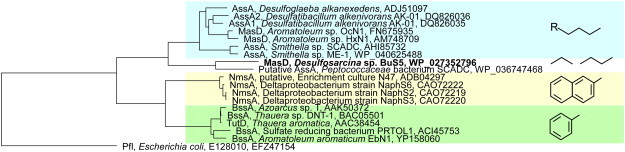
Phylogenetic reconstruction showing the relationship of the putative MasD of strain BuS5 (in boldface), likely involved in propane and n-butane activation, with other n-alkane and alkylaromatic hydrocarbon activating enzymes. R ≥ C2. The tree was calculated in ARB by maximum likelihood, using the pyruvate-formate lyase of E. coli as an outgroup. F. Musat and S. Sievert, unpublished.
6. Conclusion
Evidence for the anaerobic degradation of gaseous alkanes has been provided for various subsurface environments, mostly marine sediments from hydrocarbon seepage areas. From such environments, the first microorganisms able to degrade short-chain alkanes under anoxic conditions have been enriched or isolated. Both microbiological and geochemical studies suggest that propane and n-butane appear more susceptible to biodegradation than ethane and iso-butane, despite the relatively high abundance of the latter in natural gas. Analysis of metabolites demonstrated that under anoxic conditions propane and n-butane are biochemically activated by addition to fumarate at the secondary carbon atom, a mechanism similar to the activation of higher n-alkanes, cycloalkanes and alkyl-aromatic hydrocarbons. For propane, an additional route of activation at the primary carbon atoms has been shown, which could in principle be employed also for the activation of ethane or iso-butane.
So far, most of the anaerobic gaseous alkane degraders cultivated or otherwise identified by molecular biology methods are sulfate-reducing bacteria which belong to the Desulfosarcina–Desulfococcus cluster of the Deltaproteobacteria. Members of this group are generally abundant in anoxic marine sediments, and in recent studies have been directly linked to biodegradation of SCA in environmental samples. These findings point out to a major, if not global contribution to the marine carbon and sulfur cycles. Quantitatively, a larger fraction of the natural gas in marine environments is released through microseepage than through the more conspicuous gas seeps. It would be indeed interesting for future studies to determine if gaseous alkane degraders have a more widespread distribution in anoxic marine sediments than presently recognized.
Acknowledgments
The Max Planck Society and the Helmholtz Centre for Environmental Research are acknowledged for funding.
References
- 1.Tissot B.P., Welte D.H. Springer; Berlin: 1984. Petroleum formation and occurrence. [702 pp.] [Google Scholar]
- 2.Hinrichs K.U., Hayes J.M., Bach W., Spivackl A.J., Hmelo L.R., Holm N.G. Biological formation of ethane and propane in the deep marine subsurface. Proc Natl Acad Sci U S A. 2006;103:14684–14689. doi: 10.1073/pnas.0606535103. [DOI] [PMC free article] [PubMed] [Google Scholar]
- 3.Xie S., Lazar C.S., Lin Y.-S., Teske A., Hinrichs K.-U. Ethane- and propane-producing potential and molecular characterization of an ethanogenic enrichment in an anoxic estuarine sediment. Org Geochem. 2013;59:37–48. [Google Scholar]
- 4.Pozzer A., Pollmann J., Taraborrelli D., Jöckel P., Helmig D., Tans P. Observed and simulated global distribution and budget of atmospheric C2–C5 alkanes. Atmos Chem Phys. 2010;10:4403–4422. [Google Scholar]
- 5.Etiope G., Ciccioli P. Earth's degassing: a missing ethane and propane source. Science. 2009;323:478. doi: 10.1126/science.1165904. [DOI] [PubMed] [Google Scholar]
- 6.Sloan E.D., Jr. Fundamental principles and applications of natural gas hydrates. Nature. 2003;426:353–359. doi: 10.1038/nature02135. [DOI] [PubMed] [Google Scholar]
- 7.Milkov A.V. Molecular and stable isotope compositions of natural gas hydrates: a revised global dataset and basic interpretations in the context of geological settings. Org Geochem. 2005;36:681–702. [Google Scholar]
- 8.Saito T., Yokouchi Y., Kawamura K. Distributions of C2–C6 hydrocarbons over the western North Pacific and eastern Indian Ocean. Atmos Environ. 2000;34:4373–4381. [Google Scholar]
- 9.Davis J.B., Chase H.H., Raymond R.L. Mycobacterium paraffinicum n. sp., a bacterium isolated from soil. Appl Microbiol. 1956;4:310–315. doi: 10.1128/am.4.6.310-315.1956. [DOI] [PMC free article] [PubMed] [Google Scholar]
- 10.Dworkin M., Foster J.W. Experiments with some microorganisms which utilize ethane and hydrogen. J Bacteriol. 1958;75:592–603. doi: 10.1128/jb.75.5.592-603.1958. [DOI] [PMC free article] [PubMed] [Google Scholar]
- 11.Shennan J.L. Utilisation of C2–C4 gaseous hydrocarbons and isoprene by microorganisms. J Chem Technol Biotechnol. 2006;81:237–256. [Google Scholar]
- 12.Cerniglia C.E., Perry J.J. Crude oil degradation by microorganisms isolated from the marine environment. Z Allg Mikrobiol. 1973;13:299–306. doi: 10.1002/jobm.3630130403. [DOI] [PubMed] [Google Scholar]
- 13.Redmond M.C., Valentine D.L., Sessions A.L. Identification of novel methane-, ethane-, and propane-oxidizing bacteria at marine hydrocarbon seeps by stable isotope probing. Appl Environ Microbiol. 2010;76:6412–6422. doi: 10.1128/AEM.00271-10. [DOI] [PMC free article] [PubMed] [Google Scholar]
- 14.Yakimov M.M., Timmis K.N., Golyshin P.N. Obligate oil-degrading marine bacteria. Curr Opin Biotechnol. 2007;18:257–266. doi: 10.1016/j.copbio.2007.04.006. [DOI] [PubMed] [Google Scholar]
- 15.Kinnaman F.S., Valentine D.L., Tyler S.C. Carbon and hydrogen isotope fractionation associated with the aerobic microbial oxidation of methane, ethane, propane and butane. Geochim Cosmochim Acta. 2007;71:271–283. [Google Scholar]
- 16.Mastalerz V., de Lange G.J., Dahlmann A. Differential aerobic and anaerobic oxidation of hydrocarbon gases discharged at mud volcanoes in the Nile deep-sea fan. Geochim Cosmochim Acta. 2009;73:3849–3863. [Google Scholar]
- 17.Valentine D.L., Kessler J.D., Redmond M.C., Mendes S.D., Heintz M.B., Farwell C. Propane respiration jump-starts microbial response to a deep oil spill. Science. 2010;330:208–211. doi: 10.1126/science.1196830. [DOI] [PubMed] [Google Scholar]
- 18.Widdel F., Musat F. Diversity and common principles in enzymatic activation of hydrocarbons. In: Timmis K.N., editor. Handbook of Hydrocarbon and Lipid Microbiology. Springer; Berlin Heidelberg: 2010. pp. 983–1009. [Google Scholar]
- 19.Dubbels B.L., Sayavedra-Soto L.A., Arp D.J. Butane monooxygenase of ‘Pseudomonas butanovora’: purification and biochemical characterization of a terminal-alkane hydroxylating diiron monooxygenase. Microbiology. 2007;153:1808–1816. doi: 10.1099/mic.0.2006/004960-0. [DOI] [PubMed] [Google Scholar]
- 20.Kotani T., Yamamoto T., Yurimoto H., Sakai Y., Kato N. Propane monooxygenase and NAD+-dependent secondary alcohol dehydrogenase in propane metabolism by Gordonia sp. strain TY-5. J Bacteriol. 2003;185:7120–7128. doi: 10.1128/JB.185.24.7120-7128.2003. [DOI] [PMC free article] [PubMed] [Google Scholar]
- 21.Hamamura N., Yeager C.M., Arp D.J. Two distinct monooxygenases for alkane oxidation in Nocardioides SP. STRAIN CF8. Appl Environ Microbiol. 2001;67:4992–4998. doi: 10.1128/AEM.67.11.4992-4998.2001. [DOI] [PMC free article] [PubMed] [Google Scholar]
- 22.Curry S., Ciuffetti L., Hyman M. Inhibition of growth of a Graphium sp. on gaseous n-alkanes by gaseous n-alkynes and n-alkenes. Appl Environ Microbiol. 1996;62:2198–2200. doi: 10.1128/aem.62.6.2198-2200.1996. [DOI] [PMC free article] [PubMed] [Google Scholar]
- 23.Schaefer C.E., Yang X., Pelz O., Tsao D.T., Streger S.H., Steffan R.J. Aerobic biodegradation of iso-butanol and ethanol and their relative effects on BTEX biodegradation in aquifer materials. Chemosphere. 2010;81:1104–1110. doi: 10.1016/j.chemosphere.2010.09.003. [DOI] [PubMed] [Google Scholar]
- 24.Yaneva N., Schuster J., Schäfer F., Lede V., Przybylski D., Paproth T. Bacterial acyl-CoA mutase specifically catalyzes coenzyme B12-dependent isomerization of 2-hydroxyisobutyryl-CoA and (S)-3-hydroxybutyryl-CoA. J Biol Chem. 2012;287:15502–15511. doi: 10.1074/jbc.M111.314690. [DOI] [PMC free article] [PubMed] [Google Scholar]
- 25.Orcutt B.N., Boetius A., Lugo S.K., MacDonald I.R., Samarkin V.A., Joye S.B. Life at the edge of methane ice: microbial cycling of carbon and sulfur in Gulf of Mexico gas hydrates. Chem Geol. 2004;205:239–251. [Google Scholar]
- 26.Orcutt B., Boetius A., Elvert M., Samarkin V., Joye S.B. Molecular biogeochemistry of sulfate reduction, methanogenesis and the anaerobic oxidation of methane at Gulf of Mexico cold seeps. Geochim Cosmochim Acta. 2005;69:4267–4281. [Google Scholar]
- 27.Joye S.B., Boetius A., Orcutt B.N., Montoya J.P., Schulz H.N., Erickson M.J. The anaerobic oxidation of methane and sulfate reduction in sediments from Gulf of Mexico cold seeps. Chem Geol. 2004;205:219–238. [Google Scholar]
- 28.Niemann H., Duarte J., Hensen C., Omoregie E., Magalhães V.H., Elvert M. Microbial methane turnover at mud volcanoes of the Gulf of Cadiz. Geochim Cosmochim Acta. 2006;70:5336–5355. [Google Scholar]
- 29.Hensen C., Nuzzo M., Hornibrook E., Pinheiro L.M., Bock B., Magalhães V.H. Sources of mud volcano fluids in the Gulf of Cadiz — indications for hydrothermal imprint. Geochim Cosmochim Acta. 2007;71:1232–1248. [Google Scholar]
- 30.Dupré S., Woodside J., Foucher J.P., de Lange G., Mascle J., Boetius A. Seafloor geological studies above active gas chimneys off Egypt (Central Nile Deep Sea Fan) Deep-Sea Res I Oceanogr Res Pap. 2007;54:1146–1172. [Google Scholar]
- 31.Omoregie E.O., Niemann H., Mastalerz V., de Lange G.J., Stadnitskaia A., Mascle J. Microbial methane oxidation and sulfate reduction at cold seeps of the deep Eastern Mediterranean Sea. Mar Geol. 2009;261:114–127. [Google Scholar]
- 32.Orcutt B.N., Joye S.B., Kleindienst S., Knittel K., Ramette A., Reitz A. Impact of natural oil and higher hydrocarbons on microbial diversity, distribution, and activity in Gulf of Mexico cold-seep sediments. Deep-Sea Res II Top Stud Oceanogr. 2010;57:2008–2021. [Google Scholar]
- 33.Joye S.B., Bowles M.W., Samarkin V.A., Hunter K.S., Niemann H. Biogeochemical signatures and microbial activity of different cold-seep habitats along the Gulf of Mexico deep slope. Deep-Sea Res II Top Stud Oceanogr. 2010;57:1990–2001. [Google Scholar]
- 34.Kallmeyer J., Boetius A. Effects of temperature and pressure on sulfate reduction and anaerobic oxidation of methane in hydrothermal sediments of Guaymas Basin. Appl Environ Microbiol. 2004;70:1231–1233. doi: 10.1128/AEM.70.2.1231-1233.2004. [DOI] [PMC free article] [PubMed] [Google Scholar]
- 35.Bowles M.W., Samarkin V.A., Bowles K.M., Joye S.B. Weak coupling between sulfate reduction and the anaerobic oxidation of methane in methane-rich seafloor sediments during ex situ incubation. Geochim Cosmochim Acta. 2011;75:500–519. [Google Scholar]
- 36.Head I.M., Jones D.M., Larter S.R. Biological activity in the deep subsurface and the origin of heavy oil. Nature. 2003;426:344–352. doi: 10.1038/nature02134. [DOI] [PubMed] [Google Scholar]
- 37.Formolo M.J., Lyons T.W., Zhang C., Kelley C., Sassen R., Horita J. Quantifying carbon sources in the formation of authigenic carbonates at gas hydrate sites in the Gulf of Mexico. Chem Geol. 2004;205:253–264. [Google Scholar]
- 38.Sassen R., Roberts H.H., Carney R., Milkov A.V., DeFreitas D.A., Lanoil B. Free hydrocarbon gas, gas hydrate, and authigenic minerals in chemosynthetic communities of the northern Gulf of Mexico continental slope: relation to microbial processes. Chem Geol. 2004;205:195–217. [Google Scholar]
- 39.Gieg L.M., Suflita J.M. Detection of anaerobic metabolites of saturated and aromatic hydrocarbons in petroleum-contaminated aquifers. Environ Sci Technol. 2002;36:3755–3762. doi: 10.1021/es0205333. [DOI] [PubMed] [Google Scholar]
- 40.Gieg L.M., Davidova I.A., Duncan K.E., Suflita J.M. Methanogenesis, sulfate reduction and crude oil biodegradation in hot Alaskan oilfields. Environ Microbiol. 2010;12:3074–3086. doi: 10.1111/j.1462-2920.2010.02282.x. [DOI] [PubMed] [Google Scholar]
- 41.Wawrik B., Mendivelso M., Parisi V.A., Suflita J.M., Davidova I.A., Marks C.R. Field and laboratory studies on the bioconversion of coal to methane in the San Juan Basin. FEMS Microbiol Ecol. 2012;81:26–42. doi: 10.1111/j.1574-6941.2011.01272.x. [DOI] [PubMed] [Google Scholar]
- 42.Duncan K.E., Gieg L.M., Parisi V.A., Tanner R.S., Tringe S.G., Bristow J. Biocorrosive thermophilic microbial communities in Alaskan North Slope oil facilities. Environ Sci Technol. 2009;43:7977–7984. doi: 10.1021/es9013932. [DOI] [PubMed] [Google Scholar]
- 43.Quistad S.D., Valentine D.L. Anaerobic propane oxidation in marine hydrocarbon seep sediments. Geochim Cosmochim Acta. 2011;75:2159–2169. [Google Scholar]
- 44.Bose A., Rogers D.R., Adams M.M., Joye S.B., Girguis P.R. Geomicrobiological linkages between short-chain alkane consumption and sulfate reduction rates in seep sediments. Front Microbiol. 2013;4 doi: 10.3389/fmicb.2013.00386. [Article no. 386] [DOI] [PMC free article] [PubMed] [Google Scholar]
- 45.Adams M.M., Hoarfrost A.L., Bose A., Joye S.B., Girguis P.R. Anaerobic oxidation of short-chain alkanes in hydrothermal sediments: potential influences on sulfur cycling and microbial diversity. Front Microbiol. 2013;4 doi: 10.3389/fmicb.2013.00110. [Article no. 110] [DOI] [PMC free article] [PubMed] [Google Scholar]
- 46.Kniemeyer O., Musat F., Sievert S.M., Knittel K., Wilkes H., Blumenberg M. Anaerobic oxidation of short-chain hydrocarbons by marine sulphate-reducing bacteria. Nature. 2007;449:898-U810. doi: 10.1038/nature06200. [DOI] [PubMed] [Google Scholar]
- 47.Jaekel U., Musat N., Adam B., Kuypers M., Grundmann O., Musat F. Anaerobic degradation of propane and butane by sulfate-reducing bacteria enriched from marine hydrocarbon cold seeps. ISME J. 2013;7:885–895. doi: 10.1038/ismej.2012.159. [DOI] [PMC free article] [PubMed] [Google Scholar]
- 48.Savage K.N., Krumholz L.R., Gieg L.M., Parisi V.A., Suflita J.M., Allen J. Biodegradation of low-molecular-weight alkanes under mesophilic, sulfate-reducing conditions: metabolic intermediates and community patterns. FEMS Microbiol Ecol. 2010;72:485–495. doi: 10.1111/j.1574-6941.2010.00866.x. [DOI] [PubMed] [Google Scholar]
- 49.Widdel F., Knittel K., Galushko A. Anaerobic hydrocarbon-degrading microorganisms — an overview. In: Timmis K.N., editor. Handbook of Hydrocarbon and Lipid Microbiology. Springer; Berlin, Heidelberg, Germany: 2010. pp. 1997–2021. [Google Scholar]
- 50.Kleindienst S., Herbst F.-A., Stagars M., von Netzer F., von Bergen M., Seifert J. Diverse sulfate-reducing bacteria of the Desulfosarcina/Desulfococcus clade are the key alkane degraders at marine seeps. ISME J. 2014;8:2029–2044. doi: 10.1038/ismej.2014.51. [DOI] [PMC free article] [PubMed] [Google Scholar]
- 51.Dean J.A. McGraw-Hill; New York: 1992. Lange's handbook of chemistry. [Google Scholar]
- 52.Widdel F., Grundmann O. Biochemistry of the anaerobic degradation of non-methane alkanes. In: Timmis K.N., editor. Handbook of Hydrocarbon and Lipid Microbiology. Springer; Berlin Heidelberg: 2010. pp. 909–924. [Google Scholar]
- 53.Beller H.R., Spormann A.M. Anaerobic activation of toluene and o-xylene by addition to fumarate in denitrifying strain T. J Bacteriol. 1997;179:670–676. doi: 10.1128/jb.179.3.670-676.1997. [DOI] [PMC free article] [PubMed] [Google Scholar]
- 54.Biegert T., Fuchs G., Heider J. Evidence that anaerobic oxidation of toluene in the denitrifying bacterium Thauera aromatica is initiated by formation of benzylsuccinate from toluene and fumarate. Eur J Biochem. 1996;238:661–668. doi: 10.1111/j.1432-1033.1996.0661w.x. [DOI] [PubMed] [Google Scholar]
- 55.Leuthner B., Leutwein C., Schulz H., North P., Haehnel W., Schiltz E. Biochemical and genetic characterization of benzylsuccinate synthase from Thauera aromatica: a new glycyl radical enzyme catalysing the first step in anaerobic toluene metabolism. Mol Microbiol. 1998;28:615–628. doi: 10.1046/j.1365-2958.1998.00826.x. [DOI] [PubMed] [Google Scholar]
- 56.Buckel W., Golding B.T. Radical enzymes in anaerobes. Annu Rev Microbiol. 2006:27–49. doi: 10.1146/annurev.micro.60.080805.142216. [DOI] [PubMed] [Google Scholar]
- 57.Kropp K.G., Davidova I.A., Suflita J.M. Anaerobic oxidation of n-dodecane by an addition reaction in a sulfate-reducing bacterial enrichment culture. Appl Environ Microbiol. 2000;66:5393–5398. doi: 10.1128/aem.66.12.5393-5398.2000. [DOI] [PMC free article] [PubMed] [Google Scholar]
- 58.Rabus R., Wilkes H., Behrends A., Armstroff A., Fischer T., Pierik A.J. Anaerobic initial reaction of n-alkanes in a denitrifying bacterium: evidence for (1-methylpentyl)succinate as initial product and for involvement of an organic radical in n-hexane metabolism. J Bacteriol. 2001;183:1707–1715. doi: 10.1128/JB.183.5.1707-1715.2001. [DOI] [PMC free article] [PubMed] [Google Scholar]
- 59.Callaghan A.V. Enzymes involved in the anaerobic oxidation of n-alkanes: from methane to long-chain paraffins. Front Microbiol. 2013;4 doi: 10.3389/fmicb.2013.00089. [DOI] [PMC free article] [PubMed] [Google Scholar]
- 60.Heider J., Schühle K. Anaerobic biodegradation of hydrocarbons including methane. In: Rosenberg E., DeLong E., Lory S., Stackebrandt E., Thompson F., editors. The Prokaryotes. Springer; Berlin Heidelberg: 2013. pp. 605–634. [Google Scholar]
- 61.Jaekel U., Zedelius J., Wilkes H., Musat F. Anaerobic degradation of cyclohexane by sulfate-reducing bacteria from hydrocarbon-contaminated marine sediments. Front Microbiol. 2015;6 doi: 10.3389/fmicb.2015.00116. [DOI] [PMC free article] [PubMed] [Google Scholar]
- 62.Musat F., Wilkes H., Behrends A., Woebken D., Widdel F. Microbial nitrate-dependent cyclohexane degradation coupled with anaerobic ammonium oxidation. ISME J. 2010;4:1290–1301. doi: 10.1038/ismej.2010.50. [DOI] [PubMed] [Google Scholar]
- 63.Wilkes H., Rabus R., Fischer T., Armstroff A., Behrends A., Widdel F. Anaerobic degradation of n-hexane in a denitrifying bacterium: further degradation on the initial intermediate (1-methylpentyl)succinate via C-skeleton rearrangement. Arch Microbiol. 2002;177:235–243. doi: 10.1007/s00203-001-0381-3. [DOI] [PubMed] [Google Scholar]
- 64.Aeckersberg F., Bak F., Widdel F. Anaerobic oxidation of saturated hydrocarbons to CO2 by a new type of sulfate-reducing bacterium. Arch Microbiol. 1991;156:5–14. [Google Scholar]
- 65.Callaghan A.V., Morris B.E.L., Pereira I.A.C., McInerney M.J., Austin R.N., Groves J.T. The genome sequence of Desulfatibacillum alkenivorans AK-01: a blueprint for anaerobic alkane oxidation. Environ Microbiol. 2012;14:101–113. doi: 10.1111/j.1462-2920.2011.02516.x. [DOI] [PubMed] [Google Scholar]
- 66.Aeckersberg F., Rainey F.A., Widdel F. Growth, natural relationships, cellular fatty acids and metabolic adaptation of sulfate-reducing bacteria that utilize long-chain alkanes under anoxic conditions. Arch Microbiol. 1998;170:361–369. doi: 10.1007/s002030050654. [DOI] [PubMed] [Google Scholar]
- 67.Callaghan A.V., Gieg L.M., Kropp K.G., Suflita J.M., Young L.Y. Comparison of mechanisms of alkane metabolism under sulfate-reducing conditions among two bacterial isolates and a bacterial consortium. Appl Environ Microbiol. 2006;72:4274–4282. doi: 10.1128/AEM.02896-05. [DOI] [PMC free article] [PubMed] [Google Scholar]
- 68.So C.M., Phelps C.D., Young L.Y. Anaerobic transformation of alkanes to fatty acids by a sulfate-reducing bacterium, strain Hxd3. Appl Environ Microbiol. 2003;69:3892–3900. doi: 10.1128/AEM.69.7.3892-3900.2003. [DOI] [PMC free article] [PubMed] [Google Scholar]
- 69.Sünwoldt K., Knack D., Heider J. DFG-Priority Programme 1319 Third Meeting: Biological transformations of hydrocarbons without oxygen — from the molecular to the global scale. Deutsche Forschungsgemeinschaft; Freiburg: 2012. New reactions in anaerobic alkane and alkene metabolism. [Google Scholar]
- 70.Zedelius J., Rabus R., Grundmann O., Werner I., Brodkorb D., Schreiber F. Alkane degradation under anoxic conditions by a nitrate-reducing bacterium with possible involvement of the electron acceptor in substrate activation. Environ Microbiol Rep. 2011;3:125–135. doi: 10.1111/j.1758-2229.2010.00198.x. [DOI] [PMC free article] [PubMed] [Google Scholar]
- 71.Jaekel U., Vogt C., Fischer A., Richnow H.-H., Musat F. Carbon and hydrogen stable isotope fractionation associated with the anaerobic degradation of propane and butane by marine sulfate-reducing bacteria. Environ Microbiol. 2014;16:130–140. doi: 10.1111/1462-2920.12251. [DOI] [PubMed] [Google Scholar]
- 72.Callaghan A.V., Wawrik B., Ní Chadhain S.M., Young L.Y., Zylstra G.J. Anaerobic alkane-degrading strain AK-01 contains two alkylsuccinate synthase genes. Biochem Biophys Res Commun. 2008;366:142–148. doi: 10.1016/j.bbrc.2007.11.094. [DOI] [PubMed] [Google Scholar]
- 73.Grundmann O., Behrends A., Rabus R., Amann J., Halder T., Heider J. Genes encoding the candidate enzyme for anaerobic activation of n-alkanes in the denitrifying bacterium, strain HxN1. Environ Microbiol. 2008;10:376–385. doi: 10.1111/j.1462-2920.2007.01458.x. [DOI] [PubMed] [Google Scholar]
- 74.Callaghan A.V., Davidova I.A., Savage-Ashlock K., Parisi V.A., Gieg L.M., Suflita J.M. Diversity of benzyl- and alkylsuccinate synthase genes in hydrocarbon-impacted environments and enrichment cultures. Environ Sci Tech. 2010;44:7287–7294. doi: 10.1021/es1002023. [DOI] [PubMed] [Google Scholar]
- 75.Embree M., Nagarajan H., Movahedi N., Chitsaz H., Zengler K. Single-cell genome and metatranscriptome sequencing reveal metabolic interactions of an alkane-degrading methanogenic community. ISME J. 2014;8:757–767. doi: 10.1038/ismej.2013.187. [DOI] [PMC free article] [PubMed] [Google Scholar]
- 76.Tan B., Nesbo C., Foght J. Re-analysis of omics data indicates Smithella may degrade alkanes by addition to fumarate under methanogenic conditions. ISME J. 2014;8:2353–2356. doi: 10.1038/ismej.2014.87. [DOI] [PMC free article] [PubMed] [Google Scholar]
- 77.Tan B., Dong X., Sensen C.W., Foght J. Metagenomic analysis of an anaerobic alkane-degrading microbial culture: potential hydrocarbon-activating pathways and inferred roles of community members. Genome. 2013;56:599–611. doi: 10.1139/gen-2013-0069. [DOI] [PubMed] [Google Scholar]
- 78.Tan B., Charchuk R., Li C., Nesbø C., Abu Laban N., Foght J. Draft genome sequence of uncultivated Firmicutes (Peptococcaceae SCADC) single cells sorted from methanogenic alkane-degrading cultures. Genome Announc. 2014;2 doi: 10.1128/genomeA.00909-14. [DOI] [PMC free article] [PubMed] [Google Scholar]