


Fig. 3.
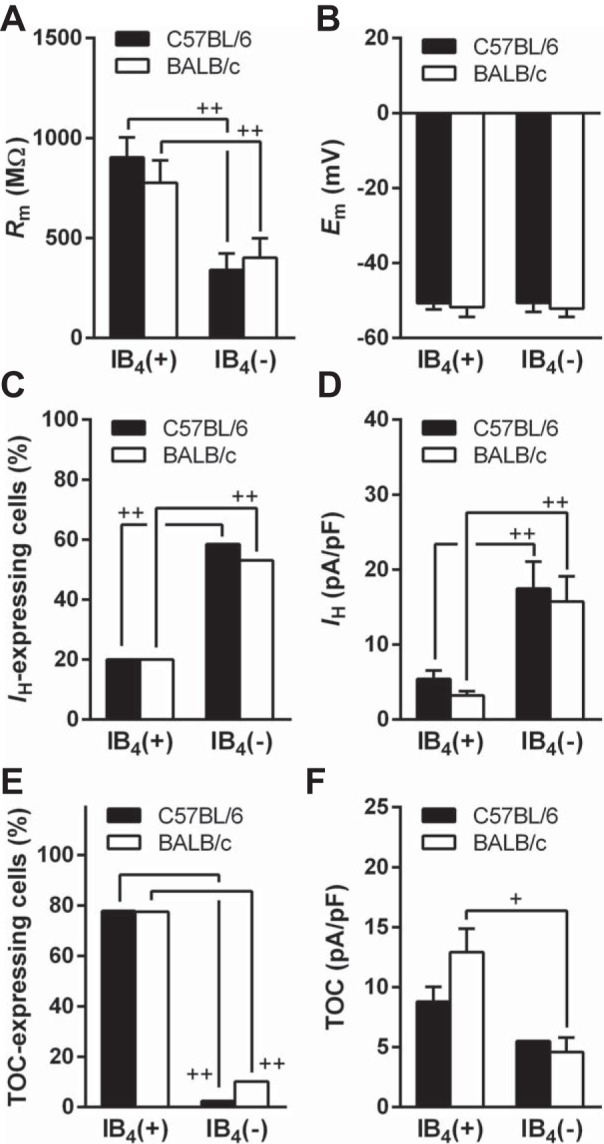
Electrophysiological properties in IB4(+) and IB4(−) TG neurons of C57BL/6 and BALB/c. A: membrane resistance (Rm). IB4(+) and IB4(−) neurons in C57BL/6: n = 45 and 40, respectively, and in BALB/c: n = 41 and 49, respectively. B: resting membrane potential (Em). Cell numbers are the same of A. C: lower hyperpolarization-activated inward current (IH)-showing cell population in IB4(+) neurons than that in IB4(−) neurons of C57BL/6 (n = 9/45 and 24/40, respectively) and BALB/c (n = 8/41 and 26/49, respectively). D: IH current densities of IB4(+) and IB4(−) neurons. IB4(+) and IB4(−) neurons in C57BL/6: n = 9 and 24, respectively, and BALB/c: n = 8 and 26, respectively. E: transient outward current (TOC) in IB4(+) and IB4(−) neurons of C57BL/6 (n = 35/45 and 1/40, respectively) and BALB/c (n = 31/41 and 5/49, respectively). F: TOC densities. +P < 0.05, between IB4(+) and IB4(−) neurons in same strain (C57BL/6: n = 35 and 1, respectively, and BALB/c: n = 31 and 5, respectively). Statistical comparison between IB4(−) neurons was not performed because the cell number for C57BL/6 was only one. In A, D, and F, +P < 0.05 and ++P < 0.01, between IB4(+) and IB4(−) neurons in same strain (Mann-Whitney U-test). In C and E, ++P < 0.01, between IB4(+) and IB4(−) neurons in same strain (Fisher's exact test).