



Abstract
Context
Educational interventions can help increase knowledge of available contraceptive methods, enabling individuals to make informed decisions and use contraception more effectively. This systematic review evaluated contraceptive education interventions to guide national recommendations on quality family planning services.
Evidence acquisition
Three databases (CINAHL, PubMed, and PsycINFO) were searched from 1985 through 2012 for peer-reviewed articles on educational interventions, with supplemental searches conducted through 2015. Primary outcomes were knowledge, participation in and comfort with decision making, and attitudes toward contraception. Secondary outcomes included contraceptive use behaviors and unintended pregnancy.
Evidence synthesis
Database searches in 2011 identified 5,830 articles; 17 met inclusion criteria and were abstracted into evidence tables. Searches in 2012 and 2015 identified four additional studies. Studies used a wide range of tools (decision aids, written materials, audio/videotapes, and interactive games), with and without input from a healthcare provider or educator. Of 15 studies that examined the impact of educational interventions on knowledge, 14 found significant improvement using a range of tools, with and without input from a healthcare provider or educator. Fewer studies evaluated outcomes related to decision making, attitudes toward contraception, contraceptive use behaviors, or unintended pregnancy.
Conclusions
Results from this systematic review are consistent with evidence from the broader healthcare field suggesting that a range of educational interventions can increase knowledge. Future studies should assess what aspects of educational interventions are most effective, the extent to which it is necessary to include a healthcare provider or educator, and the extent to which educational interventions can impact behaviors.
Context
Despite the availability of a wide variety of effective contraceptive methods,1 unintended pregnancy rates in the U.S. remain high.2 Unintended pregnancy occurs primarily among couples who use contraception incorrectly or inconsistently, or do not use any contraception.2,3 Contraceptive counseling provided by trained healthcare professionals may help prevent unintended pregnancy by encouraging sexually active individuals and couples to adopt and correctly use contraceptive methods that are the most appropriate and effective for them. An essential component of the counseling process is education. Contraceptive education aims to provide clients the basic information they need to make informed decisions about their use of contraception and to effectively use the contraceptive methods they have selected.
The importance of contraceptive education can be seen in the impact of knowledge on the selection and correct and consistent use of contraception. Many women indicate that contraceptive effectiveness is one of the most important considerations when selecting a method.4–7 Consistent with this priority, better knowledge of contraceptive effectiveness is associated with increased adoption rates for long-acting reversible contraceptives (LARCs), which have extremely low failure rates, even with typical use.8,9 Conversely, inadequate knowledge of contraception is associated with incorrect perceptions of the risks and side effects of contraceptive use, incorrect or inconsistent use, and method discontinuation.10–13 However, despite the importance of education, gaps in contraceptive knowledge have been documented frequently.9,14,15
The objective of this systematic review was to understand the aspects of educational interventions that best promote understanding and informed decision making with respect to method selection and correct and continued method use. Educational interventions delivered through a variety of mediums (e.g., written, audio/visual, computer/web-based, interactive versus non-interactive) were assessed. In addition, the impact of having a healthcare provider or health educator work with clients to help them understand the information presented was evaluated. The evidence presented here was used by the Office of Population Affairs and CDC to inform the 2014 “Providing Quality Family Planning Services: Recommendations of CDC and the U.S. Office of Population Affairs.”16
Evidence Acquisition
Definition of Contraceptive Education
This systematic review complements findings of the accompanying systematic review17 in this issue on contraceptive counseling in clinical settings. That review defined contraceptive counseling as an interactive process between a provider and client intended to help the client achieve a reproductive health goal related to contraceptive use; this review focused more narrowly on contraceptive education, defined as a process concerned with helping clients to increase their knowledge and make informed decisions about their reproductive health related to contraceptive use. It was assumed that education is a critical component, but all steps in the counseling process are needed to impact behavioral outcomes, including contraceptive use.
Development of Key Questions and Search Strategy
An overview of the systematic review methods for the articles in this series has been included in a separate paper18 in this issue. Briefly, an analytic framework was developed to show the logical relationships among the population of interest, the interventions, and the outcomes of interest (Figure 1). In contrast to the other reviews in this series, this review focused on short-term outcomes (e.g., knowledge) rather than medium- and long-term outcomes; studies were excluded if they only assessed interventions for modifying skills or behaviors. Seven key questions were addressed (Table 1). The first six (Q1–Q6) asked whether educational interventions affected knowledge of contraceptive risks and benefits, including side effects and method effectiveness, knowledge of correct method use, participation in decision making, level of comfort with decision making, attitudes toward contraception, and selection of more versus less effective contraceptive methods. The last key question (Q7) asked whether a client’s literacy influenced the effectiveness of educational interventions. During the review process, Q1 and Q2 were combined because many studies reported a composite knowledge score addressing knowledge of contraceptive risks, benefits, effectiveness, and correct use.
Figure 1.
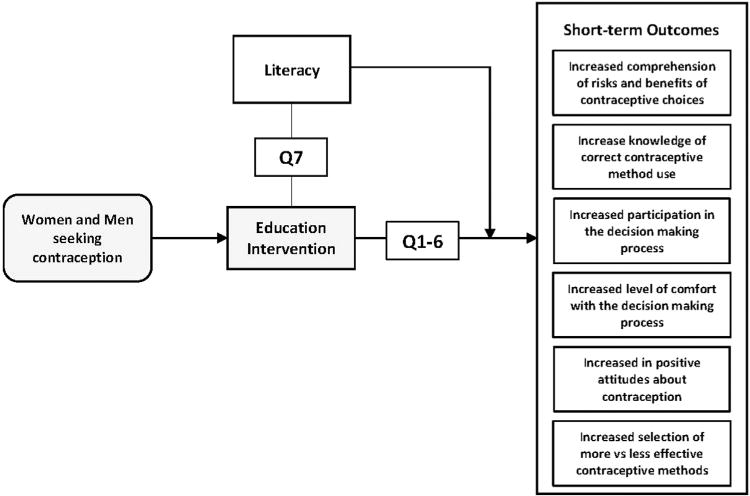
Analytic framework for systematic review of impact of contraceptive education.
Table 1.
Key Questions for Systematic Review on Impact of Education Interventions
| Key question no. | Question |
|---|---|
| 1 | Does contraceptive education increase comprehension of risks and benefits of contraceptive choices, including knowledge of side effects and method effectiveness? |
| 2 | Does contraceptive education increase knowledge of correct contraceptive method use? |
| 3 | Does contraceptive education increase participation in the decision-making process? |
| 4 | Does contraceptive education increase the level of comfort with the decision-making process? |
| 5 | Does contraceptive education increase positive attitudes about contraception? |
| 6 | Does contraceptive education increase selection of more as compared with less effective methods? |
| 7 | Does a client’s literacy level modify the effectiveness of educational interventions? |
Note: The key questions are put into context by the analytic framework presented in Figure 1.
Our search strategy (Appendix A) included terms common to the other systematic reviews in this series, as well as terms reflecting the key questions and analytic framework specific to this review. Database searches were limited to PubMed, PsycINFO, and CINAHL, but were supplemented by hand searches of bibliographies contained in key review articles and articles identified as relevant through our initial searches. Our initial database searches identified articles published in English between January 1985 and February 2011. This search was rerun from March 2011 through September 2012 to identify newly published research in the area, with more targeted searches being conducted for the period from October 2012 through March 2015.
Inclusion criteria were developed a priori. To be included, a study had to address one of our key questions. However, for studies meeting our inclusion criteria, outcomes of interest to other systematic reviews in this series (e.g., behavioral outcomes such as uptake of contraception, and long-term outcomes such as unintended pregnancy) also were evaluated. Outcomes related to our key questions were considered primary outcomes; outcomes of interest to other reviews in this series were considered secondary outcomes. To meet our inclusion criteria, studies also had to take place in a clinic-based setting where family planning services were provided, or they had to describe an intervention that could be implemented feasibly in a clinic-based setting (e.g., not a multisession course series). Studies focusing primarily on sexually transmitted infections were included only if they incorporated education on how to use condoms or addressed the use of condoms for preventing unplanned pregnancy. Studies taking place outside of the U.S., Western Europe, Australia/New Zealand, or Japan were excluded.
Data Abstraction
Detailed information on the studies included in this systematic review was collected, including information on study design, interventions, results, and information necessary to evaluate study quality. Pertinent data from the articles identified in the original database search were abstracted in 2011 by two independent abstractors. Differences in abstraction were reconciled by consulting a third abstractor. Studies identified in each article were examined to determine if they had evaluated at least one of the seven key questions outlined in the analytic framework of this review. In addition, identified education interventions were evaluated for the degree of involvement of a healthcare provider or educator. In provider-enhanced interventions, a healthcare provider or educator went beyond the standard of care to help participants in at least one study group understand the presented information. By contrast, in provider-independent interventions, a healthcare provider or educator did not go beyond the standard of care to help participants understand the presented information; if participants did meet with a provider in these studies, they received the educational intervention either before or after, rather than during their appointment, and providers were given no specific instructions to help participants understand the presented information.
Assessment of Study Quality and Synthesis of Data
Study quality was assessed using a modification of the grading system developed by the U.S. Preventive Services Task Force (USPSTF).19 Studies were given a quality rating based on the USPSTF evidence scale. Level I studies were properly designed RCTs. Level II-1 studies were well-designed controlled trials without randomization. Level II-2 studies were well-designed cohort or case-control studies. Level II-3 studies obtained data from multiple time series. Within each evidence level, specific criteria were then used to determine whether the study had a high, moderate, or low risk for bias.18
Data synthesis was primarily narrative, rather than quantitative, in nature. Meta-analysis was not performed because of the large degree of heterogeneity across studies with respect to study design, study populations, lengths of follow-up, and measured outcomes.
Summaries of evidence are presented in Appendix B, with findings stratified by primary (based on key questions developed for this review) and secondary (of interest to the other systematic reviews that were reported among included studies) outcomes. Secondary outcomes are summarized in Appendix B, but they are not discussed in detail in the text.
Evidence Synthesis
Our systematic database search identified 5,818 abstracts. Based on title and abstract review, 94 articles were retrieved. Thirteen20–32 of the 94 retrieved articles met our inclusion criteria; however, because two articles27,28 were based on the same study and subjects, they are described together, representing one piece of evidence, for a total of 12 independent studies. Hand searches yielded an additional 12 studies for possible inclusion. Five33–37 of these studies met our inclusion criteria, for a total of 17 included studies (Figure 2). Common reasons for exclusion were as follows: the intervention could not feasibly be carried out in a clinic setting (e.g., multisession course series), and the effect of the educational intervention could not be separated from a broader counseling intervention.
Figure 2.
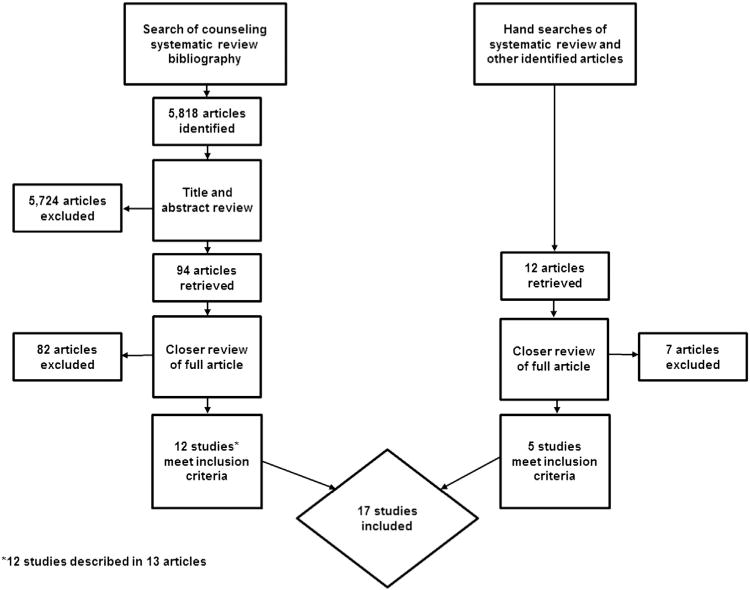
Flow diagram of the process of identifying studies to include in this systematic review of contraceptive education.
Of the 17 included studies, 1520–22,24–27,29–31,33–37 examined the impact of educational interventions on knowledge of contraceptive risks and benefits, including side effects and method effectiveness, or correct method use (Q1 and Q2). Three23,26,31 examined level of comfort with the decision-making process (Q4), and three21,29,32 examined attitudes related to contraceptive methods (Q5). No studies examined the effect of educational interventions on participation in the decision-making process or the selection of a more versus less effective contraceptive method (Q3 and Q6). Similarly, no studies examined whether the effectiveness of interventions depended on the participants’ literacy (Q7). With respect to secondary outcomes, two studies24,28 examined how intentions to use condoms were affected when a voucher was offered, three studies22,24,29 examined adoption of contraceptive methods, one study20 looked at contraceptive continuation at a 1-year follow-up, and one study21 looked at correct contraceptive use. Two studies20,29 examined unintended pregnancy.
Fifteen of the 17 studies included at least one intervention arm that evaluated the impact of a provider-independent intervention. Of these studies, seven21,23–25,30,31,33 included at least one group that received only written materials, five21,22,26–29 used audiotapes or videotapes alone or in combination with written materials, and three34,36,37 used only interactive computer games. Two studies25,31 provided different written materials to each of the study groups to assess the effect of different complexities of information.
Six studies included at least one intervention arm that evaluated the impact of a provider-enhanced intervention. Among these interventions, four22,27,28,32,35 used audiotapes or videotapes, one25 used written materials, and one20 used a contraceptive decision aid, defined as a tool providing a structured yet interactive framework for individuals to systematically evaluate their options and consider the personal importance of perceived advantages and disadvantages.38,39 Three22,25,27 of these studies also included a study arm with a provider-independent intervention, and one25 varied the complexity of the materials across study groups.
Eight21,22,24–29,31 of the studies were RCTs, although two were classified as having either a high26 or a moderate risk21 for bias. Four were interventions that included a control group, two20,34 of which were classified as having a moderate risk for bias and two23,37 of which were classified as having a high risk for bias. The remaining five30,32,33,35,36 used a pre-/post-test design and were classified as having a high risk for bias.
Knowledge
Of the 15 studies that examined the effect of educational interventions on contraceptive knowledge, 14 found a statistically significant improvement in knowledge of contraceptive risks, benefits, side effects, effectiveness, or correct use. Of these 15 studies, 13 included a provider-independent intervention arm, with one study including two different provider-independent interventions and five studies including at least one provider-enhanced intervention arm, for a total of 19 different approaches to providing education (Table 2, Appendix B). Of the 19 approaches, 18 resulted in a significant increase in knowledge. Details are described separately (below) for provider-independent and -enhanced interventions.
Table 2.
Summary of Evidence From Systematic Review on Contraceptive Education
| Impact on | Mode of education delivery: provider independenta | Mode of education delivery: provider enhancedb | |||||
|---|---|---|---|---|---|---|---|
| Decision aids | Written materials | Audio or videotape | Interactive computer games | Decision aids | Written materials | Audio or videotape | |
| Number of studies | 0 | 7 | 5 | 3 | 1 | 1 | 4 |
| Primary outcomes | |||||||
| Knowledge, including knowledge of risks and benefits and knowledge of correct method use | – | ▲▲▲▲▲● | ▲▲▲▲▲ | ▲▲▲ | ▲ | ▲ | ▲▲▲ |
| Participation in the decision making process | – | – | – | – | – | – | – |
| Comfort with decision making process | – | ▲▲ | ● | – | – | – | – |
| Positive attitudes about contraception | – | ● | ▲▲* | – | – | ▲ | |
| Selection of effective contraceptive methods | – | – | – | – | – | – | – |
| Secondary outcomes | |||||||
| Short-term | |||||||
| Intentions to use contraception (condom vouchers redeemed) | – | – | ▲▲ | – | – | – | ▲ |
| Medium-term | |||||||
| Contraceptive use, including continuation, and correct and consistent use | – | ●● | ●▲▲* | – | ● | – | – |
| Long-term | |||||||
| Pregnancy | – | – | ▲ | – | ▲* | – | – |
Note: Each symbol=1 study; studies with multiple types of interventions have a symbol for each type of intervention. ▲ education intervention had a significant positive impact (p<0.05) on this outcome; * finding had marginal significance (0.05<p<0.1); ● education intervention had neither positive nor negative impact on this outcome; – no studies identified for this outcome.
Findings for studies without input beyond the standard of care from a person, such as a healthcare provider or a health educator.
Findings for studies with enhanced input from a healthcare provider or a health educator.
Thirteen of the 14 provider-independent interventions that included an evaluation of knowledge found a significant increase. These included five studies21,24,25,30,31 that used written materials alone, five21,22,26,27,29 that used audiotapes or videotapes alone or in combination with written materials, and three34,36,37 that used interactive computer games alone. Among the studies with statistically significant findings, six21,22,24,25,27,29 were RCTs with a low risk for bias. The one study33 that did not find significant improvement was based on pre-/post-test study design and had a high risk for bias.
In two RCTs25,31 with low risk for bias, participants were presented with differing complexities of written information. In both studies, information of all complexity levels had a significant positive effect on knowledge. However, in only one31 of the two studies did the effect vary with the complexity of provided information. In this study, participants were assigned to one of three experimental groups and were asked to correctly identify the more effective of two contraceptive methods (hormonal shots versus pills and pills versus condoms). Participants were asked to complete this task prior to and while viewing one of three different tables containing different complexities of information to illustrate method effectiveness. In all three groups, women were better able to answer questions about method effectiveness after they had been given the table, but the degree of improvement was two times higher for women in the intervention arm that was provided the simplest as compared with the more complex information tables (p<0.05).
Five20,22,25,27,35 of the six studies with provider-enhanced interventions assessed their effect on knowledge. All five found a significant positive effect. Of these studies, one25 used written materials, one20 used a contraceptive decision aid, and three22,27,35 used audiotapes or videotapes in combination with feedback from a provider (Table 2).
Among these five studies, three22,25,27 were RCTs with low risk for bias that also included an experimental group in which there was no provider enhancement. This allowed for better isolation of the potential effect of provider-enhanced contraceptive education. Relative to the control groups, one study22 found a greater increase in knowledge with the use of a health educator, one25 found mixed effects depending on the complexity of the presented materials, and one27 found no difference in knowledge gains with or without a health educator.
In the first study22 that did find a greater effect with a health educator, the standard of care was compared with the use of a culturally appropriate, theoretically based videotape, and to a face-to-face session with a trained health educator. Although participants in both experimental groups, as compared with the standard-of-care group, showed a greater increase in knowledge of correct method use, the increase was greatest for participants in the health educator as compared with the videotape group (p<0.001). In the second study25 that found mixed effects, women were assigned either to a control group, a group that received a wallet-sized summary card explaining pill-taking rules, or a group that received a full-length educational leaflet. Each of these groups was then subdivided so that some women in each group received a series of interactive questions from their healthcare provider during a 2–5-minute session. The summary card and full-length leaflet had a similar effect when presented independent of the provider session. When paired with interactive questions, the effect of the summary card on knowledge of pill-taking rules increased (AOR relative to controls, with questions =6.81, 95% CI=2.85, 16.27; without questions=4.04, 95% CI=1.68, 9.75), but the effect of the full-length leaflet was smaller (AOR relative to controls, with questions=2.58, 95% CI=1.45, 6.18; without questions=3.4, 95% CI=1.45, 8.09).
Comfort With the Decision-Making Process
Three provider-independent interventions assessed level of comfort with the decision-making process. The first26 of these studies used a videotape and found no effect; however, although this was an RCT, it had a high risk for bias. The second study23 used written materials. This study found that a higher percentage of women who received comprehensive materials on their postpartum contraceptive options felt comfortable with the amount of information they received, as compared with women who received standard materials (p<0.01). However, this study used a post-test design with sequential study groups and also had a high risk for bias. The final study31 also used written materials, but was an RCT with low risk for bias. This study found mixed results. When participants in this study were presented with contraceptive effectiveness charts with varying degrees of complexity, 77% of those who viewed the simplest chart, as compared with 85% of those in each of the two groups who viewed more complex charts, indicated that they had enough information to choose a method (significance not reported). However, a greater percentage of participants viewing more complex charts (15% and 19%) as compared with the simplest chart (6%), reported that the chart was too difficult to understand (p<0.01).
Positive Attitudes Toward Contraception
Two provider-independent studies21,29 examined attitudes toward contraception following an intervention using either an audiotape or videotape, alone or in combination with written materials. Both studies were RCTs with low to moderate risk for bias. The first study21 included women who had selected oral contraceptives. In this study, women who received a brochure plus an audiotape reported higher perceived medical advantages to using oral contraceptives, as compared with controls who received the standard of care (p<0.04); however, there was no difference in scores between women who received the brochure alone as compared with women in the control group. In the second study,29 a slightly higher proportion of women who viewed an educational videotape had a positive attitude about using emergency contraception, as compared with women in a control group who received the standard of care, but this difference missed significance (8% vs 4%, p=0.06).
Only one provider-enhanced intervention32 assessed attitudes related to contraception. In this study, a higher proportion of participants who watched a videotape with active input from a healthcare provider had a positive attitude about intrauterine devices, as compared with participants in the control arm who received the standard of care (64% vs 38%, p<0.01). However, this study was based on a pre-/post-test design and had a high risk for bias.
Discussion
Our initial database searches identified 17 studies that met the inclusion criteria for this systematic review. Of these, 15 studies20–22,24–27,29–31,33–37 looked at knowledge of correct method use or contraceptive risks and benefits, including side effects and method effectiveness. All but one33 found a statistically significant positive impact of educational interventions. These studies included six RCTs with low risk for bias and covered a variety of educational mediums (i.e., written materials, audiotapes or videotapes, interactive computer games, and contraceptive decision aids). Thus, our findings are consistent with other systematic reviews40,41 from the broader healthcare field, suggesting that a range of educational interventions can help increase client understanding.
This review provides more limited evidence for our other primary outcomes. Of the three studies23,26,31 that looked at comfort with decision making, only one,23 which had a high risk for bias, showed a clear positive effect. All three studies21,29,32 that measured attitudes toward contraceptive methods found a positive effect, although the one with the clearest results had a high risk for bias.32 Previous systematic reviews40,41 from the broader healthcare field have found more limited evidence for client attitudes and comfort with decision-making processes. Although this may indicate decision-making tools have only a limited impact on these outcomes, it may also be that such effects are difficult to detect because of other influences, such as the difficulty of the choice to be made and the quality of the healthcare provider relationship and other aspects of care.41
We were unable to draw conclusions about our other outcomes. None of the studies we identified addressed our remaining primary outcomes. With respect to our secondary outcomes, we identified only two studies that addressed intentions to use condoms24,28 or unintended pregnancy.20,29 We identified five studies that evaluated uptake of contraception, or correct and continued use of contraception. Though four20,21,24,29 of these were RCTs with low to moderate risk for bias, only two21,29 found a positive effect. The absence of studies finding an impact on our secondary outcomes likely is related to the fact that educational interventions are generally intended to impact short-term outcomes such as knowledge, whereas broader counseling interventions are theorized to address outcomes that are associated with behavioral changes.17
Although this systematic review provides evidence that a wide range of mediums are effective at increasing knowledge, we identified only three studies23,25,31 that looked at the complexity of educational interventions, and one23 had a sequential post-test study design with a high risk for bias. Of the two RCTs with low risk for bias, one31 found the simplest presentation of numeric information was the most effective, but in the other,25 simpler materials were only more effective when paired with interactive questions from a healthcare provider. Research from other areas of healthcare suggests that using plain language,42–44 attending to the client’s cultural and linguistic preferences,45–47 limiting the amount of presented information and discussing important facts first,48–50 and simplifying the presentation of numeric quantities51–64 are important for promoting client comprehension. More-detailed research specific to these topics is needed in relation to contraception.
This review also leaves open questions about the extent to which educational interventions are more effective with input from a health educator or healthcare provider. Though we identified three RCTs with low risk for bias that included both provider-independent and -enhanced interventions, their results are not straightforward. The study by DeLamater and colleagues22 found knowledge increases were greater with the input of a health educator. However, in the study by Little and colleagues,25 interactive questions increased the effectiveness of a simplified tool, but not standard written materials. In the study by O’Donnell et al.,27 the addition of a facilitator-led discussion session was no more effective than a videotape alone for increasing knowledge, but it did result in a higher proportion of subjects redeeming the vouchers for free condoms.28 Nonetheless, in spite of the limited evidence provided by this review, research in other areas of healthcare suggests clients value spoken information and do not see written materials as a replacement.65,66 Moreover, provider delivery allows for active learning techniques with demonstrated effectiveness, such as the presentation of information in a question-and-answer format67–70 and use of the teach-back method in which clients restate the most important information.71,72
Additional studies addressing outcomes of interest were identified subsequent to the presentation of this systematic review to the Technical Panel on Counseling and Education weighing evidence for the recommendations: “Providing Quality Family Planning Services: Recommendations of CDC and the U.S. Office of Population Affairs.”16 Two studies subsequently identified examined literacy and found that it did not interact with other features of educational tools to impact their effectiveness. The first subsequently identified study73 was a post hoc analysis of the RCT in our review addressing the impact of written materials paired with interactive questions.25 In this analysis, the impact of the interventions did not differ by educational level. The second study74 was an RCT using daily educational text messages to provide information on the risk, benefits, side effects, effectiveness, and mechanisms of action for oral contraceptives. The effect of these messages on knowledge scores at 6 months was similar for women who had or had not completed high school. The lack of significant findings in these studies concurs with prior research suggesting that simplified materials may be more effective and preferred by users of all literacy levels.42–44
Four subsequently identified studies provide evidence addressing the impact of educational tools on knowledge of contraception, attitudes about contraception, selection of effective contraceptive methods, and continued use of contraception. In one retrospective cohort study, intrauterine device (IUD) continuation rates were compared among women who did and did not receive an enhanced health educator session that included culturally appropriate materials written in plain language, demonstrations with models and visuals, and use of the teach-back method to ensure understanding. Women who did not receive the enhanced session had significantly increased odds of having their IUD removed by 6 months.75 The second study was the aforementioned RCT using daily text messages, with respect to literacy. In this study, participants who received the text messages had significantly higher knowledge scores and continuation rates at 6 months relative to controls.74,76 The third study was an RCT that evaluated a computer-based contraceptive assessment module. Upon completing its use, participants received either a list of methods tailored to the responses they provided or a generic list of methods. Although participants in both experimental arms had significantly increased odds relative to controls of selecting an effective method (i.e., injectables, pills, patches, or rings) or highly effective method (i.e., an IUD or implant),77 only the participants who received the tailored list had increased odds relative to controls of using their selected method correctly and continuing this method through 4 months.78 The fourth study was an RCT evaluating use of an interactive iOS app designed to increase awareness of long-activing reversible contraceptives (LARCs, i.e., IUDs and implants) among clients waiting for a contraceptive appointment. Compared with participants who received the standard of care, a significantly higher percentage of app users correctly answered questions about contraceptive effectiveness and expressed an interest in receiving information about implants. There was no difference between the groups expressing interest in receiving information about IUDs, or in selection of a LARC method, although the study was not powered to detect an increase in LARC selection.51
Conclusions
This systematic review provides clear evidence that a wide range of educational tools can effectively increase client knowledge. More limited evidence is provided for the impact of educational interventions on client comfort with the decision-making process or the development of attitudes toward contraceptive methods. Although few studies identified for inclusion in this review found an effect of educational interventions on correct or continued contraceptive use, recently identified studies provide more promising results. Although the heterogeneity of studies in this review did not allow us to calculate summary measures of association, each of our outcomes were supported by some high-quality studies with a low risk for bias. Future studies in the area of family planning are needed to assess how the content and format of information can best be structured and delivered, the extent to which it is necessary to have a knowledgeable person such as a healthcare provider or educator work with clients to enhance the effectiveness educational tools, and the extent to which educational interventions can influence related contraceptive use behaviors. The information in this review was presented to an expert technical panel in May 2011 at a meeting convened by the Office of Population Affairs and CDC. Along with expert feedback and findings from a complementary review on contraceptive counseling, the information in this review was used to develop recommendations for providing quality contraceptive counseling and education in the 2014 “Providing Quality Family Planning Services: Recommendations of CDC and the U.S. Office of Population Affairs.”16
Acknowledgments
Publication of this article was supported by the U.S. Centers for Disease Control and Prevention (CDC) and the Office of Population Affairs (OPA).
The findings and conclusions in this report are those of the authors and do not necessarily represent the official position of CDC or the Office of Population Affairs.
Appendix: Supplementary data
Supplementary data associated with this article can be found at http://dx.doi.org/10.1016/j.amepre.2015.03.031.
Footnotes
No financial disclosures were reported by the authors of this paper.
References
- 1.Mosher WD, Jones J. Use of contraception in the United States: 1982–2008. Vital Health Stat. 2010;23(29):1–44. [PubMed] [Google Scholar]
- 2.Finer LB, Zolna MR. Unintended pregnancy in the United States: incidence and disparities, 2006. Contraception. 2011;84(5):478–485. doi: 10.1016/j.contraception.2011.07.013. http://dx.doi.org/1016/j.contraception.2011.07.013. [DOI] [PMC free article] [PubMed] [Google Scholar]
- 3.Gold RB, Sonfield A, Richards CL, Frost JJ. Next Steps for America’s Family Planning Program: Leveraging the Potential of Medicaid and Title X in an Evolving Health Care System. New York: Guttmacher Institute; 2009. [Google Scholar]
- 4.Stanwood NL, Bradley KA. Young pregnant women’s knowledge of modern intrauterine devices. Obstet Gynecol. 2006;108(6):1417–1422. doi: 10.1097/01.AOG.0000245447.56585.a0. http://dx.doi.org/10.1097/01.AOG.0000245447.56585.a0. [DOI] [PubMed] [Google Scholar]
- 5.Grady WR, Klepinger DH, Nelson-Wally A. Contraceptive characteristics: the perceptions and priorities of men and women. Fam Plann Perspect. 1999;31(4):168–175. http://dx.doi.org/10.2307/2991589. [PubMed] [Google Scholar]
- 6.Forrest JD. U.S. women’s perceptions of and attitudes about the IUD. Obstet Gynecol Surv. 1996;51(12 suppl):S30–S34. doi: 10.1097/00006254-199612000-00012. http://dx.doi.org/10.1097/00006254-199612000-00012. [DOI] [PubMed] [Google Scholar]
- 7.Steiner MJ, Trussell J, Mehta N, Condon S, Subramaniam S, Bourne D. Communicating contraceptive effectiveness: a randomized controlled trial to inform a World Health Organization family planning handbook. Am J Obstet Gynecol. 2006;195(1):85–91. doi: 10.1016/j.ajog.2005.12.053. http://dx.doi.org/10.1016/j.ajog.2005.12.053. [DOI] [PubMed] [Google Scholar]
- 8.Dempsey AR, Billingsley CC, Savage AH, Korte JE. Predictors of long-acting reversible contraception use among unmarried young adults. Am J Obstet Gynecol. 2012;206(6):526.e1–526.e5. doi: 10.1016/j.ajog.2012.02.014. http://dx.doi.org/10.1016/j.ajog.2012.02.014. [DOI] [PubMed] [Google Scholar]
- 9.Eisenberg DL, Secura GM, Madden TE, Allsworth JE, Zhao Q, Peipert JF. Knowledge of contraceptive effectiveness. Am J Obstet Gynecol. 2012;206(6):479.e1–479.e9. doi: 10.1016/j.ajog.2012.04.012. [DOI] [PMC free article] [PubMed] [Google Scholar]
- 10.Gardner J, Miller L. Promoting the safety and use of hormonal contraceptives. J Womens Health (Larchmt) 2005;14(1):53–60. doi: 10.1089/jwh.2005.14.53. http://dx.doi.org/10.1089/jwh.2005.14.53. [DOI] [PubMed] [Google Scholar]
- 11.Grimes DA, Schulz KF. Nonspecific side effects of oral contraceptives: nocebo or noise? Contraception. 2011;83(1):5–9. doi: 10.1016/j.contraception.2010.06.010. http://dx.doi.org/10.1016/j.contraception.2010.06.010. [DOI] [PubMed] [Google Scholar]
- 12.Frost JDL, Finer L. Young adults’ contraceptive knowledge, norms and attitudes: associations with risk of unintended pregnancy. Perspect Sex Reprod Health. 2012;44(2):107–116. doi: 10.1363/4410712. http://dx.doi.org/10.1363/4410712. [DOI] [PubMed] [Google Scholar]
- 13.Rickert VI, Berenson AB, Williamson AJ, Wiemann CM. Immediate recall of oral contraceptive instructions: implications for providers. Am J Obstet Gynecol. 1999;180(6, pt 1):1399–1406. doi: 10.1016/s0002-9378(99)70025-6. http://dx.doi.org/10.1016/S0002-9378(99)70025-6. [DOI] [PubMed] [Google Scholar]
- 14.Frost JJ, Duberstein L, Finer LB. Young adults’ contraceptive knowledge, norms and attitudes: associations with risk of unintended pregnancy. Perspect Sex Reprod Health. 2012;44(2):107–116. doi: 10.1363/4410712. http://dx.doi.org/10.1363/4410712. [DOI] [PubMed] [Google Scholar]
- 15.Hall KS, Castaño PM, Stone PW, Westhoff C. Measuring oral contraceptive knowledge: a review of research findings and limitations. Patient Educ Couns. 2010;81(3):388–394. doi: 10.1016/j.pec.2010.10.016. http://dx.doi.org/10.1016/j.pec.2010.10.016. [DOI] [PMC free article] [PubMed] [Google Scholar]
- 16.CDC. Providing quality family planning services: recommendations of the CDC and the U.S. Office of Population Affairs. MMWR Recomm Rep. 2014;63(RR-04):1–54. [PubMed] [Google Scholar]
- 17.Zapata LB, Tregear SJ, Curtis KM, et al. Impact of contraceptive counseling in clinical settings: a systematic review. Am J Prev Med. 2015;49(2S1):S31–S45. doi: 10.1016/j.amepre.2015.03.023. [DOI] [PMC free article] [PubMed] [Google Scholar]
- 18.Tregear SJ, Gavin LE, Williams JR. Systematic review evidence methodology: providing quality family planning services. Am J Prev Med. 2015;49(2S1):S23–S30. doi: 10.1016/j.amepre.2015.03.033. [DOI] [PMC free article] [PubMed] [Google Scholar]
- 19.Harris RP, Helfand M, Woolf SH, et al. Current methods of the US Preventive Services Task Force: a review of the process. Am J Prev Med. 2001;20(3 suppl):21–35. doi: 10.1016/s0749-3797(01)00261-6. http://dx.doi.org/10.1016/S0749-3797(01)00261-6. [DOI] [PubMed] [Google Scholar]
- 20.Chewning B, Mosena P, Wilson D, et al. Evaluation of a computerized contraceptive decision aid for adolescent patients. Patient Educ Couns. 1999;38(3):227–239. doi: 10.1016/s0738-3991(99)00014-2. http://dx.doi.org/10.1016/S0738-3991(99)00014-2. [DOI] [PubMed] [Google Scholar]
- 21.Deijen JB, Kornaat H. The influence of type of information, somatization, and locus of control on attitude, knowledge, and compliance with respect to the triphasic oral contraceptive Tri-Minulet. Contraception. 1997;56(1):31–41. doi: 10.1016/s0010-7824(97)00071-1. http://dx.doi.org/10.1016/S0010-7824(97)00071-1. [DOI] [PubMed] [Google Scholar]
- 22.DeLamater J, Wagstaff DA, Havens KK. The impact of a culturally appropriate STD/AIDS education intervention on black male adolescents’ sexual and condom use behavior. Health Educ Behav. 2000;27(4):454–470. doi: 10.1177/109019810002700408. http://dx.doi.org/10.1177/109019810002700408. [DOI] [PubMed] [Google Scholar]
- 23.Johnson LK, Edelman A, Jensen J. Patient satisfaction and the impact of written material about postpartum contraceptive decisions. Am J Obstet Gynecol. 2003;188(5):1202–1204. doi: 10.1067/mob.2003.308. http://dx.doi.org/10.1067/mob.2003.308. [DOI] [PubMed] [Google Scholar]
- 24.Kirby D, Harvey PD, Claussenius D, Novar M. A direct mailing to teenage males about condom use: its impact on knowledge, attitudes and sexual behavior. Fam Plann Perspect. 1989;21(1):12–18. http://dx.doi.org/10.2307/2135413. [PubMed] [Google Scholar]
- 25.Little P, Griffin S, Kelly J, Dickson N, Sadler C. Effect of educational leaflets and questions on knowledge of contraception in women taking the combined contraceptive pill: randomised controlled trial. BMJ. 1998;316(7149):1948–1952. doi: 10.1136/bmj.316.7149.1948. http://dx.doi.org/10.1136/bmj.316.7149.1948. [DOI] [PMC free article] [PubMed] [Google Scholar]
- 26.Mason V, McEwan A, Walker D, Barrett S, James D. The use of video information in obtaining consent for female sterilisation: a randomised study. BJOG. 2003;110(12):1062–1071. http://dx.doi.org/10.1111/j.1471-0528.2003.03041.x. [PubMed] [Google Scholar]
- 27.O’Donnell L, San Doval A, Duran R, O’Donnell CR. The effectiveness of video-based interventions in promoting condom acquisition among STD clinic patients. Sex Transm Dis. 1995;22(2):97–103. doi: 10.1097/00007435-199503000-00004. http://dx.doi.org/10.1097/00007435-199503000-00004. [DOI] [PubMed] [Google Scholar]
- 28.O’Donnell LN, Doval AS, Duran R, O’Donnell C. Video-based sexually transmitted disease patient education: its impact on condom acquisition. Am J Public Health. 1995;85(6):817–822. doi: 10.2105/ajph.85.6.817. http://dx.doi.org/10.2105/AJPH.85.6.817. [DOI] [PMC free article] [PubMed] [Google Scholar]
- 29.Schwarz EB, Gerbert B, Gonzales R. Computer-assisted provision of emergency contraception a randomized controlled trial. J Gen Intern Med. 2008;23(6):794–799. doi: 10.1007/s11606-008-0609-x. http://dx.doi.org/10.1007/s11606-008-0609-x. [DOI] [PMC free article] [PubMed] [Google Scholar]
- 30.Smith LF, Whitfield MJ. Women’s knowledge of taking oral contraceptive pills correctly and of emergency contraception: effect of providing information leaflets in general practice. Br J Gen Pract. 1995;45(397):409–414. [PMC free article] [PubMed] [Google Scholar]
- 31.Steiner MJ, Dalebout S, Condon S, Dominik R, Trussell J. Understanding risk: a randomized controlled trial of communicating contraceptive effectiveness. Obstet Gynecol. 2003;102(4):709–717. doi: 10.1016/s0029-7844(03)00662-8. http://dx.doi.org/10.1016/S0029-7844(03)00662-8. [DOI] [PubMed] [Google Scholar]
- 32.Whitaker AK, Terplan M, Gold MA, Johnson LM, Creinin MD, Harwood B. Effect of a brief educational intervention on the attitudes of young women toward the intrauterine device. J Pediatr Adolesc Gynecol. 2010;23(2):116–120. doi: 10.1016/j.jpag.2009.09.012. http://dx.doi.org/10.1016/j.jpag.2009.09.012. [DOI] [PubMed] [Google Scholar]
- 33.Lindenberg CS, Solorzano RM, Bear D, Strickland O, Galvis C, Pittman K. Reducing substance use and risky sexual behavior among young, low-income, Mexican-American women: comparison of two interventions. Appl Nurs Res. 2002;15(3):137–148. doi: 10.1053/apnr.2002.34141. http://dx.doi.org/10.1053/apnr.2002.34141. [DOI] [PubMed] [Google Scholar]
- 34.Paperny DM, Starn JR. Adolescent pregnancy prevention by health education computer games: computer-assisted instruction of knowledge and attitudes. Pediatrics. 1989;83(5):742–752. [PubMed] [Google Scholar]
- 35.Pedrazzini AE, McGowan H, Lucking L, Johanson RJ. “The trouble with sex—it always gets in the way”: an evaluation of a peer-produced teenage pregnancy video. Br J Fam Plann. 2000;26(3):131–135. doi: 10.1783/147118900101194544. http://dx.doi.org/10.1783/147118900101194544. [DOI] [PubMed] [Google Scholar]
- 36.Reis J, Tymchyshyn P. A longitudinal evaluation of computer-assisted instruction on contraception for college students. Adolescence. 1992;27(108):803–811. [PubMed] [Google Scholar]
- 37.Roberto AJ, Zimmerman RS, Carlyle KE, Abner EL, Cupp PK, Hansen GL. The effects of a computer-based pregnancy, STD, and HIV prevention intervention: a nine-school trial. Health Commun. 2007;21(2):115–124. doi: 10.1080/10410230701306990. http://dx.doi.org/10.1080/10410230701306990. [DOI] [PubMed] [Google Scholar]
- 38.French R, Wellings K, Cowan F. How can we help people to choose a method of contraception? The case for contraceptive decision aids. J Fam Plann Reprod Health Care. 2009;35(4):219–220. doi: 10.1783/147118909789587169. http://dx.doi.org/10.1783/147118909789587169. [DOI] [PubMed] [Google Scholar]
- 39.O’Connor AM, Bennett CL, Stacey D, et al. Decision aids for people facing health treatment or screening decisions. Cochrane Database Syst Rev. 2009(3):CD001431. doi: 10.1002/14651858.CD001431.pub2. http://dx.doi.org/10.1002/14651858.CD001431.pub2. [DOI] [PubMed] [Google Scholar]
- 40.Trevena LJ, Davey HM, Barratt A, Butow P, Caldwell P. A systematic review on communicating with patients about evidence. J Eval Clin Pract. 2006;12(1):13–23. doi: 10.1111/j.1365-2753.2005.00596.x. http://dx.doi.org/10.1111/j.1365-2753.2005.00596.x. [DOI] [PubMed] [Google Scholar]
- 41.Stacey D, Bennett CL, Barry MJ, et al. Decision aids for people facing health treatment or screening decisions. Cochrane Database Syst Rev. 2011(10):CD001431. doi: 10.1002/14651858.CD001431.pub3. http://dx.doi.org/10.1002/14651858.CD001431.pub3. [DOI] [PubMed] [Google Scholar]
- 42.Centers for Medicare and Medicaid Services. Toolkit for making written material clear and effective. 2011 doi: 10.1097/NNE.0b013e31820b5077. www.cms.gov/WrittenMaterialsToolkit/01_Overview.asp#TopOfPage. [DOI] [PubMed]
- 43.USDHHS, Office of Disease Prevention and Health Promotion. Health literacy online: a guide to writing and designing easy-to-use health Web sites. 2010 doi: 10.1177/1524839912446480. www.health.gov/healthliteracyonline/Web_Guide_Health_Lit_Online.pdf. [DOI] [PubMed]
- 44.DeWalt D, Callahan L, Hawk V, et al. (AHRQ Publication No. 10-0046-EF).Health Literacy Universal Precautions Toolkit. 2010 doi: 10.1016/j.outlook.2010.12.002. www.nchealthliteracy.org/toolkit/. [DOI] [PMC free article] [PubMed]
- 45.Olavarria M, Beaulac J, Belanger A, Young M, Aubry T. Organizational cultural competence in community health and social service organizations: how to conduct a self-assessment. J Cult Divers. 2009;16(4):140–150. [PubMed] [Google Scholar]
- 46.USDHHS Advisory Committee on Minority Health. Reducing Health Disparities by Promoting Patient-Centered Culturally and Linguistically Sensitive/Competent Health Care. Washington, DC: USDHHS Office of Minority Health; 2008. (U.S. Public Health Service). [Google Scholar]
- 47.Centers for Medicare and Medicaid Services. Toolkit for making written material clear and effective, Part 11 Understanding and using the “Toolkit Guidelines for Culturally Appropriate Translation”. 2011 www.cms.gov/WrittenMaterialsToolkit/13_ToolkitPart11.asp#TopOfPage.
- 48.McGee J. Toolkit for making written material cear and effective. (CMS Product No. 11476).Centers for Medicare aned Medicaid Services. 2010 [Google Scholar]
- 49.Peters E, Dieckmann N, Dixon A, Hibbard JH, Mertz CK. Less is more in presenting quality information to consumers. Med Care Res Rev. 2007;64(2):169–190. doi: 10.1177/10775587070640020301. http://dx.doi.org/10.1177/10775587070640020301. [DOI] [PubMed] [Google Scholar]
- 50.Berry DC, Michas IC, Rosis Fd. Evaluating explanations about drug prescriptions: effects of varying the nature of information about side effects and its relative position in explanations. Psychol Health. 1998;13(5):767–784. http://dx.doi.org/10.1080/08870449808407431. [Google Scholar]
- 51.Gilliam ML, Martins SL, Bartlett E, Mistretta SQ, Holl JL. Development and testing of an iOS waiting room “app” for contraceptive counseling in a Title X family planning clinic. Am J Obstet Gynecol. 2014;211(5):481.e1–481.e8. doi: 10.1016/j.ajog.2014.05.034. [DOI] [PubMed] [Google Scholar]
- 52.Berry DC. Informing people about the risks and benefits of medicines: implications for the safe and effective use of medicinal products. Curr Drug Saf. 2006;1(1):121–126. doi: 10.2174/157488606775252638. http://dx.doi.org/10.2174/157488606775252638. [DOI] [PubMed] [Google Scholar]
- 53.Berry DC, Raynor DK, Knapp P, Bersellini E. Patients’ understanding of risk associated with medication use: impact of European Commission guidelines and other risk scales. Drug Saf. 2003;26(1):1–11. doi: 10.2165/00002018-200326010-00001. http://dx.doi.org/10.2165/00002018-200326010-00001. [DOI] [PubMed] [Google Scholar]
- 54.Edwards A, Elwyn G, Mulley A. Explaining risks: turning numerical data into meaningful pictures. BMJ. 2002;324(7341):827–830. doi: 10.1136/bmj.324.7341.827. http://dx.doi.org/10.1136/bmj.324.7341.827. [DOI] [PMC free article] [PubMed] [Google Scholar]
- 55.Galesic M, Gigerenzer G, Straubinger N. Natural frequencies help older adults and people with low numeracy to evaluate medical screening tests. Med Decis Making. 2009;29(3):368–371. doi: 10.1177/0272989X08329463. http://dx.doi.org/10.1177/0272989X08329463. [DOI] [PubMed] [Google Scholar]
- 56.Garcia-Retamero R, Galesic M. Communicating treatment risk reduction to people with low numeracy skills: a cross-cultural comparison. Am J Public Health. 2009;99(12):2196–2202. doi: 10.2105/AJPH.2009.160234. http://dx.doi.org/10.2105/AJPH.2009.160234. [DOI] [PMC free article] [PubMed] [Google Scholar]
- 57.Garcia-Retamero R, Galesic M, Gigerenzer G. Do icon arrays help reduce denominator neglect? Med Decis Making. 2010;30(6):672–684. doi: 10.1177/0272989X10369000. http://dx.doi.org/10.1177/0272989X10369000. [DOI] [PubMed] [Google Scholar]
- 58.Gigerenzer G, Edwards A. Simple tools for understanding risks: from innumeracy to insight. BMJ. 2003;327(7417):741–744. doi: 10.1136/bmj.327.7417.741. http://dx.doi.org/10.1136/bmj.327.7417.741. [DOI] [PMC free article] [PubMed] [Google Scholar]
- 59.Knapp P, Gardner PH, Raynor DK, Woolf E, McMillan B. Perceived risk of tamoxifen side effects: a study of the use of absolute frequencies or frequency bands, with or without verbal descriptors. Patient Educ Couns. 2010;79(2):267–271. doi: 10.1016/j.pec.2009.10.002. http://dx.doi.org/10.1016/j.pec.2009.10.002. [DOI] [PubMed] [Google Scholar]
- 60.Kurz-Milcke E, Gigerenzer G, Martignon L. Transparency in risk communication: graphical and analog tools. Ann N Y Acad Sci. 2008;1128:18–28. doi: 10.1196/annals.1399.004. http://dx.doi.org/10.1196/annals.1399.004. [DOI] [PubMed] [Google Scholar]
- 61.Lipkus IM. Numeric, verbal, and visual formats of conveying health risks: suggested best practices and future recommendations. Med Decis Making. 2007;27(5):696–713. doi: 10.1177/0272989X07307271. http://dx.doi.org/10.1177/0272989X07307271. [DOI] [PubMed] [Google Scholar]
- 62.Paling J. Strategies to help patients understand risks. BMJ. 2003;327(7417):745–748. doi: 10.1136/bmj.327.7417.745. http://dx.doi.org/10.1136/bmj.327.7417.745. [DOI] [PMC free article] [PubMed] [Google Scholar]
- 63.Skolbekken JA. Communicating the risk reduction achieved by cholesterol reducing drugs. BMJ. 1998;316(7149):1956–1958. doi: 10.1136/bmj.316.7149.1956. http://dx.doi.org/10.1136/bmj.316.7149.1956. [DOI] [PMC free article] [PubMed] [Google Scholar]
- 64.Visschers VH, Meertens RM, Passchier WW, de Vries NN. Probability information in risk communication: a review of the research literature. Risk Anal. 2009;29(2):267–287. doi: 10.1111/j.1539-6924.2008.01137.x. http://dx.doi.org/10.1111/j.1539-6924.2008.01137.x. [DOI] [PubMed] [Google Scholar]
- 65.Grime J, Blenkinsopp A, Raynor DK, Pollock K, Knapp P. The role and value of written information for patients about individual medicines: a systematic review. Health Expect. 2007;10(3):286–298. doi: 10.1111/j.1369-7625.2007.00454.x. http://dx.doi.org/10.1111/j.1369-7625.2007.00454.x. [DOI] [PMC free article] [PubMed] [Google Scholar]
- 66.Raynor DK, Blenkinsopp A, Knapp P, et al. A systematic review of quantitative and qualitative research on the role and effectiveness of written information available to patients about individual medicines. Health Technol Assess. 2007;11(5):1–160. doi: 10.3310/hta11050. http://dx.doi.org/10.3310/hta11050_iii. [DOI] [PubMed] [Google Scholar]
- 67.Belcher L, Kalichman S, Topping M, et al. A randomized trial of a brief HIV risk reduction counseling intervention for women. J Consult Clin Psychol. 1998;66(5):856–861. doi: 10.1037//0022-006x.66.5.856. http://dx.doi.org/10.1037/0022-006X.66.5.856. [DOI] [PubMed] [Google Scholar]
- 68.Eldridge GD, St Lawrence JS, Little CE, et al. Evaluation of the HIV risk reduction intervention for women entering inpatient substance abuse treatment. AIDS Educ Prev. 1997;9(1 suppl):62–76. [PubMed] [Google Scholar]
- 69.Jaccard J. Unlocking the Contraceptive Conundrum. Washington, DC: The National Campaign to Prevent Teen and Unplanned Pregnancy; 2009. [Google Scholar]
- 70.Berkman ND, Sheridan SL, Donahue KE, et al. Health Literacy Interventions and Outcomes: An Updated Systematic Review. Rockville, MD: Agency for Healthcare Research and Quality; 2011. (Evidence Report/Technology Assesment No. 199. AHRQ Publication Number 11-E006). [Google Scholar]
- 71.Schillinger D, Piette J, Grumbach K, et al. Closing the loop: physician communication with diabetic patients who have low health literacy. Arch Intern Med. 2003;163(1):83–90. doi: 10.1001/archinte.163.1.83. http://dx.doi.org/10.1001/archinte.163.1.83. [DOI] [PubMed] [Google Scholar]
- 72.McMahon SR, Rimsza ME, Bay RC. Parents can dose liquid medication accurately. Pediatrics. 1997;100(3, pt 1):330–333. doi: 10.1542/peds.100.3.330. http://dx.doi.org/10.1542/peds.100.3.330. [DOI] [PubMed] [Google Scholar]
- 73.Little P, Griffin S, Dickson N, Sadler C, Kelly J. Unwanted pregnancy and contraceptive knowledge: identifying vulnerable groups from a randomized controlled trial of educational interventions. Fam Pract. 2001;18(4):449–453. doi: 10.1093/fampra/18.4.449. http://dx.doi.org/10.1093/fampra/18.4.449. [DOI] [PubMed] [Google Scholar]
- 74.Hall KS, Westhoff CL, Castano PM. The impact of an educational text message intervention on young urban women’s knowledge of oral contraception. Contraception. 2013;87(4):449–454. doi: 10.1016/j.contraception.2012.09.004. http://dx.doi.org/10.1016/j.contraception.2012.09.004. [DOI] [PMC free article] [PubMed] [Google Scholar]
- 75.Garbers S, Haines-Stephan J, Lipton Y, Meserve A, Spieler L, Chiasson MA. Continuation of copper-containing intrauterine devices at 6 months. Contraception. 2013;87(1):101–106. doi: 10.1016/j.contraception.2012.09.013. http://dx.doi.org/10.1016/j.contraception.2012.09.013. [DOI] [PubMed] [Google Scholar]
- 76.Castano PM, Bynum JY, Andres R, Lara M, Westhoff C. Effect of daily text messages on oral contraceptive continuation: a randomized controlled trial. Obstet Gynecol. 2012;119(1):14–20. doi: 10.1097/AOG.0b013e31823d4167. http://dx.doi.org/10.1097/AOG.0b013e31823d4167. [DOI] [PubMed] [Google Scholar]
- 77.Garbers S, Meserve A, Kottke M, Hatcher R, Ventura A, Chiasson MA. Randomized controlled trial of a computer-based module to improve contraceptive method choice. Contraception. 2012;86(4):383–390. doi: 10.1016/j.contraception.2012.01.013. http://dx.doi.org/10.1016/j.contraception.2012.01.013. [DOI] [PubMed] [Google Scholar]
- 78.Garbers S, Meserve A, Kottke M, Hatcher R, Chiasson MA. Tailored health messaging improves contraceptive continuation and adherence: results from a randomized controlled trial. Contraception. 2012;86(5):536–542. doi: 10.1016/j.contraception.2012.02.005. http://dx.doi.org/10.1016/j.contraception.2012.02.005. [DOI] [PubMed] [Google Scholar]