


Table 1.
Optimization of the tandem CEYM–IMDAR.
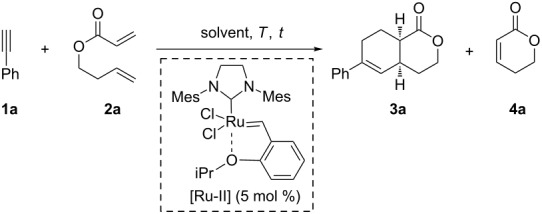 | ||||||
| entry | solvent | T (°C) | 1a:2a | t (h) | additive | % yield 3aa |
| 1 | toluene | 90 | 1:3 | 6 | – | 25 |
| 2 | toluene | 90 | 1:3 | 24 | – | 37 |
| 3 | toluene | 90 | 1:3 | 48 | – | 57 |
| 4 | toluene | 90 | 1:3 | 72 | – | 39 |
| 5 | toluene | 90 | 1:1 | 48 | – | 36 |
| 6 | toluene | 90 | 1:5 | 48 | – | 30 |
| 7 | toluene | 110 | 1:3 | 48 | – | 52 |
| 8 | toluene | 140 | 1:3 | 48 | – | 37 |
| 9 | DCM | 60 | 1:3 | 48 | – | 25 |
| 10 | C6H5CF3 | 90 | 1:3 | 48 | – | 60 |
| 11 | toluene | 90 | 1:3 | 48 | Ti(OiPr)4b | 38 |
| 12 | toluene | 90 | 1:3 | 48 | BF3·OEt2b | 15 |
| 13 | toluene | 90 | 1:3 | 48 | thioureac | 49 |
| 14 | toluene | 90 | 1:3 | 48 | BQb,d | 37 |
aIsolated yield after column chromatography. Variable amounts of 4a were observed in all cases, but never exceeded 15% (based on 2a). Some unreacted 2a was also detected in all cases; b5 mol %; c1 mol %; dbenzoquinone.