


Fig. 4. BAF complexes can be oncogenes or tumor suppressors.
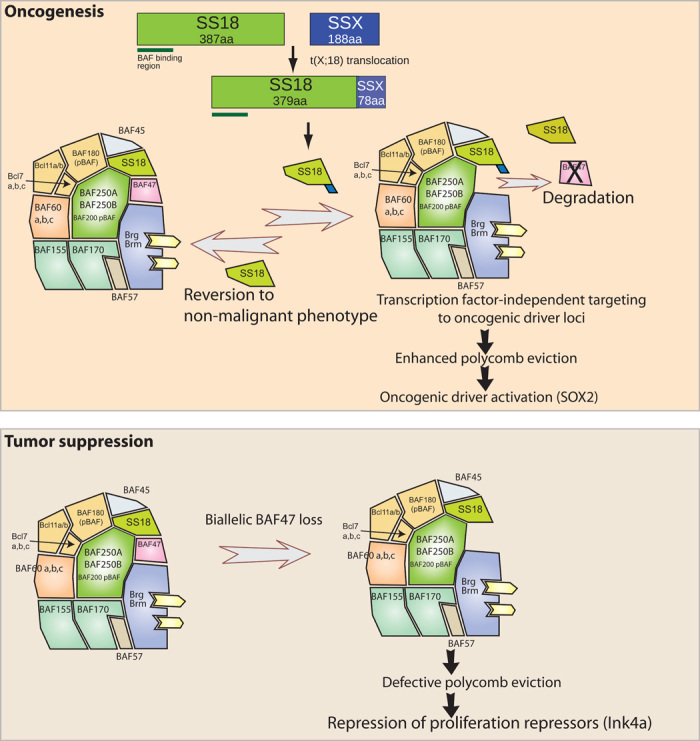
Top: The fusion of the SS18 gene to the SSX gene adds 78 amino acids (aa) of SSX to SS18, giving a fusion protein that evicts wild-type SS18 as well as BAF47 (hSNF5). The resulting oncogenic BAF complex is then targeted to new loci over the genome, such as Sox2, through a transcription factor–independent mechanism to genes that are drivers of proliferation. At these genes, it robustly evicts polycomb by unknown mechanisms leading to activation of genes such as Sox2 that can drive proliferation. Bottom: In the rare rhabdoid sarcoma of young children, the biallelic loss of BAF47 leads to a complex with defective ability to evict polycomb at loci such as Ink4a that repress proliferation. Cells are then transformed without additional mutations. Note that these mechanisms are brought about by a gain of ability to evict polycomb versus a loss of ability to evict polycomb. Both mechanisms are probably distinct from the more common cancers produced in older individuals with mutations in other subunits that compromise the ability to allow TopoII function, as shown in Fig. 6.