


Figure 3.
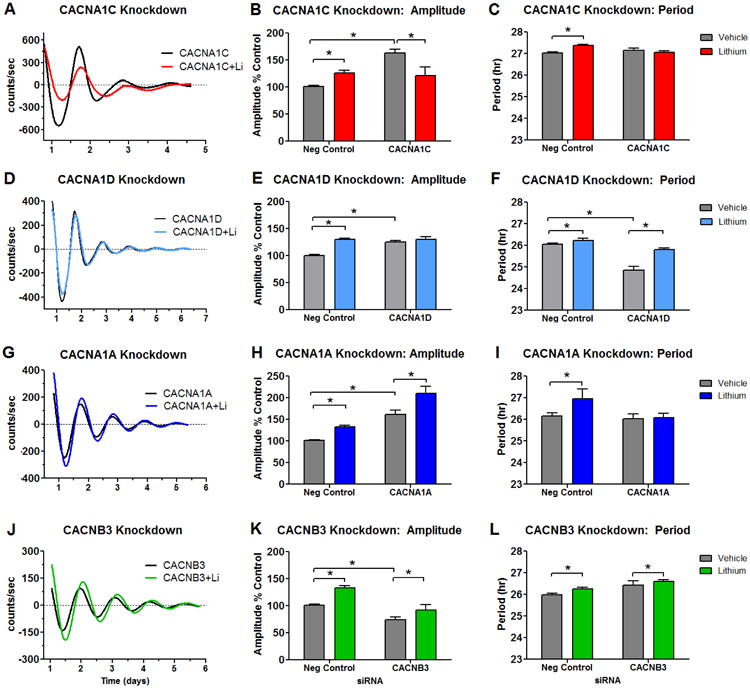
Effects of calcium channel knockdown on rhythms in NIH3T3P2L cells. Knockdown of CACNA1C (A-C) caused increases in amplitude at baseline, and reversed lithium's effect on rhythms, causing an amplitude decrease. CACNA1C knockdown alone had no effect on period, but attenuated the period lengthening action of lithium. CACNA1D (D-F) also caused increases in amplitude at baseline, and blocked lithium's ability to increase amplitude. Knockdown of CACNA1D shortened period, but had no effect on the period lengthening action of lithium. CACNA1A (G-I) caused increases in amplitude at baseline, but had no effect on lithium's ability to increase amplitude. CACNA1A knockdown alone had no effect on period, but attenuated the period lengthening action of lithium. Knockdown of CACNB3 (J-L) decreased baseline amplitude, but had no effect on lithium's amplification of rhythms. CACNB3 knockdown had no statistically significant impact on period at baseline or after lithium. Sample sizes are as follows: CACNA1C N= 12-15/ group, CACNA1D N= 3-6/ group, CACNA1A N= 4-6/ group, CACNB3 N= 9/ group. Normalized amplitude values for negative controls ± lithium were combined across experiments (total N=25 siRNA alone, N=31 siRNA+lithium). Values are means ± SEM; Analyses performed by one-way ANOVA, *p < 0.05 in post-hoc tests.