


Figure 2.
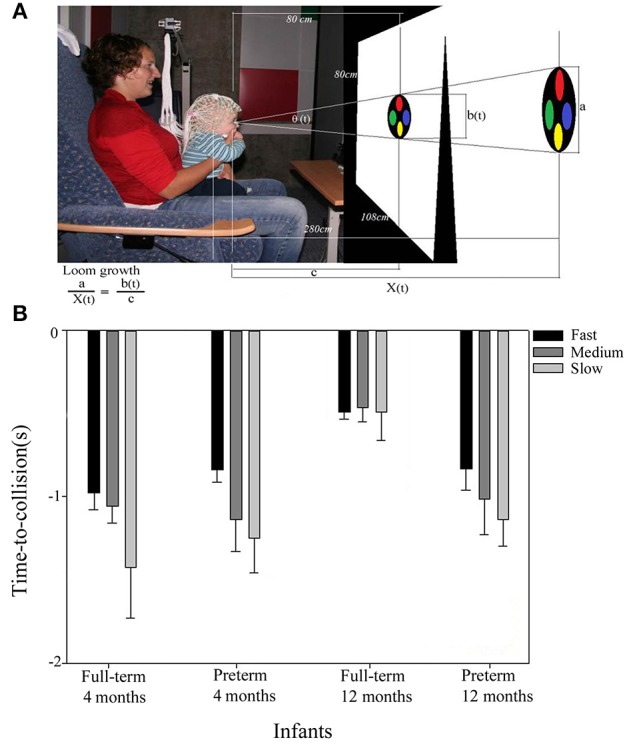
Looming experimental setup (A), and averaged looming-related VEP peak responses (with SDs) in full-term and preterm infants (B). (A) Infants were shown a flat 2-dimensional circle filled with four smaller colored circles. The looming stimuli simulated an object approaching from a distance on a direct collision course under constant accelerations of −21.1, −9.4, −5.3 ms−2 for fast loom (2 s), medium loom (3 s), and slow loom (4 s), respectively. The bottom left equation describes the growth of the visual loom. The looming stimuli approached the infant as the image on the screen grew symmetrically and stopped when the image filled the entire screen. (B) With increasing age, the full-term infants responded significantly closer to the loom's time-to-collision compared to the pre-term infants. Only the older full-term infants responded at a fixed time-to-collision irrespective of loom speed, an indication that only the full-term infants at 12 months had switched from a visual angle strategy to the more sophisticated time strategy when timing their looming-related VEP peak responses.