


Figure 2.
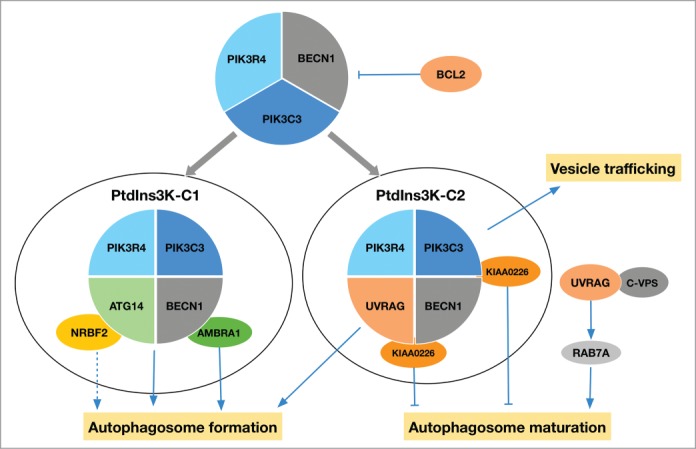
Diversified composition of class III PtdIns3K complexes and their roles in autophagy. PIK3C3-PIK3R4-BECN1 is the core complex; a proportion of the core complex is combined with ATG14 or UVRAG in a mutually exclusive manner, constituting PtdIns3K-C1 and PtdIns3K-C2, respectively. Both PtdIns3K-C1 and PtdIns3K-C2 contribute to autophagosome formation, and UVRAG can regulate autophagosome maturation independent of BECN1 through interacting with the class C VPS complex (C-VPS) and activating RAB7A. BCL2, by binding to BECN1, inhibits the formation of class III PtdIns3K complexes. KIAA0226 is considered as a negative regulator of autophagosome maturation, which interacts with PtdIns3K-C2 through directly binding to PIK3C3, BECN1, and UVRAG. As peripheral proteins, AMBRA1 and NRBF2 both interact with PtdIns3K-C1. AMBRA1 activates autophagy at an early step, while NRBF2 plays regulatory roles in autophagosome formation (dotted line denotes that there is controversy about the effect of NRBF2 on autophagy). Additional peripheral components of class III PtdIns3K complexes have also been reported, which are not included in the diagram.