


Figure 3. Crabp2a but not Cyp26a1 attenuates level of noise in RA.
Analysis of the temporal distribution of RA’s relative abundance in wildtype (WT), Crabp2a morpholino (MO)-injected, Crabp2a mRNA-injected (gain-of-function - GOF) and Cyp26a1 MO and mRNA-injected zebrafish embryos. Each column shows the signal obtained for a single representative cell and each point corresponds to a single time point. Lines represent the mean and standard deviation. Embryos with reduced or increased levels of Crabp2a show increased and decreased variability in RA, respectively, while altering Cyp26a1 changes the mean concentrations but not the variance.
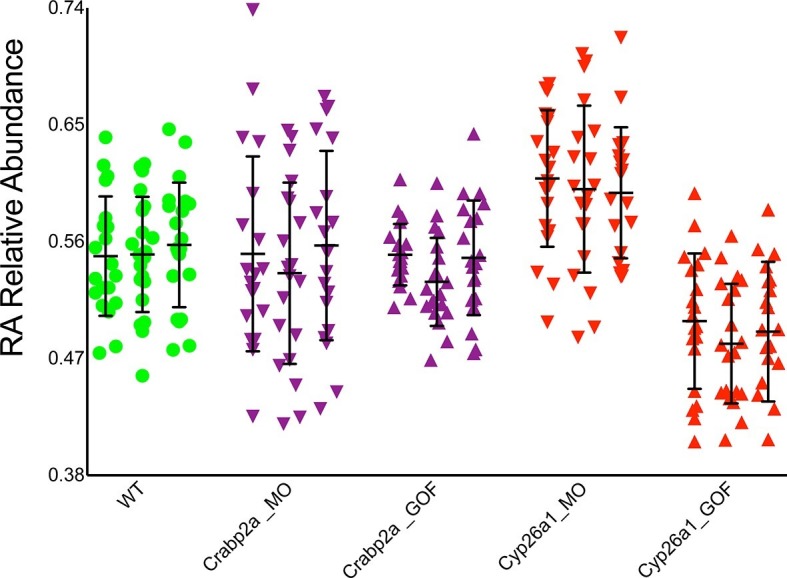
Figure 3—figure supplement 1. Crabp2a actively modulates RA signal noise.
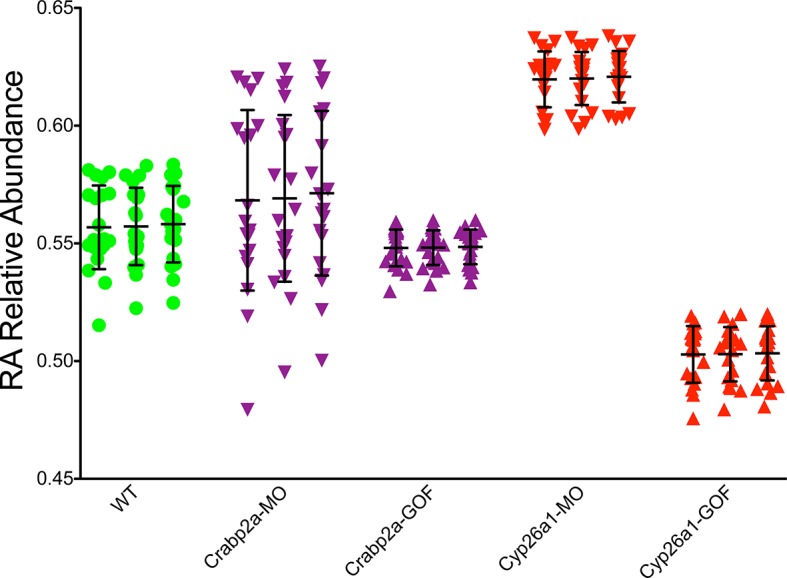
Results of three realizations of our stochastic mathematical model analyzing the temporal distribution of RA’s relative abundance in wildtype (WT), Crabp2a morpholino (MO)-injected, Crabp2a mRNA (gain-of-function - GOF) injected, Cyp26a1 MO-injected and Cyp26a1 mRNA-injected zebrafish embryos. Each column shows the signal obtained for a single realization for a single cell. Each point corresponds to a single time point. Lines represent the mean and standard deviation. Embryos with altered Crabp2a expression show changes in the variability in free intracellular RA, while embryos with altered Cyp26a1 expression show changes in the mean levels of RA as in the experimental case shown in Figure 3.