



Abstract
The problem of selection bias has long been recognized in the analysis of two-stage trials, where promising candidates are selected in stage 1 for confirmatory analysis in stage 2. To efficiently correct for bias, uniformly minimum variance conditionally unbiased estimators (UMVCUEs) have been proposed for a wide variety of trial settings, but where the population parameter estimates are assumed to be independent. We relax this assumption and derive the UMVCUE in the multivariate normal setting with an arbitrary known covariance structure. One area of application is the estimation of odds ratios (ORs) when combining a genome-wide scan with a replication study. Our framework explicitly accounts for correlated single nucleotide polymorphisms, as might occur due to linkage disequilibrium. We illustrate our approach on the measurement of the association between 11 genetic variants and the risk of Crohn's disease, as reported in Parkes and others (2007. Sequence variants in the autophagy gene IRGM and multiple other replicating loci contribute to Crohn's disease susceptibility. Nat. Gen. 39(7), 830–832.), and show that the estimated ORs can vary substantially if both selection and correlation are taken into account.
Keywords: Correlated outcomes, Genome-wide scan, Selection bias, Two-stage sample, Uniformly minimum variance conditionally unbiased estimator
1. Introduction
The two-stage “learn and confirm” strategy is widely implemented across biomedical research. For example, in the sphere of randomized clinical trials, the vast majority of adaptive trial designs follow a two-stage strategy, where design adaptations are made at the first interim analysis, with the trial then proceeding under a fixed design until its completion. See Bauer and others (2016), Bretz and others (2009), and Posch and others (2005) for a thorough review of the literature.
A key application has been in two-stage adaptive seamless trials incorporating mid-trial treatment selection (Bowden and Glimm, 2014; Kimani and others, 2013; Sampson and Sill, 2005). Typically, multiple experimental treatments are simultaneously compared with a control in stage 1, and the most promising treatment is selected for confirmatory analysis in stage 2.
In biomedical science more generally, there is an increasing focus on the identification of genetic markers predictive of phenotypic variation, in order to better understand disease etiology and to target future drug development. The design of choice is the genome-wide association study (GWAS), in which upwards of one million single nucleotide polymorphisms (SNPs) can be tested simultaneously for their association with a given phenotype. Those SNPs achieving “genome-wide” significance (typically defined as a  -value of
  ) are then validated in a replication study (Ioannidis and others, 2009).
A whole variety of formal two-stage design procedures have been proposed in this setting; see, for example, Satagopan and Elston (2003), Satagopan and others (2004, 2002), Thomas and others (2004), with an overview provided in Thomas and others (2009). In practice, the two-stage GWAS approach has been successfully applied to many disease areas, including sclerosis (Chiò and others, 2009), epilepsy (Guo and others, 2012), and breast cancer (Sapkota and others, 2012).
However, ranking and selecting candidates in a two-stage trial can induce bias in the final estimates of the parameter of interest. Indeed, as a general rule, the more aggressive the selection, the worse is the bias (Bauer and others, 2010). Specifically, a candidate has to perform “well” in stage 1 in order to proceed to stage 2, which often leads to overly optimistic estimates, or the so-called “winner's curse”. When there is heavy selection from many candidates of roughly equivalent parameters, then the selected candidate is typically based on chance variability rather than true superiority (Sill and Sampson, 2007). All this calls into question the generalizability of the trial's findings to future patients.
The need to correct for this selection bias in the analysis of two-stage trials has long been recognized. An efficient and unbiased estimator can be obtained through the technique of Rao–Blackwellization. This involves taking the unbiased stage 2 data and conditioning on a complete, sufficient statistic for the parameter in question. By the Lehmann–Scheffé theorem, this gives the uniformly minimum variance conditionally unbiased estimator (UMVCUE).
This two-stage framework was introduced by Cohen and Sackrowitz (1989), who derived the UMVCUE for the selected mean, where the stage 1 populations are independent and normally distributed. The method lends itself naturally to estimation in two-stage adaptive seamless phase II/III clinical trials (Bowden and Glimm, 2008; Kimani and others, 2013), with equivalent work carried out in biomarker research (Pepe and others, 2009; Koopmeiners and others, 2012; Robertson and others, 2015). In the GWAS setting, Bowden and Dudbridge (2009) extended the Cohen and Sackrowitz method to derive the UMVCUE for the SNP-disease log odds ratios (ORs), where either a one-sided or two-sided  -value test is used for ranking the SNPs.
A crucial assumption in all of the above analyses is that the stage 1 population parameter estimates are independent random variables. However, this may not be a reasonable assumption to make. For example, in the GWAS setting, SNPs in the same chromosomal region may be in linkage disequilibrium (LD).
The aim of this paper is to present general theory to enable the calculation of UMVCUEs for each setting that explicitly accounts for correlation. We achieve this by deriving the UMVCUE in the multivariate normal setting with an arbitrary known covariance structure. We illustrate the utility of the new theory using an application in the GWAS setting.
Since the focus of this paper is on point estimation, our primary criterion for comparing the performance of different estimators is the magnitude of the bias. Of course, bias is not the only criterion with which to judge an estimator, especially considering the bias–variance trade-off. However, it is important to quantify the bias of an estimator, not least due to regulatory concerns. As a secondary criterion, we also compare the mean squared error (MSE) of the estimators, which takes into account the variance. In practice, the relative importance attached to the criterion of bias and MSE will vary from setting to setting.
In Section 2, we describe the general model framework and derive the form of the multivariate normal UMVCUE. We then present a short simulation study in Section 3 for the bivariate normal case. We extend our framework to estimating ORs in genome-wide scans in Section 4, and apply the resulting UMVCUE to data reported in Parkes and others (2007). We conclude with a discussion in Section 5.
2. General framework for the UMVCUE
2.1. Model description
Consider the following two-stage trial design. Suppose that we have  correlated continuous stage 1 parameter estimates, defined by
  , for the candidate treatments, biomarkers or genetic variants
  . Let
. Let  follow a multivariate normal distribution, defined by
  , where
  is the vector of (unknown) means and
  is the covariance matrix. We assume that
  is known and is positive definite. For notational convenience, we let
  for
for 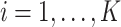 .
.
We denote the ordered stage 1 estimates as  , where the ordering is simply by effect size:
  . We consider other ordering mechanisms in due course. Let
  be the stage 2 estimate of the
  th ranked candidate, and so
 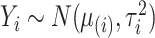 . At the end of stage 2, the aim is to efficiently estimate
  for some
  .
.
The MLE for  is a weighted average of the first- and second-stage data:
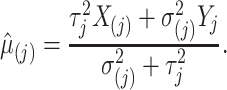 |
This estimator may be biased, because it does not take into account the first-stage selection procedures or the correlation. An unbiased estimator can easily be found by just using the stage 2 data  . However, this estimator suffers from lower precision since we are neglecting the stage 1 data. Hence we look for an unbiased estimator that uses data from both stages.
2.2. Calculating the UMVCUE
Let  be the event
  , which implies that
  for
for 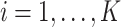 . Without loss of generality, we condition on
  for the remainder of the derivation of the UMVCUE.
To start with, consider estimating the mean of the highest ranked population,  . For notational convenience, we let
  and
and  . In Section 1 of the supplementary materials (available at Biostatistics online), we prove the following theorem for the complete and sufficient statistic for
  .
.
Theorem 2.1. —
The statistic
is sufficient and complete for
, where
for
.
Then, by the Lehmann–Scheffé theorem,  is the UMVCUE for
  under
under  . Hence we have the following result, as proved in Section 2 of the supplementary materials (available at Biostatistics online).
Theorem 2.2. —
The UMVCUE for
given
is
(2.1) where
and we define
and
.
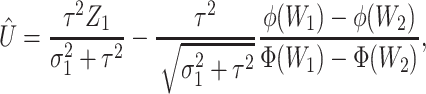
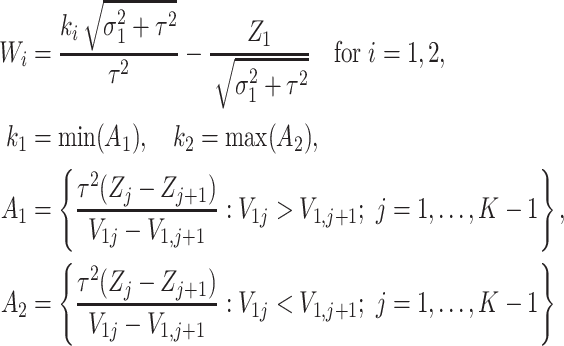
Remark. —
In the independent normal setting, Cohen and Sackrowitz (1989) note that all dependency on observations
vanished in the expression for the UMVCUE—which they interpreted as a negative result when
. However, we see in Equation (2.1) that accounting for correlation means that all of the observations can contribute to the sets
and
and be implicitly used in the estimator. In fact, any of the observations
can be used explicitly, depending on which feature in
and
.
Remark 2. —
It is often the case that the stage 1 estimates are asymptotically normal rather than precisely normal. For example, log ORs have an asymptotic normal distribution. In these settings, our theorems hold asymptotically.
Suppose that, instead of only selecting the single top-ranking treatment or biomarker for continuation to stage 2, we take forward the top  from a larger group of
  . For example, in the GWAS setting, typically
  and
and  . We now require the UMVCUE for the
  th best candidate out of
  and the following corollary covers this case.
Corollary 2.3. —
For a given value of
, the statistic
is sufficient and complete for
, where
(2.2) for
.
Also, the UMVCUE for
given
is
(2.3) where
and we define
and
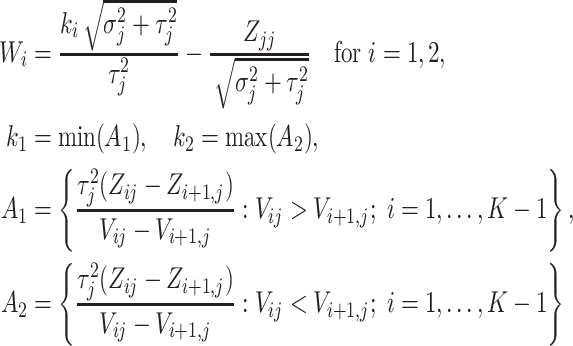
.
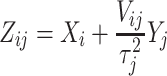
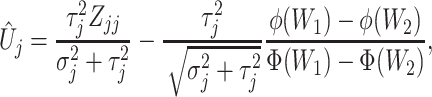
Remark. —
As a simple check of our methodological development's consistency with previous results, if we set the off-diagonal terms of the covariance matrix
equal to zero, then we recover the independent normal setting. The UMVCUE was derived in this special case by Bowden and Glimm (2008). We compare our results in Section 3 of the supplementary materials (available at Biostatistics online) and show that they are the same.
In Section 4, we show the form of the UMVCUE when ranking by  -value, and subsequently show how to construct bootstrapped confidence intervals (CIs) in this setting.
3. Simulation study: bivariate normal case
3.1. Bivariate normal UMVCUE
We now consider the UMVCUE derived in the bivariate normal setting, where  . Suppose we have two correlated continuous stage 1 outcome measures, defined by
 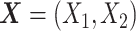 , for the candidates
  and
and  . We let
  follow a bivariate normal distribution, with
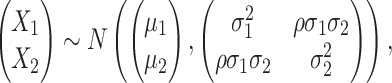 |
where  is the correlation coefficient between
  and
and  , and we assume
  .
.
From Equations (2.1), the statistic  is sufficient for
  , where
 |
The UMVCUE depends on whether  . Since
  if follows that, from Equation (2.1), the UMVCUE for
  given
given  is
is
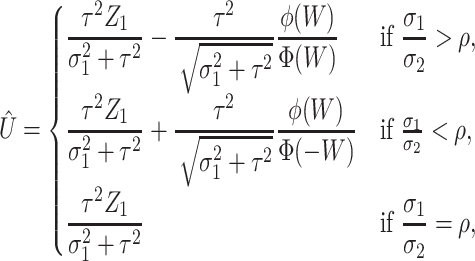 |
(3.1) |
where
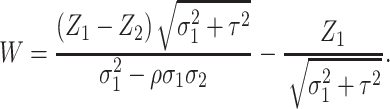 |
Remark. —
Note that if
, then the UMVCUE is in fact equal to the MLE
.
3.2. Simulation results
In this subsection, we compare various estimators for the largest mean  in the bivariate normal setting:
 observed stage 2 data for the highest ranked population.
 MLE for
  , which ignores selection and correlation.
 UMVCUE derived by Bowden and Glimm (2008), which accounts for selection but ignores correlation. Note that this is equivalent to
  when we set
  .
.
 UMVCUE given in Equation (3.1), which accounts for selection and correlation.
To evaluate the performance of a generic estimator for  , say
, say  , we calculate the bias and MSE as defined in Posch and others (2005), Sill and Sampson (2007), and Bowden and Glimm (2008):
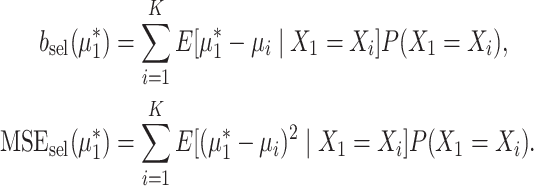 |
In our simulation study, we set  and
and  and then consider four simple scenarios (i)–(iv) with varying values of the true means
 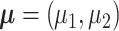 and stage 2 variance
  :
:
 |
Note that, for scenarios (i) and (ii),  . For scenarios (iii) and (iv), the exact MSE of
  is as follows:
 |
Figure 1 shows the mean relative bias (defined as  ) of the MLE
  and the UMVCUE
  (which ignores correlation) as a function of
  for the four scenarios. Since the mean bias of the stage 2 data
  and the UMVCUE
  are virtually identical to zero for all values of
  (by definition), we do not show the simulation results here.
Fig. 1.

Mean relative bias of the MLE ( , blue), and the UMVCUE (
 , black) that ignores the correlation. Plots show the mean of 100 000 simulations for each value of
  . The horizontal line shows where the bias equals zero.
The plots show that the bias of both estimators is at a maximum for  close to
  . The MLE is positively biased for
  , and in scenarios (ii) is in fact substantially biased for all values of
  . We see that
  is positively biased for
  , unbiased when
  (as would be expected), and negatively biased for
  . The bias of both estimators is worse when
  compared with
  .
.
Figure 2 shows the MSE of the estimators 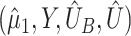 for the four scenarios. As would be expected, the MLE always has the lowest MSE, while
  always has the highest. We also see that there is a substantial reduction in the MSE when using the UMVCUEs
  or
or  .
.
Fig. 2.

MSE of the MLE (blue),  (green),
  (black), and
  (red). Plots show the mean of 100 000 simulations for each value of
  , except for
  , which is the theoretical value of the MSE.
In scenarios (i)–(iii), the MSE of  decreases as
  approaches 0.5, and then increases again. This is to be expected given Equation (3.1), which shows that
  reduces down to the MLE when
  . In scenarios (iii) and (iv), we also see that, for
  close to 1, the MSE of
  and the MLE are very close.
In all of the scenarios, the MSE of  is greater than that for
  when
when  , equal when
  (as would be expected), and less than that for
  when
when  . However, these differences in the MSE are much less than the differences between the MSE of
  and either
  or
or  . In conclusion, there is little or no advantage in terms of MSE when using the estimator
  as opposed to our UMVCUE
  , which properly accounts for correlation.
4. Application to the Parkes and others' GWAS data
We now apply our methodology to data from the genome-wide association scan for Crohn's disease published in 2007 by the Wellcome Trust Case Control Consortium (2007) (WTCCC). There were 1748 cases for the disease, and 2938 controls in this cohort, which identified 12 SNPs associated with disease status at genome-wide significance.
A replication study was then reported by Parkes and others (2007) in a follow-up cohort of 1182 cases and 2024 controls, in which 12 SNPs were successfully replicated in this study. Following Bowden and Dudbridge (2009), we exclude one (rs6887695) from our illustration (as its significance in the WTCCC scan was severely reduced after data cleaning).
Table 1 shows the estimated ORs for stages 1 and 2 (i.e. the WTCCC data and the replication data), as well as the overall MLE. This is then followed by two previously described estimators that combine the data from the two stages in a way that attempts to correct for bias. The first estimator (denoted by ZP) is the corrected MLE of Zhong and Prentice (2008). The second (denoted by  ) is the estimator considered in Bowden and Dudbridge (2009), who calculated the UMVCUE assuming that all of the log ORs for the SNPs are uncorrelated.
Table 1.
The ORs ( CIs) of 11 SNPs estimated from allele frequencies reported by Parkes and others (2007) in an initial scan (stage 1) and replication study (stage 2). SNPs are ranked in order of stage 1 statistical significance, with those on the same chromosomal region highlighted in bold
| Chr | SNP | Stage 1 OR | Stage 2 OR | MLE | ZP |  |
|---|---|---|---|---|---|---|
| 5p13 | rs17234657 | 1.55 (1.38, 1.74) | 1.16 (1.00, 1.35) | 1.39 | 1.39 | 1.16 |
| 5p13 | rs9292777 | 1.38 (1.26, 1.51) | 1.34 (1.20, 1.50) | 1.37 | 1.37 | 1.39 |
| 10q24 | rs10883365 | 1.27 (1.17, 1.38) | 1.18 (1.05, 1.32) | 1.24 | 1.24 | 1.16 |
| 18p11 | rs2542151 | 1.35 (1.21, 1.50) | 1.15 (1.00, 1.32) | 1.27 | 1.25 | 1.15 |
| 5q33 | rs13361189 | 1.51 (1.30, 1.76) | 1.38 (1.15, 1.66) | 1.46 | 1.45 | 1.40 |
| 3p21 | rs9858542 | 1.26 (1.15, 1.38) | 1.17 (1.04, 1.31) | 1.22 | 1.21 | 1.17 |
| 5q33 | rs4958847 | 1.35 (1.20, 1.53) | 1.36 (1.17, 1.59) | 1.36 | 1.35 | 1.35 |
| 5q23 | rs10077785 | 1.29 (1.16, 1.43) | 1.19 (1.05, 1.36) | 1.25 | 1.22 | 1.19 |
| 1q24 | rs12035082 | 1.22 (1.12, 1.33) | 1.14 (1.02, 1.27) | 1.19 | 1.17 | 1.15 |
| 21q22 | rs2836754 | 1.22 (1.12, 1.33) | 1.15 (1.03, 1.28) | 1.19 | 1.16 | 1.16 |
| 1q31 | rs10801047 | 1.38 (1.18, 1.61) | 1.47 (1.22, 1.76) | 1.42 | 1.39 | 1.44 |
As the bold entries in Table 1 indicate, two pairs of SNPs are on the same chromosomal region. The first- and second-ranked SNPs (rs17234657 and rs9292777) are both on chromosomal region 5p13, while the fifth- and seventh-ranked SNPs (rs13361189 and rs4958847) are both on chromosomal region 5q33.
It can be safely assumed that SNPs from distinct genomic regions are in linkage equilibrium. However, in an effort to assess the potential correlation between SNPs in the same genomic region, we used the data from 498 Europeans in the 1000 genomes project (1000 Genomes Project Consortium, 2012). The empirical correlation between the SNPs (encoded as 0,1,2 to indicate the number of risk increasing alleles) on chromosomal regions 5p13 and 5q33 were  and
and  respectively.
Although the populations considered by Parkes and others (2007) and the 1000 genomes project are different, these correlations do suggest LD exists between these SNPs. Hence a natural question to ask is how the OR estimates are affected by correlation. To do so, we first need to extend our framework to account for ranking by  -value.
4.1. Calculating the UMVCUE
Consider a two-stage design with a genome-wide association scan (stage 1) followed by a replication study (stage 2). Only those SNPs that meet selection criteria (see below) in stage 1 continue on to stage 2. A common approach in the genome-wide setting is to rank the SNPs according to the statistical significance of the effects, with a  -value threshold
  . We assume that
  of the SNPs pass
  and are then ranked.
For a one-sided test, we condition (WLOG) on the event
 |
The UMVCUE in this case is given in Section 4 the supplementary materials (available at Biostatistics online).
For a two-sided test, we instead condition (WLOG) on the event
 |
Then the UMVCUE for  is as follows, with the proof found in Section 5 of the supplementary materials (available at Biostatistics online):
Theorem 4.1. —
The UMVCUE for
given
is
(4.1) where
and we define
and
.

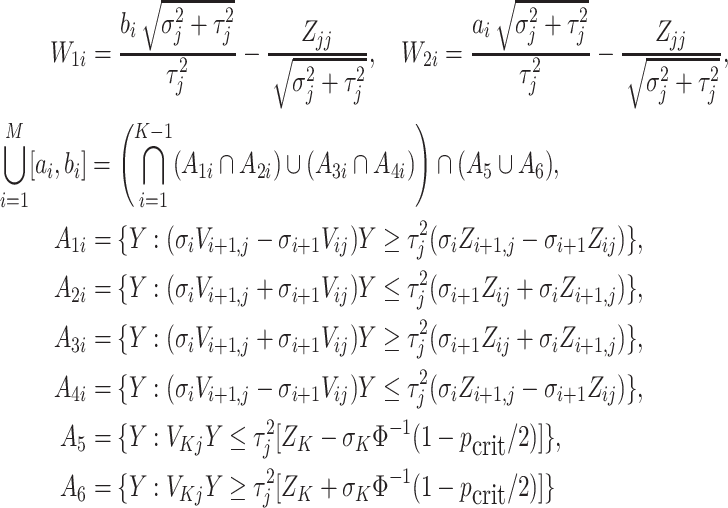
Remark. —
The introduction of the variable
above is for notational convenience. In particular, we re-express the intersection of sets
as the disjoint union of
closed intervals on the real line
, where
. Note that possibly
and/or
.
For either test, if all the off-diagonal terms of the covariance matrix are equal to zero, then we recover the independent normal setting as in Bowden and Dudbridge (2009). In Section 6 of the supplementary materials (available at Biostatistics online), we compare our estimators and show they are the same.
4.2. Results
Rather than assuming we know  , we take each pair of SNPs that are on the same chromosomal region and calculate the UMVCUEs as the correlation between the log ORs varies between
  . More explicitly, given a pair of SNPs on the same chromosomal region which have stage 1 ranks
  and
and  respectively, then we assume that the log ORs
  and
and  follow a bivariate normal distribution, with correlation coefficient
 |
Starting with the SNPs on chromosomal region 5p13, the upper half of Figure 3 shows the UMVCUEs for the ORs as a function of the correlation coefficient  . The first plot for SNP rs17234657 shows that the UMVCUE can vary substantially if there is positive correlation between the SNPs. As
  increases from 0 to 0.88, the UMVCUE increases from 1.16 to 1.32, with a particularly rapid increase for
  greater than about 0.5. For
  we actually see a (small) decrease in the UMVCUE. In contrast, for negative values of
  , the UMVCUE is hardly affected.
Fig. 3.

The UMVCUEs for the ORs of the SNPs on chromosomal region 5p13 (rs17234657 and rs9292777) and 5q33 (rs13361189 and rs4958847) as a function of the correlation coefficient.
The second plot for SNP rs9292777 shows that the UMVCUE decreases as  increases, but in absolute terms correlation has little effect. The main reason for this is because the stage 1 and stage 2 estimates for the OR were very similar (1.38 and 1.34, respectively), so we would not expect the UMVCUE to be dramatically different regardless of any correlation.
Performing the analysis for the SNPs on chromosomal region 5q33 gives the results displayed in the lower half of Figure 3. Looking at the first plot for SNP rs13361189, in absolute terms correlation has little effect on the UMVCUE. However, note the piecewise nature of the UMVCUE: it increases for  , decreases for
  , remains constant for
  and then (rapidly) decreases again for
  . Also note that this time, there is a large discrepancy between the stage 1 and stage 2 log ORs (1.51 and 1.38, respectively). The fact that the UMVCUE hardly varies indicates that the substantial correction to the stage 1 estimate is in fact robust to correlation.
As for the second plot for SNP rs4958847, again the correlation hardly changes the value of the UMVCUE (in fact, the UMVCUE remains constant until  ). However, this should be expected since the stage 1 and stage 2 estimates for the OR were very similar (1.35 and 1.36, respectively).
Constructing CIs. After constructing a point estimate for the OR, it is natural to construct CIs as well. We use a parametric bootstrap procedure inspired by Bowden and Glimm (2008) and Pepe and others (2009), where we assume that the true log OR mean  (the UMVCUE calculated from the observed data).
Starting with the SNPs on chromosomal region 5q33, these had the fifth and seventh stage 1 ranks. Given the observed stage 1 log ORs  and the assumed correlation coefficient
  between
  and
and  , we use the following procedure:
- Simulate “bootstrapped” stage 1 data
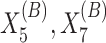 by drawing from a bivariate normal distribution
conditional on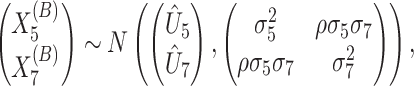
 and
and  .
.
Simulate bootstrapped stage 2 data
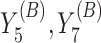 from independent normal distributions
 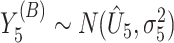 and
and 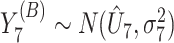 .
.
Calculate the bootstrapped UMVCUEs
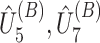 using
using  and the original observed values
  .
.
These steps are then repeated for a large value of  , with the
  and
and  empirical quantiles then used as the
  CIs for
  and
and  . Bootstrapped CIs for the MLE, as well as the Zhong & Prentice estimator (ZP) are also then straightforwardly available.
Further details of how the variables are generated in step 1 can be found in Section 7 of the supplementary materials (available at Biostatistics online), as well as an extension to the general multivariate case.
As for the SNPs on chromosomal region 5p13, these had the first and second stage 1 ranks. The same bootstrap procedure described above can be used, except that in step 1, we condition on  .
.
Figure 4 shows the bootstrapped 95% CIs for SNP rs17234657 on chromosomal region 5p13. When the correlation  , the CI for the UMVCUE is virtually identical to that achieved by just using the stage 2 data. However, we see that, for
  the CIs become appreciably different, since the stage 2 OR ignores the correlation.
Fig. 4.

The UMVCUE for the OR of the highest ranked SNP (rs17234657) as a function of the correlation coefficient with the second-ranked SNP (rs9292777). Also plotted are the 95% bootstrapped CIs for the UMVCUE, using 10 000 bootstrapped replicates per data point. The 95% CIs for the stage 2 OR (in red) and the MLE (in black) are displayed for comparison purposes.
Table 2 compares the bootstrapped 95% CIs for the various estimators for the two highest ranked SNPs (rs17234657 and rs9292777) when the correlation  . For the SNP rs9292777, there is a 12% reduction in the CI width (from 0.304 to 0.268) when using the UMVCUE compared to just using the stage 2 data. For both SNPs, the ZP estimator and the MLE give very similar CIs.
Table 2.
Bootstrapped  CIs for the ORs of the two highest ranked SNPs when the correlation
  . There were
  bootstrapped replicates used
| rs17234657 | rs9292777 | |
|---|---|---|
| Stage 2 | (1.002, 1.348) | (1.243, 1.547) |
| UMVCUE | (1.003, 1.348) | (1.299, 1.566) |
| ZP | (1.289, 1.529) | (1.308, 1.487) |
| MLE | (1.290, 1.526) | (1.307, 1.485) |
5. Discussion
In this paper, we present a general framework for accounting for selection and correlation in two-stage trials, with an emphasis on the GWAS setting. We achieve this by deriving the UMVCUE in the multivariate normal setting with an arbitrary known covariance structure. Our framework relaxes the assumption present in the literature that the stage 1 population parameter estimates are independent.
As the bivariate normal simulation study demonstrated, it is important to correctly account for correlation. Indeed, if the correlation coefficient is not close to zero, then the UMVCUE that ignores correlation can be substantially biased. Due to the bias–variance trade-off, the MSE of the UMVCUE is greater than that of the MLE, but is substantially less than the MSE of using the (unbiased) stage 2 data alone.
The GWAS example showed how our estimation strategy can be applied in practice. We also described how to construct CIs using a parametric bootstrap procedure. Our results demonstrate how correcting for correlation is necessary in the GWAS setting. Indeed, for the Parkes and others (2007) data, the OR estimate for the highest ranking SNP varied substantially for high positive values of the correlation coefficient.
In the GWAS setting, our framework assumes that the LD structure of the SNPs is known. In practice, we would envisage using large external datasets such as the International HapMap Project (The International HapMap Consortium, 2003) to give an estimate of SNP LD. Alternatively, the correlation could be estimated based on the stage 1 data itself if individual participant data were available, but further research is needed to give guidance as to whether doing so would induce bias into our UMVCUE and/or appreciably increase the MSE.
Even if it is not possible to have reliable estimates of the correlation between the (log) ORs, a sensitivity analysis (like the one we carried out) is still useful to probe the robustness of the reported ORs to any LD between the SNPs.
Due to the structure of the Parkes and others (2007) data, our results in Section 4.2 focused on the bivariate setting. Of course, in other GWAS studies the data may mean that it is necessary to consider multiple (i.e.  ) SNPs in a local region that are in LD. Our UMVCUE, although still tractable, would then have a much more complex dependence on
  correlation coefficients.
We note that some progress was made to account for correlated outcomes by Sill and Sampson (2007), who looked at two-stage trials with mid-trial treatment selection based on a surrogate endpoint. They derived the UMVCUE for the final endpoint when the surrogate and final endpoint follow a bivariate normal distribution. However, our framework is a more general one, and allows application to other trial settings. Indeed, as current work, we have applied our estimator to two-stage adaptive seamless phase II/III clinical trials, allowing for unequal stage 1 (and stage 2) variances as well as generalized selection rules.
One of the limitations of our work is the construction of CIs. In the bivariate case, we can simply use a parametric bootstrap procedure. As for the general multivariate case, in the supplementary materials (available at Biostatistics online) we show theoretically how to extend our method. However, it is not clear what the coverage of such CIs would be in practice. An alternative approach could be based on the work of Sampson and Sill (2005), who developed exact CIs in the independent normal setting. It may be possible to extend their analysis to correlated multivariate normal outcomes.
In the framework for our UMVCUE, we treat the stage 2 data as coming from independent univariate normal distributions, i.e. we ignore the potential stage 2 correlation structure. As current work, we are deriving efficient unbiased estimators that make use of, and fully account for, all the available correlated stage 2 outcomes. However, preliminary results appear to show that no UMVCUE exists for this case, despite the obvious appeal of making use of more data, when available.
Finally, another extension would be trials with more than two stages. Bowden and Glimm (2014) derived Rao–Blackwellized estimators for multistage drop-the-loser trials assuming independent normal outcomes, and this could be a starting point for looking at multistage trials with multiply correlated outcomes.
Supplementary material
Supplementary Material is available at http://biostatistics.oxfordjournals.org.
Funding
This work was supported by a Medical Research Council Methodology Research Fellowship (grant number MR/N501906/1 to J.B.). Funding to pay the Open Access publication charges for this article was provided by the MRC BSU, grant codes MC_UP_1302/2 and MC_UP_1302/3.
Supplementary Material
Acknowledgments
The authors would like to thank the anonymous referees for their helpful comments, and Paul Newcombe for his help in accessing the 1000 genomes project data. Conflict of Interest: None declared.
References
- 1000 Genomes Project Consortium. (2012). An integrated map of genetic variation from 1092 human genomes. Nature 4917422, 56–65. [DOI] [PMC free article] [PubMed] [Google Scholar]
- Bauer P., Bretz F., Dragalin V., König F., Wassmer G. (2016). Twenty-five years of confirmatory adaptive designs: opportunities and pitfalls. Statistics in Medicine 353, 325–347. [DOI] [PMC free article] [PubMed] [Google Scholar]
- Bauer P., Koenig F., Brannath W., Posch M. (2010). Selection and bias—two hostile brothers. Statistics in Medicine 291, 1–13. [DOI] [PubMed] [Google Scholar]
- Bowden J., Dudbridge F. (2009). Unbiased estimation of odds ratios: combining genome-wide association scans with replication studies. Genetic Epidemiology 335, 406–418. [DOI] [PMC free article] [PubMed] [Google Scholar]
- Bowden J., Glimm E. (2008). Unbiased estimation of selected treatment means in two-stage trials. Biometrical Journal 504, 515–527. [DOI] [PubMed] [Google Scholar]
- Bowden J., Glimm E. (2014). Conditionally unbiased and near unbiased estimation of the selected treatment mean for multistage drop-the-losers trials. Biometrical Journal 562, 332–349. [DOI] [PMC free article] [PubMed] [Google Scholar]
- Bretz F., Koenig F., Brannath W., Glimm E., Posch M. (2009). Adaptive designs for confirmatory clinical trials. Statistics in Medicine 28, 1181–1217. [DOI] [PubMed] [Google Scholar]
- Chiò A., Schymick J. C., Restagno G., Scholz S. W., Lombardo F., Lai S. L., Mora G., Fung H. C., Britton A., Arepalli S.. and others (2009). A two-stage genome-wide association study of sporadic amyotrophic lateral sclerosis. Human Molecular Genetics 188, 1524–1532. [DOI] [PMC free article] [PubMed] [Google Scholar]
- Cohen A., Sackrowitz H. B. (1989). Two stage conditionally unbiased estimators of the selected mean. Statistics & Probability Letters 83, 273–278. [Google Scholar]
- Guo Y., Baum L. W., Sham P. C., Wong V., Ng P. W., Lui C. H. T., Sin N. C., Tsoi T. H., Tang C. S. M, Kwan J. S. H.. and others (2012). Two-stage genome-wide association study identifies variants in CAMSAP1L1 as susceptibility loci for epilepsy in Chinese. Human Molecular Genetics 215, 1184–1189. [DOI] [PubMed] [Google Scholar]
- Ioannidis J. P. A., Thomas G., Daly M. J. (2009). Validating, augmenting and refining genome-wide association signals. Nature Reviews Genetics 105, 318–329. [DOI] [PMC free article] [PubMed] [Google Scholar]
- Kimani P. K., Todd S., Stallard N. (2013). Conditionally unbiased estimation in phase II/III clinical trials with early stopping for futility. Statistics in Medicine 3217, 2893–2910. [DOI] [PMC free article] [PubMed] [Google Scholar]
- Koopmeiners J. S., Feng Z., Pepe M. S. (2012). Conditional estimation after a two-stage diagnostic biomarker study that allows early termination for futility. Statistics in Medicine 315, 420–435. [DOI] [PMC free article] [PubMed] [Google Scholar]
- Parkes M., Barrett J. C., Prescott N. J., Tremelling M., Anderson C. A., Fisher S. A., Roberts R. G., Nimmo E. R., Cummings F. R., Soars D.. and others (2007). Sequence variants in the autophagy gene IRGM and multiple other replicating loci contribute to Crohn's disease susceptibility. Nature Genetics 397, 830–832. [DOI] [PMC free article] [PubMed] [Google Scholar]
- Pepe M. S., Feng Z., Longton G., Koopmeiners J. (2009). Conditional estimation of sensitivity and specificity from a phase 2 biomarker study allowing early termination for futility. Statistics in Medicine 28, 762–779. [DOI] [PMC free article] [PubMed] [Google Scholar]
- Posch M., Koenig F., Branson M., Brannath W., Dunger-Baldauf C., Bauer P. (2005). Testing and estimation in flexible group sequential designs with adaptive treatment selection. Statistics in Medicine 2424, 3697–3714. [DOI] [PubMed] [Google Scholar]
- Robertson D. S., Prevost A. T., Bowden J. (2015). Correcting for bias in the selection and validation of informative diagnostic tests. Statistics in Medicine 34, 1417–1437. [DOI] [PMC free article] [PubMed] [Google Scholar]
- Sampson A. R., Sill M. W. (2005). Drop-the-losers design: Normal case. Biometrical Journal 473, 257–268. [DOI] [PubMed] [Google Scholar]
- Sapkota Y., Robson P., Lai R., Cass C. E., Mackey J. R., Damaraju S. (2012). A two-stage association study identifies methyl-CpG-binding domain protein 2 gene polymorphisms as candidates for breast cancer susceptibility. European Journal of Human Genetics 206, 682–689. [DOI] [PMC free article] [PubMed] [Google Scholar]
- Satagopan J. M., Elston R. C. (2003). Optimal two-stage genotyping in population-based association studies. Genetic Epidemiology 252, 149–157. [DOI] [PMC free article] [PubMed] [Google Scholar]
- Satagopan J. M., Venkatraman E. S., Begg C. B. (2004). Two-stage designs for gene-disease association studies with sample size constraints. Biometrics 603, 589–597. [DOI] [PMC free article] [PubMed] [Google Scholar]
- Satagopan J. M., Verbel D. A., Venkatraman E. S., Offit K. E., Begg C. B. (2002). Two-stage designs for gene-disease association studies. Biometrics 581, 163–170. [DOI] [PMC free article] [PubMed] [Google Scholar]
- Sill M. W., Sampson A. R. (2007). Extension of a two-stage conditionally unbiased estimator of the selected population to the bivariate normal case. Communications in Statistics – Theory and Methods 364, 801–813. [Google Scholar]
- The International HapMap Consortium. (2003). The international hapmap project. Nature 426, 789–796. [DOI] [PubMed] [Google Scholar]
- Thomas D. C., Casey G., Conti D. V., Haile R. W., Lewinger J. P., Stram D. O. (2009). Methodological issues in multistage genome-wide association studies. Statistical Science 244, 414. [DOI] [PMC free article] [PubMed] [Google Scholar]
- Thomas D., Xie R., Gebregziabher M. (2004). Two-stage sampling designs for gene association studies. Genetic Epidemiology 274, 401–414. [DOI] [PubMed] [Google Scholar]
- Wellcome Trust Case Control Consortium. (2007). Genome-wide association study of 14 000 cases of seven common diseases and 3000 shared controls. Nature 447, 661–678. [DOI] [PMC free article] [PubMed] [Google Scholar]
- Zhong H., Prentice R. L. (2008). Bias-reduced estimators and confidence intervals for odds ratios in genome-wide association studies. Biostatistics 94, 621–634. [DOI] [PMC free article] [PubMed] [Google Scholar]
Associated Data
This section collects any data citations, data availability statements, or supplementary materials included in this article.