


Figure 2. Targeting inhibition of translation of Snail1 by miR-153, Slug by miR-506 and ZEB1 by miR-200b in HCC cells.
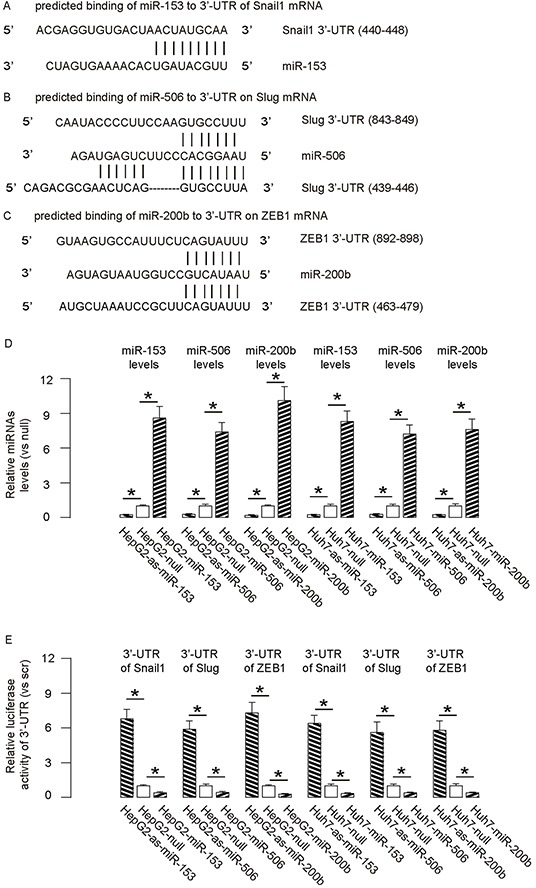
A–C. By bioinformatics analyses, we found that miR-153 bound to 3′UTR of Snail1 mRNA at 440-448 base site (A), miR-506 bound to 3′UTR of Slug mRNA at both 439-446 and 843-849 base sites (B), and miR-200b bound to 3′UTR of ZEB1 mRNA at both 463-479 and 892-898 base sites (C) D. We either overexpressed miR-153, miR-506 and miR-200b, or inhibited miR-153, miR-506 and miR-200b in both HCC cell lines. These HCC cells were also transfected with a plasmid carrying a null sequence as a control (null). The overexpression or inhibition of these miRNAs in both HCC cell lines was confirmed by RT-qPCR. E. The miR-153-modified HCC cells were then transfected with 1μg of Snail1-3′UTR luciferase-reporter plasmid. The miR-506-modified HCC cells were transfected with 1μg of Slug-3′UTR luciferase-reporter plasmid. The miR-200b-modified HCC cells were transfected with 1μg of ZEB1-3′UTR luciferase-reporter plasmid. The luciferase activities were quantified in these cells. *p<0.05. N=5.