



Abstract
A new study shows that fasting induces the differentiation and elimination of some types of leukemia, which implicates fasting or its mimetics as a novel strategy for the treatment of leukemia.
Acute leukemias, characterized by the excess production of hematopoietic progenitor cells of the lymphoid (acute lymphoblastic leukemia, ALL) or myeloid lineages (acute myeloid leukemia, AML), are among the most common causes of childhood cancer worldwide. Both ALL and AML are challenging to treat because subsets of patients fail to respond to conventional therapies, such as chemotherapy or radiation, as well as to targeted therapies, such as tyrosine-kinase inhibitors and bone marrow transplantation1. In this issue of Nature Medicine, Lu et al.2 explore the therapeutic potential of fasting (i.e., food deprivation without water restriction), a dietary intervention that has been previously proposed to promote normal hematopoietic regeneration3, as a treatment for acute leukemia. Their findings reveal that periodic fasting selectively inhibits the development of ALL, but not AML, by upregulating the leptin receptor (LEPR) protein and its downstream effector PR-domain zinc-finger protein 1 (PRDM1).
Similar to normal hematopoiesis, leukemia often follows a hierarchy whereby primitive, self-renewing leukemia-propagating cells give rise to bulk leukemic blast cells1. Unlike normal hematopoietic cells, leukemic blast cells are blocked at an early stage of their development and fail to differentiate into mature, functional hematopoietic cells. In acute leukemia, neoplastic progenitors proliferate and overrun normal hematopoietic cells of the marrow, spleen and peripheral blood, and eventually, they reduce blood cell counts. Accordingly, therapeutic strategies that force cancer cells to resume the process of lineage maturation have been proposed as an alternative approach to cytotoxic chemotherapy for eliminating cancer cells such as leukemia. However, despite the success of all-trans-retinoic acid (ATRA) in the treatment of acute promyelocytic leukemia (APL), which enables the differentiation of APL leukemic blast cells, only a limited number of pharmacological agents that drive the terminal differentiation of leukemic cells have been identified4. Lu et al.2 turned their attention to dietary approaches for inducing the differentiation of leukemia cells. The authors first investigated the effects of fasting on ALL and AML development using mouse models of acute leukemia. In these models, fluorescence-tagged and oncogenic-engineered cancerous precursors were generated in vitro and then transplanted into immune-compromised mice to generate acute leukemia (Fig. 1). The mice then underwent cycles of fasting during leukemogenesis. Notably, the authors found that early fasting was sufficient to prevent the initiation, and to almost completely prevent the development, of both B cell and T cell ALLs. Fasting not only had a strong inhibitory impact on the early growth of ALLs, but was also quite effective at reducing leukemia progression at later stages associated with high disease burden. This finding raises the possibility that fasting or its pharmacological mimetics might have a role in treating patients that have advanced leukemia. Notably, the effects of fasting were found to be cancer-type dependent; in contrast to ALL, fasting cycles had negligible effects on AML.
Figure 1.
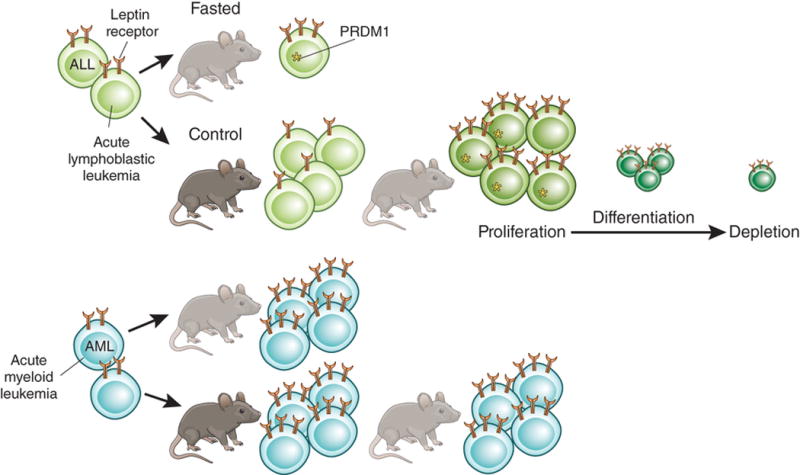
Fasting regulates LEPR-mediated leukemia differentiation. Fluorescence-tagged preleukemic acute lymphoblastic leukemia (ALL) and acute myeloid leukemia (AML) cells are transplanted into recipient mice. As leukemia develops in the mice, ALL cells express low levels of LEPR. However, Lu et al.2 show that fasting induces LEPR expression, which leads to the activation of its downstream effector PRDM1. This fasting-induced gene-expression program, at early stages, prevents the development of leukemia, and at later stages, drives the differentiation and eventual depletion of leukemic cells. By contrast, AML cells express high levels of LEPR and are refractory to the effects of fasting.
In response to fasting, ALL cells demonstrated rapid proliferation, apoptosis and differentiation. To gain more mechanistic insight into how fasting might eliminate ALL cells, the authors carried out RNA-sequencing and pathway analysis and found a prominent signature indicative of LEPR signaling in these cells, including strong activation of PRDM1. PRDM1 is a downstream target of LEPR-mediated STAT signaling that drives the terminal differentiation of lymphoid progenitors. The authors propose that fasting upregulates the expression of LEPR and its downstream transcription factor PRDM1and that this process enables ALL blast cells to differentiate (Fig. 1). The authors reveal that LEPR expression was reduced upon the development of ALL but not that of AML. Furthermore, they show that attenuation of LEPR signaling is essential for the maintenance of ALL, but not of AML, in two mouse models of obesity, which indicates that the activation of LEPR signaling underlies the fasting-induced inhibition of ALL growth. Although it remains unclear whether fasting universally inhibits the development of most ALLs—even those with different genetic drivers than those tested in these mouse models—the authors provide convincing evidence that fasting-induced LEPR signaling might mitigate disease burden in some types of ALL.
Dietary interventions have been applied successfully to treat certain solid cancers in animal models5. For example, periodic fasting sensitizes a wide range of xenograft tumor models, such as melanoma, glioma and breast cancer, to chemotherapy6. Furthermore, recent studies focused on the hematopoietic and immune systems illustrate that fasting or fasting mimetics enhance antitumor immunity, which results in delayed progression of breast cancer and melanoma in preclinical models3,7. However, whether these findings apply to humans is unknown.
As an alternative to dietary interventions, another approach might be to co-opt pathways activated by such interventions with pharmacologic agents. In this study, Lu et al.2 show that in patients with pediatric pre-B-ALL, LEPR signaling is highly associated with the prognosis of the disease. Fasting-induced LEPR signaling, for instance, effectively inhibits human B-ALL disease development in xenograft assays. Additionally, overexpression of LEPR or its effector PRDM1 in mouse models of ALL recapitulated the ability of fasting to promote the differentiation of ALL cells. Collectively, these results suggest that fasting-induced LEPR and PRDM1 signaling can be exploited therapeutically for the treatment of ALL.
Leptin, a hormone known for its role in satiety, held hope as a treatment for obesity; however, treatments involving leptin failed in part owing to the development of leptin resistance, which is associated with high levels of leptin, low levels of LEPR and diminished sensitivity to the hormone8. It was then proposed that the reversal of leptin resistance might improve the treatment of obesity. Notably, as reported by Lu et al.2, fasting reduces leptin levels while boosting LEPR signaling in ALL (i.e., it enhances leptin sensitivity). The use of leptin sensitizers, such as withaferin A or metaformin, might represent an effective alternative to mimic the antitumor effects of fasting in the treatment of ALL9. However, just as AML and ALL have different requirements for LEPR-signaling in their maintenance, such differences might also exist across other tissues, cell lineages or even between normal and cancerous cells; therefore, it will be important to decipher the potential toxicities of fasting or of LEPR-based therapies.
Recent studies indicate that, in response to therapy, a subset of acute leukemias can switch lineages or acquire mixed lineage phenotype (i.e., they possess both myeloid and lymphoid features) at relapse, which might permit such leukemias to escape fasting- or LEPR-induced differentiation10. Thus, proposed therapeutic interventions will need to overcome such complications or mechanisms of escape. Despite these potential challenges, this study identifies an important role for LEPR and PRDM1 signaling in leukemic cell differentiation that might one day be exploited therapeutically to reduce disease burden in patients with ALL.
Footnotes
COMPETING FINANCIAL INTERESTS
The authors declare no competing financial interests.
Contributor Information
Chia-Wei Cheng, Koch Institute for Integrative Cancer Research at MIT and Department of Biology, Massachusetts Institute of Technology, Cambridge, Massachusetts, USA.
Ömer H Yilmaz, Koch Institute for Integrative Cancer Research at MIT and Department of Biology, Massachusetts Institute of Technology, Cambridge, Massachusetts, USA; Department of Pathology, Massachusetts General Hospital and Harvard Medical School, Boston, Massachusetts, USA.
References
- 1.Riether C, Schürch CM, Ochsenbein AF. Cell Death Differ. 2015;22:187–198. doi: 10.1038/cdd.2014.89. [DOI] [PMC free article] [PubMed] [Google Scholar]
- 2.Lu Z, et al. Nat Med. 2017;23:XXX–XXX. [Google Scholar]
- 3.Cheng CW, et al. Cell Stem Cell. 2014;14:810–823. doi: 10.1016/j.stem.2014.04.014. [DOI] [PMC free article] [PubMed] [Google Scholar]
- 4.Nowak D, Stewart D, Koeffler HP. Blood. 2009;113:3655–3665. doi: 10.1182/blood-2009-01-198911. [DOI] [PMC free article] [PubMed] [Google Scholar]
- 5.Mihaylova MM, Sabatini DM, Yilmaz ÖH. Cell Stem Cell. 2014;14:292–305. doi: 10.1016/j.stem.2014.02.008. [DOI] [PMC free article] [PubMed] [Google Scholar]
- 6.Vernieri C, et al. Cancer Discov. 2016;6:1315–1333. doi: 10.1158/2159-8290.CD-16-0615. [DOI] [PMC free article] [PubMed] [Google Scholar]
- 7.Di Biase S, et al. Cancer Cell. 2016;30:136–146. doi: 10.1016/j.ccell.2016.06.005. [DOI] [PMC free article] [PubMed] [Google Scholar]
- 8.Park J, Scherer PE, et al. Endocr Relat Cancer. 2011;18:C25–C29. doi: 10.1530/ERC-11-0163. [DOI] [PMC free article] [PubMed] [Google Scholar]
- 9.Crunkhorn S. Nat Rev Drug Discov. 2016;15:601. doi: 10.1038/nrd.2016.166. [DOI] [PubMed] [Google Scholar]
- 10.Dorantes-Acosta E, Pelayo R. Bone Marrow Res. 2012;2012:406796. doi: 10.1155/2012/406796. [DOI] [PMC free article] [PubMed] [Google Scholar]