


Figure 1.
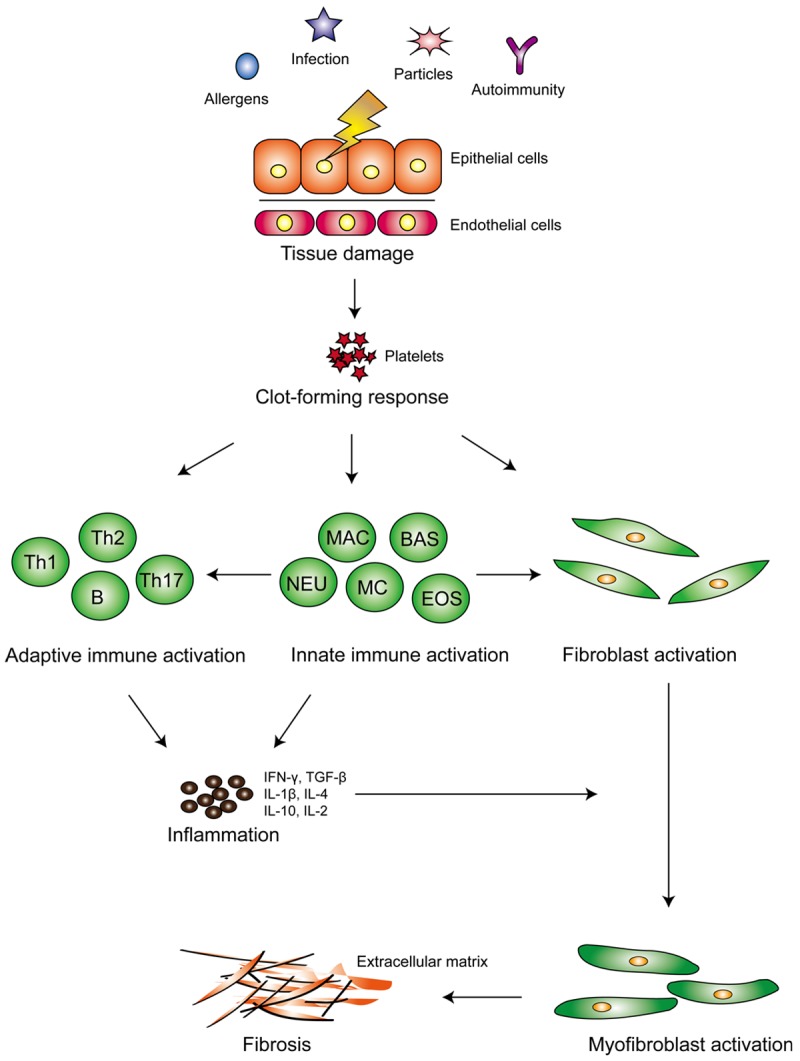
Overview of fibrogenesis in IPF. In the early phase of fibrogenesis, epithelial and/or endothelial damage caused by a variety of irritants can initiate an anti-fibrinolytic coagulation cascade, temporarily plugging the damaged vessel with platelets and fibrin-rich clots to quickly restore homeostasis. Meanwhile, thrombin and the injured epithelium can directly evoke fibroblast activation and promote fibroblast differentiation into collagen-producing myofibroblasts. After a short period of time, clot-forming responses rapidly progress into a phase, in which many inflammatory cells such as macrophages, neutrophils, and lymphocytes are recruited into the injured site, where they secretecopious amount of cytokines to eliminate the inciting factor whilst activating the resident quiescent fibroblasts into myofibroblasts. However, once an imbalance in cytokine production coupled with dysregulated cellular recruitment occurs, a normal wound-healing response can switch into a pathological fibrotic reaction, ultimately resulting in pulmonary fibrosis. MAC = macrophages, BAS = basophils, NEU = neutrophils, MC = mast cells, EOS = eosinophils.