



Abstract
Breastmilk is the only dietary source of zinc for exclusively breastfed young infants, and it remains a potentially important source of zinc for older infants and young children who continue breastfeeding beyond early infancy. Therefore, we examined available information on breastmilk zinc concentration and total milk consumption to develop estimates of the amount of zinc transferred in breastmilk to children of different ages. Breastmilk zinc concentration declines rapidly during the first few months postpartum and more slowly thereafter. Breastmilk supplies all of the theoretical zinc needs for at least the first several months of life, although the period during which breastmilk alone remains sufficient is uncertain. Breastmilk continues to provide more than half of children’s estimated zinc requirements after the introduction of complementary foods, even into the second year of life. Public health programs to promote and support breastfeeding should be included among the strategies to ensure adequate zinc status of young children.
Keywords: Breastfeeding, breastmilk, infant, zinc, zinc absorption, zinc requirements
Background
Promotion and support of appropriate breastfeeding practices should be considered among the recommended dietary strategies to enhance the zinc status of infants and young children, for two main reasons: breastmilk is an important potential source of bioavailable zinc, and breastfeeding protects against diarrhea [1–3], which causes excessive zinc losses [4], This paper will provide a summary of available information on the amount of zinc that can be provided to infants and young children through breastfeeding. The paper is divided into three sections, which address the following questions with regard to breastfeeding as a component of dietary intervention strategies to prevent zinc deficiency:
Section 1: How much zinc is transferred in breastmilk to exclusively breastfed infants less than 6 months of age in relation to their physiological requirements for absorbed zinc?
Section 2: How much zinc is transferred in breastmilk to infants and young children less than 24 months of age who are consuming breastmilk in addition to complementary foods?
Section 3: What are the programmatic implications of the answers to the foregoing questions, and what are the remaining research needs?
Section 1
How much zinc is transferred in breastmilk to exclusively breastfed infants less than 6 months of age in relation to their physiological requirements for absorbed zinc?
Conclusions
The mean amount of zinc transferred in breastmilk to exclusively breastfed infants declines rapidly from ~4 mg/day during the first few days of life to ~1.75 mg/day by 1 month. Zinc transfer declines more slowly thereafter to ~0.7 mg/day at 6 months. The adequacy of breastmilk as the sole source of zinc during this period is difficult to determine because of uncertainty in the fractional absorption of zinc (FAZ) from breastmilk and doubts regarding the true physiological requirements for absorbed zinc during this period of life Nevertheless, using different assumptions for likely FAZ, based on available studies that suggest a mean FAZ of ~0.50 and current estimates of zinc requirements, breastmilk alone is probably adequate for exclusively breastfed term infants for at least 3 months and possibly for as long as 6 months, depending on which sets of estimates are applied and whether zinc accrued by the fetus during gestation is available for infant metabolism.
There is little information from zinc supplementation trials conducted among exclusively breastfed term infants less than 6 months of age, and the results of supplementation trials carried out among a broader age range of breastfed infants are inconsistent. In general three such trials carried out in industrialized countries failed to demonstrate a consistent functional advantage of providing additional zinc to infants less than 6 months of age, so the amount transferred in breastmilk is presumably adequate during this period. Breastmilk is clearly an important source of highly bioavailable zinc during this period of life and may be adequate as the sole source of zinc for exclusively breastfed term infants until ~6 months.
Detailed review of evidence
Overview of methodologie issues
Milk sampling
Accurate measurement of the amount of zinc transferred through breastmilk from mothers to their nursing children requires first, collection of representative samples of milk for analysis of zinc concentration and second, assessment of the total amount of milk consumed. The total amount of zinc transferred through breastmilk can then be determined by multiplying the milk zinc concentration by the total amount of milk consumed. To develop an appropriate milk sampling protocol for assessing milk zinc concentration, several investigators have examined whether milk zinc concentration varies by the time of day, portion of the feeding, left versus right breast, the gestational age at birth and postnatal age of the child, and the age, parity, and zinc status of the mother. The results of these studies are summarized in the following paragraphs. The single factor that appears to have the greatest impact on milk zinc concentration is the time postpartum. Thus, assessments of other factors affecting milk zinc concentration are interpretable only if the age of the child is held constant. The specific relation between time postpartum and milk zinc concentration is discussed in more detail in the next section.
Studies of milk zinc concentration in relation to time of day have yielded inconsistent results. Four studies found no relation between the time of day and milk zinc concentration [5–8], but three studies found that specimens obtained early in the morning had ~15% greater milk zinc concentration than specimens obtained in the afternoon or evening [9–11]. Thus, it might be advisable to obtain more than one sample during the day to gather more representative information on the total amount of zinc transferred, even though many studies suggest that just one sample might he sufficient.
Two studies examined milk zinc concentrations in different portions of the feeding, and neither found any significant differences in the zinc concentrations of foremilk and hindmilk [5, 12]. Only one study compared zinc concentrations in milk obtained from the left versus the right breast, and no consistent differences were detected [12].
Ten studies are available that compared the zinc concentration in the milk of mothers who delivered at term with that of mothers who delivered prematurely [13–22]. There were no consistent differences in the zinc concentrations of milk obtained from the respective sets of mothers. Other studies of the relations between maternal age and parity and milk zinc concentrations are difficult to interpret because of the failure to control adequately for infant age. Among the subset of studies that did compare results at specific, narrowly defined time periods postpartum, there are no consistent effects of maternal age or parity on milk zinc concentrations [7,23–26].
As reviewed by Hess and King in this issue [27], maternal zinc status and maternal zinc supplementation do not appear to affect milk zinc concentration. On the other hand, several longitudinal studies have found greater variability in milk zinc concentration between women than within women [10, 28], indicating that individual women have characteristic levels of zinc in their milk, possibly because of genetic factors influencing zinc transport to or within the mammary gland. The public health importance of these interindividual differences in breastmilk zinc concentration is unknown, because no relevant studies are available relating milk zinc concentration to infant growth.
In summary, there are few extraneous factors, other than time postpartum, that consistently affect breastmilk zinc concentration. Thus, it is possible to collect milk samples for analysis of zinc concentration from either breast, from any portion of the feeding, and at just one time or a few times per day, regardless of the age, parity, and nutritional status of the mother.
Pattern of distribution of data regarding milk zinc concentration and milk volume
To calculate the range of total zinc consumption from breastmilk by children of different ages, information is needed on the distribution of data concerning milk zinc concentration and total milk intakes during each age interval of interest. Few studies have reported information on the distribution of milk zinc concentration at different ages, so we reanalyzed data from a previously published study that collected milk samples from 71 infants at 2 weeks of age and again monthly from 1 through 7 9 months of age [28]. As shown in figure 1, these data indicate that the distribution of milk zinc concentration is skewed somewhat to higher values at each age, although the data can he normalized by logarithmic transformations.
FIG. 1.
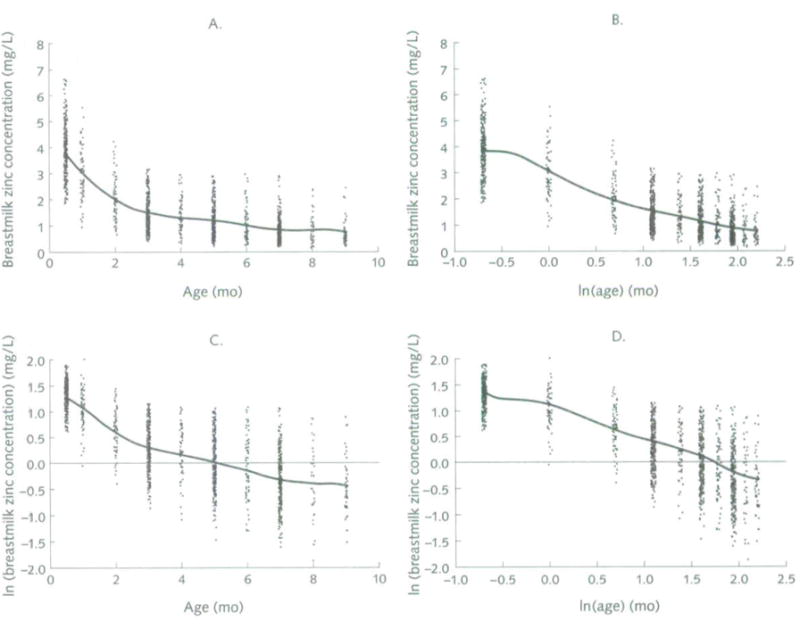
Distribution of breastmilk zinc concentration according to time postpartum, and effects of different mathematical transformations of data. Data provided by Krebs et al, [28]
We also examined the results of seven previously completed studies of breastmilk intake to assess the age-specific distribution of milk volumes [28–34] and concluded that milk intake was generally normally distributed in all studies (Shapiro-Wilk statistic > 0.98 in all cases).
Studies of breastmilk zinc transfer to exclusively breastfed infants under 6 months of age
Identification and selection of studies
Data sets containing information on breastmilk zinc concentration were identified through a computerized database search (PubMed, accessed September 12, 2007) using the keywords “breast,” “milk,” “zinc,” and “infant” and no additional limits, which yielded 320 bibliographic citations. The titles were screened for relevance, and the full texts of the articles were obtained when possible. Additional data sets were located from the lists of citations included in the articles found during this initial search, through papers cited in a previously published review [35], and by contacting other experts in the field. Using this search strategy, we identified a total of 69 publications from 64 different studies that reported data on breastmilk zinc concentration.
From the set of 69 publications that were retrieved, we selected only those studies that presented data from mothers of healthy, term infants and provided information on both milk zinc concentration and time postpartum. Despite the conclusions of the methodologic review presented above, for the sake of caution we excluded studies that enrolled preterm infants or children with specific illnesses, unless data were reported separately for unaffected children. We also excluded studies of mothers who were receiving zinc supplements, unless the authors specifically stated that there was no effect of supplementation on milk zinc concentration or data from nonsupplemented women were presented separately. We also excluded studies of women who were receiving other mineral-containing supplements or other medicines. These exclusions resulted in a final set of 33 studies that were included in the combined analysis, as shown in table 1 [5, 7, 13–18, 21, 23, 26, 28, 36–61]. The studies that were excluded from the analysis are shown in table 2 [6, 8–11, 19, 22, 24, 25, 62–86], along with the reason(s) for the exclusion.
TABLE 1.
Publications included in the data analysis
| Country, year [reference] author | Study group | Health and zinc status of mothers | Zinc concentration in milk according to stage of lactation (mg/L) | Description of milk sample | Growth or zinc status of infant |
|---|---|---|---|---|---|
|
| |||||
| Argentina, 2001 [14] Ronayne de Ferrer | n = 20 mothers with term milk (mean gestational age of infants, 39.5 wk; range, 38–41 wk; mean birthweight, 3,303 g) and n = 24 middle- class mothers with preterm milk (mean gestational age of infants, 30.9 wk; range, 27–35 wk; mean birthweight, 1,440 g) | Apparently healthy | Mean ± SEM, term infants only; Days 2–5: 6.96 ± 0.69 Days 6–10: 4.27 ± 0.51 Days 11–15: 3.36 ±0.31 Days 16–30:2.44 ±0.11 |
Full breast sample collected by manual or pump expression between 10 and 12 am | Infant growth and zinc status not reported |
| Brazil, 1989a [41] Donangelo (excluded data from 31 to 280 days because of wide range of infant ages) | n =93 mothers of low SES with normal and uncomplicated gestations, both partially breastfeeding and exclusively breastfeeding. Mean maternal age, 25.9 ± 5.6 (SD) yr; mean birthweight, 3,277 ± 476 (SD) g | Mothers received iron, vitamin B12, and/or folate during pregnancy (but not lactation). 11% of mothers had serum zinc below cutoff for low zinc for adult women | Mean ± SEM, exclusively breastfeeding mothers: Days 1–5:5.94 ± 0.55 (n = 17) Days 6–30: 2.84 ± 0.37 (n = 13) Days 31–280: 1.65 ±0.38 (n = 10) Mean ± SEM, partially breastfeeding mothers: Days 31–280: 1.26 ± 0.19 (n = 21) |
5–10 mL, collected by manual expression between 9 and 10 am before the infant was fed | Infant growth and zinc status not reported |
| Brazil, 1998 [15] Trugo | n = 28 mothers with term milk (mean birthweight, 3,380 ± 53 [SD] g) and n = 7 mothers with preterm milk (mean birthweight, 1,810 ± 47 [SD] g) at 1–5 days postpartum; n = 9 mothers with term milk (mean birthweight, 3,160 ± 29 [SD] g) and n = 15 mothers with preterm milk (mean birthweight, 1,700 ± 39 [SD] g at 6–36 days postpartum). All of low SES | All low SES; none received supplements. No information on maternal health and zinc status | Mean ± SD (range), term infants only: Days 1–5:7.26 ± 3.03 (1.3–13.7) (n = 22) Days 6–36:2.79 ± 1.14(1.2–4.2) (n = 8) |
5–10 mL, of milk collected by manual expression between 9 and 10 am before the infant was due to be fed | Infant weights were adequate for gestational age. Infant zinc status not reported |
| Brazil, 2003 [21] da Costa | n = 50 mothers of term infants (37–41 wk gestation) > 20 yr of age, with at least 2 yr interparturition period; no supplements | Maternal health and zinc status not reported | Mean ± SD: Days 1–7: 6.97 ± 2.82 (n = 48) |
Manual expression of 1.5 mL of colostrum from both breasts between the 1st and 7th days of lactation | Infant growth and zinc status not reported |
| Burundi, 1995 [53] Robberecht | n = 5 exclusively breastfeeding middle-class women (mean age, 32 yr) with infants aged 0–10 mo. Uncomplicated pregnancies | Healthy; zinc status not measured specifically | Mean ± SD: Days 2–4 (colostrum): 3.76 ± 0.51 (n = 1,8 samples) Days 5–14; 3.08 ± 0.62 (n = 1, 10 samples) 1 mo: 2.47 ± 1.17 (n = 3,12 samples) 2 mo: 1.64 ± 0.06 (n = 2,6 samples) 4 mo: 1.30 ± 0.06 (n = 2,5 samples) 10 mo: 0.75 ±0.02 (n = 2,6 samples) |
Breastmilk samples from 5 lactating women [54] | Infant growth and zinc status not reported |
| Canada, 1982 [18] Mendelson |
n = 10 mothers of term infants (mean gestational age, 39.0 wk; range, 38–40 wk; mean ± SD birthweight, 1,143 ± 305 g) and n = 14 mothers of preterm infants (mean gestational age, 28.7 wk; range, 26–33 wk; mean ± SD birthweight, 3,361 ± 550 g) All appropriate for gestational age |
Normal pregnancy; maternal health and zinc status not reported | Mean ± SD, term infants only: Days 3–5: 5,35 ± 1.2 (n = 8) Days 8–10:4.1 ± 0.65 (n = 8) Days 15–17:3.37 ± 0.6 (n = 7) Days 28–30:2.6 ± 0.65 (n = 6) |
Complete 24-h expression with breast pump | Infant growth and zinc status not reported |
| Canada, 1999 [20] Friel | n = 19 mothers 20–35 yr of age with full-term infants | Healthy, nonvegetarian; zinc not specifically measured | Mean ± SD: Days 2–3: 4.58 ± 0.52 (n = 17) Day 8: 3.99 ±0.88 (n = 16) Day 15: 3.54 ±0.74 (n = 16) Day 22: 3.37 ± 2.06 (n=15) Day 28: 2.5 ± 0.94 (n = 15) Day 36: 2.32 ± 1.41 (n = 15) Day 43:1.89 ± 0.65 (n = 15) Day 50:1.56 ± 0.96 (n = 15) Day 61:1.14 ± 0.55 (n = 12) |
Full breast expression by electric pump during a regular feeding of the child between 10 am and 2 pm; a 15-mL aliquot was taken | Infant growth and zinc status not measured |
| China, 2007 [60] Xiang | n = 41 term, exclusively breastfeeding mother-infant pairs in rural China. Group I: n = 18 at 1 mo (mean maternal age, 26.6 yr). Group II; n = 23 at 3 mo (mean maternal age, 27.4 yr) | Mean maternal zinc intake, 7.5 mg/day; mothers apparently healthy | Mean ± SD: Group I (1 mo): 3.24 ± 0.23 Group II (3 mo): 1.94 ±0.17 |
5-mL milk samples were expressed manually at 5 time intervals (8–10 am. 10 am–12 pm, 12–2 pm, 2–4 pm, and 4–6 pm) after the breast had been suckled by the infant for 2 min | Weights and lengths were in normal ranges at birth, 1 mo, and 3 mo. Infant zinc status not reported |
| Finland, 1979 [57,58] Vuori | n = 27 mothers aged 20–35 yr (mean, 28 yr) | Healthy, well-nourished, all were primiparous mothers of term infants | Mean; Wk 2:4.0 (n = 20) Wk 3: 3.0 (n = 23) Wk4: 2.5 (n = 22) Wk 5: 2.4 (n = 25) Wk 6:2.1 (n = 17) Wk 7:1.9 (n =18) Wk 8–10:1.3 (n = 22) Wk 11–13: 1.1 (n = 18) Wk 14–16: 0.95 (n = 11) Wk 17–19: 0.78 (n = 12) Wk 20–22:0.75 (n = 13) Wk 23–25: 0.49 (n = 10) Wk 26–28: 0.52 (n = 9) Wk 29–31:0.44 (n = 6) Wk 32–34: 0.42 (n = 1) Wk 35–37: 0.48 (n = 2) |
Fore- and hindmilk sample from each feeding (5–7/day in first 3 mo; 3–4/day thereafter) at 1–2 wk intervals up to 2 mo and 3–4-wk intervals thereafter | Infant growth (measured by height and weight) was comparable to reference norms for Finnish infants. Infant zinc status not reported |
| Germany, 1992 [55] Sievers | n = 10 healthy mothers aged 26–35 yr with term infants | Healthy; zinc not measured specifically | Median (10th, 90th percentile): Day 17: 3.6(2.4, 49) Day 35: 2.6 (1.6, 3.6) Day 56: 1.7 (1.1, 2.8) Day 85:1.3 (0.8, 1.4) Day 117:1.2 (0.6, 1.9) |
At each feed 2 mL of fore- or hindmilk from nursed breast (n = 2,207 specimens) | Negative zinc balance observed in 11 of 33 breastfed infants; median daily zinc retention was positive in all cases. Infant growth not reported |
| Greece, 2005 [49] Leotsinidis | n = 180 mothers aged 25 ± 4 (SD) yr with full term infants, mean birthweight 3,396 ± 480 g | Healthy; zinc status not specifically measured. Anemia prevalence was 41.9% | Mean ± SD: Day 3:4.91 ± 1.73 Day 14:2.99 ± 0.92 |
10–20 mL collected in the morning by manual expression, 2 h after the previous breastfeeding | Infant growth and zinc status not reported |
| Honduras and Sweden, 2004 [40] Dömellof | n = 263 mother-infant pairs (total for Honduras + Sweden); mothers > 16 yr of age; exclusively breastfeeding at 4 mo. Infants were full term, with birthweight > 2,500 g, no illness | Maternal zinc status not reported. Prevalence of low ferritin (< 12 μg/h) was 32% in Honduras and 12% in Sweden | Mean ± SD at 9 mo: Honduras: 0.7 ± 0.18 (n = 108) Sweden: 0.46 ± 0.26 (n = 86) |
10–40 mL collected by manual expression at 9 mo postpartum in the morning > 1 h after feeding | Infant growth and zinc status not reported |
| India, 1997 [16] Hemalatha (colostrum and transitional milk data not included because day of collection not reported) |
Mothers of 68 preterm infants (gestational age at birth not given), 92 term breastfed infants, and 26 term formula-fed infants. All weaned with cereal at 6 mo | Maternal health and zinc status not reported | Mean ± SD, term infants only: Colostrum: 2.27 ±0.191 Transitional: 2.19 ± 0.297 Mo 1–3:1.90 ±0.20 Mo 4–6: 1.50 ± 0.225 Mo 7–12: 1.15 ±0.15 |
Full breast expression from the left breast between 10 and 11 am | Mean ± SEM plasma zinc (μg/dL): Cord: 118.3 ± 5.07 Mo 3:76.9 ± 8.85 Mo 6:74.2 ±5.12 Mo 9: 83.8 ± 7.84 Yr 1:114.6 ± 13.02 Infant growth not reported |
| Italy, 1999 [26] Chierici |
n = 22 mothers of appropriate weight for gestational age term infants. Half were randomized to receive vitamin and mineral supplements | Healthy, nonsmokers, nonvegetarians; uncomplicated pregnancy, labor, and delivery | Mean ± SD, placebo group only (n = 11): Day 3: 8.16 ±2.96 Day 30: 3.9 ± 1.01 Day 90:2.87 ± 1.23 |
10 mL of milk was obtained from both breasts with a breast pump before the baby nursed | No difference in gains in infant weight, length, or head circumference between the 2 maternal study groups |
| Japan, 1982 [23] Higashi (colostrum data excluded because day of collection not specified) |
n = 65 mothers 21–37 yr of age (mean, 27.3 yr) with healthy, full-term infants with birthweight > 2,500 g | Mothers judged to have good nutritional status based on clinical examination. Mean serum zinc ranged from 55 to 115 μg/dL | Mean ± SD: Colostrum: 10.39 ± 4.43 (n = 65) Wk 1:4.56 ±3.01 (n = 65) Mo 1: 2.66 ± 1.03 (n = 65) Mo 3: 1.14 ± 0.67 (n = 45) Mo 5: 1.05 ± 0.46 (n = 35) |
10 mL of milk obtained by manual expression in the morning before the baby was due to be fed | Infant growth and zinc status not reported |
| Japan, 2005 [61] Yamawaki |
n = 1,197 mothers under 40 yr of age (mean, 29.12 ± 3.99 [SD] yr) who did not smoke or use vitamin supplements, with infants with no symptoms of atopy and birthweight > 2,500 g (mean, 3,135 ± 346 [SD] g) | Zinc status not specifically measured | Mean ± SD: Days 1–5:4.75 ± 2.48 (n = 20) Days 6–10: 3.84 ± 1.39 (n = 38) Days 11–20: 3.37 ±0.89 (n = 40) Days 21–89: 1.77 ± 1.08 (n = 551) Days 90–180:0.67 ±0.8 (n = 476) Days 181–365:0.65 ± 0.43 (n = 39) |
~50 mL of milk obtained at an intermediate time during suckling | Mean birthweight, 3,135 ±346 (SD) g. Infant zinc status not specifically reported |
| Nigeria, 1982 [36] Atinmo |
n = 20 low-SES mothers with term infants | Maternal health and zinc status not reported | Mean ± SD: Days 2–4:5.98 ± 1.12 Days 8–14: 5.49 ±0.73 Mo 1–2:3.93 ±0.78 |
10 mL of milk collected by manual expression at noon just before infant feeding | Infant growth and zinc status not reported |
| Nigeria, 1984 [50] Mbofung |
n = 240 low-SES mothers 17–40 yr of age who had given birth to a normal, full-term infant | Mothers judged healthy by clinical examination and medical history; zinc not specifically measured | Mean ± SEM; Days 1–7: 5.83 ± 0.13 (n = 96) Wk 4:3.2 ± 0.10 (n = 54) Wk 8: 3.0 ±0.10 (n = 34) Wk 12: 2.3 ±0.11 (n = 84) Wk 16: 1.88 + 0.13 (n = 40) Wk 20:1.08 ± 0.10 (n = 31) Wk 24:0.98 ± 0.08 (n = 21) Wk 32:0.82 ± 0.09 (n= 12) Wk 36: 0.68 ± 0.10 (n = 8) |
8–12 mL of milk collected between 9 am and noon from the breast due for the next feeding by the mother using manual expression | Infant growth and zinc status not reported |
| Spain, 1997 [52] Ortega |
n = 57 lactating women aged 18–35 yr with healthy infants with normal birthweight and a mean gestational age of 39.4 wk | Comparison of healthy mothers with low zinc intake (< 50% RI; mean serum zinc, 78.5 ± 9.8 μg/dL) and high zinc intake (≥50% RI; mean serum zinc, 87.0 ± 17 μg/dL) (p< .05) | Mean ± SD, mothers with low zinc intake: Days 13–14:3.05 ± 0.48 Day 40:1.88 ±0.41 Mean ± SD, mothers with high zinc intake: Days 13–14: 3.34 ±0.60 Day 40: 2.16 ±0.52 8% of mothers with low zinc intake and none with high zinc intake had < 0.75 mg/L breastmilk zinc |
5-mL samples collected from each breast pre- and post-feeding between 10 and 11 am | Normal growth No difference in infant growth between groups |
| Spain, 2001 [56] Silvestre |
n = 22 women, well-nourished and healthy with term infants | Well nourished; zinc not measured specifically | Mean ± SD: Days 2–4: 7.99 ± 3.23 Day 14:3.31 ± 1.06 Day 30: 2.41 ±0.90 Day 60: 1.40 ±0.65 Day 90: 1.05 ±0.71 |
Foremilk collected from both breasts prior to feeding; collection between 11 am and 4 pm | Healthy; infant growth and zinc status not reported |
| Turkey, 2005 [13] Ustundag |
n = 20 mothers (mean age, 21 ± 1 [SD] yr) of term infants and n = 20 mothers (mean age, 21 ± 2 [SD] yr) of preterm infants (< 37 wk gestational age); all mothers were nonsmokers | Healthy mothers; weight ranged from 50 to 65 kg. Zinc not measured specifically | Mean ± SD, mothers of term infants only: Days 0–7:2.41 ± 0.28 Days 7–14: 2.28 ±0.19 Day 21:2.39 ±0.20 Mo 2:2.01 ±0.18 |
Milk collected by manual expression within 2 h of the first feeding in the morning between 8 and 11 am | Infant growth and zinc status not reported |
| UK, 1982 [44] Hibberd |
n = 10 mothers of term infants | Healthy; zinc not specifically measured | Mean ± SD: Day 2:7.75 ± 1.33 Day 4:4.51 ± 1.32 Day 6:3.90 ± 1.23 Day 9:3.32 ± 1.27 Day 16: 2.81 ±1.16 Day 23: 2.33 ± 1.31 Day 30: 1.71 ± 1.15 Day 37: 1.71 ± 0.92 |
Complete expression from both breasts at each feeding with the use of an electric breast pump; an aliquot was taken for analysis and samples from each 24-h period were pooled | Infant growth and zinc status not reported |
| USA, 1979a [59] Vaughan |
n = 38 Caucasian women aged 19–42 yr, mothers of term infants; 1–31 mo postpartum (average participation was 4 mo); 22 primiparous and 16 multiparous | “Good or excellent” nutritional status Maternal zinc intake (mg/day): Mo 4–6:12.7 Mo 7–9:17.3 Mo 10–12: 16.5 Mo 13–18: 16.1 Mo 19–31: 13.1 Serum zinc concentration (μg/dL): Mo 4–6: 230 Mo 7–9: 220 Mo 10–12: 140 Mo 13–18: 150 Mo 19–31:220 |
Mean ± SD: Mo 1–3:1.60 ± 0.23 (n = 28) Mo 4–6:1.05 ±0.15 (n = 39) Mo 7–9:0.75 ± 0.11 (n = 23) Mo 10–12: 0.63 ± 0.09 (n = 13) Mo 13–18: 0.69 ± 0.18 (n = 28) Mo 19–31: 0.60 ± 0.19 (n = 30) Total: 15.0 ± 4.2 |
150–200 mL of milk collected once per month at 4-wk intervals. Mothers instructed to collect milk over a 3–5-day period in the morning, afternoon, and evening at random intervals within feeding | Infant growth and zinc status not reported |
| USA, 1983a [7] Feeley |
n = 102 mothers aged 16 to 38 yr with healthy full-term infants; no difficulties during delivery. Middle SES; 97 Caucasian, 3 African-American, 2 Asian-American |
n = 39 (38%) took self-prescribed zinc supplements at a dose of 15 mg/day; n = 2 (2%) took self-prescribed zinc supplements at a dose of 25 mg/day No association between use of zinc supplements and milk zinc concentration |
Mean ± SD: Days 4–7: 5.36 ± 0.02 (n = 91) Days 10–14:4.22 ± 0.01 (n = 163) Days 30–45: 2.99 ± 0.01 (n = 158) Means for each stage of lactation are significantly different (p< .05) |
30 mL (1/3 foremilk, 1/3 halfway through feeding, 1/3 hindmilk) milk sample obtained early morning and late evening by the mother with the use of manual expression or pump | Infant birthweight ranged from 2.5 to 4.8 kg with a mean of 3.5 ± 0.5 (SD) kg. Infant zinc status not reported |
| USA, 1983b [43] Garza |
Longitudinal study of n = 6 mothers 26–35 yr of age with healthy term infants with appropriate weight for gestational age; and exclusively breastfeeding until beginning of study (5–7 mo postpartum) | Healthy, nonsmoking, limited coffee, tea, and alcohol, no medications. Zinc not specifically measured | Mean ± SEM: Mo 6:1.2 ±0.2 (n = 5) Mo 6.5: 1.2 ±0.4 (n=6) Mo 7:1.2 ±0.3 (n = 6) Mo 7.5:0.8 ± 0.3 (n = 6) Mo 8:0.7 ± 0.3 (n = 5) Mo 8.5:0.8 ± 0.3 (n = 6) Mo 9:0.7 ±0.1 (n = 4) |
Entire contents of a single breast obtained with an Egnell pump 3 to 4 h after the previous feeding, between 8 am and noon | Infant growth and zinc status not reported |
| USA, 1983c [51] Moser |
n = 23 mothers of term infants recruited from private obstetrics clinic. Mean age was 30 ± 2 (SEM) yr; mean education was 15 ± 2 (SEM) yr | Mean ± SEM maternal zinc intake (mg/day): Wk 37 gestation: 9.8 ± 0.6 (n = 23) Mo 1 postpartum: 9.4 ± 0.5 (n = 23) Mo 3 postpartum: 12.8 ±1.8 (n = 20) Mo 6 postpartum: 9.6 ±0.7 (n=19) Mean ± SEM maternal plasma zinc (μg/dL): Wk 37 gestation: 63.8 ± 2.0 (n = 23) Mo 1 postpartum: 79.1 ±1.7 (n = 23) Mo 3 postpartum: 87.6 ± 2.2 (n = 21) Mo 6 postpartum: 84.4 ± 2.4 (n = 19) |
Mean ± SEM: Mo 1:2.6 ±0.2 (n = 21) Mo 3:1.3 ±0.1 (n = 20) Mo 6: 1,1 ±0,1 (n = 18) |
30 mL collected at the first morning feeding after 6 am containing ½ foremilk and ½ hind milk | Infant growth and zinc status not reported |
| USA, 1984a [17] Butte |
Longitudinal study of n = 8 preterm infants (gestational age, 30–36 wk; mean, 33.9 wk; birthweight, 1,920 ± 70 [SD] g) and n = 13 term infants (gestational age, 37–42 wk; mean, 39.2 wk; birthweight, 2,990 ± 46 [SD] g) | Mothers of term infants 20–35 yr of age who did not consume > 2 servings/day of coffee, tea, alcohol, or carbonated beverages; parity ≤ 2, no routine medications. Maternal health was judged to be good by health history | Mean ± SD, term infants only: Wk 2:3.4 ± 0.8 Wk 4: 2.9 ± 0.9 Wk 6:2.1 ±0.9 Wk 8: 1.9 ±0.6 Wk 10:1.8 ± 1.0 Wk 12: 1.4 ±0.7 |
Full breast expression with breast pump between 8 and 12 am, at least 2 hours after feeding | Mean birthweight, 2.99 ± 0.46 (SD) kg. Infant zinc status not reported |
| USA, 1985a [38] Casey |
n = 11 mothers aged 26–39 yr. White, middle-class, well nourished. Mean parity was 2.5 (range,2–4) | Apparently well-nourished, with uncomplicated pregnancy; zinc not measured specifically | Mean ± SD: Day 1:7.94 ± 5.65 (n = 7) Day 2:11.5 ±4.7 (n = 8) Day 3; 9.34 ± 1.97 (n = 9) Day 4:6.40 ± 0.66 (n = 9) Day 5:5.42± 1.11 (n = 8) Day 8 ± 2:4.74 ± 1.02 (n =10) Day 14 ± 3:3.88 ± 0.91 (n =10) Day 21 ± 3:3.71 ± 1.09 (n =9) Day 28 ± 3:2.98 ± 0.78 (n = 8) |
5 mL collected from both breasts in the middle of the midmorning feeding (2 min after letdown) | Mean birthweight, 3.33 ± 0.46 (SD) kg (range, 2.70–4.05); mean weight at 1 mo, 3.95 ± 0.33 (SD) kg. Infant zinc status not reported |
| USA, 1985b [5, 45] Krebs (only data from placebo group included) |
Middle-income, healthy lactating women, longitudinal trial, zinc supplement (ZS): n = 14, placebo (NZS): n = 39. Mean infant age was 3.4 mo | Healthy; some took zinc supplements during pregnancy [47]. NZS: mean dietary zinc intake 10.7 ±4.1 mg/day | Mean ± SD: Placebo group: Mo 1:2.65 ±0.81 Mo 9: 0.67 ± 0.40 Zinc supplement group: Mo 1: 2.83 ± 1.05 Mo 9: 0.82 ± 0.54 (at mo 9,8 subjects remained in placebo and 4 in zinc supplement group) |
5 mL collected by manual expression. Pooled samples from 6 collections/day | Infant growth and zinc status not reported |
| USA, 1987 [37] Butte |
n = 45 mothers of healthy, full-term, exclusively breastfed infants aged 0–4 mo | Healthy; zinc not measured specifically | Mean ± SD: Mo 1: 2.37 ± 0.82 Mo 2: 1.55 ± 0.62 Mo 3: 1.13 ±0.52 Mo 4: 1.03 ± 0.52 Interindividual variability (CV),0.33 Intraindividual variability (CV), 0.42 |
24-h alternate breast pooled sample: full breastmilk samples (entire content of 1 breast), at each feeding over 24-h period | Infant growth progressed satisfactorily. Infant length positively associated with zinc intake at mo 1 and 2 |
| USA, 1989 [39] Casey |
n = 13 well-educated mothers (mean age, 31.9 ± 4.4 [SD] yr), median income > US$35,000, with normal prepregnancy weight and weight gain during pregnancy. Uneventful pregnancy | Healthy mothers, nonsmokers, all multiparous. Dietary assessment: mean zinc intake, 10.9 ± 0.5 (SD) mg/day; 5/13 took supplemental zinc (additional 10–45 mg/day); no effect of supplement reported | Mean breastmilk zinc peaked at 2 days, then declined throughout lactation; decline was nonlinear and more rapid in 1st 2 wk. Higher zinc concentrations at 3, 6, 9, and 12 mo were not associated with supplemental zinc intake Mean ± SD (n = 13): Day 7: 4.70 ± 1.20 Mo 1:2.90 ±0.70 Mo 12:0.46 ± 0.30 |
2–5 mL obtained by manual expression from both breasts at midfeeding in the morning | Infant growth and zinc status not reported |
| USA, 1995 [28] Krebs (pooled data from maternal supplementation trial) |
Healthy, lactating women. Prospective, randomized, double-blind, controlled trial; maternal zinc supplementation group (15 mg/day) (n = 40), placebo group (n = 31) | Healthy (plasma zinc was 79.8 μg/dL in both the zinc-supplementation and the non-zinc supplementation groups, compared with 88.3 μg/dL in the nonlactating control group) Randomized, controlled trial. Maternal zinc supplementation, 15 mg/day. No difference in milk zinc concentration between groups; thus, data were pooled |
Mean ± SD (n = 71): Mo 0.5: 3.88 ± 0.99 Mo 1: 3.06 ± 1.12 Mo 2: 2.04 ± 0.83 Mo 3: 1.48 ± 0.65 Mo 4: 1.44 ±0.66 Mo 5: 1.16 ±0.62 Mo 6: 1.09 ± 0.67 Mo 7: 0.85 + 0.51 Mo 8: 0.87 ± 0.58 Mo 9: 0.78 ± 0.51 |
Milk collection: 1st 29 subjects, 5–10 mL hand- expressed midfeeding from both breasts during 3-day period. 2nd 42 subjects, 3 midfeeding samples/day for 3 days, with > 4 h between samples | Healthy infants. Mean weight-for-age percentile was 62 at 2 mo, 33 at 7 mo, and 25 at 9 mo of age. Mean length-for-age percentile was 43 at 2 wk, 28 at 7 mo, and 26 at 9 mo of age [48] |
| USA, 1996 [46] Krebs |
n = 9 mothers (individually identified as; A–I) of normal, term, exclusively breastfed infants aged 2–5 mo | Healthy; zinc not measured specifically | Mean ± SD for each infant: Mo 2.0: A (1.37 ± 0.2), B (1.96 ± 0.26), Mo 2.3: C (1.01 ±0.28), D (1.96 ±0.25) Mo 4.0: E (2.76 ± 0.3),F (1.69 ± 0.32), Mo 4.5: G (1.40 ±0.21) Mo 4.8: H (1.33 ±0.15) Mo 5.0:1 (1.08 ± 0.14) |
5–10 mL expressed at each feeding over 3 days | Mean weight change during 1-wk study period was 20 ± 7.9 g/day. Mean total zinc absorbed was 0.61 ± 0.23 mg/day |
RI, recommended intake; SES, socioeconomic status
TABLE 2.
Publications excluded from the data analysis
| Country, year [reference] author | Study group | Health and zinc status of mothers | Description of milk sample | Zinc concentration in milk according to stage of lactation (mg/L) | Growth or zinc status of infant | Rationale for exclusion |
|---|---|---|---|---|---|---|
|
| ||||||
| Bangladesh, 1990 [82] Simmer |
n = 34 lactating mothers in rural area | No information on maternal health or zinc status | All milk extracted from both breasts over 24-h period using mechanical pump; 24-h infant test-weighings performed on 2 days | Mean ± SD: Mo: 1.96 + 0.99 Mo 2–3:1.25 ±0.54 Mo 6:0.93 ±0.41 Mo 9:0.73 ±0.61 Mo 12:0.54 + 0.27 |
No information on infant growth or zinc status | No information on preterm births |
| Bangladesh, 1996 [9] Hussain |
n = 34 low-SES mothers in Dhaka in wk 6–36 of lactation. Mean age, 22 yr | 2/3 of mothers had BMI <20 | 5 mL collected from alternate breasts by manual expression | Mean ± SD: 5–7 am: 2.10 ±0.83 2–3 pm: 1.74 ±0.53 10 pm: 1.84 ±0.69 |
No information on infant growth or zinc status | Data not presented by stage of lactation |
| Brazil, 1985 [66,67] Dorea |
n = 8 mothers Living in a low-income community. Mean age, 22.5 yr | General decrease in WHZ over 0–6 mo lactation but remained > 90% WHZ reference population | ~5 ml, collected at beginning and end of 1 nursing period at the same time of day | Breastmilk zinc concentration reported as a figure [67] | Infants grew normally during the study period. Breastmilk zinc was a significant predictor of weight gain (p = .0006) and linear growth (p = .02) |
Numerical results not reported |
| Brazil, 1989b [71,72] Lehti |
n = 25 Amazonian mothers | Generally inadequate nutritional status | Foremilk of the fullest breast collected by manual expression between 8;30 and 11:30 am | Mean ± SD: Mo 0–1: 2.2 ± 0.9 (n = 37) Mo 1–2:1.6 ± 0.9 (n = 59) Mo 2–3:1.4 ± 0.9 (n = 41) |
No information on infant growth or zinc status | No information on preterm births |
| Brazil, 2007 [73] Melnikov |
n = 117 mothers (mean age, 22.1 yr) and their infants. None of the infants showed malformations or clinically detectable impairment | Mothers were apparently healthy. Breastmilk zinc was not related to maternal age, parity, or history of miscarriage |
Manual expression on day 2 postpartum | 1.22 ± 0.78 mg% [sic] | No information on infant growth or zinc status | No information on preterm births |
| China, 2002 [81] Sian |
n = 18 mothers (mean age, 26 ± 2 [SD] yr) of infants ~2 mo of age (mean age, 48±11 [SD] days) | Mean maternal zinc intake estimated by 3-day diet records, 7.8 ± 1.7 mg/day (n = 18) | 5 mL collected by manual expression of midfeeding sample | At ~2 mo postpartum, mean breastmilk zinc concentration was 2.34 ± 0.83 mg/L. Milk zinc output was 2.01 ± 0.97 mg/day | No information on infant growth or zinc status | No information on preterm births |
| Côte d’Ivoire, [70] Lauber | n = 33 mothers in a rural area; 8 were primiparous. 19 infants were aged 1–3 mo and 10 infants were aged 4–15 mo | General health was good and nutritional status was fairly satisfactory | Aliquot taken from full breast expression by electric pump in early morning, from the breast not used to feed the infant the previous night | Mean ± SD: Mo 1:3.5 ±0.9 (n=4) Mo 6:2.3 ± 0,9 (n = 7) Mo 12:1.6 ± 0.9 (n = 8) Mo 18: 1.5 ± 1.3 (n = 6) |
Weight -for-age declined from mo 5 onward and leveled off at mo 10 Height-for-age remained at 94%–96% of Harvard standards; practically no change in weight-for-height |
No information on preterm births |
| Croatia, 1996 [24] Frković |
n = 29 mothers of wide SES range; mean age, 28.9 yr (range, 17–45 yr); mean parity, 1.8 | No information on maternal health or zinc status | 80 mL collected | Mean (range): Days 2–12: 4.98 (1.69–11.60) |
Mean cord blood zinc was 118 ± 21 μg/dL | No information on preterm births |
| Ethiopia, 2003 [83] Umeta |
Rural Ethiopian mothers with infants aged 5–11 mo; n = 253 (83%) agreed to give breastmilk sample | Mothers of stunted and nonstunted children | ~15-mL sample collected from right breast, ~60 min after last feeding | Age-adjusted breastmilk zinc (5–11 mo postpartum) of mothers of stunted infants (mean ± SEM): 0.60 ± 0.03 mg/L (n = 92) vs. 0.68 ± 0.02 mg/L (n = 161) in mothers of nonstunted infants (p = .02) | Infants of mothers with low breastmilk zinc were more stunted | No information on preterm births and wide infant age ranges |
| Finland, 1980 [84] Vuori |
n = 28 mothers aged 24–35 yr (mean age, 28 yr). All mothers belonged to 2 highest (out of 3) SES groups. Mean height, 164 cm; mean weight, 54.4 kg prepregnancy, 59.1 kg after delivery, 57.6 kg at 1st survey week (6–8 wk postpartum), 55.5 kg at 2nd survey week (17–22 wk postpartum) | Lowest individual zinc intake was 9.3 mg/day. No correlation between zinc levels in diet and milk. Mean ± SD zinc intake (range): 13.7 ± 2.7 (10.0–19.4) mg/day at 1st survey week, 12.8 ± 2.8 (9.3–18.6) mg/day at 2nd survey week | 8-mL aliquots at beginning and end of each feeding during a 24-h period and pooled to one sample | Mean ± SD: 1st survey week: 1.89 ± 0.74 2nd survey week: 0.72 ± 0.44 (p< .001) |
No information on infant growth or zinc status | No information on preterm births |
| Finland, 1994 [25] Satmenperä |
n – 200 exclusively breastfeeding mother-infant pairs (n = 116 exclusively breastfed to 6 mo; n = 36 exclusively breastfed to 7–9 mo). Mothers supplemented with 20 mg/day or 40 mg/day zinc or placebo | Healthy, nonsmoking mothers with uncomplicated pregnancy and delivery; full-term healthy infants of appropriate weight for gestational age | Milk was manually expressed; 10 mL of milk was pooled from the beginning and end of each feeding | Median (range) for placebo group (received iron): Days 4–5:4.75 (3.27–6.9) (n = 75) Mo 2:1.41 (1.1–2.19) (n = 77) Mo 4:0.9 (0.58–1.38) (n = 67) Mo 6: 0.67 (0.4–1.13) (n = 56) Mo 7.5: 0.61 (0.39–0.97) (n = 31) Mo 9: 0.6(0.38–0.95) (n = 14) Mo 10: 0.61 (0.42–0.87) (n = 8) Mo 11:0.43(0.33–0.57) (n =6) Mo 12:0.43(0.33–0.56) (n = 5) |
No significant difference in serum zinc between exclusively breastfed infants and infants fed complementary foods at 7.5–9 mo. Milk zinc concentration greater in mothers given 40 mg/day zinc than in those given 20 mg/day zinc at 6 and 7.5 mo (p = 02) | All women received supplemental micronutrients |
| Guatemala, 2005 [65] Dhonukshe-Rutten |
n = 56 women with healthy, exclusively breastfed infants aged 1–6 mo in periurban Guatemala City and low-income rural area | Zinc not specifically measured; 17/42 had intestinal parasites | Full expression with hand pump plus manual expression > 1 h after last feeding from breast not used in last feeding | Mean ± SD: Mo 1: 3.85 ± 0.76 (n = 4) Mo 2: 2.38 ± 0.53 (n = 14) Mo 3–6:1.53 ±0.64 (n = 29) |
No information on infant growth or zinc status | Women with parasites had higher breastmilk zinc than non-infected counterparts: 2.30 ±1.10 (SD) vs. 1.80 ±0.82 mg/L |
| India, 1980 [6] Rajaiakshmi |
Cross-sectional study: n = 412 low- income urban mothers, n = 100 high-income urban mothers, n = 208 low-income rural mothers Semilongitudinal study: n = 24 low-income mothers |
High-income women had greater height, weight, MUAC, and triceps skinfold thickness than low-income women Mean hemoglobin, 13.0 ±0.15 (SEM) g/dL in low-income group and 12.9 ±0.26 (SEM) g/dL in high-income group |
10 mL collected by manual expression just prior to infant feeding. Day-to-day variation assessed by daily collection for 5–7 days. Diurnal variation assessed by collections at 10 am and 6 pm in 6 women | Breastmilk zinc values according to stage of lactation were available from cross-sectional and semilongitudinal studies, as well as data on diurnal and day to-day variation in breastmilk zinc | No information on infant growth or zinc status | No information on preterm births |
| India, 1999 [19] Sharda |
Mothers of 155 infants of gestational age 26–41 wk and birthweight 550–3,800 g Appropriate for gestational age and small for gestational age not defined; time of collection of milk samples not reported |
Maternal serum zinc concentration ranged from 57.5 to 76.5 μg/dL Serum zinc concentration in nonpregnant women was 99.4 ± 14.4 (SD) μg/dL |
Milk samples (colostrum) obtained by mechanical expression from both breasts | Mean ± SD: Gestational age 37–41 wk: 5.03 ± 0.078 (n = 5) Term, appropriate weight for gestational age: 5.04 ± 0.072 (n = 3) Term, small for gestational age: 4.98 ± 0.098 (n = 2) Gestational age 26–30 wk:4.75 ± 0.078 (n = 3) Gestational age 31–33 wk: 4.71 ±0.098 (n = 11) Gestational age 34–36 wk: 4.75 ± 0.10 (n= 11) Preterm, appropriate weight for gestational age: 4.72 ±0.12 (n = 17) Preterm, small for gestational age: 4.75 ±0.072 (n = 8) |
Breastmilk zinc lower in preterm than in term infants and in low-birthweight than in normal-birthweight infants No difference in milk zinc concentration between mothers of term infants with different birthweights and mothers of preterm infants with different birthweights Mean ± SD milk zinc: Birthweight 0.5–1.5 kg: 4.75 ±0.085 mg/L (n = 12) 1.5–2.5 kg: 4.77 ± 1.64 mg/L (n = 14) 2.5–4.0 kg: 5,00 ±0.14 mg/L (n = 4) |
Time of milk collection postpartum not reported |
| Indonesia, 1998 [68] Gross |
n = 92 middle-income mothers in a poor urban area (East Jakarta), 25.4 ± 5.2 (SD) yr of age Mean infant age, 2.4 ± 1.4 (SD) mo (range, 0.1–5.2 mo) |
Mean BMI, 22.0; 40% anemic (hemoglobin < 120 g/L); mean plasma zinc, 85.5 ± 24.2 (SD) μg/dL (increased with time postpartum); 29% had low plasma zinc concentrations | Entire milk content from the breast last suckled was collected with a manual pump during 5 consecutive days between 9 and 11 am | Median: 2.7 10th, 90th percentiles: 1.3,4.7 Range: 0.5–12.8 (n = 91) |
Mean HAZ.WHZ, WAZ near 0 and distribution similar to NCHS reference population | Data from wide infant age range presented; values for milk zinc concentration according to infant age not presented numerically |
| Italy, 1993 [22,78] Perrone |
n = 26 mothers aged 17–37 yr with term infants and 6 mothers with preterm infants. No supplementation during pregnancy or lactation | Apparent good health | Full breast manual expression at the 2nd nursing, 9–11 am | Median ± SD mg zinc/kg dry weight of breastmilk, term infants: Wk 1:36.4 ±2.8 (n = 46) Wk2:24.2 ± 1.6 (n = 15) Wk 3: 28.6 ± 6.8 (n = 19) Wk4:21.7± 1.4 (n = 59) |
Healthy; zinc status not specifically measured | Data presented as pooled wide range of infant ages; zinc measured as mg per dry weight |
| Japan, 2003 [69] Honda |
n = 68 Japanese mothers aged 19–38 yr | No information on maternal health or zinc status | Milk samples collected at 5–8 days postpartum Details of milk collection not specified |
Mean ± SD, 5–8 days postpartum: Mother > 35 yr: 5.41 ± 1.44 Mother < 35 yr: 5.90 ± 1.83 Nullipara: 6.27 ± 1.92 Multipara: 5.35 ± 1.5 Cesarean delivery: 5.8 ± 1.58 No Cesarean delivery:5.83 ± 1.84 |
No information on infant growth or zinc status | No information on preterm births |
| Kenya, 2002 [77] Onyango |
Mothers of 250 toddlers (mean age, 13.9 mo; range, 12–26 mo) from rural, low-income families | Not supplemented; zinc not specifically measured | Details of milk collection not specified | Breastmilk zinc content not directly measured | No information on infant growth or zinc status | Breastmilk composition taken from another study in The Gambia; no information on preterm births |
| Kuwait, 2000 [62] Al-Awadi |
n = 34 mid-upper-class, lactating mothers of term infants living in Kuwait. Maternal age range was 25–40 yr | Healthy; none had plasma zinc below reference values | Manual expression between 6 and 8 am before the infant’s I st feeding | Mean ± SD: Mo 0–6: Kuwaiti: 3.2 ±0.12 Non-Kuwaiti: 2.4 ± 0.06 Mo 6–12: Kuwaiti: 2.4 ±0.14 Non-Kuwaiti: 1.9 ± 0.05 Mo 12–18: Kuwaiti: 2.0 ±015 Non-Kuwaiti: 1.7 ± 0.09 |
No information on infant growth or zinc status | Pooled data presented from wide range of infant ages |
| Nepal and USA, 1988 [74] Moser |
n = 26 Nepalese mothers 2–6 mo postpartum, and n = 23 US mothers 3–6 mo postpartum | Mean ± SD plasma zinc (μg/dL): Nepal: 66.7 ± 2.0 USA: 88.3 ± 2.0 (p< .05) No significant difference in dietary zinc intake |
Early morning, 5–10-mL prefeeding sample | Mean ± SD: Nepal: 1.10 ± 0.098 USA: 1.20 ±0.098 |
Mean ± SD infant plasma zinc (μg/dL): Nepal: 68.0 ± 5.9 USA: not determined |
Wide age ranges and results not disaggregated by age |
| Nigeria, 2000 [76] Okolo |
n = 15 mothers 26.2 ± 3.3 (SD) yr of age and infants 6.12 ± 0.26 (SD) mo of age | Healthy mothers; mean serum zinc, 117 μg/dL | Breastmilk collected at 6 mo of lactation; no information on collection method | Mean at ~mo 6:1.52 | Mean serum zinc concentration was 164 μg/dL. Infant growth not reported | No information on preterm births |
| The Gambia and UK, 1990 [63] Bates |
n = 56 mothers (mean age, 29.1 yr) in Gambia and n = 57 mothers (mean age, 31.8 yr) in UK; stage of lactation varied from 0 to 99 wk postpartum in Gambia and from 0 to 112 wk postpartum in UK | Maternal health and zinc status not reported | 1–5 mL expressed between feedings | Mean: The Gambia Mo 1:4.22 Mo 2: 3.50 Mo 3: 2.78 Mo 4: 1.71 Mo 5: 1.69 Mo 6:2.15 UK Mo 2: 1.34 Mo 3: 2.06 Mo 4:0.87 Mo 5: 0.73 Mo 6; 0.73 |
No information on infant growth or zinc status | Mothers received micronutrient supplements; no information on preterm births |
| Turkey, 2006 [79] Rakicioğlu |
n = 21 mothers, 27.3 ± 5.4 (SD) yr, nonsmokers, not taking supplements; infants aged 2–5 mo | Healthy; no chronic diseases | Manual full breast expression after the first nursing period of the day between 9 and 11 am | Mean ± SD: 1.5 ± 0.4 before Ramadan, 1.8 ± 0.3 after Ramadan (p = .001) |
Increases in the body length and weight of infants were within the normal NCHS range | No information on preterm births |
| UK, 1993 [80] Richmond |
Mothers of 39 normal, healthy children 17–61 wk of age | No information on maternal zinc status | No information on milk sample collection | Infant zinc intake from milk (geometric mean ± SD): 1.06 ± 2.10 mg/day | No information on infant growth | Zinc concentration of milk not presented. No information on preterm births |
| USA, 1976 [10] Picciano |
Mothers in 6th to 12th wk of lactation (n = 50) with healthy, full-term infants. 42 mothers were 20–30 yr old and 8 were > 30 yr. 16 were primiparous and 34 were multiparous | 37 of the 50 women were taking supplemental vitamins. “A few supplements contained less than 10% RDA for zinc” | 1 40-mL sample/day at early morning feeding for 5 consecutive days (daily period). 2 additional samples at weekly intervals (weekly period) or within 1 day (within- day period) | Mean ± SD: Daily period: 1.68 ± 0.78 Weekly period: 1.59 ± 0.84 Within-day period: 1.58 ±0.81 Mean: Time of day: morning 1.71, midday 1.54, evening 1.49 (morning value was significantly and evening values) Age: 20–30 yr, 1.55; > 30 yr, 2.00 (p < .001) Parity: 0,0.39; ≥ 1.1.75 (p< .001) Lactation history: 0,1.46; ≥1,1.75 (p<.001) |
Healthy; zinc status not specifically measured | Data not presented by stage of lactation; wide range of infant ages |
| USA, 1979b [8] Kirksey |
n – 52 Caucasian, middle-SES mothers aged 18–31 yr. 33 were patients at an obstetrical clinic at enrollment; 19 were members of La Leche League (stages of lactation in these women ranged from 1 to 30 mo) | Healthy; zinc intake exceeded 2/3 of RDA (includes supplements); zinc intake from diet was less than 2/3 RDA for 30 women | 33 obstetrical patients: 5–10 mL collected after milk letdown at 1st morning feeding on days 3 and 14 postpartum and prior to multivitamin supplementation 19 La Leche League patients: similar to obstetrical patients, except milk collected on 3 consecutive days |
Mean breast milk zinc concentration decreased from 4.72 mg/L on day 3 to 3.20 mg/L on day 14. Correlation between zinc and iron in colostrum: r = 0.730. Levels of zinc in milk were similar for supplemented subjects (mean zinc intake, 28 mg) and unsupptemented subjects (mean zinc intake, 11 mg) | No information on infant growth or zinc status | Labels missing from data table |
| USA, 1982 [86] Zimmerman |
n = 34 mothers recruited at hospital (7 preterm infants, 27 full-term infants) | Healthy mothers | 5–15-mL samples collected after letdown and before feeding, at 1,15, and 30 wk (single samples) | Mean: Wk 1:3.50 Wk 15: 0.850 Wk 30; 0.550 No difference between breastmilk zinc of mothers of preterm and full-term infants |
No information on infant growth or zinc status | Sample included 7 preterm infants |
| USA, 1984b [64] Dewey |
n = 46 mothers during mo 7–20 of lactation aged 21–37 yr | Apparently healthy; zinc status not specifically measured | Full breast expression in the morning at the 2nd feeding of the day, either manual or with an Egnell pump | Mean ± SD: Mo 4–6:0.79 ± 0.47 (n = 38) Mo 7–11:0.42 ±0.22 (n = 27) Mo 12–20:0.33 ±0.26 (n = 4) |
Weight-for-age was at or above the 25th percentile of NCHS standards for 6 of 8 infants at 7 mo and 5 of 6 infants at 11 mo. 4 of 6 infants had decreased gradually in weight for age since mo 7 | No information on preterm births |
| USA, 1985c [85] Finley |
n = 62 mothers with a mean age of 29 yr | Half of the mothers were vegetarian and half were non-vegetarian. Zinc status not specifically measured. | Manual expression of 1 breast in the morning at the 2nd feeding of the day | Data for milk zinc concentration according to month postpartum are presented as a figure | No information on infant growth or zinc status | No information on preterm births |
| USA, 1988 [11] Karra |
n = 49 middle-income mothers; mean age, 28.8 yr; mean parity, 1.7 | Apparently healthy and adequately nourished; zinc not specifically measured | Milk samples collected at every infant feeding over a 24-h period at 1,2,3,4,5, and 6 mo postpartum. 10 mL of milk was expressed manually or by breast pump | Data for milk zinc concentration according to month postpartum are presented as a figure | No information on infant growth or zinc status | All women received micronutrient supplements; numerical results not reported |
| USA, 1990 [75] Moser-Veillon |
n = 20 lactating women aged 20–36 yr. Doubleblind, randomized, controlled trial. Multivitamins (n = 10) or multivitamins + 25 mg zinc (n = 10). Supplementation from 1 day to 36 wk postpartum | Healthy; mean plasma zinc values ranged from 77.2 to 96.1 μg/dL | Manual expression of half- foremilk, half-hindmilk, in the morning | Mean ± SEM, placebo group: Wk 1; 4.62 ±0.48 Wk2: 3.63 ±0.33 Wk 4; 2.73 ±0.18 Wk 12: 1.72 ±0.12 Wk 24:1.37 ±0.22 Wk 36:0.60 ± 0.22 |
No information on infant growth or zinc status | All mothers received a multivitamin supplement |
BMI, body mass index; HAZ, height-for-age z-score; MUAC, mid-upper-arm circumference; NCHS, US National Center for Health Statistics; RDA, recommended daily allowance; SES, socioeconomic status; WAZ, weight-for-age z-score; WHZ, weight-for-height z-score
Milk zinc concentration according to infant age
To express the data on milk zinc concentration from different studies in consistent units, we applied conversion factors of 65.4 g of zinc per mole and 1.03 g of breastmilk per milliliter [35], and all results are presented as milligrams of zinc per liter of milk. The data available from all 33 acceptable studies are summarized in figure 2 and table 3. Each point in the figure represents the mean milk zinc concentration reported for the midpoint of a particular age interval in a given study. The data across studies are remarkably consistent, showing a relatively high concentration of zinc in colostrum and early transitional milk, a rapid fall in milk zinc concentration during the first 1 to 2 months postpartum, and a slower decline thereafter. Tests of various transformations of breastmilk zinc concentration and age indicated that a log-log relationship including a quadratic term for log(age) provided the best fit for the relationship between milk zinc concentration and time postpartum (r2 = 0.88.p < .0001).
FIG. 2.
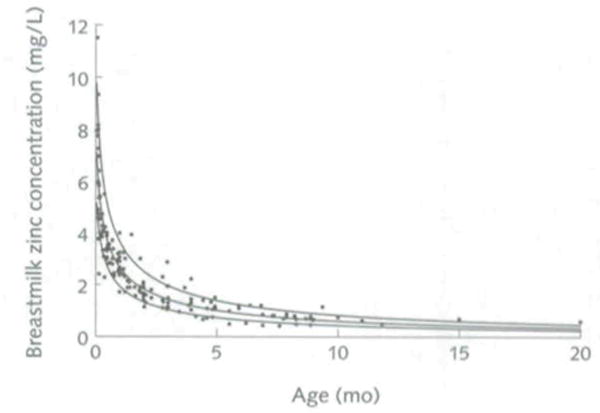
Breastmilk zinc concentration according to time postpartum, all studies. Ln(Zn concentration) = 0.975 −0.501*ln(age) − 0.063* ln (age)2
TABLE 3.
Breastmilk zinc concentration according to child’s agea
| Age group (mo) | No. of observation | Mean ± SD milk zinc concentration (mg/L) |
|---|---|---|
|
| ||
| < 1 | 74 | 4.11 ± 1.50 |
| 1 to 2 | 42 | 1.91 ±0.53 |
| 3 to 5 | 24 | 0.98 ± 0.35 |
| 6 to 11 | 24 | 0.77 ± 0.22 |
| 12 to 21 | 2 | 0.64 ± 0.05 |
Data were extracted from studies presented in table 1. Figures for milk zinc concentration represent weighted means of results from all studies that provided information for respective age ranges.
Amount of milk consumed according to infant age
Information on the amount of milk consumed by children of different ages was extracted from the publication “Complementary feeding of young children in developing countries” by the World Health Organization (WHO) and the United Nations Children’s Fund (UNICEF) [87]. This document provided separate information for exclusively breastfed infants less than 6 months of age and for non-exclusively breastfed children less than 24 months of age, as shown in table 4.
TABLE 4.
Amount of breastmilk transferred from mother to child (g/day) according to child’s age and breastfeeding patterna
| Breastfeeding pattern | Age group (mo)
|
||||
|---|---|---|---|---|---|
| 0–2 | 3–5 | 6–8 | 9–11 | 12–13 | |
|
| |||||
| Exclusive breastfeeding | 714 ± 131 | 784 ± 128 | – | – | – |
| Partial breastfeeding | 644 ± 159 | 706 ± 146 | 674 ± 151 | 616 ± 172 | 549± 187 |
Data from Brown el al. [87], Values represent mean ± SD for children from developing countries.
Total zinc transfer to exclusively breastfed infants less than 6 months of age and relation to zinc requirements
To estimate the total amount of zinc transferred in breastmilk, we completed the following simulation exercise. Breastmilk zinc concentration was assumed to follow a log normal distribution, based on the information described above [28]. Because only sample means and standard deviations were available from the individual studies used to estimate milk zinc concentrations, the means and standard deviations of log(breastmilk zinc concentration) were estimated from the untransformed summary data by using the method of moments [88]. The relationships between infant age and the means and standard deviations of log(breastmilk zinc concentration) and of breastmilk intake were estimated with regression analysis. Finally, we generated 1.000,000 simulated data points, assuming that age was uniformly distributed between 0 and 6 months for exclusively breastfed children and between 0 and 18 months for partially breastfed children, and that log(breastmilk zinc concentration) + log(breastmilk zinc concentration)- and breastmilk volume were normally and independently distributed at each age. We then multiplied individual simulated values for breastmilk intake and milk zinc concentration to estimate total zinc transfer.
The results of the simulations of the total daily amount of zinc transferred in breastmilk according to child age are shown in figure 3 for exclusively breastfed infants less than 6 months of age. The mean amount of zinc transferred in breastmilk declines from ~4 mg/day during the first few days of life to ~1.75 mg/day by 1 month. Breastmilk zinc transfer declines further, albeit more slowly, to ~0.7 mg/day by 6 months. The prediction interval displayed in the figure indicates the ranges of values for daily milk zinc intakes that are likely to occur for children at a particular age. Because the available data do not permit adjustment for day-to-day (intraindividual) variability in milk zinc transfer, the portrayed range overestimates the distribution of children’s usual zinc intakes. Thus, the curves can be used to describe the ranges of daily zinc intakes, but they cannot be used reliably to assess the adequacy of usual zinc intake from breastmilk.
FIG. 3.
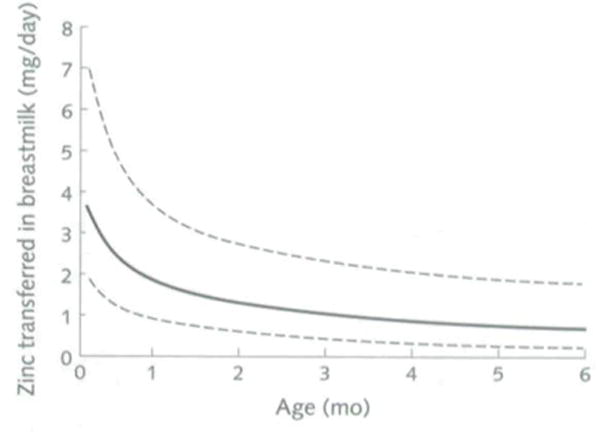
Simulated mean and 95% prediction interval of daily zinc transfer in breastmilk to exclusively breastfed infants according to infant age
Adequacy of breastmilk zinc transfer in relation to the zinc requirements of exclusively breastfed term infants less than 6 months of age
There are two possible theoretical approaches to assess the adequacy of breastmilk as a source of zinc for exclusively breastfed term infants: to compare usual zinc intake and assumed absorption from breastmilk with the physiological requirements for absorbed zinc, or to test for any functional response after providing supplemental zinc to such infants. The former approach is particularly challenging, for several reasons. First, not only is information needed on the usual total amount of breastmilk zinc consumed at each age, but knowledge is also required regarding the absorption of zinc from this food source. Furthermore, the true physiological requirements for absorbed zinc at each age must be known with some degree of certainty. Although information can be compiled on zinc consumption from breastmilk at different ages (as described above), there is less information on individuals’ usual zinc intakes or on zinc absorption from breastmilk. Moreover, because the FAZ varies according to the amount of zinc consumed in a particular meal [89, 90], and the amount of milk (and hence zinc) consumed at a single feeding may be extremely variable, the available information on mean FAZ from breastmilk should be considered a rough approximation, at best, of the true value for an individual child.
Two studies have been published on infant FAZ from breastmilk. One study, which reported results from nine exclusively breastfed infants 2 to 5 months of age who received zinc stable isotope tracers along with six feedings per day, found a mean FAZ of 0.54 (range, 0.40 to 0.68) [46]. Another study of 10 non-exclusively breastfed infants 5 to 7 months of age reported a mean FAZ of 0.50 (range, 0.27 to 0.78) when they were fed a total of 250 mL of expressed breastmilk, along with other foods, over the course of three feedings during an 8- to 12-hour study period [91]. Breastmilk zinc was highly bioavailable under the circumstances of these studies, although the actual study conditions were not necessarily consistent with usual breastfeeding practices, so the ultimate implications of these results remain uncertain. In developing countries, the mean frequency of breastfeeding is often greater than 12 times per day [1,30,32], so the amount consumed per feeding may be less than that provided in the foregoing studies. In that case, the zinc intakes per feeding would be less, and the FAZ might be even greater than was observed. Because of the broad range of FAZ reported from these studies and the uncertainty regarding the true FAZ from different amounts of breastmilk fed during real-life feeding conditions, we applied assumptions for FAZ values ranging from 0.40 to 0.60 to explore the range of zinc that might be absorbed from breastmilk by infants of different ages, according to these assumptions. 1 he results of these exploratory calculations are shown in table 5.
TABLE 5.
Estimated daily zinc intake among exclusively breastfed infants less than 6 months of age and estimated total absorbed zinc at three assumed levels of fractional zinc absorption (EAZ), and relation to estimated physiological requirements for zinc, accordine to infant’s ase
| Age group (mo) | Milk zinc transfer (mg/day) | Amount of absorbed zinc (mg/day), according to assumed FAZ
|
Estimated average physiological requirements for zinc (mg/day)a | ||
|---|---|---|---|---|---|
| FAZ = 0.40 | FAZ = 0.50 | FAZ = 0.60 | |||
|
| |||||
| < 1 | 2.52 | 1.01 | 1.26 | 1.51 | 1.3 |
| 1–2 | 1.37 | 0.55 | 0.68 | 0.82 | 1.3 |
| 3–5 | 0.86 | 0.34 | 0.43 | 0.52 | 0.7 |
Several expert groups have published estimates of the physiological requirements for absorbed zinc. A WHO committee calculated the amount of zinc that must be absorbed each day to replace endogenous losses, based on data extrapolated from adults, and to allow for infant growth, based on estimates of zinc accretion in newly synthesized tissues of growing infants [92]. The WHO committee estimated that the requirements for absorbed zinc derived by this method are 1.3 mg/day during the first 3 months of life and 0.7 mg/day for the period from 3 to 5 months. The Steering Committee of the International Zinc Nutrition Consultative Group (IZiNCG) accepted the WHO recommendations hut further noted that these requirements may he partially offset by hepatic zinc reserves accumulated during gestation [93].
According to the comparisons in table 5, breastmilk alone would provide the WHO/IZiNGG estimated mean requirements [92,93] during the first month of life (without considering the possibility of drawing on hepatic zinc reserves) if the FAZ is greater than 0.50 but would provide less than the mean requirement thereafter. Nevertheless, IZiNCG concluded that breastmilk alone is an adequate source of zinc for approximately 6 months, based on the assumption that some reserves present at birth could be used to meet physiological demands and the fact that supplementation trials have not demonstrated consistent benefits of additional zinc supplementation for exclusively breastfed term infants, as discussed below.
Zinc supplementation trials among breastfed infants less than 6 months of age
Three intervention trials in which breastfed infants less than 6 months of age received either zinc supplements or placebo have been reported from industrialized countries. However, in two of these trials, the period of supplementation lasted until the infants attained 10 to 11 months of age, so the results do not specifically reflect the effect of providing additional zinc to infants less than 6 months of age. In the one trial completed among term infants less than 6 months of age, zinc-supplemented US girls gained 3 g/day more weight than their nonsupplemented counterparts from 4 to 7 months of age, hut there were no significant effects on the linear growth of girls or on the weight or length gains of boys [94]. In another study of US term infants 4 to 10 months of age, there was no effect of zinc supplementation on growth or other functional outcomes among either girls or hoys [95]. Finally, in a study conducted in France among infants 3 to 11 months old, most of whom were African immigrants, the zinc-supplemented hoys had significantly greater weight and length gains after 3 months of supplementation than hoys in the placebo group, but there were no significant effects of supplementation among girls [96]. However, these latter findings are difficult to interpret, because differential dropout rates by treatment group may have confounded the results. Moreover, the infants in this trial were receiving nonqualified amounts of other foods, so it is uncertain whether the groups differed only with regard to zinc supplementation. In summary, the results of these three studies carried out in industrialized countries are inconsistent, and none clearly demonstrates a uniformly positive impact of additional zinc on the growth of infants under 6 months of age. Thus, it seems that breastmilk alone is probably an adequate source of zinc for approximately the first 6 months of life for normal-birthweight, term infants in industrialized settings. We could not locate any relevant information from developing countries that was obtained specifically from exclusively breastfed infants.
Section 2
How much zinc is transferred in breastmilk to infants and young children less than 24 months of age who are consuming breastmilk in addition to complementary foods?
Conclusions
The amount of zinc transferred In breastmilk to partially breastfed infants less than 6 months of age is approximately 15% less than that described above for exclusively breastfed infants, because of the smaller volumes of milk consumed by partially breastfed infants. The age-related pattern of change in milk zinc intakes is similar for both groups of infants. After 6 months of age, breastmilk continues to be an important source of zinc, providing ~0,5 mg/day from 6 to 8 months and ~0.4 to 0.3 mg/day thereafter, a time when the estimated physiological requirements for absorbed zinc range from 0.84 to 0.5 mg/day, depending on age and the source of these estimates.
Detailed review of evidence
Studies of breastmilk zinc transfer to partially breastfed infants less than 24 months of age
Identification of studies and milk zinc concentration by child age
The same process that was described above was used to identify and analyze studies of breastmilk zinc transfer to partially breastfed infants and young children, and the same summary values for milk zinc concentration were used for the specific age intervals, as shown in figure 2.
Amount of milk consumed according to child age
As with the preceding analysis, we extracted information on breastmilk volumes from the WHO/UNICEF publication on complementary feeding [87]. For the present analysis, we selected the age-specific information for partially breastfed infants and young children from developing countries, as summarized in table 4.
Total zinc transfer in breastmilk to partially breastfed children less than 24 months, and relation to requirements
The amount of zinc transferred in breastmilk to partially breastfed children was estimated using the same simulation procedure described above. The analysis had to be limited to children less than 18 months of age because there was only one data point available for milk zinc concentration from children older than 18 months, and the available information on breastmilk volumes provided a single figure for the entire age range from 12 to 23 months. Because the volume of milk consumed by partially breastfed infants less than 6 months is approximately 15% less than the volume consumed by exclusively breastfed infants, the total milk zinc transfer to the former infants is correspondingly less, although the age-related pattern of change is similar, as summarized in figure 4 and table 6. Even after 9 months of age, breastmilk continues to provide an average of ~0.4 mg/day to partially breastfed infants.
FIG. 4.
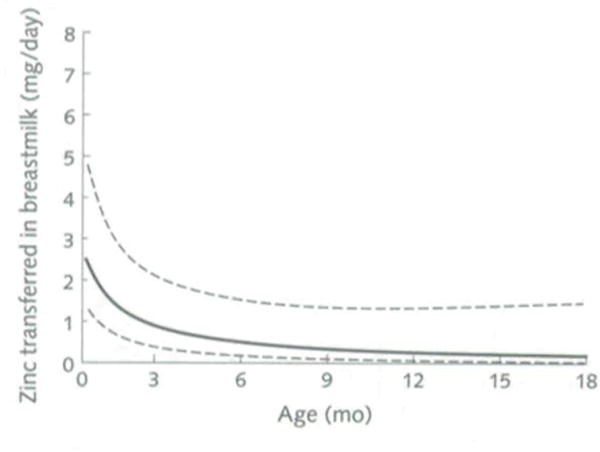
Simulated mean and 95% prediction interval of daily zinc transfer in breastmilk to partially breastfed children according to age
TABLE 6.
Estimated daily zinc intake among partially breastfed children less than 18 months of age and relation to estimated average physiological requirements for zinc, according to child’s age
| Age group (mo) | Milk zinc transfer (mg/day) | Estimated average physiological requirement for zinc (mg/day)a
|
|
|---|---|---|---|
| WHO and IZiNCG | IOM, 2000 | ||
|
| |||
| < 1 | 2.18 ± 1.06 | 1.3 | – |
| 1–2 | 1.18 ±0.56 | 1.3 | – |
| 3–5 | 0.73 ± 0.39 | 0.7 | – |
| 6–8 | 0.51 ±0.33 | 0.8 | 0.84 |
| 9–11 | 0.39 ±0.31 | 0.8 | 0.84 |
| 12–17 | 0.29 ±0.31 | 0.8/0.5 | 0.74 |
WHO and IZiNCG provided similar estimates for children < 12 months of age, although IZiNCG assumed that breastmilk was adequate for exclusively breastfed infants < 6 months of age, so the estimates in the table refer to non-exclusively breastfed infants [92,93]. At 12 to 17 months of age, the two estimates provided by WHO and IZiNCG differ. The US Institute of Medicine (IOM) does not provide estimates of physiological requirements for zinc for children < 7 months of age [97].
Assessment of the adequacy of breastmilk zinc transfer in relation to theoretical requirements is even more problematic for partially breastfed children than for those who are exclusively breastfed. Because partially breastfed children are consuming other foods in addition to breastmilk, these other foods may contribute additional zinc and they may affect zinc absorption from breastmilk [98]. Thus, we have not attempted to assess the adequacy of breastmilk zinc transfer at different ages, and we simply present the mean amount of milk zinc that is transferred to demonstrate the potential contribution that breastmilk might provide in relation to these requirements. Clearly, breastmilk provides a potentially important proportion of the daily zinc requirement, even among partially breastfed children in the second year of life.
Section 3
What are the programmatic implications of the answers to the foregoing questions, and what are the remaining research needs?
The foregoing analyses indicate that breastmilk seems to provide an adequate amount of zinc to exclusively breastfed term infants less than 6 months of age. Breastmilk continues to be an important source of zinc for partially breastfed infants well into the second year of life. Thus, breastfeeding should be promoted and supported as an intervention that contributes to the prevention of zinc deficiency. WHO currently recommends that “infants should be exclusively breastfed during the first 6 months of life. Thereafter they should receive nutritionally adequate and safe complementary foods while breastfeeding continues up to 2 years of age and beyond” [99]. Thus, these infant and young child feeding recommendations are consistent with the current conclusion that breastfeeding should be promoted as an important dietary source of highly bioavailable zinc.
Information is available on how best to promote and support appropriate breastfeeding behaviors [100], and a detailed discussion of these issues is beyond the scope of the present review. Briefly, attention must be devoted to advocacy, policy formulation, health curriculum reform and in-service training of health service personnel, and the development of suitable community-based organizations to provide information, counseling, personal support, and referral when necessary [101].
Additional research is needed on the zinc requirements of infants and young children and the bioavailability of zinc from breastmilk when fed in usual amounts, either alone or with other foods. This information is needed to help determine both the period for which breastmilk alone is an adequate source of zinc and how much additional zinc is needed from complementary foods. Information is also needed on the period of adequacy of breastmilk for providing zinc to low-birthweight infants. Finally, different approaches for promoting optimal breastfeeding behaviors require further evaluation in the context of large-scale programmatic interventions.
Contributor Information
Kenneth H. Brown, Department of Nutrition and the Program in International and Community Nutrition, University of California, Davis, California, USA Helen Keller International, Dakar, Senegal.
Reina Engle-Stone, Department of Nutrition and the Program in International and Community Nutrition, University of California, Davis, California, USA.
Nancy F. Krebs, Department of Pediatrics, University of Colorado School of Medicine, Denver, Colorado, USA
Janet M. Peerson, Department of Nutrition and the Program in International and Community Nutrition, University of California, Davis, California, USA
References
- 1.Brown KH, Black RE, López de Romaña G, de Kanashiro HC. Infant-feeding practices and their relationship with diarrheal and other diseases in Huascar (Lima) Peru. Pediatrics. 1989;83:31–40. [PubMed] [Google Scholar]
- 2.Popkin BM, Adair L, Akin JS, Black R, Briscoe I, Flieger W. Breast-feeding and diarrheal morbidity. Pediatrics. 1990;86:874–82. [PubMed] [Google Scholar]
- 3.Bahl R, Frost C, Kirkwood BR, Edmond K, Martines J, Bhandari N, Arthur P. Infant feeding patterns and risks of death and hospitalization in the first half of infancy: Multicentre cohort study. Bull World Health Organ. 2005;83:418–26. [PMC free article] [PubMed] [Google Scholar]
- 4.Castillo-Duran C, Vial P, Uauy R. Trace mineral balance during acute diarrhea in infants. J Pediatr. 1988;113:452–7. doi: 10.1016/s0022-3476(88)80627-9. [DOI] [PubMed] [Google Scholar]
- 5.Krebs NF, Hambidge KM, Jacobs MA, Mylet S. Zinc in human milk: Diurnal and within-feed patterns. J Pediatr Gastroenterol Nutr. 1985;4:227–9. doi: 10.1097/00005176-198504000-00012. [DOI] [PubMed] [Google Scholar]
- 6.Rajalakshmi K, Srikantia SG. Copper, zinc, and magnesiun) content of breast milk of Indian women. Am I Glin Nutr. 1980;33:664–9. doi: 10.1093/ajcn/33.3.664. [DOI] [PubMed] [Google Scholar]
- 7.Feeley RM, Eitenmiller RR, Iones JB, Jr, Barnhart H. Copper, iron, and zinc contents of human milk at early stages of lactation. Am J Clin Nutr. 1983;37:443–8. doi: 10.1093/ajcn/37.3.443. [DOI] [PubMed] [Google Scholar]
- 8.Kirksey A, Ernst JA, Roepke JL, Tsai TL. Influence of mineral intake and use of oral contraceptives before pregnancy on the mineral content of human colostrum and of more mature milk. Am J Clin Nutr. 1979;32:30–9. doi: 10.1093/ajcn/32.1.30. [DOI] [PubMed] [Google Scholar]
- 9.Hussain M, Sikder ZU, Wahed MA, Haque AT, Jahan F. Zinc concentration of breast milk and its diurnal variation in Bangladeshi mothers. Bangladesh Med Res Counc Bull. 1996;22:70–3. [PubMed] [Google Scholar]
- 10.Picciano MF, Guthrie HA. Copper, iron, and zinc contents of mature human milk. Am J Clin Nutr. 1976;29:242–54. doi: 10.1093/ajcn/29.3.242. [DOI] [PubMed] [Google Scholar]
- 11.Karra MV, Kirksey A. Variation in zinc, calcium, and magnesium concentrations of human milk within a 24-hour period from 1 to 6 months of lactation. J Pediatr Gastroenterol Nutr. 1988;7:100–6. doi: 10.1097/00005176-198801000-00019. [DOI] [PubMed] [Google Scholar]
- 12.Neville MC, Keller RP, Seacat J, Casey GE, Allen JC, Archer P. Studies on human lactation. I. Within-feed and between breast variation in selected components of human milk. Am J Clin Nutr. 1984;40:635–46. doi: 10.1093/ajcn/40.3.635. [DOI] [PubMed] [Google Scholar]
- 13.Ustundag B, Yilmaz E, Dogan Y, Akarsu S, Canatan H, Halifeoglu I, Cikim G, Aygun AD. Levels of cytokines (IL-1beta, IL-2, IL-6, IL-8, TNF-alpha) and trace elements (Zn,Gu) in breast milk from mothers of preterm and term infants. Mediators Inflamm. 2005;6:331–6. doi: 10.1155/MI.2005.331. [DOI] [PMC free article] [PubMed] [Google Scholar]
- 14.Ronayne de Ferrer PA, Weix-istaub A, López N, Ceriani Cernadas JM. Zinc levels in term and preterm milk. Arch Latinoam Nutr. 2001;51:33–6. [PubMed] [Google Scholar]
- 15.Trugo NM, Donangelo CM, Koury JC, Silva MI, Freitas LA. Concentration and distribution pattern of selected micronutrients in preterm and term milk from urban Brazilian mothers during early lactation. Eur J Clin Nutr. 1988;42:497–507. [PubMed] [Google Scholar]
- 16.Hemalatha P, Bhaskaram P, Kumar PA, Khan MM, Islam MA. Zinc status of breastfed and formula-fed infants of different gestational ages. J Trop Pediatr. 1997;43:52–4. doi: 10.1093/tropej/43.1.52. [DOI] [PubMed] [Google Scholar]
- 17.Butte NF, Garza C, Johnson CA, Smith EO, Nichols BL. Longitudinal changes in milk composition of mothers delivering preterm and term infants. Early Hum Dev. 1984;9:153–62. doi: 10.1016/0378-3782(84)90096-3. [DOI] [PubMed] [Google Scholar]
- 18.Mendelson RA, Anderson GH, Bryan MH. Zinc, copper and iron content of milk from mothers of preterm and full-term infants. Early Hum Dev. 1982;6:145–5l. doi: 10.1016/0378-3782(82)90101-3. [DOI] [PubMed] [Google Scholar]
- 19.Sharda B, Adhikari R, Ajmera M, Gambhir R, Singh PP. Zinc and copper in preterm neonates: Relationship with breast milk. Indian J Pediatr. 1999;66:685–95. doi: 10.1007/BF02726255. [DOI] [PubMed] [Google Scholar]
- 20.Friel JK, Andrews WL, Jackson SE, Longerich HP, Mercer C, McDonald A, Dawson B, Sutradhar B. Elemental composition of human milk from mothers of premature and full-term infants during the first 3 months of lactation. Biol Trace Elem Res. 1999;67:70–7. doi: 10.1007/BF02784423. [DOI] [PubMed] [Google Scholar]
- 21.da Gosta RS, do Carmo MG, Saunders C, de Jesus EF, Lopes RT, Simabuco SM. Characterization of iron, copper and zinc levels in the colostrum of mothers of term and pre term infants before and after pasteurization. Int J Food Sci Nutr. 2003;54:l 11–7. doi: 10.1080/0963748031000084052. [DOI] [PubMed] [Google Scholar]
- 22.Perrone L, Di Palma L, Di Toro R, Gialanella G, Moro R. Trace element content of human milk during lactation. J Trace Elem Electrolytes Health Dis. 1993;7:245–7. [PubMed] [Google Scholar]
- 23.Higashi A, Ikeda T, Uehara I, Matsuda I. Zinc and copper contents in breast milk of Japanese women. Tohoku J Exp Med. 1982;137:41–7. doi: 10.1620/tjem.137.41. [DOI] [PubMed] [Google Scholar]
- 24.Frković A, Medugorac B, Alebić -Juretić A. Zinc levels in human milk and umbilical cord blood. Sci Total Environ. 1996;192:207–12. doi: 10.1016/s0048-9697(96)05319-3. [DOI] [PubMed] [Google Scholar]
- 25.Salmenperä L, Perheentupa J, Nanto V, Siimes MA. Low zinc intake during exclusive breast-feeding does not impair growth. J Pediatr Gastroenterol Nutr. 1994;18:361–70. doi: 10.1097/00005176-199404000-00019. [DOI] [PubMed] [Google Scholar]
- 26.Chierici R, Saccomandi D, Vigi V. Dietary supplements for the lactating mother: Influence on the trace element content of milk. Acta Paediatr Suppl. 1999;88:7–13. doi: 10.1111/j.1651-2227.1999.tb01294.x. [DOI] [PubMed] [Google Scholar]
- 27.Hess SY, King JC. Effects of maternal zinc supplementation on pregnancy and lactation outcomes. Food Nutr Bull. 2009;30:S60–78. doi: 10.1177/15648265090301S105. [DOI] [PubMed] [Google Scholar]
- 28.Krebs NF, Reidinger CJ, Hartley S, Robertson AD, Hambidge KM. Zinc supplementation during lactation: Effects on maternal status and milk zinc concentrations. Am J Clin Nutr. 1995;61:1030–6. doi: 10.1093/ajcn/61.4.1030. [DOI] [PubMed] [Google Scholar]
- 29.Islam MM, Khatun M, Peerson JM, Ahmed T, Mollah MA, Dewey KG, Brown KH. Effects of energy density and feeding frequency of complementary foods on total daily energy intakes and consumption of breast milk by healthy breastfed Bangladeshi children. Am J Clin Nutr. 2008;88:84–94. doi: 10.1093/ajcn/88.1.84. [DOI] [PubMed] [Google Scholar]
- 30.Brown KH, Black RE, Becker S, Nahar S, Sawyer J. Consumption of foods and nutrients by weanlings in Bangladesh. Am J Clin Nutr. 1982;36:878–89. doi: 10.1093/ajcn/36.5.878. [DOI] [PubMed] [Google Scholar]
- 31.Brown KH, Stallings RY, de Kanashiro HC, López de Romaña G, Black RE. Effects of common illnesses on infants’ energy intakes from breast milk and other foods during longitudinal community-based studies in Huascar (Lima), Peru. Am J Clin Nutr. 1990;52:1005–13. doi: 10.1093/ajcn/52.6.1005. [DOI] [PubMed] [Google Scholar]
- 32.Kimmons JE, Dewey KG, Haque E, Chakraborty J, Osendarp SJ, Brown KH. Low nutrient intakes among infants in rural Bangladesh are attributable to low intake and micronutrient density of complementary foods. J Nutr. 2005;135:444–51. doi: 10.1093/jn/135.3.444. [DOI] [PubMed] [Google Scholar]
- 33.Brown KH, López de Romaña D, Arsenault JE, Peerson JM, Penny ME. Comparison of the effects of zinc delivered in a fortified food or a liquid supplement on the growth, morbidity, and plasma zinc concentrations of young Peruvian children. Am J Clin Nutr. 2007;85:538–47. doi: 10.1093/ajcn/85.2.538. [DOI] [PubMed] [Google Scholar]
- 34.Begin F, Santizo MC, Peerson JM, Torún B, Brown KH. Effects of bovine serum concentrate, with or without supplemental micronutrients, on the growth, morbidity, and micronutrient status of young children in a low-income, peri-urban Guatemalan community. Eur J Clin Nutr. 2007;62:39–50. doi: 10.1038/sj.ejcn.1602682. [DOI] [PubMed] [Google Scholar]
- 35.US Institute of Medicine. Nutrition during lactation. Washington, DC: National Academy Press; 1991. [Google Scholar]
- 36.Atinmo T, Omololu A. Trace element content of breastmilk from mothers of preterm infants in Nigeria. Early Hum Dev. 1982;6:309–13. doi: 10.1016/0378-3782(82)90125-6. [DOI] [PubMed] [Google Scholar]
- 37.Butte NF, Garza C, Smith EO, Wills C, Nichols BL. Macro- and trace-mineral intakes of exclusively breast-fed infants. Am J Clin Nutr. 1987;45:42–8. doi: 10.1093/ajcn/45.1.42. [DOI] [PubMed] [Google Scholar]
- 38.Casey CE, Hambidge KM, Neville MC. Studies in human lactation: Zinc, copper, manganese and chromium in human milk in the first month of lactation. Am J Clin Nutr. 1985;41:1193–200. doi: 10.1093/ajcn/41.6.1193. [DOI] [PubMed] [Google Scholar]
- 39.Casey CE, Neville MC, Hambidge KM. Studies in human lactation: Secretion of zinc, copper, and manganese in human milk. Am J Clin Nutr. 1989;49:773–85. doi: 10.1093/ajcn/49.5.773. [DOI] [PubMed] [Google Scholar]
- 40.Dömellof M, Lönnerdal B, Dewey KG, Cohen RJ, Hernell O. Iron, zinc, and copper concentrations in breast milk are independent of maternal mineral status. Am J Clin Nutr. 2004;79:111–5. doi: 10.1093/ajcn/79.1.111. [DOI] [PubMed] [Google Scholar]
- 41.Donangelo CM, Trugo NM, Koury JC, Barreto Silva MI, Freitas LA, Feldheim W, Barth C. Iron zinc, folate and vitamin B12 nutritional status and milk composition of low-income Brazilian mothers. Eur J Ctin Nutr. 1989;43:253–66. [PubMed] [Google Scholar]
- 42.Friel JK, Andrews WL, Jackson SE, Longerich HP, Mercer C, McDonald A, Dawson B, Sutradhar B. Elemental composition of human milk from mothers of premature and full-term infants during the first 3 months of lactation. Biol Trace Elem Res. 1999;67:225–47. doi: 10.1007/BF02784423. [DOI] [PubMed] [Google Scholar]
- 43.Garza C, Johnson CA, Smith EO, Nichols BL. Changes in the nutrient composition of human milk during gradual weaning. Am J Clin Nutr. 1983;37:61–5. doi: 10.1093/ajcn/37.1.61. [DOI] [PubMed] [Google Scholar]
- 44.Hibberd CM, Brooke OG, Carter ND, Haug M, Harzer G. Variation in the composition of breast milk during the first 5 weeks of lactation: Implications for the feeding of preterm infants. Arch Dis Child. 1982;57:658–62. doi: 10.1136/adc.57.9.658. [DOI] [PMC free article] [PubMed] [Google Scholar]
- 45.Krebs NF, Hambidge KM, Jacobs MA, Rasbach JO. The effects of a dietary zinc supplement during lactation on longitudinal changes in maternal zinc status and milk zinc concentrations. Am J Clin Nutr. 1985;41:560–70. doi: 10.1093/ajcn/41.3.560. [DOI] [PubMed] [Google Scholar]
- 46.Krebs NF, Reidinger CJ, Miller LV, Hambidge KM. Zinc homeostasis in breast-fed infants. Pediatr Res. 1996;39:661–5. doi: 10.1203/00006450-199604000-00017. [DOI] [PubMed] [Google Scholar]
- 47.Hambidge KM, Krebs NF, Jacobs MA, Favier A, Guyette L, Ikle DN. Zinc nutritional status during pregnancy: A longitudinal study. Am J Clin Nutr. 1983;37:429–42. doi: 10.1093/ajcn/37.3.429. [DOI] [PubMed] [Google Scholar]
- 48.Krebs NF, Reidinger CJ, Robertson AD, Hambidge KM. Growth and intakes of energy and zinc in infants fed buman milk. J Pediatr. 1994;124:32–9. doi: 10.1016/s0022-3476(94)70251-9. [DOI] [PubMed] [Google Scholar]
- 49.Leotsinidis M, Alexopoulos A, Kostopoulou-Farri E. Toxic and essential trace elements in human milk from Greek lactating women: Association with dietary habits and other factors. Chemosphere. 2005;61:238–47. doi: 10.1016/j.chemosphere.2005.01.084. [DOI] [PubMed] [Google Scholar]
- 50.Mbofung CM, Atinmo T, Omolulu A. Mineral content of colostrum and mature milk of lactating Nigerian women as influenced by stage of lactation. Nutr Rep Int. 1984;30:1137–46. [PubMed] [Google Scholar]
- 51.Moser PB, Reynolds RD. Dietary zinc intake and zinc concentrations of plasma, erythrocytes, and breast milk in antepartum and postpartum lactating and nonlactating women: A longitudinal study. Am J Clin Nutr. 1983;38:101–8. doi: 10.1093/ajcn/38.1.101. [DOI] [PubMed] [Google Scholar]
- 52.Ortega RM, Andrés P, Martinez RM, López-Sobaler AM, Quintas ME. Zinc levels in maternal milk: The influence of nutritional status with respect to zinc during the third trimester of pregnancy. Eur J Clin Nutr. 1997;51:253–8. doi: 10.1038/sj.ejcn.1600393. [DOI] [PubMed] [Google Scholar]
- 53.Robberecht H, Benemariya H, Deelstra H. Daily dietary intake of copper, zinc, and selenium of exclusively breast-fed infants of middle-class women in Burundi, Africa. Biol Trace Elem Res. 1995;49:151–9. doi: 10.1007/BF02788964. [DOI] [PubMed] [Google Scholar]
- 54.Benemariya H, Robberecht H, Deelstra H. Daily dietary intake of copper, zinc and selenium by different population groups in Burundi, Africa. Sci Total Environ. 1993;136:49–76. doi: 10.1016/0048-9697(93)90297-j. [DOI] [PubMed] [Google Scholar]
- 55.Sievers E, Oldigs HD, Dörner K, Schaub J. Longitudinal zinc balances in breast-fed and formula-fed infants. Acta Paediatr. 1992;81:1–6. doi: 10.1111/j.1651-2227.1992.tb12068.x. [DOI] [PubMed] [Google Scholar]
- 56.Silvestre D, Martinez-Costa C, Lagarda MJ, Brines J, Farré R, Clemente G. Copper, iron, and zinc contents in human milk during the first three months of lactation: A longitudinal study. Biol Trace Elem Res. 2001;80:1–11. doi: 10.1385/BTER:80:1:01. [DOI] [PubMed] [Google Scholar]
- 57.Vuori E. Intake of copper, iron, manganese and zinc by healthy, exclusively-breast-fed infants during the first 3 months of life. Br J Nutr. 1979;42:407–11. doi: 10.1079/bjn19790131. [DOI] [PubMed] [Google Scholar]
- 58.Vuori E, Kultunen P. The concentrations of copper and zinc in human milk. A longitudinal study. Acta Paediatr Scand. 1979;68:33–7. doi: 10.1111/j.1651-2227.1979.tb04426.x. [DOI] [PubMed] [Google Scholar]
- 59.Vaughan LA, Weber CW, Kemberling SR. Longitudinal changes in the mineral content of human milk. Am J Clin Nutr. 1979;32:2301–6. doi: 10.1093/ajcn/32.11.2301. [DOI] [PubMed] [Google Scholar]
- 60.Xiang M, Harbige LS, Zetterström R. Breast milk levels of zinc and omega-6 polyunsaturated fatty acids and growth of healthy Chinese infants. Acta Paediatr. 2007;96:387–90. doi: 10.1111/j.1651-2227.2006.00140.x. [DOI] [PubMed] [Google Scholar]
- 61.Yamawaki N, Yamada M, Kan-no T, Kojima T, Kaneko T, Yonekubo A. Macronutrient, mineral and trace element composition of breast milk from Japanese women. J Trace Elem Med Biol. 2005;19:171–81. doi: 10.1016/j.jtemb.2005.05.001. [DOI] [PubMed] [Google Scholar]
- 62.Al-Awadi FM, Srikuntar TS. Trace-element status in milk and plasma of Kuwaiti and non-Kuwaiti lactating mothers. Nutrition. 2000;16:1069–73. doi: 10.1016/s0899-9007(00)00426-3. [DOI] [PubMed] [Google Scholar]
- 63.Bates CJ, Tsuchiya H. Zinc in breast milk during prolonged lactation: Comparison between the UK and the Gambia. Eur J Clin Nutr. 1990;44:61–9. [PubMed] [Google Scholar]
- 64.Dewey KG, Finley DA, Lönnerdal B. Breast milk volume and composition during late lactation (7–20 months) J Pediatr Gastroenterol Nutr. 1984;3:713–20. doi: 10.1097/00005176-198411000-00014. [DOI] [PubMed] [Google Scholar]
- 65.Dhonukshe-Rutten RA, Vossenaar M, West CE, Schuniann K, Bulux J, Solomons NW. Day-to-day variations in iron, zinc and copper in breast milk of Guatemalan mothers. J Pediatr Gastroenterol Nutr. 2005;40:128–34. doi: 10.1097/00005176-200502000-00009. discussion 0–1. [DOI] [PubMed] [Google Scholar]
- 66.Dorea JG, Horner MR, Bezerra VLVA, Campanate ML. Longitudinal study of major milk constituents from two different socioeconomic groups of mothers in Brazil. Nutr Rep Intern. 1984;29:699–710. [Google Scholar]
- 67.Dorea JG, Horner MR, Campanate ML. Lacteal zinc and copper in relation to volume, total ash and energy during the first three months of lactation of Brazilian women. Acta Paediatr Scand. 1985;74:891–6. doi: 10.1111/j.1651-2227.1985.tb10054.x. [DOI] [PubMed] [Google Scholar]
- 68.Gross R, Hänsel H, Schultink W, Shrimpton R, Matulessi P, Gross G, Tagliaferri E, Sastroamdijojo S. Moderate zinc and vitamin A deficiency in breast milk of mothers from East-Jakarta. Eur J Clin Nutr. 1998;52:884–90. doi: 10.1038/sj.ejcn.1600660. [DOI] [PubMed] [Google Scholar]
- 69.Honda R, Tawara K, Nishijo M, Nakagawa H, Tanebe K, Saito S. Cadmium exposure and trace elements in human breast milk. Toxicology. 2003;186:255–9. doi: 10.1016/s0300-483x(03)00002-7. [DOI] [PubMed] [Google Scholar]
- 70.Lauber E, Reinhardt M. Studies on the quality of breast milk during 23 months of lactation in a rural community of the Ivory Coast. Am J Clin Nutr. 1979;32:1159–73. doi: 10.1093/ajcn/32.5.1159. [DOI] [PubMed] [Google Scholar]
- 71.Lehti KK. Iron, folic acid and zinc intakes and status of low socio economic pregnant and lactating Amazonian women. Eur J Clin Nutr. 1989;43:505–13. [PubMed] [Google Scholar]
- 72.Lehti KK. Breast milk folic acid and zinc concentrations of lactating, low socioeconomic, Amazonian women and the effect of age and parity on the same two nutrients. Eur J Clin Nutr. 1990;44:675–80. [PubMed] [Google Scholar]
- 73.Melnikov P, da Cruz Montes Moura AJ, Batista Palhares DB, Martimbianco de Figueiredo CS. Zinc and copper in colostrum. Indian Pediatr. 2007;44:355–7. [PubMed] [Google Scholar]
- 74.Moser PB, Reynolds RD, Acharya S, Howard MP, Andon MB, Lewis SA. Copper, iron, zinc, and selenium dietary intake and status of Nepalese lactating women and their breast-fed infants. Am J Gin Nutr. 1988;47:729–34. doi: 10.1093/ajcn/47.4.729. [DOI] [PubMed] [Google Scholar]
- 75.Moser-Veillon PB, Reynolds RD. A longitudinal study of pyridoxine and zinc supplementation of lactating women. Am J Clin Nutr. 1990;52:135–41. doi: 10.1093/ajcn/52.1.135. [DOI] [PubMed] [Google Scholar]
- 76.Okolo SN, Onwuanaku C, Okonji M, VanderJagt DJ, Millson M, Churchwell C, Glew RH. Concentration of eight trace minerals in milk and sera of mother-infant pairs in northern Nigeria. J Trop Pediatr. 2000;46:160–2. doi: 10.1093/tropej/46.3.160. [DOI] [PubMed] [Google Scholar]
- 77.Onyango AW, Receveur O, Esrey SA. The contribution of breast milk to toddler diets in western Kenya. Bull World Health Organ. 2002;80:292–9. [PMC free article] [PubMed] [Google Scholar]
- 78.Perrone L, Di Palma L, Di Toro R, Gialanella G, Moro R. Interaction of trace elements in a longitudinal study of human milk from full-term and preterm mothers. Biol Trace Elem Res. 1994;41:321–30. doi: 10.1007/BF02917432. [DOI] [PubMed] [Google Scholar]
- 79.Rakicioğlu N, Samur G, Topçu A, Topçu A. The effect of Ramadan on maternal nutrition and composition of breast milk. Pediatr Int. 2006;48:278–83. doi: 10.1111/j.1442-200X.2006.02204.x. [DOI] [PubMed] [Google Scholar]
- 80.Richmond J, Strehlow CD, Chalkley SR. Dietary intake of Al, Ca, Cu, Fe, Pb, and Zn in infants. Br J Biomed Sci. 1993;50:178–86. [PubMed] [Google Scholar]
- 81.Sian L, Krebs NF, Westcott JE, Fengliang L, Tong L, Miller LV, Sonko B, Hambidge M. Zinc homeostasis during lactation in a population with a low zinc intake. Am J Clin Nutr. 2002;75:99–103. doi: 10.1093/ajcn/75.1.99. [DOI] [PubMed] [Google Scholar]
- 82.Simmer K, Ahmed S, Carlsson L, Thompson RP. Breast milk zinc and copper concentrations in Bangladesh. Br J Nutr. 1990;63:91–6. doi: 10.1079/bjn19900094. [DOI] [PubMed] [Google Scholar]
- 83.Umeta M, West CE, Verhoef H, Haidar J, Hautvast JG. Factors associated with stunting in infants aged 5–11 months in the Dodota-Sire District, rural Ethiopia. J Nutr. 2003;133:1064–9. doi: 10.1093/jn/133.4.1064. [DOI] [PubMed] [Google Scholar]
- 84.Vuori E, Mäkinen SM, Kara R, Kuitunen P. The effects of the dietary intakes of copper, iron, manganese, and zinc on the trace element content of human milk. Am J Clin Nutr. 1980;33:227–31. doi: 10.1093/ajcn/33.2.227. [DOI] [PubMed] [Google Scholar]
- 85.Finley DA, Lonnerdal B, Dewey KG, Grivetti LE. Inorganic constituents of breast milk from vegetarian and nonvegetarian women: Relationships with each other and with organic constituents. J Nutr. 1985;115:772–81. doi: 10.1093/jn/115.6.772. [DOI] [PubMed] [Google Scholar]
- 86.Zimmerman AW, Hambidge KM, Loepow ML, Greenberg RD, Stover ML, Casey CE. Acrodermatitis in breast-fed premature infants: Evidence for a defect of mammary zinc secretion. Pediatrics. 1982;69:176–83. [PubMed] [Google Scholar]
- 87.Brown KH, Dewey KG, Alien LH. Complementary feeding of young children in developing countries: A review of current scientific knowledge. Geneva: World Health Organization; 1998. [Google Scholar]
- 88.De Groot MH. Probability and statistics. Reading, Mass, USA: Addison-Wesley; 1975. [Google Scholar]
- 89.Sandström B, Cederblad Å, Lönnerdal B. Zinc absorption from human milk, cow’s milk, and infant formulas. Am J Dis Child. 1983;137:726–9. doi: 10.1001/archpedi.1983.02140340010002. [DOI] [PubMed] [Google Scholar]
- 90.López de Romaña D, Salazar M, Hambidge KM, Penny ME, Peerson JM, Krebs NF, Brown KH. Longitudinal measurements of zinc absorption in Peruvian children consuming wheat products fortified with iron only or iron and 1 of 2 amounts of zinc. Am J Clin Nutr. 2005;81:637–47. doi: 10.1093/ajcn/81.3.637. [DOI] [PubMed] [Google Scholar]
- 91.Abrams SA, Wen J, Stuff JE. Absorption of calcium, zinc, and iron from breast milk by five- to seven-month-old infants. Pediatr Res. 1997;41:384–90. doi: 10.1203/00006450-199703000-00014. [DOI] [PubMed] [Google Scholar]
- 92.World Health Organization/Food and Agriculture Organization/International Atomic Energy Agency. Trace elements in human health and nutrition. Geneva: WHO; 1996. [Google Scholar]
- 93.International Zinc Nutrition Consultative Group (IZiNCG) Brown KH, Rivera JA, Bhulta Z, Gibson RS, King JC, Lönnerdal B, Ruel MT, Sandtröm B, Wasantwisut E, Hotz C. Assessment of the risk of zinc deficiency in populations and options for its control. Food Nutr Bull. 2004;25(1 suppl 2):S99–203. [PubMed] [Google Scholar]
- 94.Krebs NF, Westcott JE, Butler-Simon N, Hambidge KM. Effects of a zinc supplement on growth of normal breast-fed infants. FASEB J. 1996;10:1324. [Google Scholar]
- 95.Heinig MJ, Brown KH, Lönnerdal B, Dewey KG. Zinc supplementation does not affect growth, morbidity, or motor development of US term breastfed infants at 4–10 mo of age. Am J Clin Nutr. 2006;84:594–601. doi: 10.1093/ajcn/84.3.594. [DOI] [PubMed] [Google Scholar]
- 96.Walravens PA, Chakar A, Mokni R, Denise J, Lemonnier D. Zinc supplements in breastfed infants. Lancet. 1992;340:683–5. doi: 10.1016/0140-6736(92)92229-9. [DOI] [PubMed] [Google Scholar]
- 97.US Institute of Medicine. Dietary reference intakes for vitamin A, vitamin K, boron, chromium, copper, iodine, iron, manganese, molybdenum, nickel, silicon, vanadium, and zinc. Washington, DC: National Academy Press; 2000. Zinc; pp. 442–501. [Google Scholar]
- 98.Jalla S, Westcott J, Steirn M, Miller LV, Bell M, Krebs NF. Zinc absorption and exchangeable zinc pool sizes in breast-fed infants fed meat or cereal as first complementary food. J Pediatr Gastroenterol Nutr. 2002;34:35–41. doi: 10.1097/00005176-200201000-00009. [DOI] [PubMed] [Google Scholar]
- 99.UNICEF/World Health Organization. Global strategy for infant and young child feeding. Geneva: WHO; 2003. [Google Scholar]
- 100.World Health Organization. Community-based strategies for breastfeeding promotion and support in developing countries. Geneva: WHO; 2003. [Google Scholar]
- 101.Wellstart International. Community-based breastfeeding support: a planning manual. Washington, DC: 1996. [Google Scholar]