


Figure 5. Relationships between PTSD symptoms and neuropsychological performance and functional connectivity with the rostral ACC and medial PFC regions of interest.
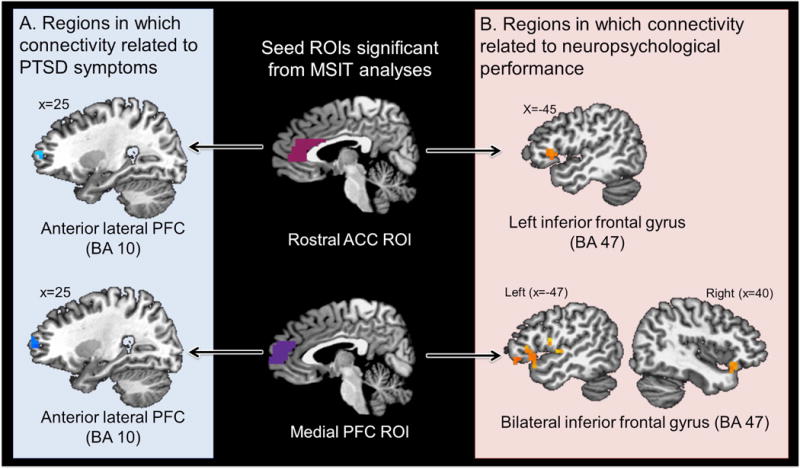
(A) Worse PTSD symptoms related to decreased functional connectivity between the medial PFC ROI and a cluster within the right anterior lateral PFC (BA 10; 640 mm3; x,y,z = 31,56,9; t = −2.539), as well as between the rostral ACC ROI and a similar right anterior lateral frontal cluster (BA 10; 320 mm3; x,y,z = 27,57,11; t = −3.71). (B) Worse neuropsychological performance related to reduced functional connectivity between the medial PFC ROI and bilateral inferior frontal gyrus (left BA 47; 1728 mm3; x,y,z = −47,18,−7; t = −2.67; right BA 47; 1280 mm3; x,y,z = 35,19,−10; t = −2.83) and other regions not pictured (e.g., insula, temporal lobe, and cerebellum) as well as reduced functional connectivity between the rostral ACC ROI and left inferior frontal gyrus (BA 47; 1216 mm3; x,y,z = −46,19,8; t = −2.540).