


Figure 2.
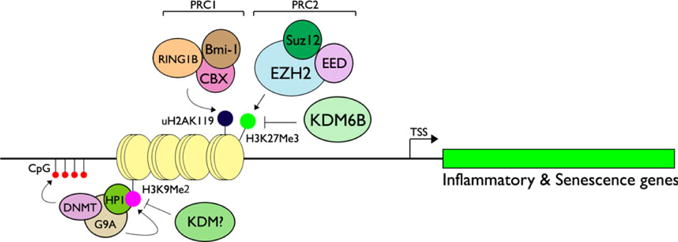
KDMs and KMTs regulating inflammatory and senescence genes through epigenetic modifications. PRC2 subunit EZH2, a KMT specific for H3K27, triggers K27Me3, which is recognized by CBX subunit of PRC1, which also contains Bmi-1 and RING1B. These protein subunits of PRC1 demonstrate E3 ubiquitin ligase activity for H2AK119, causing monoubiquitination, which then inhibits Pol II elongation (Li et al, 2006; Zhou et al, 2008). During inflammatory signaling or senescence, KDM6B is induced and demethylates H3K27Me3 and suppresses PcG-mediated gene silencing. Inflammatory cytokines are also regulated through G9a, a KMT specific for H3K9Me2 that recruits HP1 and Dnmt3a/b, resulting in hypermethylation of CpG islands (Han et al, 2016). During inflammation, demethylation of H3K9Me2 has been found strongly associated with RNA Pol II recruitment to the pro-inflammatory cytokines (Saccani and Natoli, 2002), although the corresponding KDM is yet to be identified.