


Figure 13.
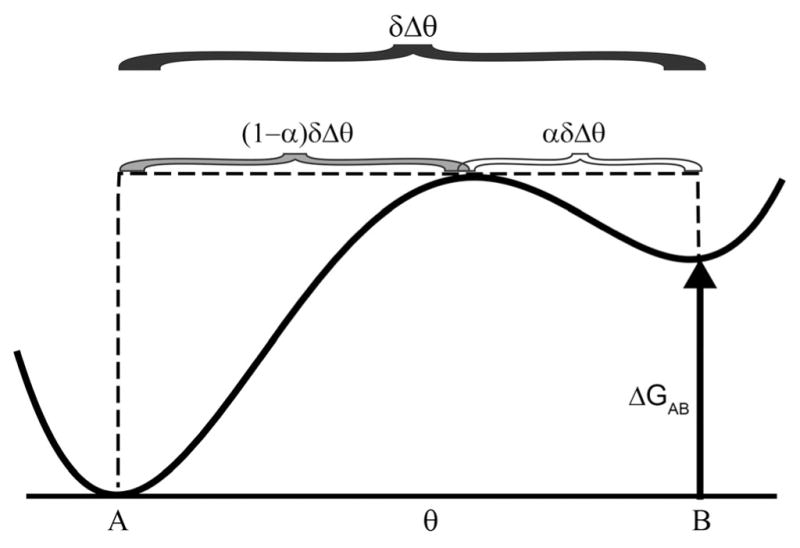
Anatomy of a “power stroke”. In clockwise cycling, the motor moves through the transition B → A. Seemingly, the energy ΔGAB provides the power for the power stroke and according to Howard[82] allows the motor to do work against an applied force or applied torque provided ΔGAB Xθ, with a maximum efficiency[51] of ηmax = ΔGAB/Xξ. This analysis is correct for an optically driven machine, but is totally wrong for a chemically driven motor. In the thermodynamic control limit, irrespective of whether ΔGAB is positive, negative, or zero, a chemically driven motor can do work against an applied force or applies torque provided Xξ Xθ, and the maximum eddiciency is bounded only by unity.