


Figure 1.
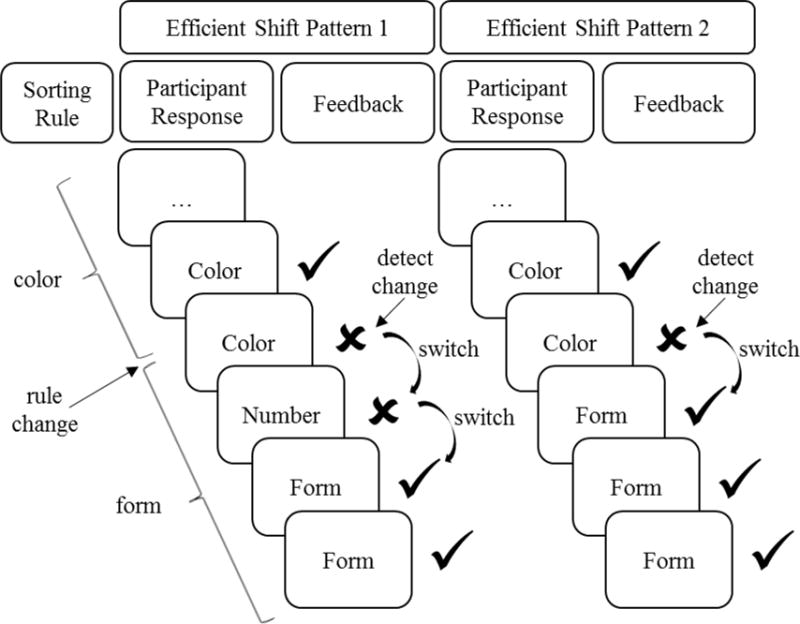
Diagram of two possible efficient shift trial sequences in which the correct sorting rule changed from color to form. ✓: correct response; ✘: incorrect response. Participants can first detect a rule change upon receiving negative feedback for using the previous sorting rule. Following detection of a rule change, participants performing optimally will switch to one of the two remaining rules, which could be the incorrect rule (Efficient Shift Pattern 1) or the correct rule (Efficient Shift Pattern 2). An efficient error occurs when the participant switches to the wrong rule but then switches to and keeps using the right rule (e.g., the “Number” response in Efficient Shift Pattern 1). Both patterns shown in the diagram are expected as part of the optimal performance strategy after the sorting rule changes.