


Table 1.
Synthesis of spiropyrans C2–C12SP.
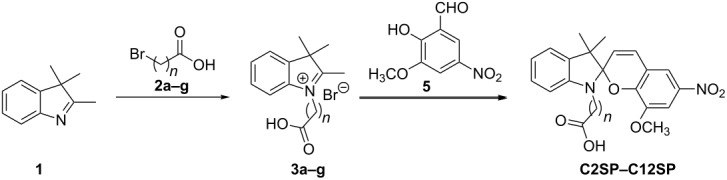 | ||||||
| Entry | n | Bromoacid | Alkylation conditionsa |
Condensation conditionsb |
Product | Yield from 1 |
| 1 | 1 | 2a | method A | – | C2SP | 0% |
| 2 | 1 | 2a | method Bc | method Cc | C2SP | 21% |
| 3 | 2 | 2b | method A | method C | C3SP | 81% |
| 4 | 3 | 2c | method A | – | C4SP | 0% |
| 5 | 3 | 2cd | method A | method D | C4SP | 38% |
| 6 | 5 | 2d | method B | method C | C6SP | 52% |
| 7 | 5 | 2d | method A | method C | C6SP | 71% |
| 8 | 5 | 2d | method Ae | method C | C6SP | 48% |
| 9 | 7 | 2e | method A | method C | C8SP | 60% |
| 10 | 9 | 2f | method A | method C | C10SP | 82% |
| 11 | 11 | 2g | method A | method C | C12SP | 67% |
aMethod A: Solution of bromoacid (1 equiv) and 2,3,3-trimethylindolenine (1 equiv) in acetonitrile (0.6 M) heated at 80 °C without a condenser for 20 h; Method B: Solution of bromoacid (1 equiv) and 2,3,3-trimethylindolenine (1 equiv) in acetonitrile (0.6 M) heated at reflux for 72 h. bMethod C: Solution of crude indolium salt (1 equiv), salicylaldehyde 5 (1 equiv) and piperidine (1 equiv) in MEK (50 mM) heated at reflux for 20 h; Method D: (i) Solution of crude indolium salt (1 equiv) and salicylaldehyde 5 (1 equiv) in ethanol (0.1 M) heated at reflux for 20 h then (ii) solution of crude spiropyran stirred in 2:1 THF/NaOH (50 mM). cConducted at room temperature. dReaction used ethyl 4-bromobutyrate. eConducted without solvent.