


Fig. 3. Photoswitchable kinases allows fine dissection of Raf-MEK signaling and identification of a novel fast feedback mechanism.
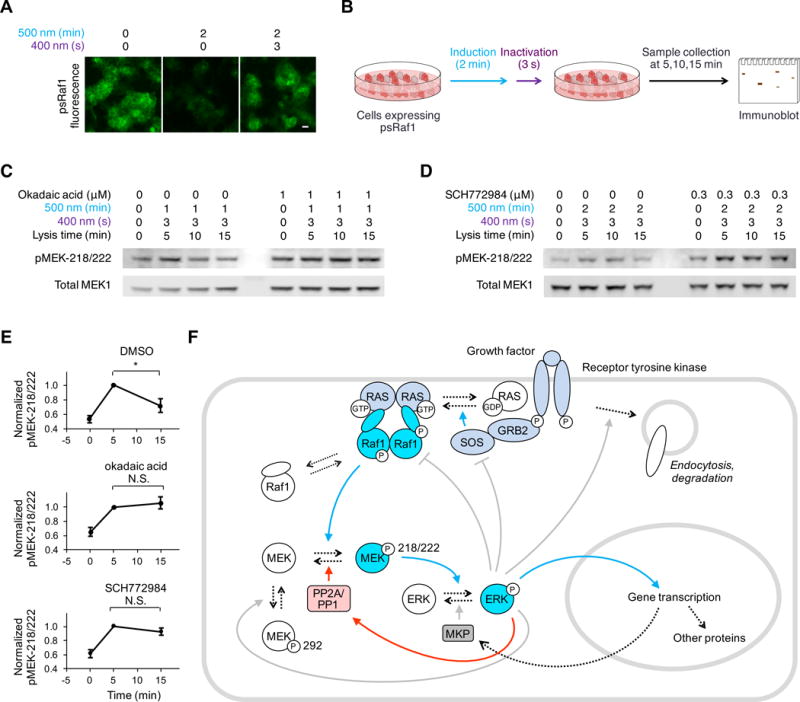
(A) 2 min illumination by 20-mW/cm2 500-nm light effectively switched off pdDronpa fluorescence. 3 s of illumination by 10-mW/cm2 400-nm light fully recovered pdDronpa fluorescence. Scale bar, 20 μm. (B) Cells stably expressing psRaf1 were illuminated by 500-nm light for 1–2 minutes followed by illumination with 400-nm light. Cell are then collected at 5,10,15 min and immunoblotted. (C) MEK phosphorylation is downregulated over time, and downregulation requires PP2A/PP1. Lysis time means the time from the start of the stimulation to cell lysis. (D) MEK phosphorylation is downregulated over time, and downregulation requires ERK activity. Lanes 1–4, decreases of pMEK-218/222 occurred over time after transient activation of psRaf1 (by 1–2 min of 500-nm light followed by 3 s 400-nm light), demonstrating that dephosphorylation of pMEK-218/222 occurs. Right, downregulation of pMEK did not occur in cells incubated with ERK inhibitor SCH772984, indicating that ERK regulates the phosphatase activity. (E) Quantification of pMEK-218/222 over time in cells treated with DMSO, okadaic acid, or SCH772984. Error bars are standard error of the mean (n = 3). Unpaired two-sided t-tests were used for statistical analysis. (F) Simplified diagram of known positive (blue arrows) and negative (gray arrows) regulatory pathways mediating signaling from growth factor receptors to ERK. The new proposed pathway of ERK-induced dephosphorylation of pMEK218/222 is marked with red arrows. Dashed arrows indicate protein transitions, while solid arrows indicate regulatory effects.