


Fig.1. Brown, white and beige adipocytes.
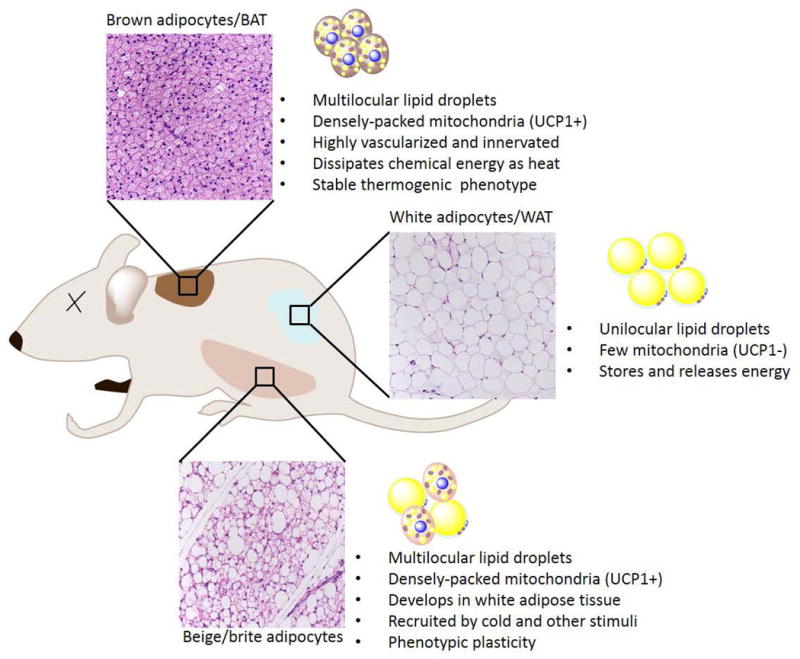
There are three types of adipocyte: brown, white and beige. Mice have a major interscapular BAT depot, as indicated. Brown adipocytes in brown adipose tissue (BAT) are characterized by the presence of multilocular lipid droplets and densely packed mitochondria containing uncoupling protein 1 (UCP1). BAT is highly innervated and vascularized so that it can efficiently dissipate chemical energy as heat. White adipose tissue (WAT), dispersed in various subcutaneous and intra-abdominal depots, and contains mostly white adipocytes. White adipocytes are characterized by the presence of unilocular lipid droplets and few mitochondria that are devoid of UCP1. WAT is a major organ for the storage and release of energy. Beige adipocytes are found in various WAT depots and are especially prominent in the subcutaneous inguinal WAT. Beige fat cells develop in response to cold and certain other stimuli. Like brown adipocytes, beige cells have multilocular lipid droplets and densely packed UCP1+ mitochondria. Compared with brown adipocytes, beige adipocytes have more phenotypic flexibility, and can acquire a thermogenic or storage phenotype, depending on environmental cues.