


Figure 2. Task design and behavior.
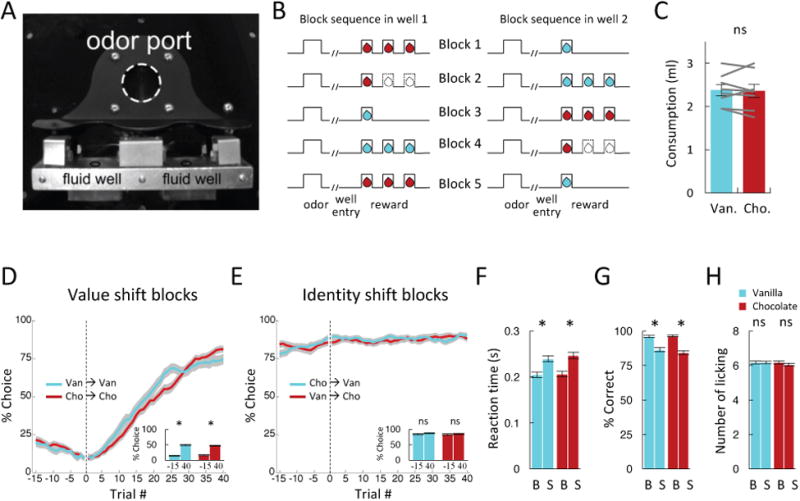
(A) Picture of apparatus used in the task, showing the odor port (∼2.5 cm diameter) and two fluid wells. (B) Line deflections indicate the time course of stimuli (odors and rewards) presented to the animal on each trial. Dashed lines show when a reward was omitted, and solid lines show when reward was delivered. At the start of each recording session one well was randomly designated to deliver the big reward, which consisted of 3 drops of flavored milk (chocolate or vanilla). One drop of the other flavored milk was delivered in the other well (block 1). In the second and fourth blocks, number of drops delivered in the two wells were switched without changing the flavors (value shift). In the third and fifth blocks, the flavors delivered in the two wells were switched without changing the number of drops (identity shift). (C) Chocolate and vanilla flavored milk were equally preferred in 2-min consumption tests conducted at the end of some sessions. Gray lines indicate data from individual rats. (D – E) Choice rates in last 15 trials before and first 40 trials after a switch in reward number (D) or flavor (E). Y-axis indicates percent choice of side designated as big reward after block switch. Inset bar graphs show average choice rates in the last 15 before and first 40 trials after the switch. (F) Reaction times on the last 10 forced-choice trials in response to big and small amounts of each flavor. (G) Percentage correct on the last 10 forced-choice trials in response to big and small amounts of each flavor. (H) Number of licks in 500 ms after 1st drop of reward on the last 10 trials in response to big and small amounts of each flavor. B, big; S, small. Error bars, S.E.M.